


LG G6 coming to T-Mobile April 7 for $650
T-Mobile is the first U.S. carrier to officially announce its plans for the LG G6, and they’re in line with expectations.
T-Mobile is first out of the gate for announcing the pricing and release date of the LG G6, which will be April 7, as we reported.

The company is rolling out the proverbial red carpet for the new flagship, pricing it at $650 outright, or 24 payments of $26 after $26 down — a hair cheaper than Verizon’s price, and in line with expectations for most high-end smartphones.
T-Mobile also says that the G6 will, like Verizon, be bundled with a Google Home if the device is ordered before April 30 — a nice bonus for anyone purchasing the phone in the U.S. The Google Home itself is being provided by LG, so this is not a T-Mobile-specific deal (it appears that all carriers offering the device will be offering it) but it’s one more great incentive for users to go with the G6 rather than wait for the Galaxy S8. That April 30 date is likely no accident, either — the Galaxy S8 is expected to be released in the U.S on April 28.
It’s unclear if, like Verizon, pre-orders will begin on Friday, March 17, but we’ll have to wait and see.
LG G6
- LG G6 review!
- LG G6 specs
- LG G6 vs. Google Pixel: The two best cameras right now
- Everything you need to know about the G6’s cameras
- LG forums
B&H

LG G6 coming to AT&T on April 7 for $720, but you get a second G6 for free
AT&T’s G6 is a bit more expensive, but you get a deal on another G6.
Third out of the gate with an LG G6 announcement is AT&T, which is going about things a bit differently than T-Mobile and Verizon. The company has announced that LG’s next flagship will indeed be available April 7 — the same day as T-Mobile, and a week later than Big Red — but it will be sold primarily through its Next or Next Every Year programs.

Customers will be able to buy the phone for 30 instalments of $24 — $720 total — through AT&T Next, or 24 instalments of $30 through AT&T Next Every Year.
There are also a few good deals to go along with the purchase: AT&T is throwing in what amounts to a free G6 after credits when one signs up for a second line on AT&T Next. And along with the free Google Home (which all other carriers are giving away, too), customers can get an LG Watch Sport for $50 on a 2-year plan.
The deals are not exactly groundbreaking, and probably not as competitive as Verizon’s, but they’re good to have nonetheless.
See at AT&T

NVIDIA Shield Android TV is the best Kodi box you can buy

While it’s more expensive than the competition, the NVIDIA Shield Android TV’s long-term value makes it so much more than a Kodi box.
Kodi has been popping up in the news more and more often these days with the popularity of cord cutting on the rise. It’s a very capable media center that’s available for a multitude of different platforms but arguably works best and is easiest to set up on an Android TV box — especially if you’re looking to integrate it into your home theatre setup.
Meanwhile, the NVIDIA Shield TV is the best Android TV box you can get so, ergo, the NVIDIA’s set top Android console is also the best Kodi box. But you don’t have to take our word for it.
NVIDIA considers the Shield TV to be the best Android TV box for Kodi, which admittedly might seem less than objective, but there’s also a fleshed out entry from the Shield on the Kodi Wiki as well as a top recommendation from TVAddons.ag — one of the biggest and best resources for configuring Kodi with valuable add-ons.
More: The best legal add-ons for Kodi

Why is the NVIDIA Shield TV the best for Kodi?
The reasons are patently clear: while you may be able to find an Android TV box online for dirt cheap, they’re often running on KitKat or Lollipop — outdated software that’s certainly not as secure as the Shield, which was updated to Nougat back in January, and will also be soon be receiving Google Assistant. It’s also the most powerful Android TV box available on the market, with top specs available for both the 16GB Shield and the 500GB Shield Pro. We’re talking NVIDIA’s Tegra X1 processor and 4K streaming capabilities.
Go looking and you’ll find plenty of sites and stores advertising Android set-top boxes sold with Kodi pre-installed for marked-up prices.
Go looking and you’ll find plenty of sites and stores advertising Android set-top boxes sold with Kodi pre-installed for marked-up prices. Don’t waste money on inferior products with inflated prices because some guy spent half an hour installing and setting up Kodi. Kodi is a free app from the Google Play Store and it’s fairly easy to set up on your Shield, so you’re definitely better off investing more of your money into better hardware than just forking it over to enterprising Amazon sellers trying to make a quick buck.
If you’re a bit more technical, you might also be interested in SPMC, a Kodi fork that offers a similar experience specially optimized for Android TV. While it’s lacking the latest interface update that Kodi 17 recently unveiled, it’s still a very good media streaming app that can also be set up as a custom launcher for your Shield if you plan on using it exclusively for Kodi. But if that’s the case, you can also get Kodi for the Amazon Fire TV Stick for a more minimalist option for your TV.
But again, the Shield offers so many other great features, including a ton of great gaming options, making it a surprisingly powerful device for its size.
Which Shield should I get?
If your budget is a little tight, you might be inclined to get the cheaper 16GB NVIDIA Shield TV over the 500GB NVIDIA Shield TV Pro. On the smaller, cheaper unit, though, you can always add some expandable storage at any point via on of the USB ports on the back of the 2017 model when you start running out of storage, or via microSD on older Shield boxes.
But for our money, the 500GB NVIDIA Shield TV Pro is your best bet, with nearly 50x more storage for only $100 more.
See NVIDIA Shield TV (16GB) at Amazon
See the NVIDIA Shield TV Pro (500GB) at Amazon
NVIDIA Shield Android TV
- Read our Shield Android TV review
- The latest Shield Android TV news
- Shield vs. Shield Pro: Which should I buy?
- Join the forum discussion
- Complete Shield Android TV specs
Amazon
Google has ANOTHER new messaging app, because of course it does
I kind of like this better than Allo, not gonna lie.

The guttural moan that escaped my face hole when I saw a new messaging app from Google in the Play Store, entirely separate from Allo and Duo and Hangouts and Google Voice and everything else Google has elsewhere, was enough to send my dog running from the room. Can we get 10 minutes where Google seems focused on delivering a single cohesive messaging experience to its users please? Do we really need another app for talking to people with Google accounts?
It turns out, the answer is yes. I fully expected to hate this experience and spend the next 500 words giving Google hell for wasting everyone’s time, but I’m pretty sure this is actually something I’m going to love using with my friends.
I hate myself and am using Supersonic, yet another messaging app from Google. Add me, so we can cry together! https://t.co/GDriZYABmD
— Russell Holly 📎 (@russellholly) March 16, 2017
It’s called Supersonic, and it’s not technically a Google app. In its current form, it’ll never be a part of the core Google experience. The app itself is under the publishing name Area 120, because it’s the creation of Google employees inside of an internal incubator program for building new and exciting apps. At its core, Supersonic is a walkie-talkie style voice chat app for your friends. You hold down the mic, speak, and the message is transcribed to text with a voice recording attached.
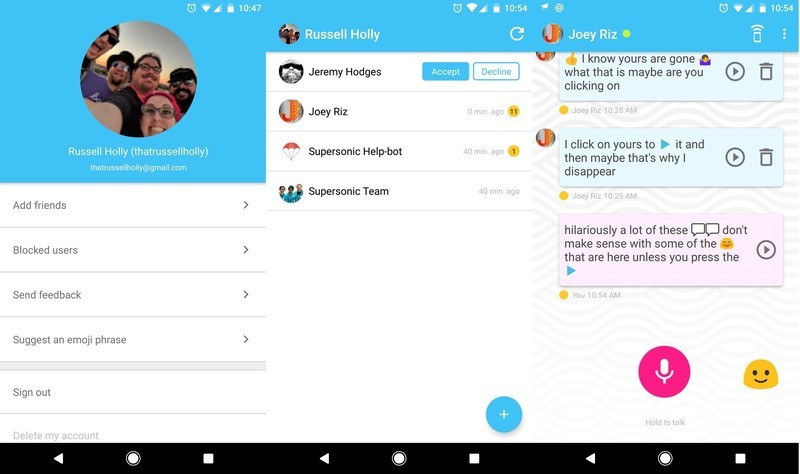
This is where things get kind of interesting. If you’re actively chatting with a friend, those messages arrive in real-time and the voice autoplays as though you’re on speakerphone with them. This means you can either send a quick message to be read later, or have a quick nearly real-time chat without a constant voice connection. It’s less data being used, and if you’re in a noisy place you can read instead of listen. You can also message in a group, which can be especially handy when you have chatty friends and are sick to death of Facebook Messenger.
This app will let me chat in a slightly more personal way with my closest friends
It also helps that the text translation is real time and remarkably accurate, given some of the Google text hilarity we’ve seen in the past. Part of the text transcription includes converting some of your words to emoji, which is either deeply frustrating or incredibly cool depending on your age. If you like this feature, and would like more emoji, the app allows you to submit phrase translations you’d like to see in the future.
While having another messaging app on my phone is the absolute last thing I wanted right now, I’m going to keep using Supersonic for a bit. Unlike Allo, I don’t have to give a phone number. Supersonic isn’t limited to a number of devices, and I don’t have to import my whole Hangouts list if I don’t want to. This app lets me chat in a slightly more personal way with my closest friends, and while that would be a nice thing to see built into one of my existing apps at some point this is actually kinda nice.
Check out Supersonic on Google Play
Oxygen OS 4.1.0 Nougat update starts rolling out for OnePlus 3 and 3T
It’s a great day to update your phone!
OnePlus has begun its OTA rollout of the latest version of Oxygen OS for the Android 7.1.1 update for both the OnePlus 3 and 3T. You can read all about it on the OnePlus forum post here.

Here are some of the highlights of what new for both the OnePlus 3 and OnePlus 3T update:
- Upgraded Android 7.1.1
- Updated Google security patch to 1st March 2017
- Added expanded screenshots
- Improved picture taking of moving objects with blur reduction
- Improved video stability when recording
- Improved WiFi connectivity
- Improved bluetooth connectivity
- General bug fixes
The update will only reach a small number of users today before becoming more broadly available over the next few days. If you simply can’t wait, a hero in the thread comments has uploaded a full zip of the OnePlus 3T update if you’re so inclined.
Meanwhile, we’re still waiting on the first official Nougat update for the OnePlus 2, which OnePlus has said is still coming… eventually.
Have you received the 7.1.1 update on your OnePlus 3 or 3T? Let us know your thoughts on it in the comments.
OnePlus 3T and OnePlus 3
- OnePlus 3T review: Rekindling a love story
- OnePlus 3T vs. OnePlus 3: What’s the difference?
- OnePlus 3T specs
- Latest OnePlus 3 news
- Discuss OnePlus 3T and 3 in the forums
OnePlus
Amazon
LG G6 review: Dual camera done right
Let’s make this clear right away: the LG G6 is a great phone. It feels very comfortable in your hands, and the camera is amazing. Not to say that it doesn’t have it’s shortcomings, but for LG, this is a great leap forward over the previous iteration.
I’m Michael Fisher, better known as MrMobile, and if you’re looking to buy an Android phone that’s not made by Samsung, start here. Even with losing the removable battery and using last year’s chipset, LG’s new flagship should turn some heads.
Check out Android Central’s review of the LG G6 or all of their coverage of the LG G6.
Featured Products
- LG G6
- Pond Ripple Wireless QI Charger
- HTC U Ultra
Stay social, my friends
- YouTube
- The Web
- Snapchat
OnePlus again uses scarcity to market its fancy, all-black 3T
OnePlus pulled off a neat (but occasionally controversial) trick with its original invitation-only selling scheme — it allowed it to ramp up manufacturing capacity while also driving demand by playing hard-to-get. Now that the Chinese firm can make all the phones it wants, it’s pulling a similar stunt to draw interest. In collaboration with Paris luxury retailer Colette, it’s selling just 250 all-black, special-edition engraved OnePlus 3T models.
This could be a way to test different marketing strategies — black phones like Apple’s Jet Black iPhone 7, Nokia’s limited edition “Arte Black” model and others are in vogue right now. At the same time, it’s a way for OnePlus (and Colette) to grab some easy publicity for the 3T model, released in November last year, until the rumored OnePlus 5 comes along.
Despite the tie-in with Colette, which sells a lot of very expensive things, the branded OnePlus 3T will go for the same price as the regular 3T, €479 (around $515). Assuming you could make it to the Paris store on March 21st at 11AM, you’d be able to get a 128GB OnePlus 3T in all-black engraved with the Colette logo and a special box. Other specs, like the Snapdragon 821 CPU, 6GB of RAM, fast-charging and dual 16-megapixel cameras, remain the same.
If France has the same number of rabid OnePlus fans as elsewhere, they might go fast. If you can’t make it yourself, we’ll try to get over there and have a look.
Source: OnePlus
Vevo’s Watch Party lets you watch music videos in sync with your friends
Ever since streaming video became commonplace, people have expressed a desire to be able to virtually have a movie night with friends who aren’t in the same place. Google has even released an app that lets you watch YouTube in sync with friends on your phones. Vevo may not have feature films or popular TV shows on its service, but the company believes that letting friends simultaneously watch its vast catalog music videos can be highly engaging.
To that end, Vevo is announcing a new feature called “Watch Party,” which should be live by the end of the month. It lets you invite a bunch of friends to a room hosted on the Vevo website and build a queue of music videos that’ll play back in sync regardless of where you’re tuning in from. (Assuming you’re in one of the 14 countries where Vevo is available, of course.) Anyone with a Vevo account can set up a “room” and start inviting friends to it; once people start joining, the playback continues unabated; there’s no way to pause or rewind. It’s basically like you’re all tuned in to MTV from your various homes, except that this version of MTV still plays music videos.
It’s worth noting that when Watch Party launches, it’ll only be available on the desktop web version of Vevo. A company spokesperson said that they were specifically looking for ways to increase web engagement and also noted that they’ve gotten requests for such a feature from users. Data also showed higher desktop web usage during the work week. We’ll almost surely see this feature come to mobile as well, but it’s rather unusual to see something come to the web first these days.
In use, Watch Party is pretty straightforward. Once you create a room, you can start inviting friends, and everyone can start adding music videos to the queue. Alternately, if you want to play DJ without interference, you can set the room so that only the room’s creator can add things to the playlist. If you choose the more collaborative option, users can vote on which videos they want to play sooner; songs with more votes will move up in the queue.

One of the best things about Watch Party is that there are no ads while watching in a party room. Vevo said it would explore adding them over time, but for starters it wanted to make sure there were no problems with the synchronized playback features. There’s also a chat room built in so you and your friends can drop comments and emoji as you watch. Rooms are essentially permanent creations, too — once someone creates a room, it’ll be available for those invited to jump in and out of at any time. The room creator can always delete it, but otherwise you can just meet your friends there any time. If you ever used Turntable.fm back in in the day, the concept is pretty similar, just with music videos instead of audio-only tracks.
While Watch Party isn’t coming to mobile yet, the company does have another update coming soon for its iOS app. The home page when you start it up is being redesigned yet again. Last year, a big redesign made the “spotlight” feed the default view when you opened the app up, with full-screen tiles showing a selection of curated, recommended videos. Now, the home screen will more closely resemble what you might see when opening up Spotify.

You’ll still see videos you can jump right into: at the top is a “watch again” feed featuring your favorite videos. Scrolling down you’ll find recommended playlists based on your viewing history, artist “stations” from the musicians you follow and curated sections for a particular vibe (like Friday Night vibes).
As for why it’s making a big change after totally redesigning the app last summer, Vevo simply said it wasn’t seeing the engagement it wanted from the home screen. A company spokesperson also noted that Vevo has a pretty deep collection of playlists and recommendations for users at this point and the old home screen simply wasn’t surfacing them well enough. I’m inclined to agree — the new home screen may not be all that different than what you see when loading up other music apps, but there’s a much greater variety of content to try.
For starters, the new home screen experience will come to iOS only, but it’ll be rolling out to Android later. It should be available for iOS by mid-April. If you want to try Watch Party, that’ll be out sooner — Vevo says it should launch before the end of March.
EU tool lets whistleblowers report anti-competitive companies
In a bid to surface more illegal tax deals and clamp down on shady practices like price fixing, the European Commision has launched a new tool to let whistleblowers anonymously come forward. The regulator has set up a tips hotline and a public email address (if the person doesn’t mind being named) but now also hosts an encrypted web form that can “alert the Commission about secret cartels and other antitrust violations” while protecting a person’s identity.
“If people are concerned by business practices that they think are wrong, they can help put things right. Inside knowledge can be a powerful tool to help the Commission uncover cartels and other anti-competitive practices,” said Commissioner Margrethe Vestager in a statement. “With our new tool it is possible to provide information, while maintaining anonymity. Information can contribute to the success of our investigations quickly and more efficiently to the benefit of consumers and the EU’s economy as a whole.”
The system has been designed to enable two-way communications so Commission representatives can ask for additional information or to clarify statements. The website uses a passcode that can be used to access replies, which typically come within 15 working days, but won’t pass on any metadata like an IP address.
Before today, the Commission relied heavily on companies giving themselves up. Its “leniency programme” incentivises wrongdoers to disclose their sins in exchange for a reduced fine. Instead, the new tool may incentivize employees to come forward when they become aware of illegal arrangements put in place by the company they work for.
Over the past couple of years, major technology companies including Apple, Amazon and Google have been on the receiving end of a Commission antitrust probes. When such cases become public, employees could share additional information, making it easier for the regulator to secure a prosecution.
Source: European Commission
A Russian military contractor is building huge drone tanks
A Russian weapons company named after the inventor of the AK-47 has revealed that it’s building a new type of unmanned combat vehicle. The firm states that its upcoming drone tank will carry both machine guns and anti-tank missiles, weighing 20 tons.
While it has yet to release a prototype, we can get a vague idea of what to expect from the company’s previous work – the BAS-01G Soratnik. Weighing a fraction of the proposed new tank at just 7 tons, the Soratnik is a machine gun mounted infantry support vehicle equipped with anti-tank missiles. With a top speed of 25 miles, the mini-tank can be operated from a range of up to six miles and is even able to carry out certain tasks autonomously. Unfortunately, the firm is remaining tight-lipped on exactly what the tank can do without human orders.
As the zippy 7-ton Soratnik is already on the market carrying similar weaponry, it raises the question of how useful the proposed tank would be if it’s three times larger. Still, with Kalashnikov Concern being partly state-owned, the Russian government’s seal of approval might help encourage others to invest in the bulky behemoth.
Source: Popular Mechanics
 AIVAnet