


Nvidia’s Volta line of GPUs could be 12nm parts manufactured by TSMC
Why it matters to you
If you’re skipping Pascal, then Nvidia’s next generation of GPUs could be even more powerful, efficient, and worth the wait.
Nvidia’s Pascal GPU architecture has been extremely successful, with today’s GeForce GTX 10 series offering unparalleled performance at increasingly attractive prices. The company can’t rest on its laurels, however, because AMD has a new line of GPUs coming soon that could give Nvidia some real competition.
Of course, Nvidia isn’t sitting idly and already has plans for its own next generation of GPUs. Code-named Volta, the new line is expected sometime before the end of 2018 and could transition Nvidia’s production to a new 12nm process, Hexus reports.
More: Nvidia ditches mobile for self-driving cars with latest super chip: Xavier
Chip manufacturer Taiwan Semiconductor Manufacturing Company (TSMC) is expected to be tasked with the production of the Volta GPUs. Apparently, Volta is expected to be combined with Nvidia’s upcoming Xavier “supercomputer” platform to create systems-on-chip (SoCs) for self-driving cars. If the rumors are to be trusted, then Xavier will be produced on a 12nm process as well.
There is some uncertainty about whether or not the 12nm process in question is actually as impressive as it sounds. It’s possible that TSMC’s process will remain 16nm, but that a combination of improvements to that process, subcomponent design, and marketing spin will allow the chips to merely be marketed as “12nm.”
There is no specific word on when Volta’s design and manufacturing specifications will be finalized and officially announced. Past Nvidia timelines suggest Volta should arrive sometime in 2018, but there is no precise timing nor specific information on GPU add-in cards for PC based on Volta. Xavier doesn’t have an official timeline either but Nvidia did demo the SoC at CES 2017.
Some other related information pegs TSMC as the manufacturer of Qualcomm’s upcoming Centriq 2400 server processors that are expected to be tasked to bring ARM to Microsoft’s cloud data centers. That is expected to happen by the end of 2017 and represents a real win for the ARM platform.
Everything we know about Samsung’s Galaxy Note 7 recall
Editors’ note: Under no circumstance do we recommend anyone purchase a Galaxy Note 7 at the moment. If you own one, trade it in and get a different phone. Now.
The Samsung Galaxy Note 7 is dead. Samsung has not only halted sales of the device “over concerns about the smartphone’s safety,” but it has also warned users that they should power down their phones. The Seoul, South Korea-based firm and the United States Consumer Product Safety Commission have issued a second recall for all Note 7 devices.
In March, after a months-long independent investigation involving three quality-control and supply-chain analysis firms, Samsung discovered the cause of the Galaxy Note 7’s manufacturing defects. According to Dongjin Koh, the company’s chief mobile executive, misshapen Samsung-made batteries caused overheating in some units. Batteries made by third party ATL, meanwhile, resulted from “the quick ramp-up” of replacement phone production.
The company announced its findings during a press event in Seoul, South Korea. Koh apologized for the Note 7 debacle, pledging to “restore trust of consumers so that they can use Samsung products without any safety concerns.”

Here’s what you need to know.
Verizon takes a new approach to killing the Galaxy Note 7
Verizon is taking a new approach to ensuring users stop using their Galaxy Note 7 — by forwarding all non-emergency calls to Verizon customers service. The new approach comes after an update that was supposed to render the phone completely useless, but some users seem to have evaded that update altogether.
“In spite of our best efforts, there are still customers using the recalled phones who have not returned or exchanged their Note 7 to the point of purchase,” said Verizon in an interview with Fortune. “The recalled Note 7s pose a safety risk to our customers and those around them.”
On top of the call forwarding, Verizon is also considering charging some users with the full retail cost of the phone — that’s because it seems as though Verizon issued refunds to some people even though they hadn’t returned the phone.
It’s important to note that the vast majority of people have indeed returned their device. However, it seems that Samsung and carriers won’t rest until all devices have been returned.
Airlines no longer need to notify passengers
The Federal Aviation Administration has issued a statement saying airlines no longer have to notify passengers about bringing the Samsung Galaxy Note 7 on board. The ban is still in place, but airlines are not required to make a pre-boarding notification.
More: Samsung head to answer new accusations of bribery, potentially faces arrest
It’s still up to airlines if they want to keep repeating the message or not, though.
“The Department of Transportation removed the requirement for air carriers to specifically notify passengers about the Note 7 phone immediately prior to boarding due to the high degree of public awareness of the ban since issuance of the emergency restriction/prohibition order, as well as the extensive efforts by Samsung and U.S. wireless providers to make all Note 7 users aware the phone is recalled and banned from transport on U.S. aircraft,” according to the statement.
Samsung says it has “successfully recalled” more than 96 percent of Note 7 devices.
Samsung has reportedly concluded its investigation
Earlier this year, Samsung promised to conduct a thorough investigation into the cause of the Galaxy Note 7’s malfunction and reveal the results to the public, a commitment which it recently reaffirmed. According to a new report, it won’t be long: the company has completed its internal investigation and has sent the report to the Korea Testing Laboratory and the American safety organization UL.
The company is expected to announce its findings at a press event in Seoul, South Korea on January 22.
T-Mobile is shutting down the Galaxy Note 7
T-Mobile is officially putting an end to the Galaxy Note 7. As promised, the company has started rolling out an update to Galaxy Note 7 devices on the T-Mobile network that disables the battery on the phone, rendering it unusable.
The changelog for the update says that it will offer an on-screen reminder to bring the device in for exchange, and that once it’s installed the phone will not be able to charge.
Samsung is disabling the Galaxy Note 7 starting on December 19 — Verizon gets update on January 5:
Samsung has confirmed that it will disable the Galaxy Note 7 in a software update set to begin rolling out December 19. “To further increase participation, a software update will be released starting on December 19 that will prevent U.S. Galaxy Note7 devices from charging and will eliminate their ability to work as mobile devices,” Samsung said in a statement. “If you have not yet returned your device, you should immediately power it down and contact your carrier to obtain a refund or exchange.”
The company said it’s working with carriers in the U.S. to notify customers at “multiple touchpoints” that they should return their Galaxy Note 7. And it reaffirmed that exchange incentives introduced earlier this year would remain in place.
Verizon has announced that Galaxy Note 7 devices on its network will start to receive the update a bit later, on January 5.
There’s no word yet on whether the company will extend the disabling of Galaxy Note 7s to additional countries, but it has employed other techniques. In Canada and Australia, for example, the phone is limited to a maximum battery capacity of 60 percent.
The following is a list of reported incidents so far, all involving Galaxy Note 7 phones that were replaced:
- A Kentucky resident suffered lung damage after his phone filled his bedroom with smoke on October 4
- A Note 7 caught fire on a Southwest Airlines flight on October 5
- A woman in Taiwan noticed that her phone was emitting smoke in her pocket on October 7
- A 13-year-old girl in Minnesota suffered a burn on October 7 when her phone became extremely hot under her thumb
- A Virginia man reported that his Note 7 caught fire on his nightstand and filled his room with smoke on October 9
Following this string of incidents, Samsung issued an official statement saying that it has asked all carriers to stop sales of the phone, and that all Galaxy Note 7 users should power down their phones and either get refunds or replace their device as soon as possible.
“Samsung has received 96 reports of batteries in Note 7 phones overheating in the U.S., including 23 new reports since the September 15 recall announcement,” according to the US Consumer Product Safety Commission (CPSC). “Samsung has received 13 reports of burns and 47 reports of property damage associated with Note 7 phones.”
Before that, an official at a supplier for Samsung told a Korean news agency that production had been temporarily halted. “This measure includes a Samsung plant in Vietnam that is responsible for global shipments,” the official said. The move follows the decision of U.S. carriers AT&T, Verizon, and T-Mobile to temporarily suspend the phone’s sales.
The crisis began in late August, but reached a head on September 15, when the CPSC, the federal agency charged with overseeing product reports and alerts, issued a formal recall of the more than 1 million Note 7 devices shipped to consumers in the U.S.
Since the recall, Samsung had begun issuing replacement phones. But even those have issues: A replacement phone caught fire aboard a Southwest airlines flight on Oct 5. And on October 7, a woman in Taiwan suffered a scare of her own while walking her dog in a local park when she heard a bang from her jeans pocket. She discovered that her Galaxy Note 7 was emitting smoke. She claims to have replaced her original Samsung device on September 27.
On Friday, 13-year-old Minnesota resident Abby Zuis discovered her replacement Note 7 was no safer than the original. She told local newscasters that she felt a “weird, burning sensation” in her thumb while holding the phone, ultimately suffering a minor burn as a result of the fiery Samsung device.
Most damning is the report that a replacement Galaxy Note 7 caught on fire, and that Samsung knew about it and withheld everything from customers. Kentucky resident Michael Klering told a local news station that he awoke at 4 a.m. on October 4 and realized his new phone had spontaneously combusted and filled his entire bedroom with smoke. Klerig wound up in the hospital with smoke-induced acute bronchitis.
“The phone is supposed to be the replacement, so you would have thought it would be safe,” he told WKYT. “It wasn’t plugged in. It wasn’t anything, it was just sitting there.”
When Klering reported the incident to Samsung, he accidentally received a horrifying text response from a company representative clearly not meant for him:”Just now got this. I can try and slow him down if we think it will matter, or we just let him do what he keeps threatening to do and see if he does it.”
Digital Trends reached out to Klering and we are waiting to hear back.
A fifth replacement Galaxy Note 7 in the U.S. reportedly caught fire over the weekend: Shawn Minter of Virginia reached out to The Verge when his replacement, just over two weeks old, caught fire on his nightstand in the wee hours of the morning.
“My Galaxy Note 7 replacement phone just burst into flames,” Minter said in his emailed statement. “It filled my bedroom with a smoke. The same as the Kentucky man. I woke up in complete panic.”
Under no circumstances should you buy a Galaxy Note 7, or continue using one that you already have.
Related: Federal court reinstates Apple’s $120 million patent win over Samsung
A timeline of events
The saga first began soon after the Galaxy Note 7 went on sale, and initially it was unclear exactly what was happening.
On Aug. 31, Yonhap News reported that Samsung had temporarily suspended deliveries of Note 7 devices to major South Korean mobile carriers including SK Telecom, KT, and LG Uplus. Initially, the company was reluctant to acknowledge the delay. “We are checking whether the deliveries were halted or not,” a Samsung official told the publication.
Related: Performance art: Google USB Type-C cable reviewer fries his own Chromebook
Early speculation pointed to a mechanical flaw involving the S-Pen, the proprietary stylus that ships with the Note 7. YouTube videos and reports on the web appeared to show a problem with the S-Pen’s handset slot — the ejection button used to remove the pen had a tendency to become stuck on some units. Samsung acknowledged the issue on Wednesday, began offering free replacements to affected customers, and instructed owners that hadn’t experienced the issue “not to push too hard” in the S-Pen’s housing “after the click sound.”
But evidence of a far more serious — and dangerous — problem began to emerge early this week: the potential for Note 7 devices to explode while connected to a wall charger. One documented account on social media, a YouTube video posted by user Ariel Gonzalez, appeared to show a Note 7 warped almost beyond the point of recognition.
“Came home from work, put it to charge for a little bit before I had class,” he said. “Went to put it on my waist and it caught fire. Yup. Brand new phone, not even two weeks old. Be careful out there, everyone rocking the new Note 7, might catch fire.”
A South Korean schoolteacher, Park Soo-Jung, told the Associated Press that her Galaxy Note 7 “burst into flames” unexpectedly, filling her apartment with smoke. “If the exploded phone in flame was near my head, I would not have been able to write this post.”
And posts on Korean social media appeared to corroborate reports. Most showed Note 7 units with severely damaged screens and charging ports.


In response to the growing chorus of concern, Samsung confirmed to Yonhap News on August 31 that it had delayed Note 7 shipments in order to conduct “quality control” testing. “The most important thing is the safety of our customers, and we don’t want to disappoint our loyal customers,” a company official said.
The results of those tests, the company said, were consistent with reports: some Note 7 units could explode while being charged. “[We] conducted a thorough investigation and found a battery cell issue,” it said in a statement on Thursday. “Samsung is committed to producing the highest-quality products and we take every incident report from our valued customers very seriously.”
Related: Amazon tightens up rules on USB Type-C cables after Google engineer’s criticisms
The company indicated the problem wasn’t widespread — a representative told Yonhap news that Note 7 units with faulty batteries accounted for “less than 0.1 percent of the entire volume sold” — but not necessarily easy to resolve. Samsung said the issue “couldn’t be [fixed] by changing the battery.”
Out of an abundance of caution, Samsung announced a broad recall on September 2. “The problem can be simply resolved by changing the battery, but we’ll come up with convincing measures for our customers,” a spokesperson for the company said. “For customers who already have Galaxy Note 7 devices, we will voluntarily replace their current device with a new one over the coming weeks.”
That recall, however, might not be the last we hear of the issue. U.S. investigators promptly announced that they were investigating the issue, and Sprint said that it would allow users to swap in their phone for another device while the investigation was ongoing.
That recall, however, wasn’t the last we heard of the issue. U.S. investigators said they were looking into reports of the replacement device exploding, after which multiple reports of replacement phones catching fire popped up. Finally, Samsung issued a statement saying that production on the phone had been halted and that users should immediately power down their phones.
The New York Times suggests that Samsung still does not know what caused issues in the Note 7, and they have been unable to reproduce the problem in tests.
The US Consumer Product Safety Commission and Samsung have issued a second recall for the Note 7.
Separately, the Department of Transportation, along with the Federal Aviation Administration (FAA) and the Pipeline and Hazardous Materials Safety Administration (PHMSA), announced on Friday, October 14, that all Samsung Galaxy Note 7 devices would be banned from airplanes in the U.S. “Individuals who own or possess a Samsung Galaxy Note 7 device may not transport the device on their person, in carry-on baggage, or in checked baggage on flights to, from, or within the United States,” the agency said. “This prohibition includes all Samsung Galaxy Note 7 devices,” the agency said, noting that the phones also can’t be shipped as air cargo.
How will this affect Samsung?
The Galaxy Note 7 recall is one of the industry’s largest in history, and obviously a major setback for Samsung. But it’s unclear how drastically it will impact the company’s bottom line — or reputation, for that matter.
Samsung was expected to sell as many as 15 million Note 7 phones this year, or almost double the 9 million Note 5 units it shipped last year. And before news of a widespread recall, it appeared well on its way to hitting that mark: the company said it sold 400,000 units in the first week of the Note 7’s availability and that demand had generally outstripped supply.
Samsung’s 2016 revenue bested expectations, too. The company reported a rise in second quarter operating profit to $15 billion — up 15 percent from the same period a year earlier. And it gained market share at the expense of rivals like Apple, nabbing 22.4 percent of smartphone sales — a five percent jump — thanks to higher-than-anticipated “demand for higher-end phones,” according to market analysts at IDC.
In light of the newest developments, though, some analysts expect a reversal. Park Jung-hoon, an asset fund manager at HDC, told Reuters that that Samsung’s profits would fall short of initial projections. He anticipates a decline in mobile operating profit by up to 200 billion won — or roughly $179 million — in the fiscal period between July and September.
Samsung shareholders stopped worrying too much when news that Samsung’s profits are expected to rise hit in October, according to the Wall Street Journal.
Where has the Galaxy Note 7 been banned?
The list of airlines, public transit authorities, and businesses that have banned the use of Samsung’s Note 7 continues to grow.
Australian airlines, Qantas, Jetstar, and Virgin Australia have warned customers against charging of Galaxy Note 7 during flight. Quantas issued a statement in September: “Following Samsung Australia’s recall of the Samsung Galaxy Note 7 personal electronic device, we are requesting that passengers who own them do not switch on or charge them in flight.”
They aren’t the first. Philippines-based airline carrier Cebu Pacific Air banned the use of the Note 7 on all flights, citing Samsung’s global recall. “In light of … safety issues, [we] advise passengers that the usage and charging of the device are prohibit on board all [flights] until further notice,” the company said in a statement.
Singapore Airlines followed suit. “The powering up and charging of Samsung Galaxy Note 7 mobile phones is prohibit on all our flights,” the airline said in a statement.
Airlines in the United Arab Emirates are a few of the latest to restrict the use of Galaxy Note 7 on airliners — both Etihad Airways and Flydubai have banned the in-flight use of handset. An Emirates spokesperson told the Khaleej Times that it had “advise[d] customers not to turn on or charge their Samsung Galaxy Note 7 smartphones during flights or stow them in checked baggage due to concerns over the phone’s fire-prone batteries.”
In the U.S., New York City’s MTA has advised commuters not to charge the phone on subways or buses. And the Federal Aviation Administration (FAA), following the lead of Japan’s airline authority, urged airline passengers not to use or stow Note 7 on domestic flights. “[The agency] strongly advises passengers not to turn on or charge these devices on board aircraft and not to stow them in any checked baggage,” a spokesperson said.
India’s Ministry of Civil Aviation, meanwhile, issued a warning against the use of Note 7 units on domestic and international flights. “The ministry has advised airlines and traveling public not to turn on or charge the said mobile during flights,” the agency said in a statement. “This has been done in light of several incidents globally, involving the battery of the Galaxy Note 7. Passengers have also been advised not to stow them in their check-in baggage.”
Even institutions of higher learning are exercising an abundance of caution. On September 12, New Jersey’s Stockton University became the first college to ban the use of Note 7. “We have 3,000 students that live on campus and anywhere from 10,000 individuals that come on our campus each day,” Pedro Santana, Stockton University’s dean of students, said in a statement. “[We] wanted to take a proactive measure and assure that the environment is safe, and free from a potential fire. The bottom line is, we want it on our campus.”
What are the chances your Note 7 will explode?
The Note 7 may be one of the higher-profile consumer devices in recent to exhibit — ahem — explosive tendencies, but it’s far from the first. Still, it seems to be getting the most attention.
The battery’s the problem.
The sort of Lithium-ion cells found in smartphones are packed extremely tightly. As a result, the flammable separator between the battery’s anode and cathode — the two elements between which current flows — is incredibly thin, and therefore prone to damage. Once the separator’s pierced, catastrophe results, typically in the form of a short circuit. An excessive amount of heat boils the battery’s electrolyte, ruptures its cell casing, and causes an explosion or fire.
More: The days of exploding lithium-ion batteries might soon be over
And worse, Lithium-ion battery fires are difficult to contain. Most electrolytes burn quickly when hit by a fresh supply of air, and when the fire reaches a certain thermal threshold, the materials in the cathode begin to supply oxygen, too.
On September 20, Samsung will push an over-the-air update to current Note 7 devices in South Korea that limits the battery recharge to 60 percent — in part to prevent them from overheating and thus reduce the risk of an explosion, according to the Associated Press. It’s more a band-aid than a solution — updated Note 7 units are still susceptible to explosion — but could reduce the likelihood of battery heat buildup. Samsung’s in talks with carriers to push the update to other Note 7 devices in the U.S. and around the world.
In 2006, Dell and HP were forced to recall millions of laptop batteries after reports emerged of overheating. More recently in 2014, car manufacturer Tesla redesigned its cars to better protect the batteries housed within them.
How to prevent a battery fire
Preventing a battery fire is relatively straightforward and, unless you have a phone prone to exploding like the Note 7, you can usually prevent it by taking these steps. And again, it’s also extremely rare.
Common sense tips to avoid an exploding phone:
- Stick to the original charging cable and wall adapter. In the case of the Note 7, use the official Samsung accessories that came bundled with your smartphone.
- Don’t leave your device in hot areas — especially when it’s charging.
- If you plan to use a demanding app that’s likely to generate a lot of internal heat, make sure you do so in a well-ventilated, cool place.
- Don’t smother your smartphone. Putting it under your pillow, or in a tight, restricting enclosure, or under a cushion will encourage a buildup of heat.
- The same goes for laptops and other devices that use lithium-ion batteries (almost everything that recharges these days).
As for the widely held perception that fully charged smartphones present a clearer danger than, say, handsets left to drain by your bedside all night, that’s only half true. While battery fires are more intense if the battery is fully charged, the capacity of the battery itself in no way impacts its likelihood of explosion.
I bought a secondhand Galaxy Note 7. How do I know if it’s safe?
Now that even replacement devices seem to be exploding, we don’t believe any Note 7 can be called a safe unit. Digital Trends recommends immediately returning any models, “safe” or otherwise, to the store where it was purchased.
When the initial recall was issued, Samsung found a way to alert customers about whether they had a safe device. New devices featured a green battery icon, while the older, unsafe phones had white ones. Not only that, but when refurbished Note 7 units began to ship, they included a circular sticker with a blue S in the middle. Samsung said it looks something like this:

You can read more about the recall and the company’s statement here.
Sending back your Note 7
You’ll have to send your shiny new Note 7 back where it came from.
Under the terms of Samsung’s arrangement with the CPSC, more than 1.9 million Galaxy Note 7 units sold in the U.S. are subject to recall.
Here’s the skinny on the recall process: Galaxy Note 7 owners in the U.S. can exchange it for a Galaxy S7 or S7 Edge and a refund of the difference in price between the two devices. Samsung recommends owners complete that process at the store from which they bought the Note 7, or by calling 1-800-SAMSUNG. If you exchange your device for another Samsung phone, you will get $100 in bill credit. If you swap the Note 7 for a device from another brand, you’ll get $25 in bill credit.
A company spokeswoman told Digital Trends that as of November 4, nearly 85 percent of Galaxy Note 7 devices had been replaced through the company’s exchange program, with the majority of customers opting to receive another Samsung smartphone. “We remain focused on collecting the outstanding Galaxy Note 7 phones in the market,” she said. “Any Galaxy Note 7 owner who has not yet participated in the U.S. Note 7 Refund and Exchange Program should immediately power down their phone and contact their carrier or retailer today,” the spokesperson added.
If you’re eligible for a refund but would prefer not wait for a replacement device direct, your best bet is heading stopping by your carrier’s store for a refund, exchange, or loaner device.
Here’s what every major U.S. carrier is offering:
- Sprint offers customers “loaner devices” to use while they receive a replacement unit.
- T-Mobile is halting sales of the Galaxy Note 7. It is waiving restocking fees and providing a full refund to customers who return their device, and furthermore giving subscribers who return their Note 7 a $25 credit on their monthly bill. In addition, T-Mobile’s offering a “complete refund” on Note 7 devices and accessories — specifically, the full amount paid at time of purchase plus any and all associated fees — and letting those who received a free Netflix subscription as a bonus for pre-ordering the Note 7 retain that benefit, if they so choose.
- Verizon has suspended sales of the Galaxy Note 7. It’s encouraging customers concerned about the safety of their replacement Note 7 smartphones to “take [them] back to the original point of purchase” in exchange for another smartphone. And it’s allowing online Verizon customers to exchange replacement Note 7 units at Verizon stores.
- AT&T, following suit, has suspended sales of the Galaxy Note 7. The carrier is encouraging customers with a recalled Note 7 to visit an AT&T location to exchange the device for another Samsung smartphone or smartphone of their choice, and will also refund any Note 7 accessories.
Internationally, things are a bit more piecemeal. Samsung’s voluntary Note 7 recall affects the estimated 1.5 million units that have been shipped to sellers and buyers in 10 countries, but it’s largely leaving exchange and returns at the discretion of individual carriers and retail partners. It has, however, instructed partners to return Note 7 deliveries as they receive them, and major cell phone carriers in the U.S., Australia, and South Korea have taken the extraordinary step of preemptively withdrawing the Note 7 from sale.
Note 7 owners in South Korea are eligible for a full refund for their device or can exchange it for a new one. And starting Saturday, Samsung said it’ll roll out a “battery-monitoring service” for users in the country to “ensure their devices are safe.”
In the U.K., Samsung has begun a separate exchange process. All U.K. providers and operators should have already contacted Galaxy Note 7 owners to set up an exchange, and the swapping process has now officially begun.
Samsung’s dedicated customer support line for the Galaxy Note 7 remains active at 0330-726-1000.
If you’re in Canada, Samsung Electronics Canada Executive Vice President Paul Brannen has made it clear that your safety is a major concern of the company. “Samsung holds safety and consumer satisfaction as a top priority,” he said. “While there have been no confirmed incidents in Canada, Samsung is taking a proactive approach to address customer needs around the Note 7 and immediately addressing any consumer concerns.” Canadian Galaxy Note 7 owners will be able to exchange their phone for a Galaxy S7 or Galaxy S7 Edge. You can register your Galaxy Note 7 here for the recall.
Article originally published in August 2016. Imad Khan, Julian Chokkattu, Christian de Looper, and Lulu Chang contributed to this report. Updated on 03-14-2017 by Kyle Wiggers: Added news that Samsung has detailed the results of its investigation into the Note 7 explosions.
This insane iPhone case packs a fully functional Android phone
Why it matters to you
If you’ve ever wanted to stick an Android phone on the back of your iPhone, the ESTI Eye is for you.
Let’s face it: No mobile operating system is perfect. Apple’s iOS has awesome features that Google’s Android doesn’t, and Android boasts some sweet apps and tools that iOS can’t match. Since the dawn of the modern smartphone, though, it’s been impossible to get the best of both worlds — you’ve had to settle for an Android phone or an iPhone. But the Eye wants to change that.
The Eye, which launched Monday on Kickstarter, is ostensibly an iPhone case with a rear-facing 5-inch display. In reality, it’s a fully functional Android smartphone replete with two SIM card slots, 3GB of memory, an octa-core MediaTek Helio P20 processor, a 2,800mAh battery, and up to 256GB of storage (via MicroSD slot). And it’s just as bulky as you’d expect.
More: This crazy case makes your iPhone feel like a OnePlus 2, but it also holds a secret
Size aside, though, the Eye’s creators make an interesting pitch. The 5-inch Full HD (1,920 x 1,080 pixels) AMOLED screen is reportedly the “best […] on the market,” and the Eye’s MicroSD cards double as storage for your iPhone via a Lightning connector. Its battery extends your phone’s battery life, too, and enables wireless charging via Qi — you can stick the Eye on a compatible pad and it’ll charge your iPhone.
That’s only the tip of the iceberg. The Eye can mirror the connected iPhone’s camera preview screen so that you can take selfies with the rear-facing camera. Its dual SIM card slots deliver 4G LTE speeds up to 300Mbps, and its 3.5mm jack and dedicated DAC (digital to analog converter) let you use a conventional pair of headphones with the otherwise port-free iPhone 7.
And there’s more. An NFC (Near Field Communication) radio allows you to program NFC stickers, and send files and pictures to another NFC-support phone. And an infrared blaster lets you control home appliances like TVs, set-top boxes, and stereo systems with a compatible app.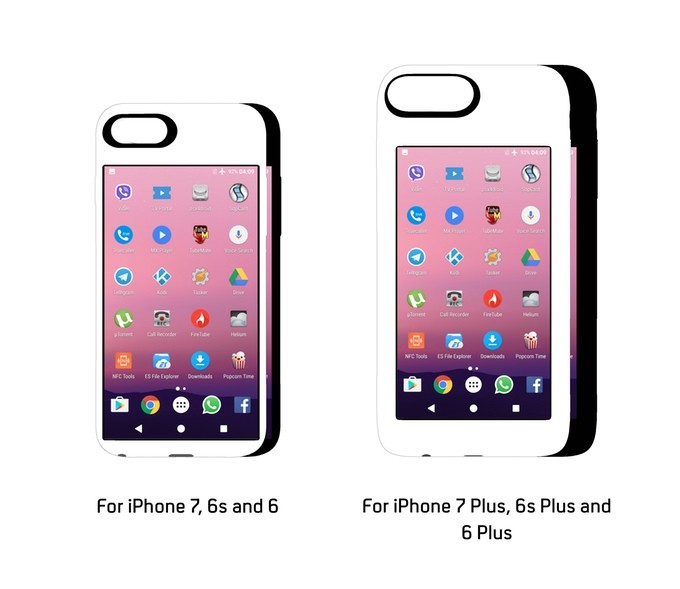
And the Eye runs Android 7.1 Nougat.
More: 40 of our favorite iPhone 6 cases for style and protection
If that all sounds too good to be true, it very well might be. The startup behind the Eye, Israel-based ESTI, is a newcomer to the smartphone accessory business. That’s not a reason to dismiss the project out of hand, but certainly cause to be wary.
Even if the Eye delivers on its promises, though, it inherently involves compromises — at the end of the day, you’re slapping an Android phone on the back of your iPhone. NFC, IR, and a beefy external battery sound like great features in theory, but when you have to contend with the extra weight and bulk that come along with them, they’ll undoubtedly lose their luster.
If none of that dissuades you, the Eye starts $100 on Kickstarter (with an estimated later retail price of $190). It comes in black and white, and fits the iPhone 6, 6 Plus, 6S, 6S Plus, 7, and 7 Plus.
LaCie 4TB Rugged USB Type-C review

Research Center:
LaCie Rugged Type-C
There’s nothing glamorous about an external hard drive. Destined for days in a lonely corner of your desk, or tossed around between backpacks while traveling — a tool that serves an important duty, but only draws your attention if it breaks.
Which makes this Lacie 4TB Rugged USB Type-C a hammer, or a chisel, in your toolkit of electronics. Steadfast and sturdy, the design hasn’t changed in years, and that’s totally fine, because it doesn’t need to. A Type-C port gracing one end of the drive is the only clue this drive wasn’t made 10 years ago.
And yet, the bright orange silicon and muted silver chassis still fits in alongside more modern offerings. These Lacie drives set the stage for the external drives that have become ubiquitous in a laptop-driven market, and the Lacie Rugged Type-C carries that tradition on without changing a thing.
Design
Lacie’s Rugged external drives are immediately familiar, with a silver body wrapped in a thick layer of orange silicone. The drives haven’t changed much over the years, but here, that’s a good thing. The original design is still very attractive, and the wrap is a lot thicker and more durable than a cheap phone case. The drive itself feels solid and beefy, without being overly large, and the outer shell is removable if need be.
 Bill Roberson/Digital Trends
 Bill Roberson/Digital Trends
It serves a purpose too. Lacie has drop tested the drive to four feet while not in use. You could theoretically drive a car over it. And while it isn’t water-proof, it should be fine in the rain. We didn’t durability test these features by dropping from specific heights, but we had no fear throwing the drive in a backpack or taking it with us anywhere. Our confidence comes from past experience with these drives, which have made their rounds through our video production crew.
You could theoretically drive a car over it.
While the Lacie is very durable, do keep in mind that it’s only protected when it’s not actively being written to or read from. It’s still a spinning disk drive with moving parts, and if it takes a drop while you’re using it, you’re likely to lose some of your data and risk corruption. Solid state drives have no moving parts, and that means you can toss it around or plug it into your phone and not worry about breaking anything. You may not be able to drive over it with a car, but it’s worth considering that in this case, there are two kinds of durability.
Normally we’d break out a section for connectivity, but here it’s just a single USB 3.0 Type-C plug. If you don’t have a Type-C plug on your computer, no need to worry. Lacie includes Type-C to Type-C and Type-C to Type-A cables inside, both USB 3.0 compatible.
Setup
When you first plug the drive in, you won’t see the volume immediately. Instead, at least in Windows, there’s a read-only 256MB partition named Lacie Setup. Running setup allowed us to format a NTFS partition — Windows only — of 4TB, or to devote up to 32GB to a FAT32 partition that can be read and written by Mac and Linux machines.

Bill Roberson/Digital Trends
After a few minutes, your drive will be properly partitioned and ready to go. Lacie offers to install a few applications, like Adobe Reader Link and Genie Timeline, a backup suite. It will also stash some documentation and the installation software on the FAT32 partition, if you had it create one.
More: Samsung T3 2TB Portable SSD review
It’s not exactly a stressful or time-consuming process, but it’s one that’s increasingly uncommon among external drives. Often, you just plug the drive in, and it’s already formatted and ready to go. Lacie’s approach is due to a belief that different users might need to format this drive different ways. That makes sense, but also underscores the fact this drive is for people who need something more than bargain-priced backup storage.
Performance
Lacie promises a 130Mbps read speed, close to the limit for mechanical drives as a category. That’s a cap we’ve seen on other USB 3.0 drives as well, but you don’t buy an external drive for speed, usually.
The Lacie Rugged managed to average 135MBps in our testing, with the write speed trailing close behind. That’s basically the limit for mechanical drives, and even internal hard disks running over a SATA connection rarely break 150MBps or so.
Only external SSDs like the Samsung T3, used over a high-speed USB 3.1 connection, are able to start producing even higher speeds. They provide numerous other benefits too, including a lack of moving parts for increased durability. The T3 is also several times smaller than this hard disk. Those features come at a steep price, however, as the largest 2TB Samsung T3 is around $800, which is almost four times the price of this 4TB Lacie drive.
LaCie Rugged Type-C Compared To

WD PR4100 NAS

Plextor M8Pe

Intel SSD 750 Series

Seagate Backup Plus Ultra Slim…

LaCie Porsche Design hard drive

Samsung T3 Portable SSD MU-PT2T0B

Transcend SSD370

Crucial BX200 960GB

Toshiba Q300 480GB HDTS748XZSTA

Samsung Portable SSD T1

ioSafe Solo G3

ioSafe Rugged Portable

HP MediaSmart EX487

Corsair Flash Survivor (8GB)

Crucial Gizmo! 256MB
Warranty
Lacie’s two-year limited warranty may not feel luxurious, particularly at the price point, but it’s twice the length you’ll find on less expensive drives. That said, the much more expensive Samsung T3 once again steals the show with a three year warranty – you get what you pay for.
Our Take
Lacie’s Rugged USB-C drive sells in a variety of capacities, with our 4TB review unit retailing for $250. It boasts a sturdy design, massive capacity, and portability only matched by much pricier external SSDs. Those drives offer their own advantages at an elevated price, but that’s not all there is to this story.
Are there any alternatives?
External hard drives are an easy business to get into, and there’s no shortage of options with every feature set and capacity under the sun. Seagate, which owns Lacie, also offers a 4TB drive of the same size for just $120, without the orange shield. The rugged category is much smaller, but Transcend offers a 2TB drop-tested drive for just $100, or a 256GB SSD for $120.
The DT Accessory Pack
Das Keyboard 4 Professional Soft Tactile MX Brown Mechanical Keyboard
$169.99
Logitech MX Master Wireless Mouse, Large Mouse, Computer Wireless Mouse
$72.88
Kingston HyperX FURY 8GB RAM
$61.20
How long will it last?
As for longevity, the Lacie Rugged is a mixed bag. Like the name implies, the drive’s construction is unlikely to fail you anytime soon. The USB-C connection is a forward-looking move, with a cable thrown in for anyone who hasn’t upgraded their system in a while. On the other hand, mechanical drives are often more prone to failure than more expensive solid state options. Lacie’s two year warranty is solid for the industry, and should give you some peace of mind, but it won’t save your files if you drop the drive while copying to it.
Should you buy it?
Yes, if you really need a drive that can take a beating. Lacie’s rugged line continues to set the standard high for external hard drives, both in terms of construction and performance. It’s the drive’s main draw, and it’s a great fit for traveling photographers, designers and engineers working in potentially troublesome situations, or anyone who carries around tools or heavy objects around with their computing gear.
That said, not everyone needs a drive that can be driven over by a car. Sometimes you just need it to survive a trip to the office in your backpack a few times a week. For those people, there are any number of 4TB drives available close to $100, less than half the price of the Lacie.
If you need something you don’t have to worry about denting or dropping, at least when it isn’t in use, the Lacie Rugged is the only solid choice, but that durability comes at a steep cost.
Researchers figured out how to hack your phone using only sound waves
Why it matters to you
Hackers are developing increasingly creative and complex ways of accessing your phone, so security is likely to always be a concern.
Hackers are developing new and improved ways to take control of your devices. The latest? Apparently, it’s by using sound waves.
Researchers have come up with a new way to hack all kinds of different devices and it’s a pretty complex system that basically imitates micro-electro-mechanical systems (MEMS) accelerometers — which is a chip in your device that lets phones and trackers know when they are moving and how quickly.
More: WikiLeaks releases documents chronicling the CIA’s hacking weapons
You would expect the system to use some pretty impressive tech, right? On the contrary, the hackers simply used a $5 speaker, which was able to blast as many as 20 different accelerometers from five different manufacturers with sound waves. Those frequencies were able to trick the sensors in devices like smartphones into doing a range of different things. Accelerometers are basically sensors suspended on a few different springs, and when the sound waves reach the chip, it moves — just like what would happen when you move.
“It’s like the opera singer who hits the note to break a wine glass, only in our case, we can spell out words,” Kevin Fu, author of the research paper and professor at the University of Michigan, told the New York Times. “You can think of it as a musical virus.”
So what exactly is the result of the hack? Well, the team was basically able to trick a phone into doing whatever they wanted. Specifically, the team was able to tell the phone to show a video or even control an app that controls a remote control car — all using only sound waves. That’s just the beginning, though — the team notes that if you had an app to start your car using the accelerometer when you shake your phone, you could potentially hack the phone to start the car.
It’s important to note that for now, this is only a proof of concept and it’s unlikely we’ll see hackers walking around with tiny speakers to control your phone. The fact is, however, that hacking methods are getting increasingly creative and complex.
Check out the video below to see the system in action.
Researchers figured out how to hack your phone using only sound waves
Why it matters to you
Hackers are developing increasingly creative and complex ways of accessing your phone, so security is likely to always be a concern.
Hackers are developing new and improved ways to take control of your devices. The latest? Apparently, it’s by using sound waves.
Researchers have come up with a new way to hack all kinds of different devices and it’s a pretty complex system that basically imitates micro-electro-mechanical systems (MEMS) accelerometers — which is a chip in your device that lets phones and trackers know when they are moving and how quickly.
More: WikiLeaks releases documents chronicling the CIA’s hacking weapons
You would expect the system to use some pretty impressive tech, right? On the contrary, the hackers simply used a $5 speaker, which was able to blast as many as 20 different accelerometers from five different manufacturers with sound waves. Those frequencies were able to trick the sensors in devices like smartphones into doing a range of different things. Accelerometers are basically sensors suspended on a few different springs, and when the sound waves reach the chip, it moves — just like what would happen when you move.
“It’s like the opera singer who hits the note to break a wine glass, only in our case, we can spell out words,” Kevin Fu, author of the research paper and professor at the University of Michigan, told the New York Times. “You can think of it as a musical virus.”
So what exactly is the result of the hack? Well, the team was basically able to trick a phone into doing whatever they wanted. Specifically, the team was able to tell the phone to show a video or even control an app that controls a remote control car — all using only sound waves. That’s just the beginning, though — the team notes that if you had an app to start your car using the accelerometer when you shake your phone, you could potentially hack the phone to start the car.
It’s important to note that for now, this is only a proof of concept and it’s unlikely we’ll see hackers walking around with tiny speakers to control your phone. The fact is, however, that hacking methods are getting increasingly creative and complex.
Check out the video below to see the system in action.
Researchers figured out how to hack your phone using only sound waves
Why it matters to you
Hackers are developing increasingly creative and complex ways of accessing your phone, so security is likely to always be a concern.
Hackers are developing new and improved ways to take control of your devices. The latest? Apparently, it’s by using sound waves.
Researchers have come up with a new way to hack all kinds of different devices and it’s a pretty complex system that basically imitates micro-electro-mechanical systems (MEMS) accelerometers — which is a chip in your device that lets phones and trackers know when they are moving and how quickly.
More: WikiLeaks releases documents chronicling the CIA’s hacking weapons
You would expect the system to use some pretty impressive tech, right? On the contrary, the hackers simply used a $5 speaker, which was able to blast as many as 20 different accelerometers from five different manufacturers with sound waves. Those frequencies were able to trick the sensors in devices like smartphones into doing a range of different things. Accelerometers are basically sensors suspended on a few different springs, and when the sound waves reach the chip, it moves — just like what would happen when you move.
“It’s like the opera singer who hits the note to break a wine glass, only in our case, we can spell out words,” Kevin Fu, author of the research paper and professor at the University of Michigan, told the New York Times. “You can think of it as a musical virus.”
So what exactly is the result of the hack? Well, the team was basically able to trick a phone into doing whatever they wanted. Specifically, the team was able to tell the phone to show a video or even control an app that controls a remote control car — all using only sound waves. That’s just the beginning, though — the team notes that if you had an app to start your car using the accelerometer when you shake your phone, you could potentially hack the phone to start the car.
It’s important to note that for now, this is only a proof of concept and it’s unlikely we’ll see hackers walking around with tiny speakers to control your phone. The fact is, however, that hacking methods are getting increasingly creative and complex.
Check out the video below to see the system in action.
Notebook makers to offer better prices on smaller SSDs in 2017
Why it matters to you
You will be able to stock up that new notebook with a 512GB SSD in 2017, but you will have to pay more for the privilege.
PC component prices, particularly the memory chips that go into system RAM and solid-state disk (SSD) storage devices, have been on the upswing for a while due to a variety of factors. Now, it appears that SSDs are going to become even more pricey, which could have a significant impact on notebook PCs in 2017.
SSD prices were already under pressure due to demand of NAND chips outstripping supply. Going forward, it won’t just be higher prices but also SSD capacity that could be impacted, industry analyst Dramexchange reports.
More: Parts shortages in the PC market are set to drive up costs
According to Dramexchange, contract pricing for the SSDs that go into client machines like notebooks will see pricing increases of between 10 and 16 percent compared to the fourth quarter of 2016. In spite of the increase in prices, SSDs will likely remain popular due to their significant advantage in speed over hard disk drives (HDDs). The result is that PC manufacturers could continue to most prominently position 128GB and 256GB SSD options as opposed to larger alternatives.
As Alan Chen, senior research manager of Dramexchange put it, “Average contract prices of client-grade SSDs in the PC-OEM market are rising this first quarter because not only PC clients are aggressively stocking up their inventories, smartphone clients are also maintaining strong demand for storage components.” What that means is that if you are in the market for a notebook PC in 2017, you are likely going to find more of a premium for 512GB or larger SSD options.
At the end of 2016, about 36 percent of notebook users opted for SSDs, and total SSD sales were 33.2 million units, an increase of around three percent over the previous quarter. For the rest of 2017, it’s expected that TLC NAND-based SSDs will be preferred by 75 percent of SSD purchasers for use in machines with PCIe interfaces. The more expensive MLC SSDs will be reserved for the highest-performing SSD applications. Finally, PCIe will become the dominant connection option by the end of the year.
If you’ve been planning a notebook purchase for 2017, then rest assured that SSDs remain your best options. Just be prepared to pay more if you need 512GB SSDs or larger, and for your PC manufacturer of choice to offer you the best deals if you can live with a 256GB SSD or smaller.
Use these exclusive promo codes to save even more on Anker portable chargers
We’ve teamed up with electronics company Anker to provide exclusive discounts on some of its most popular products . For March, we’ve locked in special pricing on two Anker portable chargers, the PowerCore+ 20100 USB-C 400 and the PowerCore+ 10500, with special promo codes that provide even greater savings on the already discounted devices.
More: The Best Portable Battery Chargers
 The PowerCore+ 20100 USB-C 400 provides USB and USB-C output charging. It can fully charge a Macbook or get up to seven smartphone charges. The charger features a premium matte aluminum finish that offers both durability and style.
The charger uses advanced charging technologies to keep devices continually powered up. The first is PowerIQ, which delivers an optimum, high-speed charge to devices including Apple and Android phones, tablets, cameras, consoles, and more. The second is VoltageBoost, which is a smart technology that determines when charging output is encountering resistance and automatically compensates for this to ensure charging remains fast regardless of cable or device. Finally, the charger features Multiprotect technology which is a combination of 10 safety features that work together to provide ultimate protection for your devices.
The thin but powerful PowerCore+ 20100 USB-C 400 is the perfect solution for those who need days of backup charging with them at all times. The device is ideal for use by business travelers. It holds a 4.6 out of 5 stars rating on Amazon based on more than over 600 reviews.
The PowerCore + 20100 USB-C 400 normally retails for $120 but is currently discounted to $66. Use Digital Trends’ special promo code DTDEALS2 to drop the price to $54, a full $66 (55 percent) discount on Amazon. The promo code will only work while supplies last.
 Next up is the PowerCore+ 10500, which is already discounted by 33 percent on Amazon. The portable charger again combines Anker’s proprietary PowerIQ and VoltageBoost technologies to deliver the fastest possible charge to almost any USB device. The charger uses Quick Charge 3.0 technology to charge devices up to four times faster than standard 1A chargers. For example, it can charge many compatible devices up to 80 percent full in 30 minutes.
The charger provides nearly four iPhone 7 charges, more than two Galaxy S6 charges, or one full iPad Air 2 charge. Thanks to a quick charge import, the portable charger goes from zero to fully charged in less than four hours — up to twice as fast as similar products. Like the C-400, it’s built from high-end materials and components, and features a premium matte aluminum finish.
The PowerCore+ 10500 is essentially a lighter (8.32 ounces rather than 16 ounces) version of the PowerCore+ 20100 USB-C 400. The product earned a 4.7 out of 5 stars rating based on more than 100 reviews on Amazon.
The PowerCore+ 10500 normally retails for $60 but is currently discounted to $40. Use Digital Trends’ special promo code DTDEALS1 to drop the price to only $30 (a full 50 percent or $30 discount) on Amazon. The promo code is active from now until March 31.
Buy it now from:
Amazon
iPhone thieves tried to trick a man into giving up his iCloud password
Why it matters to you
Next time your iPhone goes missing, think twice about clicking any suspicious links from strangers.
It’s bad enough having your iPhone stolen out of the blue, but it’s magnitudes worse when the thieves try to extract your personal information from it. According to Krebs on Security, that is what happened to an unfortunate Brazilian woman who was robbed by a gang of street muggers.
After losing her iPhone, the woman’s husband used Apple’s Find my iPhone feature to pinpoint the device’s location and sent text messages to the thieves. Soon, he received a reply telling him that the iPhone had been found by the authorities and that he needed to click on a link to retrieve it.
More: You can hack almost any iPhone with just $100 worth of electronics
The link — and the text — were bogus. It led to a careful replica of Apple’s and Find my iPhone’s log-in pages hosted on a third-party website. The husband didn’t fall for the ruse but the scammers were persistent. Two days later, he received an automated call from a Siri-like voice assistant instructing him to await text messages for information regarding the stolen iPhone.
“To me, it really got to another level, connecting the lowest kind of criminals to a high profile one that can buy this kind of scam,” he told Krebs on Security. “That’s when I thought I had to tell this story to someone.”
It’s not a new tactic. In 2015, Symantec reported that cybercriminals had created multiple phishing websites to trick iOS devices owners into providing login credentials for their iCloud accounts. The aim was to acquire the victim’s iCloud credentials to turn off the stolen phone’s Lost Mode, a security feature which makes the phone unusable.
More: Update your Apple devices now — New Stagefright-style hack discovered
Smartphones go missing all the time — not just in Brazil. That’s why it’s worth turning on the Find My iPhone feature, which makes it easy to locate a lost or stolen phone via Apple’s iCloud dashboard. More often than not, a phone can be put in “Lost mode” or remotely erased.
Apple, too, provides a few helpful hints about what to do when your smartphone’s gone missing.
 AIVAnet