


Snapchat’s politics show is coming back for a second season
Snapchat will stream a second season of Good Luck America, a political show that aims to “help Snapchatters make sense of a weird time in America,” the social network told Variety. It’s once again hosted by Peter Hamby, a former CNN correspondent and Snapchat’s head of news. The first season launched in January, 2016 and to date it’s the only show that the company has produced itself.
Last year, the show informed its mostly young viewers on basics about the nomination process and more in-depth coverage about field organization, debates and more. Hamby also talked about issues important to millennials like student debt and income inequality, and interviewed President Obama, Paul Ryan, Hillary Clinton and other key figures. In the inaugural broadcast, he presciently ended the show by saying “Welcome to 2016. Things are about to get really weird. Good luck America.”
In the first episode this season, Hamby will interview Democrat Cory Booker and Republican Steve Daines, Senators who both use Snapchat. Upcoming episodes will feature chats with Republican Senator John McCain, Senator Bernie Sanders and Pod Save America co-host Jon Favreau.
Snapchat used Good Luck America to develop techniques for TV news-style reporting adapted for its unique vertical platform. It shared many of those techniques with partners like Disney, which is producing a Snapchat “Aftershow” for The Bachelor. Snap recently went public, earning its founder Evan Spiegal some $850 million, and sees broadcast and media streaming as a key strategy to generate ad revenue.
Source: Variety
Congress begins rolling back Obama’s broadband privacy rules
As expected, Republicans in Congress have begun the process of rolling back the FCC’s broadband privacy rules which prevent excessive surveillance. Arizona Republican Jeff Flake introduced a resolution to scrub the rules, using Congress’ powers to invalidate recently-approved federal regulations. Reuters reports that the move has broad support, with 34 other names throwing their weight behind the resolution.
The rules require broadband providers to secure their customers’ consent before they can sell their private data to marketing agencies. That information includes your precise geolocation, financial and health data, information about your children and your social security number. In addition, the rules forbade ISPs from storing your web browsing, app usage and contents of your text messages automatically.
Ajit Pai, current head of the FCC, has already moved to undermine the rules by halting their rollout late last month. Pai, who opposed move during his predecessor’s tenure, claims that they favor one set of companies over another. He believes that limits on ISPs data-gathering are unfair given that social networks are exempt from the regulation.
The American Civil Liberties Union issued a statement saying that “Congress is essentially allowing companies like Comcast, AT&T and Verizon to sell consumers’ private information to the highest bidder.” The organization added that “consumers have a right to control how these companies use their sensitive data.”
Source: Reuters, ACLU
Some Google Pixel phones are having microphone issues
Following hundreds of user complaints, Google has confirmed that some of its Pixel and Pixel XL smartphones are having microphone problems that require a warranty replacement. Owners have reported failures of one or more of the three mics on the devices, resulting in either no audio input at all or failure of the camera app’s audio recording function. “The most common problem is a hairline crack in the solder connection on the audio codec,” said Google employee Brian Rakowski. “The other related problems are due to a faulty microphone.”
In other words, the problems with the devices (built in partnership with HTC) are hardware-related, so you can’t just install an update to fix them. Luckily for frustrated owners, the company is handling the problem expeditiously. “Google will put a hold your credit card for the replacement and ship you the phone immediately,” said Rakowski. “Once we receive the defective phone and verify the problem, the hold will be removed.” If you purchased your phone from elsewhere, you’re advised to contact the dealer.
Google said that it has reinforced the connections on Pixel phones manufactured since January, so recent phones should be fine. While it has also started inspecting refurbished phones for the problem, “it’s possible that some replacement phones were not properly qualified before we understood this issue.” In other words, there’s a chance that your replacement phone will have the same problem, so watch it closely after you get it.
The problem doesn’t bode well for wannabe Pixel buyers, as the devices are already in short supply. However, Google is shipping a new Pixel sometime this year, and if, as promised, it build its own silicon and pushes out suppliers like Qualcomm and HTC, quality control may (or may not) improve. Either way, the new devices won’t be cheap.
Via: Android Police
Source: Google forums
Foxconn Chairman Raises Uncertainties About U.S. iPhone Manufacturing Plant
Uncertainties over Foxconn’s manufacturing expansion into the United States have been raised once again, this time following comments made by company chairman Terry Gou, who spoke to reporters at an event celebrating the start of construction on a $8.87 billion display plant in Guangzhou, China (via Nikkei). At the ceremony, Gou told reporters he had just returned from a trip to Washington without confirming if he met with the Trump administration while he was there.
Since the November election, and even before it, the Trump administration has advocated for Apple specifically to make some of its products in the U.S. and not at foreign facilities, leading to multiple reports that Apple suppliers are looking into building large plants stateside. Now, Gou has raised concerns over any of the company’s previous U.S. manufacturing plans because he’s not sure if the U.S. government can work fast enough to stay ahead of all of the work needed to be done before any company like Foxconn can build a successful, large-scale facility in the states.
“I am concerned as to whether the U.S. can resolve all the investment issues in only a few months’ time,” Gou said, adding America also lacks the skilled labor and comprehensive supply chain the display industry requires.
“Does the U.S. offer incentive programs for foreign investors? They’ll need to pass bills first, and we’ll need to wait for American authorities to make a decision first,” Gou said.
Ultimately, Gou tried to avoid strictly siding with one country or the other, saying that the best course of action would be to support both once the option became available. “I am not willing to choose between [the U.S. and China]. Why should I give up on any market?” Gou ended the line of questioning from reporters with a pledge for the governments of both countries to avoid a trade war and “get along peacefully.”
“It is in the interest of the entire humanity that China and the U.S., the top two economies in the world, can get along peacefully,” Gou said. “They are in the process of gambling with each other, and I can foresee that the two will eventually work together to grow [their] economies and deliver beneficial outcome for many. If they don’t, then everyone will be losers.”
In a separate report from Reuters, Foxconn is now said to have lost ground in its bidding for Toshiba’s memory chip business “due to its close ties with China.” The Japanese government is worried about “the transference of key technology” if a winning bidder has a close relationship with China, and Toshiba executives are reportedly aware of the government’s wishes and “will take into account how close bidders are to China in the selection.”
Apple accounts for over 50 percent of Foxconn’s total revenue, and because of lukewarm demand for the iPhone 7 in 2016, Foxconn saw its first ever profit decline since the company went public 1991. Optimism has now surrounded the company’s 2017 outlook, however, due mostly to excitement for the debut of the “iPhone 8,” perhaps called the “iPhone Edition.”
Note: Due to the political nature of the discussion regarding this topic, the discussion thread is located in our Politics, Religion, Social Issues forum. All forum members and site visitors are welcome to read and follow the thread, but posting is limited to forum members with at least 100 posts.
Tag: Foxconn
Discuss this article in our forums
Readdle’s PDF Expert for Mac Gains Improved Search, New Toolbar Layout
Readdle today updated its popular PDF Expert app for the Mac to version 2.2, overhauling the app and adding new features to make editing and annotating PDFs even easier than before.
New editing tools automatically detect the font, size, and opacity of the original text in a PDF document, so PDFs can be edited more like regular text documents for a much quicker editing experience.
Readdle has also introduced a new toolbar layout that’s specialized for tasks like going over a contract or reading an article, with options for viewing several pages of a single document, comparing two documents, and more.
To make searching faster, version 2.2 of PDF Editor includes search indexing, plus the ability to search all opened files and save history has been added.

PDF Expert for Mac can be downloaded from the Mac App Store for $59.99. [Direct Link]
Tag: Readdle
Discuss this article in our forums
Samsung Galaxy S8 may feature super-fast face recognition
Awkward fingerprint placement and slow iris scanner may not matter if Samsung can make facial recognition work.
One of the most common criticisms of the Galaxy S8 images we’ve seen so far has been the apparently awkward placement of its fingerprint scanner. It’s located around the back, according to leaked photos, to the right of the main camera lens, where it’s not exactly convenient to reach. At the same time, the Note 7’s iris recognition system, an alternative way to unlock the phone, was widely panned in last year’s phone. But Samsung could have a solution to both problems.

According to reports from Korea’s The Investor, which cites local outlet Korea Economic Daily, Samsung will plug the gap with facial recognition in the upcoming phone.
“Due to some limits of iris scanning such as speed and accuracy, we have decided to add facial recognition to the Galaxy S8,” a Samsung official was quoted as saying. “With a face scanner, it will take less than 0.01 seconds to unlock the phone.”
Face recognition via the front-facing camera has been part of Android since 2011’s 4.0 Ice Cream Sandwich release, but it’s always been finicky. (In fact, the feature failed publicly during its first on-stage demo at Google’s Galaxy Nexus launch event, and hasn’t improved much since.)
So if Samsung has made use of the additional sensors and computing horsepower of modern phones to make face recognition work quickly and reliably, it might convince GS8 owners that this should be their main security method. There will be challenges, however, such as making the system smart enough to not be fooled by a photograph, and handling face recognition in darker environments, where the Note 7’s iris scanner didn’t do so well.
We’ll find out more when the Galaxy S8 officially breaks cover on March 29 in New York.
Samsung Galaxy S8 and S8 Plus
- Latest Galaxy S8 rumors!
- Galaxy S8 announcement coming March 29 in NYC
- Galaxy S8 release date set for April 28
- Join our Galaxy S8 forums
Size comparison: Galaxy S8 versus Galaxy S7, S6 and iPhone 7 Plus
CAD renders show how Samsung’s 2017 flagship may be both bigger and smaller than you were expecting.
With its super-slim bezels and the apparent shift to an extra-tall “18:5” aspect ratio, the Samsung Galaxy S8 is purported to pack a larger display than ever into a standard-sized body. Rumors put the display diagonal of the regular GS8 at 5.8 inches, and the larger GS8 Plus at a whopping 6.2 inches. Those are big, but the new aspect ratio makes it hard to visualize just how large they might be.
Thanks to French leaker Steve Hemmerstoffer, better known as @onleaks on Twitter, we have CAD mock-ups showing how the two Galaxy S8 models measure up against Samsung’s previous two flagships, as well as Apple’s iPhone 7 and 7 Plus. Hemmerstoffer has made a name for himself rounding up accurate CAD visuals and measurements of unannounced phones, so there’s a good chance what we see here is an accurate size comparison.


A few quick takeaways from these shots:
- The regular GS8 is narrower but taller than both of its predecessors.
- The GS8 Plus is almost the same width as the Note 7, but a good 5.5mm taller.
- The regular GS8 is a good deal taller than the iPhone 7, but only slightly wider — a difference of less than 1mm.
- The GS8 Plus is noticeably narrower than the iPhone 7 Plus, but around the same height — again, less than 1mm difference.
Would like to compare #Samsung #GalaxyS8 vs #GalaxyS8Plus vs #GalaxyNote7 and maybe more? Just ask and forget approximate Weibo crap… 😉 pic.twitter.com/LYPzwmEXV7
— OnLeaks (@OnLeaks) March 8, 2017
.@Blaa_Boi There you have it, #Samsung #GalaxyS8 vs #Apple #iPhone7 vs #GalaxyS8Plus vs #iPhone7Plus… 😉 pic.twitter.com/uMT2xWDaDq
— OnLeaks (@OnLeaks) March 8, 2017
With the move to aspect ratios around 18:9 (or 2:1) in some of 2017’s flagship Android phones (and perhaps even Apple’s iPhone 8), and larger screen measurements, visual comparisons like this will become even more important in showing how new, taller phones measure up to their predecessors.
Perhaps the most striking contrast in today’s set of images is the iPhone 7, using a three-year-old design, fits only a 5.5-inch display into a body of comparable size to Samsung’s upcoming 6.2-incher. We can surely expect the Korean company to make a great deal of noise about that at the Galaxy S8’s March 29 launch event.
Samsung Galaxy S8 and S8 Plus
- Latest Galaxy S8 rumors!
- Galaxy S8 announcement coming March 29 in NYC
- Galaxy S8 release date set for April 28
- Join our Galaxy S8 forums
Nougat update is finally rolling out to the Galaxy S6, S6 edge

Samsung’s 2015 flagships are starting to receive the Nougat update.
Samsung was scheduled to roll out the Nougat update to the Galaxy S6 and S6 edge in the UK at the end of February, but the company said in a tweet that the update would be delayed as it encountered quality issues. While Samsung didn’t provide a timeline for when the Nougat update will be kicking off, it looks like Vodafone customers in the UK — along with S6 and S6 edge customers in Germany, Austria, Switzerland, and Italy — are picking up the update right now.

According to screenshots obtained by SamMobile, the update weighs in at 1.3GB, and brings all the UI enhancements we’ve seen with the Nougat update on the Galaxy S7 and S7 edge to Samsung’s 2015 flagships as well as the February security patch.
Although the rollout has kicked off, we don’t have a timeline for when the update will be making its way to other regions. Samsung made the update available to most variants of the Galaxy S7 last month, which resulted in a noticeable boost for Nougat’s userbase in the latest Android distribution numbers, but unlocked models in the U.S. are yet to pick up the update.
Thanks Peter!
Samsung Galaxy S6
- Galaxy S6 review
- Galaxy S6 complete specs
- Galaxy S6 news | GS6 edge news
- Galaxy S6 beginner’s guide
- Galaxy S6 forums | GS6 edge forums
- Shop for accessories
Amazon
Verizon
AT&T
Sprint
T-Mobile
How to add multiple destinations in Google Maps

Easily add multiple stops to your Google Maps route.
One of the best additions to Google Maps is the ability to add multiple stops to your route. If you’re running an errand or picking up groceries on your way back home, the feature gives you a quick look at the overall time for the trip and any delays along the way. You can add up to nine stops, and there’s also the option to rearrange the stops to figure out the most efficient route.
How to add multiple destinations in Google Maps
Open the Google Maps app from the app drawer or home screen.
Tap the blue Directions button in the lower-right corner.
Select the Choose destination textbox.

Enter your desired destination in the text field.
Alternatively, you can place a pin on the map with the Choose on map option.
By default, Maps will use your current location as the starting point. You can edit this if you want by selecting the Your location field.

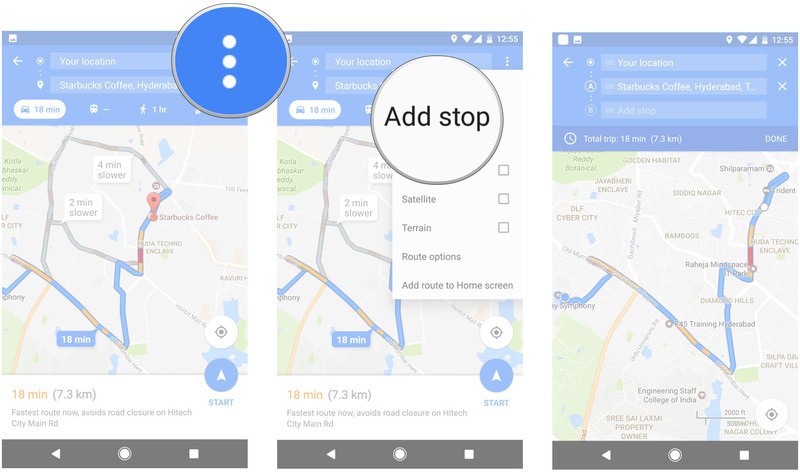
After entering the destination, tap the action overflow button (the three vertical dots) on the top right corner of the screen.
Select Add stop.
You’ll see a new line with Add stop in your trip list, along with an estimated total trip time. Type in the second destination here.
As soon as you enter the second destination, a new line will be automatically added underneath, giving you the option to add another stop.
You can rearrange stops easily by dragging the three horizontal lines next to the location names.
You can also clear a destination by selecting the X icon to the right.
Once you’ve figured out all the stops, tap Done to get started.

You’ll see an overview of your trip, as well as all the stops and the overall time.
Tap the Start button in the lower right corner to start navigation to your first stop.
If you want to remove a destination once you’re on your way, you can do so by pulling up the turn-by-turn directions pane from the bottom of the screen and editing the list of stops.

That’s it! The ability to add multiple stops is definitely one of the best new additions to come to Google Maps over the course of the last year, and is a feature I use every time I navigate with Maps. What are your thoughts on the feature? Let us know in the comments.
PSA: Don’t remove the Huawei P10’s factory-fitted screen protector
In a bizarre change from previous flagships, there’s no oleophobic coating on the P10’s display.
The Huawei P10, like many of the company’s phones, comes with a factory-fitted screen protector out of the box. That’s great if you were already planning on covering up the phone’s screen to guard against scratches and other damage, and many other Chinese manufacturers like OnePlus and Oppo do the same. But the screen protector itself is made of plastic film, and that’s exactly what it feels like — nowhere near as nice as the glass beneath it. So for that reason, peeling off the screen protector is usually one of the first things we do when unboxing a new Huawei phone.
In the case of the Huawei P10, however, that’s a very, very bad idea.
 This is what awaits you if you take off the screen protector on the Huawei P10.
That’s because there’s no oleophobic coating on the actual display of the P10 — at least on the review devices we were given in Barcelona last week. An oleophobic coating may sound obscure and technical, but it’s a staple feature of all but the cheapest smartphone screens. This nanocoating, usually applied to the glass during manufacturing, repels oils — like the kind on your face and fingers — and stops the display from looking like it’s been used as a pizza slice after you’ve been tapping, swiping and calling.
Without an oleophobic coating, a phone’s display quickly starts to look like… well, the image you see above, with copious oily smudges and a generally unpleasant in-hand feel.
Usually it’s only the cheapest phones which forego the oleophobic coating.
To say this is a bizarre omission in such an expensive series of phones is an understatement. Usually it’s only bargain-bin models that don’t use oleophobic coatings on the display, in order to save on their bill of materials. A Huawei spokesperson wasn’t able to provide any further clarity on the oleophobic issue, but instead offered the following statement:
Huawei remains focused on delivering high-quality devices to provide the best consumer experience. The P10 is the world’s first smartphone with capacitive under-glass fingerprint sensor for seamless navigation. For screen protection, we have used premium materials such as Gorilla Glass 5 and include a screen protector as part of the integrated product.
In the meantime, if you plan on buying a Huawei P10 (or P10 Plus), plan on using it with the preinstalled screen protector, or with an aftermarket replacement when they become available.
More: Huawei P10 hands-on
 AIVAnet