


Galaxy S8+ specs materialize: 6.2-inch extra-tall display with rounded corners expected
This is shaping up to be a big phone … but not as big as you’d think.
We’re still over a month away from an expected announcement of the Galaxy S8 and S8+, and that means we’re well into the flow of leaks. The latest, which comes from @evleaks, details purported specs for the larger Galaxy S8+ — and aside from physical size it looks to be very similar to the smaller Galaxy S8.
Samsung Galaxy S8+ spec sheet. Impress your friends, confound your enemies…with knowledge. pic.twitter.com/lHrHge8BUa
— Evan Blass (@evleaks) February 22, 2017
The thing that really stands out here is the confirmation (of sorts) that we’re indeed looking at a really large 6.2-inch display for the bigger Galaxy S8+ model. The resolution of “QHD+” points again to the display being taller than the 16:9 panels we’re used to, with something more of an 18:9 aspect ratio. So even though a 6.2-inch display seems like it would be huge compared to an already-large 5.7-inch display we saw with the Galaxy Note 7 (RIP), the difference in aspect ratio and bezel size may not actually give your hand as many struggles as you’d first think.
This new aspect ratio is where the market is headed.
The larger, taller screen in a more compact body follows right along with the details LG has revealed about the G6, though despite the concurrent development Samsung will technically be second to the party as it launches its phones over a month later. Interestingly it also seems as though Samsung is getting in on the rounded display game as well, curving the corners of the Galaxy S8+ screen for a neat visual effect. Given this information, it seems to be the direction the market is going: taller displays, smaller bezels and generally larger screens without as big of increases in overall size.

The rest of the specs shown off by @evleaks corroborate what we’ve seen before: 4GB of RAM and 64GB of storage, a 12MP camera on the back and iris scanning from the front. Samsung is sticking with all of the same basic features that were big hits on the Galaxy S7 and Note 7, while adding several new items in the bigger display and redesigned body.
Failed ‘Super Retro Squad’ Kickstarter returns as ‘Glitch Strikers’
When Jay Pavlina created Super Mario Bros. Crossover in 2010, he had a viral hit on his hand. The popular fan game tweaked Nintendo’s classic platformer to allow characters from other retro games to take Mario’s place. Two years later, Pavlina gambled big on the crossover gameplay mechanic and lost, successfully crowdfunding $53,000 for an original game called Super Retro Squad before announcing in 2014 that the game was on indefinite hiatus. The project was assumed dead, with backers facing endless silence in the face of refund requests. Today, however, the project returned as Glitch Strikers, a new title based on the original concept that actually looks like it might come out. It even has a trailer.
At a glance, the trailer looks a lot like Pavlina’s original promise: a game with multiple worlds based on classic NES titles that can cross-over into each other. Specifically, the trailer shows a Mario-like character named Manni exploring game worlds inspired by The Legend of Zelda, Megaman, Metroid, Contra, Ninja Gaiden and more, stopping in each world to ask the characters for help beating his own game — which has been overrun by impassable glitches.
Despite the similarity to the game’s original vision, the game isn’t quite everything the Super Retro Squad promised to be. Instead of offering both 16 and 8-bit graphics, Glitch Strikers music and visuals will be based specifically on the NES era of gaming — and the original project’s online multiplayer and stretch-goal bonus levels may not make the final cut, either. The game is also being released in stages, with the planned Steam release offering the portion of the game based on the original Super Mario Bros to start, and DLC packs with additional game experiences later down the line.
It’s nice to see something come out of this old project, but Pavlina understands that not all backers will be satisfied with the late release. On Twitter, he says refunds for the original Kickstarter may continue if Glitch Strikers turns a profit.
Source: Exploding Rabbit
Huawei teases Honor VR Camera ball thingy that shoots 360-degree vids
Huawei makes clip-on 360-degree cameras now.
The company has announced a new device called Honor VR Camera. It’s a camera accessory for smartphones, and it was quietly developed in partnership with Insta360. Huawei has only revealed that the tiny ball-like product supports “3K photography” and live-streaming — and that you’ll be able to save and share 360-degree videos through an app developed by Insta360. Oh, and it’ll be available internationally.
- Huawei P10 and P10 Plus: Release date and everything you need to know
But that’s all we know for sure. We don’t know the camera’s shooting resolution, nor whether it will work with non-Honor/Huawei-branded smartphones. From looking at the images given to the media, there appears to be a USB Type-C plug on the camera ball itself. This would presumably go into a compatible port on your device, while all the camera controls appear to be limited to the app from Insta360.
Huawei
Mobile World Congress 2017 is a few days away. Huawei will likely announce more details, including information about pricing, during the show. Pocket-lint will be there live to bring you the latest.
FCC approves first LTE-U devices
Federal Communications Commission Chairman Ajit Pai announced that as a way to help alleviate network congestion, his organization has approved devices that tap into the LTE-U spectrum. Specifically, allowing devices to access the less-trafficked, unlicensed parts of the 5GHz frequency band. In layman’s terms this means that as demand for Wi-Fi networks increases, LTE-U backs off a bit. And when the reverse happens, customers can take advantage of some of the unused network capacity for their LTE gizmos. T-Mobile will be among the first carriers to do so, and allow its customers to co-opt the first 20MHz of “underutilized unlicensed spectrum” in the 5GHz band.
“The LTE-U devices that were certified today have been tested to show they meet all of the FCC’s rules,” the Commission said in a statement. The FCC went on to say that such devices aren’t required to meet the coexistence plan (LTE-U and WiFi) to be certified by the Commission.
As TechCrunch notes, the gadgets that passed certification today are base stations from Ericsson and Nokia that are already out in the wild. “The grants issued today are for the ability for the devices to operate under Part 15 rules in the 5GHz band,” according to an FCC statement given to the publication. So, maybe don’t expect to see widespread rollout of anything that’ll boost your mobile speeds just yet.
Source: FCC, T-Mobile
Apple CEO Tim Cook Will Move His Office to Apple Park
Apple CEO Tim Cook plans to work out of Apple Park, the official name for Apple’s second spaceship-shaped campus, according to information obtained by The Chronicle.
Cook will presumably move his office from Apple’s Infinite Loop campus to Apple Park when it opens for employees in April of 2017. Apple announced its plans to open Apple Park in April in a press statement released this morning.
Apple Park will eventually house more than 12,000 employees, who will move to the campus over a period of six months. While Apple Park will open in a little over a month, smaller construction projects and landscaping will continue into the summer.
The Chronicle has learned @tim_cook will be moving his office to Apple Park. https://t.co/cLKasjawEn
— Owen Thomas (@owenthomas) February 23, 2017
In addition to the main ring-shaped building, Apple Park includes a visitor’s center with a full Apple Store and cafe, a fitness center for employees, auxiliary research buildings, underground parking structures, a cafeteria, and a theater named “Steve Jobs Theater” after late Apple CEO Steve Jobs.
The entire campus is powered by 100 percent renewable energy and features huge swathes of greenery suitable for the California climate, with more than 9,000 native and drought-resistant trees.
First conceived in 2011 by Steve Jobs, Apple Park has been under construction since 2013 and is rumored to have cost Apple upwards of $5 billion.
Discuss this article in our forums
The Xiaomi Mi Max 2 could be launched sometime in May, rumors suggest
Why it matters to you
Looking for a phone with decent specs at a budget price? The Xiaomi Mi Max 2 could be the phone for you.
The huge Xiaomi Mi Max was launched in the first half of last year, but now it’s looking more and more like the popular Chinese company will follow it up with a device aptly called the Xiaomi Mi Max 2.
But what will the phone have to offer? The original Xiaomi Mi Max was a midrange phone, but it was pretty high-powered for the price. Here’s everything we know about the upcoming Xiaomi Mi Max 2 so far.
More: Xiaomi could release a lot more smartphones in 2017
Specs
A new rumor first picked up by AndroidPure about the Xiaomi Mi Max 2 suggests that the device will feature the same 6.44-inch display used on the original phone — a display that bucks the trend of smartphone displays being 6 inches at most. Under the hood, the device will reportedly upgrade from the Snapdragon 650 to the Snapdragon 660. Despite the decidedly midrange processor, the phone will reportedly boast some other pretty top-notch specs, like 6GB of RAM, 128GB of storage, and a 5,000mAh battery.
As far as software goes, the device will most likely run Android Nougat with Xiaomi’s MIUI over the top.
Release date
So when will we see the upcoming device? While Xiaomi isn’t expected to make much of an appearance at Mobile World Congress next week, we could still see the device in the near future. Current rumors suggest that the device will be officially launched in May — almost exactly a year after the original Xiaomi Mi Max was launched.
It’s not yet known exactly how much the device will cost, but if it’s the same price as last year’s Xiaomi Mi Max, it wall fall somewhere in the $230-$300 range, which is pretty good for a phone with these specs.
We’ll keep this article updated as we hear more about the Xiaomi Mi Max 2.
College student turns his Honda Civic into a self-driving car for $700
Why it matters to you
Self-driving cars aren’t going to be affordable to the masses anytime soon but this enterprising college student found a way around that.
Anyone who has been to college knows that students are permanently broke, constantly having to sacrifice the finer things in life (meals) in favor of the bare essentials (beer.) By facing those hardships, few students are likely to be able to afford a self-driving car anytime soon.
That is not the case for Brevan Jorgenson, though. A senior at the University of Nebraska, Omaha, Jorgenson is the proud owner of a self-driving Honda Civic — and all it cost him was $700 (plus the cost of the car itself.)
His newly autonomous set of wheels is due to his decision to become an early beta tester for Comma Neo, the kit from self-driving car technology developed by former teen hacker George Hotz, now CEO and founder of Comma.ai.
More: Self-driving retrofit software now available for free, but it comes with caveats
“For the beta test stage you just downloaded their beta Android app Chffr, and let it record your driving with a suction phone mount,” Jorgenson told Digital Trends. “I did that for a few months, and in that time I was offered a promotion from student worker to full-time employee [at my job]. With my new income, I decided to buy the 2016 Honda Civic Touring in March. In September, I saw an article with a picture of a 2016 Honda Civic in the background of George Hotz’s garage. I got really excited because I knew that might mean that he is working on getting a Comma system working for my car. I could not believe that the exact car model I bought by coincidence was going to work on the Comma system I was a beta tester for months before [I had bought it.]”

Last November, Comma open-sourced everything necessary to get the 2016 Civic Touring and Acura ILX running the technology. This came after it suddenly abandoned earlier plans to sell the Comma Neo hardware and software to customers as a $1,000 unit, following concerns from the National Highway Traffic Safety Administration.
Jorgenson immediately ordered the necessary parts to build his own Neo device, based on plans he found online and Comma’s free software. The finished unit he assembled includes a OnePlus 3 smartphone running Comma’s Openpilot code, circuit board, and a 3D-printed case.
Having already put his autonomous car through its paces on the open road, Jorgenson next plans to use his kitted-out car to drive (or, at least, to have it drive him) the 7.5-hour journey from Omaha, Nebraska, to Denver so he can visit his girlfriend in March.
We guess that rocking up in a self-driving car is one way to impress the object of your affections. Back in our day, we just stood outside bedroom windows holding up a boombox!
College student turns his Honda Civic into a self-driving car for $700
Why it matters to you
Self-driving cars aren’t going to be affordable to the masses anytime soon but this enterprising college student found a way around that.
Anyone who has been to college knows that students are permanently broke, constantly having to sacrifice the finer things in life (meals) in favor of the bare essentials (beer.) By facing those hardships, few students are likely to be able to afford a self-driving car anytime soon.
That is not the case for Brevan Jorgenson, though. A senior at the University of Nebraska, Omaha, Jorgenson is the proud owner of a self-driving Honda Civic — and all it cost him was $700 (plus the cost of the car itself.)
His newly autonomous set of wheels is due to his decision to become an early beta tester for Comma Neo, the kit from self-driving car technology developed by former teen hacker George Hotz, now CEO and founder of Comma.ai.
More: Self-driving retrofit software now available for free, but it comes with caveats
“For the beta test stage you just downloaded their beta Android app Chffr, and let it record your driving with a suction phone mount,” Jorgenson told Digital Trends. “I did that for a few months, and in that time I was offered a promotion from student worker to full-time employee [at my job]. With my new income, I decided to buy the 2016 Honda Civic Touring in March. In September, I saw an article with a picture of a 2016 Honda Civic in the background of George Hotz’s garage. I got really excited because I knew that might mean that he is working on getting a Comma system working for my car. I could not believe that the exact car model I bought by coincidence was going to work on the Comma system I was a beta tester for months before [I had bought it.]”

Last November, Comma open-sourced everything necessary to get the 2016 Civic Touring and Acura ILX running the technology. This came after it suddenly abandoned earlier plans to sell the Comma Neo hardware and software to customers as a $1,000 unit, following concerns from the National Highway Traffic Safety Administration.
Jorgenson immediately ordered the necessary parts to build his own Neo device, based on plans he found online and Comma’s free software. The finished unit he assembled includes a OnePlus 3 smartphone running Comma’s Openpilot code, circuit board, and a 3D-printed case.
Having already put his autonomous car through its paces on the open road, Jorgenson next plans to use his kitted-out car to drive (or, at least, to have it drive him) the 7.5-hour journey from Omaha, Nebraska, to Denver so he can visit his girlfriend in March.
We guess that rocking up in a self-driving car is one way to impress the object of your affections. Back in our day, we just stood outside bedroom windows holding up a boombox!
Want to simulate anti-gravity in VR? Use a headset in your swimming pool
Why it matters to you
Virtual reality may be able to give you the visuals for any setting, but taking a waterproof headset into your swimming pool could simulate weightlessness, too.
Folks in tech have a thing about convergence. Whether it’s combining personal data assistants with cellphones to create smartphones, or crossing web browsing computers with televisions to create smart TVs, there’s something irresistible about combining two different concepts and hoping the results are greater than the sum of their parts.
That’s what friends Stephen Greenwood and Allan Evans may have achieved when they decided to combine a scene from a popular Netflix series with virtual reality headsets to create … floating underwater VR. Sure, it sounds a bit crazy, but it’s hard not to be a little intrigued.
More: With Google’s new Expeditions app, teachers can take their whole class on a VR field trip
“We were out in San Francisco one night,” Greenwood, who is director of creative development at Discovery Digital Networks, told Digital Trends. “I had just been watching the show Stranger Things on Netflix, and was really inspired by one scene in the show where one of the characters is in a sensory deprivation tank. We started talking about sensory deprivation, and all of a sudden we came up with the idea of using a VR headset in one of these sensory deprivation tanks.”
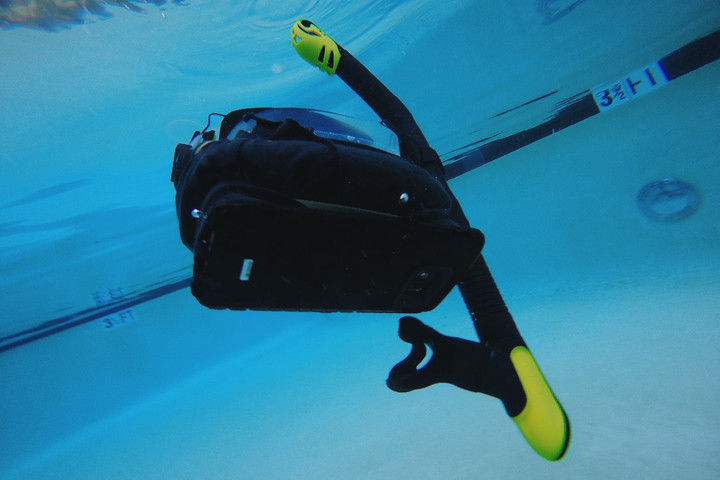
Evans, co-founder of headset maker Avegant, immediately set about thinking of ways to develop a prototype to see if the idea was worth exploring further. The very next day he got hold of a diving mask and 3D-printed two blocks to go inside it to allow a waterproof Android smartphone to be slotted inside like an aquatic Google Cardboard device. It was then just a matter of finding a swimming pool to test the creation in.
“The first experience I wanted to test out was simulating a space environment,” Greenwood continued. “I was able to track down a CG-rendered video of the International Space Station floating above the Earth. The impact was pretty much immediate. Even though it’s not the highest resolution or fidelity, there was a moment where — for a brief second — you really felt like you were an astronaut floating in space.”
Evans is quick to point out that this is in no way a finished product. “It’s the earliest possible stage of a prototype,” he said. “It couldn’t be any earlier.”
They’re not finished yet, though. “The next step is to see if we can incorporate a positional tracking system so that, rather than just being able to turn your head to look around at a 360 video, there’s the ability to swim toward objects in virtual reality,” he continued. “That’s going to be a big step to us.”
Hey, at the very least this neat hack promises to make bath time infinitely more enjoyable!
Microsoft is making Windows 10 Mail & Calendar app easier to use, more efficient
Why it matters to you
Microsoft is giving you a better Mail & Calendar app in Windows 10, with the hope of ending your search for a better alternative.
The Windows 10 Creators Update, which will add new gaming features, 3D support, and more to the OS, is due soon. But it’s not just Windows 10 that’s being enhanced, as Microsoft continues to improve its first-party Windows 10 apps as well.
The Mail & Calendar app is particularly important to users, as it serves as the main communications tool for most people running Windows 10. Not everyone has an interest in Outlook 2016 or in searching out alternatives, and so the changes that Microsoft outlined in its recent post on the Windows blog should be particularly welcome.
More: Microsoft brings Focused Inbox to the Windows 10 Mail app for some lucky users
First up is a new feature that’s been covered before and that should be familiar to anyone using Microsoft’s Outlook Mobile app on iOS and Android. Called “Focused Inbox,” the feature makes it easier to keep your most important email separated from the less important messages — if you trust Microsoft’s machine intelligence to determine what’s important, that is.
Just as its name implies, Focused Inbox creates a separate tab where the app places those messages it deems most important. Lesser emails are placed in an Other tab. Both tabs provide a visual indicator that new messages are available in whichever tab isn’t currently open, and you can fine-tune the Focused Inbox feature by moving email from one tab to another. You can also turn Focused Inbox off if you find it more of a hindrance than a help.

Next up is the ability to precede a name with the @ symbol when it’s in the body of an email message to pull up frequent contacts and gain access to the contact directory. If that person isn’t in the list of recipients, they’ll be added, and they’ll also be highlighted in blue so they know they’re being addressed. If you’ve been mentioned in an email using the feature, then the @ symbol will appear in your message list and you’ll be able to filter to see all of the messages where you’ve been mentioned.

Changes are also coming for the Calendar portion of the Mail & Calendar app. New features include:
- Color categories to allow you to categorize events by color and quickly pick out specific event types.

- An Interesting Calendars feature that lets you add a variety of different calendars that are powered by Bing to let you more easily keep track of things like your favorite sports team and maintain a TV schedule.

- The Mail & Calendar app already pulls travel and package delivery information from your emails and adds them to your calendar. Now, Microsoft is adding simplified summary cards in your Mail inbox and in the calendar to make it easier for you to access the details.

- A variety of smaller improvements have also been added to the Calendar app. You’ll see location suggestions from Bing, have the ability to add Skype for online meetings, be able to more easily pick emojis, and more.

All of these new features work with Outlook.com and Office 365 accounts for now. Microsoft will be adding support for other services in the future. You may already be enjoying some of these new features if you’re a Windows Insider running the most recent Windows 10 preview builds, but soon enough everyone will have access to much-improved Mail & Calendar functionality.
 AIVAnet