


It will cost $670 to get 90 percent of 2017’s ‘Hearthstone’ cards
Since it launched in 2014, Blizzard’s free-to-play digital card game Hearthstone has dominated its niche. To keep gameplay fresh, the studio has alternated new content additions between Adventures, which guarantees some cards for a $20 flat fee, and larger expansion sets that dole out cards in randomized packs bought with in-game gold or real-world currency. Last week, the studio announced it will forgo any Adventure releases in 2017, instead launching three of the latter full-size content blocks for 2017. While this means a record amount of cards will be added, it will be harder — and more expensive — to get all of them.
How pricey does that make Hearthstone now? If players only spent real-world money buying enough packs to get 90 percent of this year’s content, it would cost them about $670 up front.
That’s the number Redditor FliccC arrived at in a post they published shortly after Blizzard’s announcement, a total that is significantly higher than the $440 or so it cost to buy the same percentage of last year’s content. While casual players can coast along, picking up a pack every so often with in-game currency awarded for daily playing, competitive online and tournament play relies on high-performing decks filled with many of the latest cards. And if you imagine yourself a Hearthstone innovator, the only way to workshop new strategies is to personally try out novel combinations in live matches against real opponents who are also packing the newest and coolest toys.
This level of ranked online and tournament competition is kind of like Hearthstone’s end-game content, the challenge lying beyond the casual-mode bunny slopes. As with any statistics-driven scenario, science points to an arbitrary threshold before pouring more money into the card-pack slot machine gives diminishing returns (e.g., duplicates). According to FliccC’s calculations based on this BlizzPro guide, purchasing 200 packs should net a player around 90 percent of any given 130-plus card expansion set. Despite strategically choosing the pre-order deal and bulk buys, this comes out to $223 when shopping straight from the studio’s online store. Even the slick trick of using Amazon Coins for cheaper packs nets a maximum discount of 25 percent off.

While players faced this pricey pack roulette for two of last year’s content releases, they caught a break with last August’s Adventure, One Night In Kharazan, which provided every card in its small set for $20. In its announcement, Blizzard, which has not yet responded to a request for comment on this story, committed to adding Adventure-style single-player content to the second of this year’s expansions, which will reward free packs. But as far as we know, it won’t also offer cheap packages that guarantee cards. Basically, then, if you’re paying up front and want most of this year’s Hearthstone content, for completionist satisfaction or to play competitively, you’ll probably have to spend a little over $200 more than you did last year.
Frankly, that’s kind of nuts. That kind of money spent on a single expansion could buy 13 more months on World of Warcraft or three more $60 major studio games. Heck, purchasing most of all three expansions at that $670 figure could sponsor your 20-person WoW raid group for two months.
Not everyone buys the whole set up front, of course, and most don’t spend much more than a WoW subscriber. Redditor FliccC has spent $800 since the game launched, or about $20 per month. That’s not uncommon: A SuperData report noted that digital collectible card game (CCG) players spend an average of $34.22 per month on those titles. Given that Hearthstone earned four times as much as its next competitor, it will likely take the lion’s share of the $1.4 billion digital CCGs are expected to rake in this year.
There are irregular straw polls on the r/Hearthstone subreddit asking how much total money users put into the game, and one last April found that 24 percent of the more than 25,000 vote sample size hadn’t spent a dime. There will always be the few whales in the ecosystem paying thousands of dollars, like in mobile gaming. But a combined 32 percent — 8,000 — had dropped between $100 and $400 over Hearthstone’s lifetime. That percentage was almost identical in the latest poll, released two months ago.

The question is whether you need all of those cards. Having every option on hand is obviously helpful when tinkering, but the quality of cards in any given set follows a bell curve, with useless junk at the bottom and powerful cards at the top. FliccC, a player since the game was in beta, pointed out that only a small selection of the 901 total cards in Standard format are used at the competitive level.
“If you look at the decks that are competitively played on ladder and in tournaments, the number of viable cards is relatively small. Simply due to the fact that there are currently some cards which are so strong, that if you didn’t include them in your deck, your deck would be considerably worse,” FliccC told Engadget. “In the current meta, people are building decks around mainly two very strong cards: Kazakus and Patches, the Pirate. This leads to many different decks, but since they share a lot of the same cards, the overall competitively viable card pool is rather small.”
For the cash-strapped, Blizzard is a merciful game custodian, and there are mechanisms in Hearthstone to help players chisel away at new content’s sticker price. Completing daily quests and wins nets them, on average, enough in-game gold to buy about 1.5 packs per day. But they’ll still deal with the random results of opening packs, which could hand out dominating legendary-rarity cards or poor-quality “pack fillers.” In many ways, Adventures leveled the playing field, doling out the same cards to everyone who paid its entry fee, including a handful that still make it into top-tier decks today.
That’s where Hearthstone’s free-to-play tier will veer even further from competitive viability in 2017. There’s always been a divide between free-to-play casuals and players committed enough to drop cash on the game, but ditching Adventures also makes the game more expensive, period. Those small sets were not only fun single-player experiences but also affordable and cost-efficient. The most recent, One Night In Kharazan, cost $0.40 per card, while a standard expansion (not considering freebies given out by Blizzard) costs about $1.90 per, according to FliccC’s numbers.
You might notice the former rate is far lower, which is what happens when comparing flat-fee sets giving guaranteed cards with the randomness of the pack roulette. The latter ends up providing players with many duplicates that can be refunded via “disenchanting” for a miserly amount of dust, a secondary resource that can be spent to make any card at a cost that ratchets up based on rarity. Obviously, more extra cards means more dust to go around, making it easier for higher-paying players to afford crafting missing cards. This largesse lets them build out the highest-rated decks listed online, which all cost at least 3,000 dust to make from scratch. A single legendary-rarity card like the game’s current scourge Patches, The Pirate costs 1,600 dust to craft.
There are some unknowns that affect whether paying players will get a bigger competitive edge over their free-to-play peers in 2017, but the most significant x factor is Blizzard’s generosity. While it only gave out six free boosters as quest rewards when the latest expansion, Mean Streets of Gadgetzan, launched, the studio promised daily giveaways of gold, dust and free packs leading up to the first new content release in 2017.
If you’re good and scrappy, you can get pretty far on free stuff: Popular Hearthstone streamer Trump (mayor of value town, not president of the US) infamously almost made it to Legendary rank with a free-to-play account after 2016’s first expansion. If we’re lucky, the fountain of gratis goods coming with the year’s inaugural set will soothe the growing gap between the game’s low-spending and high-paying players.
Source: r/Hearthstone (post)
Indie devs with disabilities win full ride on Train Jam to GDC
Two game developers with disabilities are headed to the 31st annual Game Developers Conference (GDC) this year via Train Jam, a four-day rail excursion from Chicago to San Francisco that was founded in 2013. Train Jam participants collaborate to create new games during the trip, which they can debut at GDC. Both developers are being sponsored by the AbleGamers Foundation, a nonprofit that provides access to video games for people with disabilities via assistive technologies like adapted controllers.
Veve Jaffa and AJ Ryan, two talented indie developers who experience disabilities, were chosen to receive accessible rooms on the train along with airfare, lodging and Train Jam event tickets, thanks to the sponsorship of both AbleGamers and GDC itself. They’ll also get All Access passes for the following week’s GDC events in San Francisco, which include development panels, technology showcases and demos of new and upcoming video games. GDC is the largest and longest-running conference of its kind, and has become the place to be for anyone working or writing about the gaming industry.
Veve Jaffa experiences chronic pain with sensory and ambulatory challenges. They (their preferred pronoun) are looking forward to the train ride itself, and feel included rather than tokenized. Train Jam is something they’ve always wanted to participate in, but needed accommodations to do so. They’re also speaking at GDC this year about urban exploration and photogrammetry in game design, as well as demonstrating their latest game prototype, Nakam.
“I often strive to meet accessibility standards in my games,” Jaffa told Engadget in an email, “whether it’s unimodal interfaces, text descriptions or accessible colour palettes. I want to demonstrate that you can make complex and engaging games while accommodating a variety of players and abilities.”
Ryan has muscular dystrophy, a progressive disease that affects motor strength. He’s not been to GDC before but wants to prove to the game industry that there are game developers with disabilities who can do great work.
“I’ve successfully done this (created an accessible game) before during multiple game jams but being on a train will bring unique challenges such as no internet access and a bumpy road to code on,” he said in an email.
AbleGamers founder Mark Barlet is proud of his foundation’s sponsorship. Sending two indie developers to both Train Jam and GDC is a move designed to help raise the visibility of people with disabilities in such a culturally significant industry. “We can’t wait to see what Veve and AJ cook up while touring across the country,” he said in a press release, “and are eager to hear about their experiences and opportunities encountered while at GDC in San Francisco.”
Source: Able Gamers
The Wirecutter’s best deals: Save $100 on a Dell UltraSharp monitor
This post was done in partnership with The Wirecutter, a buyer’s guide to the best technology. When readers choose to buy The Wirecutter’s independently chosen editorial picks, they may earn affiliate commissions that support their work. Read their continuously updated list of deals here.
You may have already seen Engadget posting reviews from our friends at The Wirecutter. Now, from time to time, we’ll also be publishing their recommended deals on some of their top picks. Read on, and strike while the iron is hot — some of these sales could expire mighty soon.
RAVPower 22000 mAh Ace Series portable charger

Street price: $40; MSRP: $60; Deal price: $28 w/ code RAV22000
This is a nice deal on our super powerful USB battery pick, and a new lowest price ever. Just make sure to use code: RAV22000 in order to get the best deal price of $28.
The RAVPower 22000mAh Ace Series is our more powerful pick in our guide to the best USB battery packs. Mark Smirniotis wrote, “If you require a lot of power—say, you need to charge your smartphone every night on a weeklong camping excursion, or to keep a couple tablets or large smartphones fully charged throughout an international flight—you should get the RAVPower Ace Series 22000mAh Power Bank. Though only about 85 percent of the capacity of our previous large pick from RAVPower, the RAVPower 26800mAh Xtreme Portable Charger, this newer pack can charge more devices faster than any other contender in our test group. Even though it was second place in overall capacity, it still had enough power to charge a smartphone every night for a week, and when it’s dead, it recharges faster than any other pack we tried.”
Dell UltraSharp U3415W 34-Inch curved LED-Lit monitor

Street price: $700; MSRP: $1,200; Deal price: $600
This is a great deal on our ultrawide pick for the best 27-inch monitor, and the best price we’ve seen so far. This comes in at over $100 below the average street price we’ve been seeing for this ultrawide monitor from Dell and is overall a great price to pick up this monitor. While there is a newer version of this monitor available, the improvements seem very small and we’ve seen quite a few mixed reviews on it, so we suggest sticking to the U3415W.
The Dell UltraSharp U3415W is our ultrawide pick in our guide to the best 27-inch monitor. David Murphy wrote, “If you need a lot more space than our 27-inch 1440p pick provides but don’t want to mess with 4K’s screen-scaling issues, or if you don’t have a computer powerful enough to run a 4K monitor, consider an ultrawide monitor instead. Our favorite is the Dell U3415W. Its factory-calibrated display wasn’t as color-accurate as our other picks on our tests, but it still works well for everyday use. Its display connections and stand are just as good as the P2715Q’s.”
Lewis N. Clark umbrella

Street price: $17; MSRP: $20; Deal price: $10
A new low on an already very affordable umbrella. This $10 deal now means you have no excuse for getting caught out in the rain without an umbrella.
The Lewis N. Clark umbrella is our top pick in our guide to the best umbrellas. Tim Heffernan wrote, “The Lewis N. Clark Umbrella is our overall pick as the best umbrella for most people because it offers more features and durability for the price than anything we’ve tested in the past three years. At 10 ounces, it’s the second-lightest in our test, and the shortest (when closed) at 11 inches (the company lists it at 10.25 inches; it’s not). Its 38-inch canopy (the company underestimates it as 37 inches) is right in the sweet spot for full-size umbrellas, and it performed satisfactorily in last year’s mannequin-in-the-shower test, keeping the head, shoulders, and upper torso dry. This year, it survived the battery of 20 consecutive inversions and continued to open and close without problem (though one arm appeared slightly bent afterward), and it has a handle that stays grippy when wet.”
Refurbished Samsung Gear Fit2 fitness tracker

Street price: $150 (new); MSRP: $180 (new); Deal price: $85
While we’ve seen the Gear Fit2 as low as $130 new, an $85 refurbished large size wearable is a nice discount if you’re in the market for an Android-friendly fitness tracker. Only the black color in large is available for this price (if you’re seeking the small size in black it is also available refurb for $95, but that’s less of a bargain relative to the previous deal pricing we’ve seen). This model, as a Geek Squad refurb, carries a 90 day warranty.
The Samsung Gear Fit2 is our best for Android users pick in our best fitness trackers guide. Amy Roberts writes, “If you’re an Android user, the full-color Gear Fit2 might be the better pick, especially if you value sleekness. It’s noticeably thinner than the Vívosmart HR+ even though it also has GPS, a heart-rate sensor, and automatic activity detection. It’s much cheaper too. However, it is Android-only and is held back by an extremely short battery life of just 2 days, so you have to charge it almost daily. The activity auto-detection is particularly impressive: Once it recognizes a walk, run, or bike ride lasting 10 minutes or longer, the screen changes to a timer recording your effort, and once it detects you’re done, congratulates you on a job well-done.”
Because great deals don’t just happen on Thursdays, sign up for our daily deals email and we’ll send you the best deals we find every weekday. Also, deals change all the time, and some of these may have expired. To see an updated list of current deals, please go to The Wirecutter.com.
US Republicans Now Favor Conference Calling Instead of Usual Town Hall Meetings
A growing number of Republican legislators are ditching conventional town hall meetings for conference calls, and this is largely because of the manner in which protesters disrupt such face-to-face meetings.
Since President Donald Trump assumed office, protesters everywhere have seen town hall meetings as events that must be hijacked, and this is giving legislators security concerns. The Christian Science Monitor reports that Republican legislators now choose conference calling over in-person town hall conferences when meeting with their constituents.
Using conference calls in place of town hall meetings is now referred to as “tele-town halls,” and it provides a medium where legislators can safely interact with their constituencies from the safety of their own homes or offices. According to several lawmakers, this security measure is becoming necessary since angry demonstrators easily disrupt town hall meetings. Meanwhile, a number of critics say this mode of communicating with people is not ideal for a health democracy.
Since people are getting angrier and distressed with the government, town hall meetings have become a forum where participants shout at one another, throw things at each other, bend out of shape and destroy public property. This leaves many legislators with no choice than to adopt conference calls or even web video conferencing in certain other instances. Public officers desire to meet with their constituencies, but it is obvious they are not ready to do that where their personal security is at stake.
Conferencing call services and why lawmakers now prefer using them
Republican lawmakers and business executives choose to use conference calls because of the ease of use and added security where they must speak with many people at the same time. Conference calling services are changing the face of mass communication and public interactions. Politicians and businessmen say it is cheap and affordable, and it secure with little chances of being hacked or compromised.
Secure audio conference calling uses specialized communication apps or software that connects you to people almost instantly. You can invite people to join you for a conversation or meeting with the press of a button, and you can use dial-up numbers to speak to people within your vicinity or people from around the world simultaneously. And what’s more, you are in complete control of the conference calls and fully able to see call participants, mute callers, exit participants and also lock on call participants among other conferencing options.
President Donald Trump mentioned by name in conference calls of 148 companies
The CNBC just reported that President Donald Trump was mentioned by name 20% of the time when 148 companies used conference calling to report their quarterly earnings. This actually means that 32 S&P 500 companies mentioned the name of President Trump when using conferencing calls to report their quarterly earnings in a manner that was not even seen when former President Obama was in power.
This fact goes a long way to reveal that the use of conferencing calls spans all aspects of public and private lives. To this extent, people prefer using it where face-to-face communication is not possible with a large number of people. Meanwhile, the use of conference calls is best where you have to speak with a large number of people simultaneously on the same issue.
Anyone can spend as long a time as possible talking on conference calls as can be done with physical communications. You can talk to up to 50 people simultaneously and chat on various issues for as long as 10 hours if you care to, and both politicians and businessmen and civilians are well aware of this positive aspect of using conference calling.
Harman Could Bring Wireless CarPlay to Audi, VW, Mercedes-Benz, Chrysler, and Other Automakers
Harman today announced that it has achieved the first-ever implementation of wireless CarPlay in vehicles. It said its infotainment system is currently being deployed for a luxury German automaker, which more than likely refers to BMW, the only automaker that currently supports wireless CarPlay as a built-in feature.
A number of BMW models have supported wireless CarPlay since late last year, and Harman’s announcement comes just as the 2017 BMW 5 Series with wireless CarPlay hits the streets in the United States.
Harman did not disclose plans to roll out wireless CarPlay to other automakers, but it has business relationships with several vehicle manufacturers, including Volkswagen Group, Daimler, and FCA, so it is plausible that wireless CarPlay could expand to brands such as Audi, VW, Mercedes-Benz, Chrysler, Dodge, and Jeep in the future.
Harman provided the following statement to MacRumors:
HARMAN is the renowned Tier 1 supplier of infotainment systems to global automakers. Our customers include Audi/VW, Daimler, BMW, Chrysler/FCA, and many others. HARMAN has pioneered the introduction of many Apple features in the past into car – iPod out, CarPlay, etc – as well as other “smart apps” such as Android Auto and Baidu CarLife, for automakers across the world.
Volkswagen actually wanted to demonstrate wireless CarPlay at CES 2016, but it said Apple blocked them from doing so for undisclosed reasons.
Due to confidentiality agreements, it is likely we will have to wait for each of these automakers to announce wireless CarPlay individually, but Harman and BMW have proven that it can be accomplished.
Apple introduced wireless CarPlay support in iOS 9, but the majority of current systems require connecting an iPhone to the vehicle with a Lightning to USB cable. Harman’s system is the first to enable wireless implementation, with the iPhone connecting via Bluetooth and data transferring via Wi-Fi.
Last month, Alpine introduced the first aftermarket system with wireless CarPlay for do-it-yourself installations. The iLX-107 features a 7-inch capacitive touchscreen with LED backlighting, and it begins shipping this month for a suggested price of $900. Some resellers may offer it for cheaper as seen with other Alpine receivers.
CarPlay is available in over 200 vehicle models around the world, enabling drivers to make and receive calls, access text messages, play music, get directions, check traffic conditions, and more with Siri voice commands and on-screen controls. CarPlay requires an iPhone 5 or newer.
Related Roundup: CarPlay
Tag: HARMAN
Discuss this article in our forums
Apple to Open First Argentinian Apple Store in Buenos Aires in 2018
Apple is planning to open an Apple Store in Buenos Aires in 2018, according to Gizmodo en Español. The store will be Apple’s first official retail location in Argentina, but it is not yet clear where it will be located in the city.
As Apple plans to open its first store in Argentina, several third-party retailers will also start selling Apple products. Starting in 2017, electronics chain Frávega will open 15 store-within-a-store locations that offer a range of Apple products. It is not known, however, if the Frávega locations will be offering the iPhone.
Apple Morumbi in São Paulo Brazil
At the current point in time, Apple products are exorbitantly expensive in Argentina due to taxes, tariffs, and inflation. Products sell for up to three times as much in Argentina as they do in the United States. The entry-level iPad Pro, for example, sells for $1,418 (22,149 pesos) compared to $599 in the U.S.
Argentina just announced plans to remove a 35 percent import tariff on computers, laptops, and tablets, which, along with a local Apple Store, could lower prices for Argentinian Apple customers.
Apple retail stores have been slow to roll out in Latin America. Apple has two stores in Brazil and just recently opened its first Apple Store in Mexico City. Apple is rumored to be planning to open additional stores in Mexico in Guadalajara and Monterrey, along with locations in Chile and Peru.
Related Roundup: Apple Stores
Tag: Argentina
Discuss this article in our forums
AtomicX V201: All you need is love and these headphones (review)

There are some people who splurge hundreds of dollars in crazy-expensive headphones because they want the best audio quality. There are people who think that the crappy headphones included with their phone are good enough. Then there are people that are willing to trade off a bit of quality in favor of an affordable set, especially if it brings additional features such as Bluetooth and Active Noise Cancelling.
For this ever-increasing customer segment, iDeaUSA has brought the AtomicX V201 headphones to market. If you want a nice looking, sturdy and wireless set with great battery life and good sound quality, then you’re in for a treat.
Design and Build
When opening the box, you will find a rigid case with a faux carbon fiber design. I didn’t expect a case with these headphones, considering that I’ve bought slightly more expensive headphones and they haven’t come with a case. Now I feel ripped off by them.
Anyways, inside the case you will find the following items:
- AtomicX V201 over-ear headphones
- 3.5mm to 3.5mm cord
- MicroUSB to USB charging cable
- Dual mono to 3.5mm adapter
It was a surprise to see the adapter, since, again, I’ve never had one included in any of the headphones I’ve bought. What I’ve seen included with other headphones, especially with Audio-Technica, is a 3.5 to 6.35mm adapter, and the V201 doesn’t include one. This is not a dealbreaker for 99% of people, and chances are that if you need one, you already have one.
 The V201 headphones follow closely the design set by the carrying case, with faux carbon fiber elements on the cups and on the top part of the headband. The rest of the device is made up of plastic.
When you adjust the cups in order to fit your head, you will discover that a metal frame hold the headphones together. There’s also some padding added to the bottom part of the headband and to the inner side of the cups.
On the bottom part of the cups you will find several elements. On the left one, there’s a switch to toggle Active Noise Cancelling. There’s also a microUSB port for charging purposes.
On the right, you will find a power button that doubles as a pause button, plus volume down/previous and volume up/forward buttons. There’s also a 3.5mm plug to connect the included cable. A status red/blue light is also present on both sides.
 The carrying case is very nice and has the same faux carbon fiber design.
All of these elements add up to a weight of 210 grams. I haven’t found myself wishing that they were neither lighter nor heavier. They are light enough so that long sessions don’t turn into hell, and they are heavy enough to convey a sense of quality.
Contrary to what some companies are doing, iDeaUSA opted to offer the V201 in black only. Thank you very much, iDeaUSA. Even though I prefer bright colors for some stuff, such as cellphone cases, I would hate to have a bright green thing on top of my head. This device won’t turn heads, that’s for sure, but, in my opinion, that’s how headphones should work.
I’ve been using these headphones basically non-stop for a week and the first day I felt some discomfort on my ears, but the next day it went away. Probably it was just me getting used again to over-ear headphones, which I haven’t used in months. The padding makes a good job here, and the weight means that the discomfort is kept to a minimum.
The whole set just feels very sturdy and strong. I feel like these headphones will serve me well for several years, thanks to a well-designed build and durable materials.
Sound Quality
Normally, Bluetooth headphones are not renowned for their audio quality, unless it is a very expensive piece. Also, when headphones add ANC, audio quality tends to suffer in favor of a more pleasant experience through the reduction of ambient noise.
As I previously said, I have some experience with headphones but I am in no way an expert. I use a pair of Apple EarPods for my daily walk to the university, and I am fine with them, even though I know they are not good.
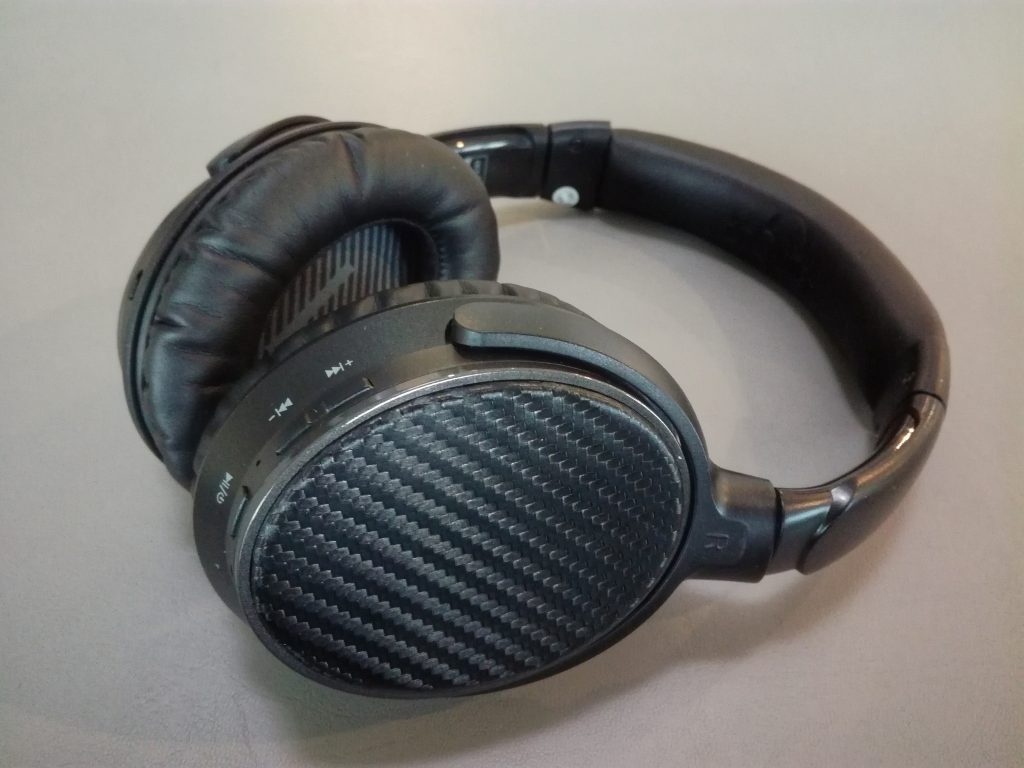 Sound quality could be improved but it is acceptable.
However, it is easy to notice the difference between a pair of crappy earbuds and the V201. I noticed some sounds in Delain’s Here Comes the Vultures that I have never heard in the (probably) 200 times I’ve listened to that song. This happened with several songs, proving that the sound it produces can be refined and detailed.
In case you were wondering, these headphones can get extraordinarily loud. This will obviously make the sound bleed (and annoy people around you in the process), but listening to The Game by Dragonforce on full volume was almost a concert-like experience.
 The padding makes sure that the device fits as comfortably as possible.
I like when headphones have a pronounced bass, and unfortunately the V201 isn’t the best at this.
I heard several songs through the V201 and my EarPods and there were some cases, such as in Shine by Tolmachevy Sisters (don’t judge, a series of weird events led me there), where I could hear the bass drum more clearly through my EarPods.
Also, in some songs, such as Epica’s Edge of the Blade, which is filled with very prominent hi-hat and crash cymbal sounds, some mild distortion could be heard in these high sounds, especially when I increased the volume.
The situation improved when I turned on Active Noise Cancelling. Then, the perceived sound had more punch to it, with richer bass sound and a more dynamic range. This alleviated slightly my complaints about the sound, so I will keep it on.
Talking about ANC, I must say that it is hit or miss. It reduced the clicking sound of my keyboard and this weird sound that the heater in my room does (or maybe it is the normal sound, it’s just that I’m not used to having heaters in my room, but rather fans), but it couldn’t filter rain, for example. It obviously didn’t do a good job in reducing my flatmates’ voices, but it did reduce them a little.
Connectivity
 There are several accessories included with the headphones.
The V201 headphones support the latest Bluetooth 4.1 standard. Unlike several Bluetooth devices I’ve used, there is no hissing sound, something that is specially noticeable when nothing is playing.
I did experience a couple of interruptions while playing music, but they lasted a couple of tenths of a second.
Pairing the phones to a Huawei Honor 7 Lite (known as Huawei Honor 5C in other markets), a Nomu S10 and a Windows laptop was extremely easy. Just hold the power button for five seconds and the headphones will change to pairing mode. Choose it from the list of Bluetooth devices and you are done.
If you like, you can use the included 3.5 to 3.5mm cable to listen to your favorite tunes. This works exactly as expected, and the sound quality wasn’t either benefitted nor affected by the change of output.
As a bonus, the headphones include a mic, so you can answer calls through them. You accept a call by pressing the power button. This built-in mic gets the job done. Obviously, it is much better to answer your call through your phone, but the mic is there for when you need it.
Battery Life
The headset features a 500mAh battery that can be charged through the included microUSB cable. There’s no charger included, but come on, it is 2017, everyone has one already.
 The charging port is under the left cup, and the device can be charged and used at the same time.
Even though the battery is small, iDeaUSA claims 20 hours of battery life with ANC turned on and 25 turned off. I had ANC turned off almost all the time and I can attest to this fact. I’ve used these headphones on average 8 hours per day and I’ve had to charge them twice in one week.
Charging is another matter, though, and even though iDeaUSA claims two hours battery charging time, I’ve never been able to replicate this. Both times, the battery was charged after a 2.5-hour period. If I manage to get a better time, I will update the article accordingly, but don’t hold your breath.
Conclusion
The AtomicX V201 headphones feature a nice build, responsive controls and good battery life in a nice packaging and a welcoming price. You can use them through the state-of-the-art Bluetooth 4.1 standard or by regular 3.5mm cable. Sound quality could be better, and Active Noise Cancelling can be hit or miss, but the overall experience provided by these headphones is very good.
Considering that you can get them for less than $100 (exactly $89.99 at the time of writing), you get a lot of value for your hard-earned cash. You probably can’t do much better, and definitely can do much worse.
You can get more information about the iDeaUSA AtomicX V201 headphones or buy them from Amazon.
Reigns : Rule your kingdom with a swipe of your finger (Review)

When it comes to games that give you the role of a ruling king, I’d say that 9 times out of 10 you are in the middle of a deep strategy game, requiring you to know who to barter with, go to war with, and when to adjust the price of wares sold to keep your peasants happy, you rich, and your kingdom thriving. Reigns takes all this, simplifies it dramatically, and turns it into a card-swiping game. Will you raise the price of bread? It will increase your money but will make your people angry. What about a war with the eastern territories to increase your domain? Better yet, how about a nice crusade? It’s all here and more, all in the swipe of a card.
Developer: DevolverDigital
Price: $2.99
Download: Google Play/App Store
 Long live the King
Gameplay
The entire game is about Yes or No choices, with some variation. Generally, a swipe to the right will be for “Yes” or a positive response, and a swipe to the left is for “No” or negative. Through this simple, binary response system, the game fleshes out a story where a long time ago a King made a deal with the Devil to have ultimate power but at the loss of his soul. Now cursed to living in an endless cycle of deaths and resurrections, it’s your duty to appease the Devil’s demands or try and trick him.
There are hundreds of cards with more unlocking as you make different achievements through the game. Cards include everything from the army needing more troops, to your miner finding a cave of gold and you deciding to keep it for yourself or share the wealth. You may end up with a bastard son, or you could be a great war hero. This game has incredible variety. All of these choices effect 4 meters at the top of the screen. There is a Religion, People, Army, and Treasury meter. Just about everything you do will either raise or lower the bar for any of these areas, and it’s important to maintain a balance with each of these. If the Chuch gains too much power, they will overthrow the government and you lose, but it they lose all of their power, the pagans overthrow your castle and murder you. No one stat can be maxed or emptied.
 En garde!
There are times when you will wander into a dungeon or be challenged to a duel. Swiping right will attack while swiping left will block and charge a special attack. This is a little bit of “rock paper scissors” and a little bit of luck as you aren’t able to choose which specials you throw out, so sometimes you’ll do a dive attack when a sword throw would win the match. It’s fun, but can be frustrating when things don’t go your way and you have no control over it.
There are special situations that will effect these meters as well, romancing a lover will make the people happy and will lock the People meter so that it is unaffected by any choice made. Starting a holy crusade will continuously raise profits and increase the Church’s power over time, but with a steady decrease of the military. There are powerups to save you from famine, mushrooms that let you see the exact increase or decrease of each choice you make, and even a potion to turn all your villagers into rabbits. This game has an incredible amount of variety and even after hours of playing it, there are still a few cards I have not seen yet.
 Yeah, sure. Thin the herd.
Graphics
The visuals are all similar to a flat, material design with bright vibrant colors. All the characters are unique and diverse, from the Executioner with his hood hiding his face, to the crazy heretic that released a lion in your village as part of God’s wrath. It’s a simple design, but it’s beautiful and keeps the game moving at just the right pace. You aren’t supposed to be locked into the beauty of the cards, you’re supposed to recognize the character, read what they say, and swipe. The simple graphics compliment the simple gameplay.
 Maintain a balance at all times, or the scales will not tip in your favor.
Sounds
The sound is on point, with the low chanting music that one would expect from a medieval game. Every character has their own unique voice and chatter, even if it is something that sounds like it comes out of The Sims. It is a fun way to make the characters seem a little more engaging. Again, there is no over-complication in the sounds, but there are just enough details that prevent if from getting dull.
Longevity
There are hundreds and hundreds of cards available to unlock and the pacing of unlocking them is spot on, with more cards getting unlocked the deeper in the story you get. There are many branching storylines, some dependant on completing other in a single playthrough to unlock. Considering that each life of the King on average only lasts between 5 to 10 minutes, it’s full of quick and achievable goals, but luck plays into getting the cards needed to pull off certain achievements. With the Devil only showing up every 666 years, there’s plenty of time to have fun and explore without having to worry about mandatory story quests, but there’s still plenty of story quests sprinkled throughout. You are able to continue playing after you break free from the Devil’s control to pick up any last achievements that are missing. All in all, the game took me just shy of two weeks of off and on playing to get through the main story.
Conclusion
Reigns is a brilliant game. It’s easy gameplay and short bursts of story are perfect for the mobile gamer on the go. The story is engaging, the characters are endearing, and the strategy is easy to pick up but difficult to master. Besides the bit of random luck involved in duels, the game is as flawless as they come. At $2.99, this game knows it’s worth and is worthy of the price tag.
Online product listing unveils the new Asus VivoBook Flip TP203
Why it matters to you
The market for budget 2-in-1 laptops is heating up, which means that consumers should be able to get better hardware at more budget-friendly prices.
It looks like Asus is prepping a new entry in its VivoBook line for release in 2017. A product listing for the as-yet-unannounced VivoBook Flip TP203 has been spotted on a Taiwanese online store, revealing what specs we can expect from the 2-in-1 device.
The VivoBook Flip TP203 is set to feature 8GB of RAM and 128GB of eMMC storage, and can apparently be outfitted with an Intel Apollo Lake processor. This is a step up from the previous model, the TP201, which topped out at 4GM of RAM and an Intel Braswell CPU.
The system boasts an 11.6-inch display, and reportedly offers nine hours of battery life from a single charge. The laptop is touted as an ideal choice for commuters, thanks to its battery life and its small, lightweight design. The system’s desktop footprint is said to be smaller than a sheet of A4 paper.
More: New Asus ZenBook Pro could be a real beast with GeForce GTX 1060 graphics
In terms of connectivity, the TP203 features a USB Type-C port, a USB 3.0 port, a standard HDMI port, and a MicroSD card reader. It also features a fingerprint reader for users who want to use biometrics to keep their device safe and secure.
The fact that eMMC storage and Apollo Lake chips are being implemented suggests that the FlipTP203 will be a budget-friendly 2-in-1, according to a report from Liliputing. Asus is yet to detail the system’s pricing and availability, but if it’s inexpensive enough, this device could carve out its own niche in the growing hybrid sector.
Microsoft’s Surface line has long dominated the market for high-end 2-in-1 systems, but there’s more and more demand for less expensive devices that blur the line between tablet and laptop. A swathe of different manufacturers are fielding their own hybrids aimed at these users, but it remains to be seen whether any one company can seize the lion’s share of sales.
Researchers confirm long-held fears about SHA-1 encryption’s vulnerabilities
Why it matters to you
A paper on SHA-1 encryption’s vulnerabilities evidence that standards need to evolve with the times to ensure that online browsing remains safe and secure.
SHA-1 is a cryptographic hash function that underpins various security applications and protocols to help keep the internet safe. Experts, however, have warned for years that it’s out of date. Now, evidence of the first known “collision” of two files with the same SHA-1 hash has demonstrated that the function is no longer safe to use.
A collision refers to an event where two separate files or messages produce the same cryptographic hash, which malicious entities can use to feign authentication and facilitate an attack. While this has been observed before in relation to other hash algorithms, this is the first time that two SHA-1 hashes have collided, according to a report from Ars Technica.
More: Misconfigured Pentagon servers could have been exploited for cyberattack
SHA1 was officially deprecated by the National Institute of Standards and Technology in 2011, but the algorithm is still in use despite doubts about its security. In November 2016, Microsoft joined Google and Mozilla in making preparations to start blocking sites that use SHA-1 protection.
A paper that was published Thursday demonstrates that SHA-1 is unsafe as of right now, and should be retired immediately. The paper is the result of two years of collaborative work undertaken by the Centrum Wiskunde & Informatica, a national research center in Amsterdam, and Google’s security, privacy, and anti-abuse research group.
It would take a great deal of computing power to carry out an attack that takes advantage of an SHA-1 collision — however, that kind of muscle is ready available, as long as the perpetrators have enough financial backing. The paper states that an attack could be performed using Amazon Web Services for as little as $110,000.
Google’s disclosure policy dictates that source code used to perform the collision detailed in the paper will be released in 90 days. As a result, the sites and services that still use SHA-1 hashing will need to discontinue their usage of the algorithm before that date, as those materials will make it much easier for an attack to be carried out.
 AIVAnet