


LG X Power2 is a phone with boring specs and a huge battery
LG continues to focus on just one feature and ignore everything else in its X series.
LG has introduced the successor to the X Power, and like last year’s handset, the X Power2 has a huge battery and not much else going for it. The phone sports a 5.5-inch 720p display, 1.5GHz octa-core CPU, 2GB of RAM (1.5GB in select markets), 16GB storage, microSD slot, 13MP rear camera, 5MP front shooter, and a 4500mAh battery that LG claims will last “an entire weekend without recharging.”

LG also says that a full charge takes “only” two hours, which the company claims is “twice as fast as most phones.” The X Power2 also has LTE and Wi-Fi (we’ll have to wait another year for dual-band), Bluetooth 4.2, and microUSB. The silver lining is that it comes with Nougat out of the box.
The X Power2 will be available in Latin America in March followed by a launch in Europe, United States, Asia, and other regions shortly thereafter. No word on pricing yet, but it is expected to be in line with its predecessor’s $250 to $300 price tag.
LeEco is finally adding an app drawer to the Le Pro3 and Le S3

Upcoming EUI update will bring new features to LeEco’s phones in the U.S.
LeEco has announced that an upcoming update to its EUI user interface will bring an app drawer to the Le Pro3 and the Le S3. The update will add the app drawer icon to the middle of the dock, moving the Live entertainment app — which lets you access LeEco’s content offerings — to the right.
LeEco says that the addition of the app drawer was based on user feedback. The update will also bring camera improvements to both phones, with the Le Pro3 getting improved HDR capabilities while the Le S3 getting better image quality in low-light conditions. Both phones will also pick up additional parental controls, as well as tweaks to the LeEco Live interface and improved Bluetooth reliability. Le S3 owners will also see increased WiFi download speeds.
The software update will be rolling out to both the Le Pro3 and the Le S3 in the coming days. As of now, there’s nothing to suggest that the update will be hitting LeEco’s phones in India.
Android Central 325: The MWC preview event!
This week, it’s Jerry, Flo and Russell on the ones and twos, chatting everything MWC. What can we expect from LG, Samsung, Sony and others? And where can we get more of that sweet, sweet jamon?
Plus, it’s GDC, which is becoming one of the biggest mobile gaming shows of the year. And Google I/O is coming up sooner than you think, so we chat about that, too!
Podcast MP3 URL: http://traffic.libsyn.com/androidcentral/androidcentral325.mp3
Google pushes RCS forward by rebranding Messenger to Android Messages

Google wants its messaging app to be the default texting platform in the age of RCS.
Google Messenger has picked up an update that renames the app to Android Messages. The core functionality is still the same, and barring the name change, the update doesn’t bring any new features to the messaging app. However, the app will now be installed on default on handsets from over 20 phone makers as Google pushes ahead with RCS.
The changelog notes bug and stability improvements, and simpler sign-up for enhanced features on supported carriers. The last bit has to do with RCS (Rich Communications Services), which is what this name change is all about, according to The Verge.
RCS is a communication standard that is a natural evolution from SMS and MMS, offering better multimedia support, read receipts, group chat, and other features to bring texting in line with Hangouts and Facebook Messenger. RCS is a universal standard, and carriers that have agreed to use the “Universal Profile” — Deutsche Telekom, Globe, Rogers, Orange, Sprint, Telenor, and Vodafone — will fully support rich text messages on their networks, bringing the total number of subscribers that are covered by the standard to over 1 billion.
What is RCS and why does it matter?
With RCS gaining adoption by several carriers around the world, Google is now pushing for Android Messages as the default messaging app for the platform. To that effect, the company has announced that over 20 manufacturers have agreed to use Android Messages as the default SMS app on their phones, in addition to its own Pixel and Android One handsets:
- LG
- Motorola
- Sony
- HTC
- Micromax
- Nokia
- ZTE
- Archos
- LeEco
- BQ
- Cherry Mobile
- Condor
- Fly
- General Mobile
- Lanix
- Lava
- Kyocera
- MyPhone
- QMobile
- Symphony
- Wiko
The list doesn’t include Samsung, but Google is hoping that the momentum with RCS will convince other carriers and manufacturers to adopt the standard. Google will be showing off RCS messaging later this week at Mobile World Congress.
LG X Power2 has a mammoth 4,500mAh battery for media heavy users
One of the main problems that plagues smartphones, even still today, is battery life. If you leave your phone alone it could potentially last two days, but start watching videos, playing games or surfing the web and you’ll soon see that diminish.
- LG G6: Release date, rumours and everything you need to know
If you’re a media hoarder and you long for better battery life, the LG X Power2 is for you. The new phone is due to be unveiled at Mobile World Congress and will be the first model in a new X series of smartphones that will incorporate premium features.
The X Power2 is fitted with a huge 4,500mAh battery that LG claims is good for 15 hours of continuous video playback, 14 hours of continuous navigation or 18 hours of web surfing. And if you do somehow manage to get through the battery quickly, the X Power2 has Quick Charge technology that will give it 50 per cent power from an hour of charge.
LG has decided to fit a 5.5in full HD screen, as opposed to a Quad HD, most likely to help improve battery life and a Comfort View feature reduces the amount of blue light given out when reading e-books to help put less stress on your eyes.
Other specs include a 1.5GHz octa-core processor, 2GB of RAM, 16GB of internal storage with microSD expansion up to 2TB and Android 7.0 Nougat.
Cameras include a 13MP lens on the rear with zero shutter lag and a 5MP wide angle lens on the front, which LG says can comfortably fit eight people into a shot when held at arm’s length. LG certainly isn’t holding back on the features for taking selfies, as the front-facing camera has it’s own soft light flash to help improve images in low-light, and a number of functions built into the UX to make taking a picture easier.
Auto Shot for example will take a picture when it detects a face, Gesture Shot and Gesture Interval Shot will respond to hand signals to take a picture, and Quick Share lets you instantly upload snaps to social media sites.
The LG X Power2 will launch initially in Latin America in March in Black Titan, Shiny Titan, Shiny Gold and Shiny Blue finished. Thee US, Europe, Asia and “other regions” will receive it soon after. Pricing will be announced closer to launch.
IPad Pro 2 not expected until May or even June, says report
It has long been rumoured that Apple will refresh its iPad line this spring. Several reports have suggested that the Cupertino firm could even announce iPad Pro 2 – in 12.9 and all-new 10.5-inch sizes – this March, alongside a new 9.7-inch iPad Air and 7.9-inch iPad mini.
However, DigiTimes claims that the launch and release date for all of the devices might not happen until May or June, based on information it has received from sources in the supply chain.
It suggests that iPad component suppliers and makers, TPK and Foxconn, are predicting poor first quarter financial results because of the delay. They are expected to pick up the following quarter because of orders from Apple for construction of the new devices.
- Apple iPad Pro 2: What’s the story so far?
Apple is long overdue an iPad refresh, especially when it comes to the iPad Air. The iPad Air 2 was released at the tail end of 2014 and while the 9.7-inch iPad Pro is critically revered, it is very much a premium, expensive tablet. Rumours suggest that a new iPad Air (iPad Air 3?) would be a cheaper alternative for the larger screen size.
If they turn out to be true, Apple will have four different devices in its range, catering for all tastes and uses.
Google Allo’s desktop client is in the works
Google just can’t stop when it comes to messaging apps. While its texting software for Android has a new name, the AI-powered Allo is coming to a new platform soon. VP Nick Fox teased a desktop web client for the service in a tweet, while saying that it’s “still in early development.” Competing services like Facebook Messenger offer access to their smarts across platforms, so it’s logical that Allo, which launched on Android last September, should as well.
Still in early development, but coming to a desktop near you… #GoogleAllo #SneakPeek pic.twitter.com/f7QNFH7IHO
— Nick Fox (@RealNickFox) February 24, 2017
A recent update let the built-in Google Assistant helper tie into your personal info, which can probably make things like coordinating plans even easier or predict just the right emoji. Unlike Android Messages, we’d be surprised to hear more about this desktop software during Mobile World Congress, but we’ll keep an ear out anyway.
Source: Nick Fox (Twitter)
Lyft’s biggest rollout takes it to 50 new cities
Lyft has just announced its biggest expansion to date. The ride-sharing service is now available in over 50 new cities and four new states across the US. They’re mostly located in the Midwest, but the list also includes a few other parts of the country. This rollout follows another expansion last month that brought the service to over 40 new locations — in all, Lyft now operates in over 300 cities in the United States.
The company announced in January that it plans to establish its presence in 100 more places in the country before the end of 2017. It worked pretty quickly to achieve that goal, and it did so within a month, perhaps to capitalize on Uber’s bad rep these days. Whatever Lyft’s reason is, you can hail one in any of the 300-plus locations where the service now operates.
Source: Lyft
Server bug leaks user data for thousands of popular websites
A number of high-profile websites have been leaking their users personal data into the ether, thanks to an error at their hosting provider. Cloudflare, which provides services to companies like Patreon, Fitbit and OKCupid among others, had an error in its code that caused pieces of memory to dump into web pages. The Register described the issue as sitting down to a fresh table in a restaurant and being handed the previous diner’s wallet.
Tavis Ormandy, a security researcher at Google, spotted the breach and found encryption keys, cookies, passwords and HTTPS requests in public caches. He contacted Clouldflare, which then began to work to identify and stop the issue, which came down to a typo in the code that caused a buffer overrun. In its public statement, Cloudflare added that it held off on disclosing the issue until it had ensured that search engine caches had been cleared of any personal data.
Cloudflare have been leaking customer HTTPS sessions for months. Uber, 1Password, FitBit, OKCupid, etc. https://t.co/wjwE4M3Pbk
— Tavis Ormandy (@taviso) February 23, 2017
If you’re worried about how this affects you — and it probably does — then it’s time to change your passwords for everything. There’s a full list of directly affected sites available here, although it’s probably wise to change all of your security keys, since you never know what data has leaked to where. Additionally, 1Password, which uses Cloudflare for hosting, has come out publicly to reassure customers that their data remains secure.
Via: Tavis Ormandy (Twitter)
Source: GitHub, Cloudflare, Chromium
Google rebrands Messenger to Android Messages for a unified RCS experience
Why it matters to you
RCS is the next standard of texting, and Google’s rounding up the carriers to adhere to the universal platform. That means your texting experience is about to get a whole lot better.

Following Sprint, Rogers, and Telenor, four new telecommunications providers will now support Google’s RCS Jibe platform: Vodafone Group, Globe Telecom, Orange, and Deutsche Telekom. To enforce a seamless experience on these networks, Google is also rebranding Messenger, the default texting application on some Android devices, to Android Messages.
RCS, or Rich Communication Services, is the follow-up to SMS and MMS. RCS lets users send higher-quality picture messages, participate in group chat, share their current location, and initiate video calls. It supports read receipts, typing indicators, and can even allow text participants to share media and other information while in a telephone conversation. It essentially brings texting up to speed with features available on instant messaging services like Facebook Messenger.
More: Google, Telenor to bring RCS messaging to more than 200 million subscribers
RCS implementation requires carrier support, but while carriers have been using the platform for some time now, they have not adhered to the universal standard. Google’s Jibe service aligns with the universal RCS profile, but it provides cloud and hub services to make it easier for carriers to adopt and roll out.
Orange S.A. has around 263 million customers worldwide, and Globe has about 48.4 million. Deutsche Telekom is the majority shareholder of T-Mobile, and also the parent company of numerous other telecommunications service providers. Vodafone also has a large presence, with networks in 26 countries.
T-Mobile has not officially announced support for RCS with Jibe yet, but the company’s CTO has said the “un-carrier” will support the platform some time this year.
Google’s says its partnership with these telecommunication providers represent more than a billion subscribers. There are 27 manufacturers and carriers in total launching RCS with Google.
“These partners have also committed to interconnecting through the Jibe RCS hub so that RCS messages are delivered to subscribers across carrier networks, helping RCS messaging become truly universal,” writes Amir Sarhangi, head of RCS at Google.
Android Messages
As Android owners may know, there has never been a universal texting application on Android devices. Google Messenger, which supports SMS, MMS, and RCS, comes pre-installed on many Android smartphones, but there’s usually a texting app from the carrier or manufacturer present as well, like AT&T Messages and Samsung Messages.
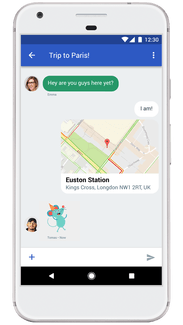
To unify this experience, Google is rebranding Messenger to Android Messages. The tech giant said these telecom partners will enable it as the default texting application to bring RCS to subscribers.
More: Samsung wants to bring text messaging into the 21st century with acquisition of RCS
To make sure Android devices can enjoy all the features RCS offers, Google is also working with the following manufacturers to make Android Messages the default messaging app on their smartphones: LG, Motorola, Sony, HTC, ZTE, Micromax, Nokia, Archos, BQ, Cherry Mobile, Condor, Fly, General Mobile, Lanix, LeEco, Lava, Kyocera, MyPhone, QMobile, Symphony, and Wiko. More partners will be added in the future, and Android Messages will be the default texting app on Google’s Pixel and Android One devices as well.
RCS for businesses
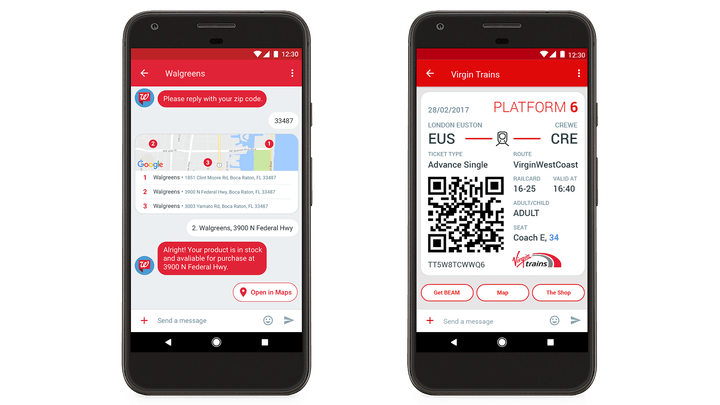
Businesses have been using SMS to reach out to customers for quite some time. For example, your airline may send you a text with flight information, or a food service like Seamless may message you that your food’s on the way. Customers usually can’t do much else with these texts, and Google’s not giving up the chance to get these businesses to upgrade the messaging experience.
The company is launching an Early Access Program for businesses to learn and build with Jibe, so that their texts can offer richer information to customers as more and more carriers adopt the universal RCS profile.
“A message from your airline reminding you to check in for a flight can now take advantage of rich media and interactivity to provide a full check-in experience, complete with boarding pass, visual flight updates, and terminal maps on demand, all directly within the messaging experience,” Sarhangi said. “Businesses can also have a branded messaging experience with information about the business and the ability to share content like images, video clips, and GIFs.”
More: Google’s Gboard keyboard on iOS adds new languages, voice typing, and more
The following companies and messaging partners will be the first to partake in Google’s Early Access Program: Virgin Trains, Walgreens, BlaBlaCar, Gamestop, G2A.com, IHG, LexisNexis Risk Solutions, Papa Murphy’s, Philips, Sky, Sonic Drive-In, Time Inc., 3C, CLX Communications, Experian Marketing Services, MessageBird, mGage, Mobivity, Movile, Vonage through Nexmo API Platform, OpenMarket, and Waterfall.
Google will be showing off RCS-enabled business messaging at Mobile World Congress next week.
 AIVAnet