


Intel drones form US flag for Lady Gaga’s halftime show
Remember when quadcopter drones juggled balls and formed up into a Star Trek logo? That seems downright quaint compared to what we just saw at Lady Gaga’s elaborately produced Super Bowl halftime show. During her first number, 300 Intel drones formed the shape of an American flag, punctuating the singer’s wire-assisted fall to the stage below.
Ok… Gaga using Drones for the synchronized sky lighting was impressive 😎👍🏾 #SuperBowl #PepsiHalftime pic.twitter.com/SIxuMp3OT1
— James Kimbrough (@JamesKimbrough) February 6, 2017
The “Shooting Star” drones Intel introduced last year are a foot across and weigh just eight ounces, thanks to a foam body designed to soften impacts. Each is equipped with a special LED that can produce four billion color combinations including, obviously, red, white and blue.
The performance is coordinated by a central computer that can do unlimited UAV animations in three dimension. Intel recently set a world record by flying 500 of them together (video, below) and said “we hope this experience inspires other creatives, artists and innovators to really think about how they can incorporate drone technology in new ways.” The sophisticated algorithms even check the battery levels and assign lesser roles to weaker drones — if one should drop out, a reserve unit automatically takes its place within a few seconds.
If you’re wondering how Intel pulled this off in a huge crowd under airtight security with strict FAA flight regulations, the answer is slightly disappointing. The drone performance was actually taped on an earlier night, and didn’t appear live to the crowd at Houston’s NRG Stadium (except on the Jumbotron). Nevertheless, as Intel refines quadcopter performers, you can expect to see them providing grand-scale spectacle in place of, say, fireworks or skydivers. And while might be a waste of their true potential, the algorithms it’s developing might eventually help make rescue, delivery and other tech possible.
Via: Wired
Source: Intel
Lenovo’s Yoga A12 offers the Halo keyboard at a low price
Why it matters to you
Need a low-cost laptop replacement? Lenovo’s Yoga A12 makes new concepts — such as the Halo keyboard — budget friendly.
If you liked the look of Lenovo’s Halo keyboard from the Yoga Book but found the $500 price point a little high, the Yoga A12 may be an affordable alternative.
The newly-announced Yoga A12 is slightly larger at 12.2-inches compared to the 10.1-inch Yoga Book, which was introduced last fall. But like the Yoga Book, it runs Android and features the futuristic-looking Halo keyboard. The keyboard doesn’t have any raised keys — it’s flat and offers haptic feedback on touch. It also adapts to your typing habits like keyboards on most smartphones thanks to built-in prediction and artificial learning software.
More: Lenovo’s Tab3 8 Plus might be the midrange Android tablet you’re looking for
The Halo keyboard on the Yoga A12 does not support the same stylus features as the Yoga Book — there’s no pen or digitizer pad.
The Yoga A12’s 12.2-inch display boasts a “HD” display, which means a 1,280 x 800-pixel resolution. It packs 32GB of internal storage and unfortunately only comes with 2GB of RAM. All of this is powered by the Intel Atom X5 processor, which should be powerful enough to handle most tasks on Android 6.0.1 Marshmallow. A 10,500mAh battery life reportedly keeps the tablet running for 13 hours, though we’ll have to test those claims.
Lenovo’s A12 uses a modified “multi-tasking hybrid UI” that makes Android a little more productive on a larger, tablet-size screen. It’s unclear when or if this device will be upgraded to Android 7.1.1 Nougat.
More: Lenovo spices up ThinkPad ‘P’ workstations with seventh-gen Intel CPUs, more
The device can be flipped like the Yoga Book thanks to the 360-degree hinge. It comes in grey and rose gold, and Lenovo says it will be available for purchase on February on the company’s website. The Yoga A12 starts at $300.
Lenovo announces a cheaper version of its innovative Yoga Book
Lenovo has announced a cheaper version of its innovative, mostly excellent Yoga Book, the aptly-named Yoga A12.
Aimed at emerging markets and people not looking for the power and extra expense of the Yoga Book itself, the Yoga A12 pares back the power — it has an Intel Atom x5 chip, 2GB of RAM and 32GB of storage by default — to go along with the 12.2-inch HD screen, though it’s unclear whether it’s 720p or 1080p (I’d venture to say the former).
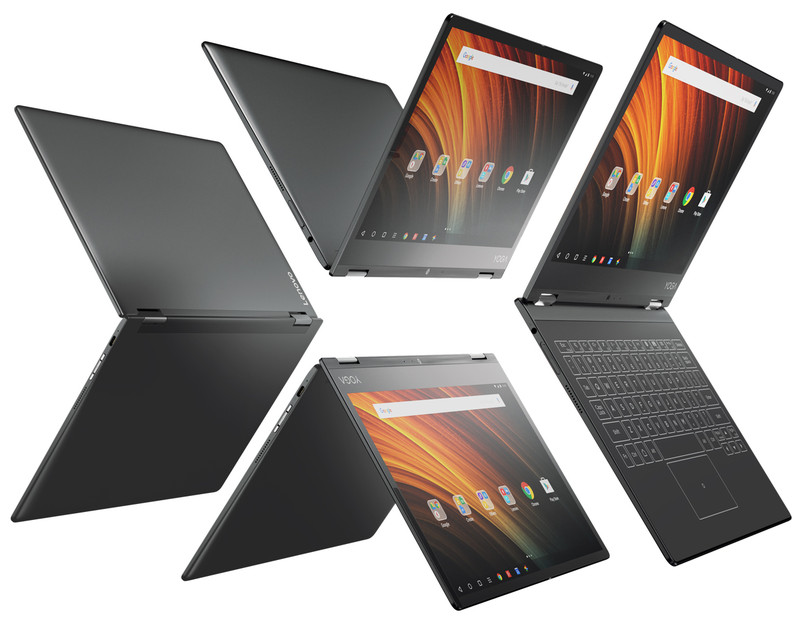
The Yoga Book’s keystone feature, the Halo keyboard, makes a return on the Yoga A12, which the company says has been improved and thinned out since its first iteration. That the Yoga A12 runs Android out of the box is a given, but this version will not come with a Windows option unlike its more expensive counterpart. There’s also no stylus input support, which leant the Yoga Book something of a productivity win with a certain demographic, but the tablet does have a 360-hinge that can be positioned in many ways.
The Yoga 12 goes on sale Friday, February 8 for $299 in one of two colors: Gunmetal Grey or Rose Gold.
See at Lenovo
Lenovo’s latest Android tablet is really a budget laptop
The tablet market is increasingly skewing toward laptop replacements, but what if you want a replacement for a low-cost laptop? Lenovo thinks it has the answer. It’s introducing the Yoga A12, a 12.2-inch tablet that’s really a budget convertible laptop for the Android crowd. Think of it as a lower-priced but larger alternative to the Yoga Book. You won’t find the earlier model’s pen input or Windows 10 option, but you’ll still get a very portable design (it’s 0.21 inches thick at its slimmest point) that can fold into a slate when you’re watching Netflix, or a laptop when you need to get work done. The trick, as with the Yoga Book, is a flat touch-sensitive keyboard that eliminates some of the usual physical bulk. We found the Book’s keyboard hard to get used to, but it might be easier on the A12’s larger, more comfortable surface.
The A12 still has an Atom x5 chip powering things, although Lenovo has cut the memory and storage in half to 2GB and 32GB respectively. You’ll also get a 13-hour claimed battery life. This is clearly meant more for browsing and the occasional productivity app than someone intending to use the tablet as their main computer. You might not mind so much when you see the price, though: the new Yoga will start at $299 when it goes on sale February 8th. That’s just inexpensive enough that it could be a compelling alternative to a conventional entry-level laptop — it doesn’t have the performance or software of Windows portables, but it’ll be easier to carry and more flexible.
Source: Lenovo
Google clamors for voice tech recognition, according to CEO
Why it matters to you
If Google doesn’t come up with a new strategy beyond on-screen ad revenue, it could lose massively to competitor Amazon as voice-based computation takes lead.
Sundar Pichai insists the company has relevancy in voice-based computing, despite Amazon’s upper hand. The Google CEO told Wall Street analysts that Google wasn’t threatened about the company’s development trajectory for voice-based technologies at the fourth-quarter’s earning conference on Thursday, Business Insider reports.
No details were given during the call in terms of a competitive ad-business plan for Google to gain footing in the voice-based software and devices game it’s currently losing to Amazon.
More: Google’s teleconferencing drone patent has now been made public
Heavily relied upon screen ads were the topic of scrutiny, since neither voice-activated devices such as Amazon Echo or Google Home use screens. Pichai said Google won’t nix screens entirely from the company’s voice-based technologies.
Sundar says that voice will be only “one mode,” and that “Users will have many different ways by which they interact” with computers, reports Business Insider.
Ad revenue is the biggest obstacle Google faces. It’s questionable whether the company can sustain without it.
“We think about it from a long-term perspective,” Pichai said. “So I see more opportunity than challenge when I think about voice search.”
When asked about comparative sales lagging behind rivalry Amazon Echo, Pichai reminded RBC Analyst Mark Mahaney that Google Home has only been on the market since November, reports Geek Wire.
“We just launched it in Q4,” said Pichai, as reported by Geek Wire. “We had a very strong quarter there and we are going to invest a lot in it over 2017. It’s very early days. When I look at what it would take to do voice search well, our years of progress … in areas like natural language processing come into play and I think there’s a lot of work ahead to make all of this work well for users. This is a core area we have invested in for the very long term. So I feel very comfortable about how this will play out in the future.”
China has become the world’s biggest producer of solar energy
Why it matters to you
While China’s solar energy capacity isn’t that impressive when compared to the size of its population, it’s showing a renewed dedication to renewable energy.
Not only is it the world’s most populous country, it’s now also the world’s biggest producer of solar energy. On Saturday, the National Energy Administration (NEA) noted that the nation officially claimed the title after doubling its installed photovoltaic (PV) capacity last year. By the end of 2016, China’s capacity hit 77.42 gigawatts, and while this is great in terms of raw numbers, it’s a lot less impressive relative to the country’s massive population.
As it stands, solar energy represents only one percent of the country’s energy output. But this may soon change as China devotes more and more of its attention towards clean energy. The NEA says that China will seek to add more than 110 gigawatts within the next three years, which could help the nation up the proportion of its renewable energy use to 20 percent by 2030. Today, it stands at 11 percent.
More: Wasted renewable energy a thing of the past as Tesla unveils energy storage center
China’s geography certainly lends itself to large solar energy farms. Last year, Shandong, Xinjiang, and Henan provinces enjoyed the greatest increase in their solar capacity, whereas Xinjiang, Gansu, Qinghai, and Inner Mongolia ended up with the most overall capacity at the end of 2016.
Weaning itself off of fossil fuels will require quite a hefty investment; one that China appears ready to make. As per a Reuters report, the nation will be pouring some 2.5 trillion yuan ($364 billion) into renewable power generation by the end of the decade.
This dedication to environmentally friendly energy sources could put pressure on other nations around the world to do the same. Already, Ireland has passed a bill that would make it the first country to divest from fossil fuels. And some countries are finding increasingly creative ways of moving away from fossil fuels — Iceland, for example, is drilling the world’s largest well for geothermal energy.
Mars’ liquid water may have had an atmospheric ‘escape route’
Scientists have long believed that Mars lost its liquid water very gradually, turning into a mostly dry planet over an extremely long time frame. However, they may have to toss that assumption out the window. A University of Colorado, Boulder team has discovered that Mars has an atmospheric “escape route” which may have helped hydrogen drift into space at much faster rates. Mars Express data shows that water molecules float higher than usual during the planet’s warmer seasons, avoiding an Earth-like “cold trap” that keeps water close to the ground. Once the molecules are in the middle atmosphere, ultraviolet light helps break them up into oxygen and hydrogen — and since hydrogen is very light, it doesn’t take much for the element to escape Mars’ gravity.
More findings are needed to illustrate exactly what happens (MAVEN and Europe’s future Trace Gas Orbiter will help), but the implications are significant. It suggests that Mars may have lost water at wildly varying rates, and that the time scales for that loss could be very different than previously thought. If nothing else, it’s a reminder that other planets aren’t guaranteed to behave like Earth. Even subtle differences could have a dramatic impact on another world’s ability to support life.
Source: LASP, Nature
Amazon flashes Prime Air drone delivery in its Super Bowl ad
The game is over, but Amazon managed to stand out with a brief (if also disgusting) 10-second spot. Unfortunately, other than the voice-controlled shopping via Echo, it needed a disclaimer that “Prime Air isn’t available in some states (or any really). Yet” but Prime Air is looking surprisingly realistic these days. Until then, though, it may be easier to prune your Super Bowl party guest list carefully.
Doritos. Drones. Drama. The perfect recipe for the big game. #JustAsk Alexa #SB51 pic.twitter.com/5sMvM5O6mU
— Amazon Echo (@amazonecho) February 6, 2017
Source: Amazon Echo (Twitter)
‘Stranger Things’ ad reveals S2 release date: Halloween
We got our first real peek at the next season of Stranger Things during tonight’s Super Bowl, and a release date for its second season. The teaser revealed it’s not coming until Halloween, so we hope you have plenty of other plans in place between now and October 31st. Things are said to pick up in 1984 about a year after they left off, with the old gang returning, and “The world is turning upside down.”
Netflix:
Stranger Things 2 is coming. Halloween 2017.
A year after Will’s return, everything seems back to normal… but a darkness lurks just beneath the surface, threatening all of Hawkins.
Source: Netflix (YouTube)
A vigilante hacker took down 20 percent of the dark web after finding child porn
Why it matters to you
After discovering that Freedom Hosting II must have known it was managing child porn sites, a hacker decided to take down a large part of the dark web
An attack on the Dark Web left a whopping 20 percent of it in shambles. On Friday, a vigilante managed to hack into Dark Web hosting service, Freedom Hosting II, after realizing that it was allowing child pornography sites. As first reported by the Verge, visitors to more than 10,000 sites on Friday saw not their expected content, but rather a message that read, “Hello, Freedom Hosting II, you have been hacked.”
According to the hacker, Freedom Hosting II must have been aware that it was managing child porn sites — those in question required gigabytes of data despite the fact that the hosting service officially claims to allow no more than 256MB. As part of the hack, not only was the usual content replaced with the hacker’s message, but it also served up a data dump (without user info), and an explanation as to the reason for the hack.
More: W-2 tax forms for 2016 can be bought and sold on the dark web at $20 or less
This is by no means the first time Freedom Hosting has come under fire for child pornography. Back in 2013, law enforcement officials busted the service, ultimately allowing for several child pornography prosecutions. But just a few years later, it looks like the second iteration of the host is running into the same issues.
On Saturday, the hacker spoke to Motherboard about the rationale behind the attack. “This is in fact my first hack ever,” the intruder wrote via an email sent from the same address posted to the hacked Freedom Hosting II sites. “I just had the right idea.”The hacker continued, “Initially I didn’t want to take down FH2, just look through it,” but after finding no fewer than 10 child pornography sites with some 30 GB of files, action had to be taken.
Thus far, it looks as though the hacker had benevolent intentions, and is handling the data in a responsible manner. Apparently, the information will be sent to a security researcher who will ultimately relay data to law enforcement, who could use it to bring the child pornographers to justice. However, the FBI may not be fully pleased with this vigilante action. As Motherboard explains, “In recent years, when law enforcement agencies such as the FBI have taken over dark web sites or hosting providers, they have then tried to identify individual users by deploying malware. But now with the plethora of Freedom Hosting II child pornography sites shut down, the feds might not be able to use that sort of tactic at all.”

