


Louisville turns your smart lights red when air quality suffers
Citizens of Louisville, Kentucky just got a way to make their smart homes even smarter, thanks to IFTTT and the local city government. According to an announcement from Mayor Greg Fischer, the city has launched its own IFTTT channel that can tie public air quality data directly to smart home devices and other connected gadgets. With the city’s home-baked applets, residents can get push notifications for days when the air quality reaches a certain level or, if it gets particularly bad, the air quality can actually be displayed in the colors of a Philips Hue connected lightbulb.
The IFTTT partnership is part of Louisville Metro’s Smart City efforts, which hopes to make more data and services freely available to residents. “We’re focused on bringing data and technology to citizens where they live, making it intuitive, accessible, inclusive and equitable,” the city’s chief of innovation Grace Simrall said in a statement. While the program is launching with only the air quality data for now, the city plans to roll out additional feeds of municipal data on the Smart Louisville channel soon. And, of course, residents don’t need an entire smart home setup to take advantage of the partnership — there are also options to send air quality alerts via text message or even download a log file to Google Drive.
Via: CNET
Source: City of Louisville, Smart Louisville on IFTTT
NASA expands emerging space economy with a commercial airlock
The first commercially funded airlock is coming to the International Space Station, and luckily it’s not being built by Weyland-Yutani.
Demand for deployments of CubeSats — miniaturized satellites used for research — and other small payloads from both commercial customers and NASA has increased in recent years. To meet this demand, NASA has accepted a proposal from spaceflight company NanoRacks to build the new commercial airlock. NanoRacks already has two research platforms permanently installed on the U.S. National Laboratory aboard the ISS and markets its services to space programs, biopharmaceutical firms, high schools and universities.
“We want to utilize the space station to expose the commercial sector to new and novel uses of space, ultimately creating a new economy in low-Earth orbit for scientific research, technology development and human and cargo transportation,” said Sam Scimemi, director, ISS Division at NASA Headquarters in Washington. “We hope this new airlock will allow a diverse community to experiment and develop opportunities in space for the commercial sector.”
NanoRacks is teaming up with Boeing (a long-time collaborator on ISS projects) to build the airlock. Once it’s completed, NASA plans to launch it on a commercial resupply mission and integrate it in 2019. It will be located on a port in the space station’s Tranquility module, which provides additional room for crew members and many of the station’s life support and environmental control systems.
Tranquility is also home to the Bigelow Expandable Activity Module. BEAM is the first expandable habitat tested in space, and early data suggests it’s performing well (after initially deflating like a leaky bicycle tire, that is). NanoRacks’ Airlock is ostensibly part of NASA’s larger efforts to commercialize the International Space Station. Or, you know, to potentially jettison Xenomorphs.
Via: The Verge
Source: NASA
Apple Working on New ‘Ultra Accessory Connector’ for Made for iPhone Program
Apple is working on a new “Ultra Accessory Connector” that would be built into headphones and headsets certified under its Made for iPhone licensing program.
The connector, introduced as part of a developer preview as shared by 9to5Mac, features 8 pins and measures 2.05mm by 4.85mm, thinner and smaller than existing Lightning and USB-C ports. It is said to be similar in shape and size to ultra mini USB connectors that are available in some accessories.
The UAC is smaller than USB-C or Lightning, both pictured
According to Apple’s Made for iPhone specifications for the Ultra Accessory Connector (UAC), it’s designed to be used with headphone cables. Accessory manufacturers will be able to develop Lightning to UAC, USB-A to UAC, and 3.5mm jack to UAC cables, connecting to a UAC port built into an accessory for charging and audio purposes.
Such a port could perhaps be built into products like Beats headphones, which currently use micro-USB for charging purposes, and it could save internal space manufacturers could use for other components.
Why Apple has developed a new port rather than encouraging manufacturers to adopt USB-C or Lightning is unknown (there are already MFi specifications for Lightning ports), and it is also unclear if Apple will allow accessories beyond headphones to use the new Ultra Accessory Connector in the future.
Tags: 9to5mac.com, MFi Program, Ultra Accessory Connector
Discuss this article in our forums
Target Discounting Series 1 Apple Watch Models by $70
Target is currently discounting its entire Series 1 Apple Watch lineup by $70, dropping prices as low as $199.99 on 38mm models and as low as $229.99 on 42mm models. Regular pricing is at $269.99 for 38mm Apple Watches and $299.99 for the 42mm Apple Watches.
Note: MacRumors is an affiliate partner with Target and may earn commissions on purchases made through these links.
A total of eight models are available at the discounted price, which is a solid deal for customers looking to pick up an Apple Watch. The Series 1 Apple Watch models feature the same faster processor that’s available in the Series 2 models, but lack the GPS, improved display, and superior waterproofing.
For customers who do not swim and do not need GPS positioning for fitness purposes, the Apple Watch Series 1 is ideal. A full list of discounted models is below:
- 38mm Space Gray Aluminum with Black Sport Band – $199.99
- 38mm Silver Aluminum With White Sport Band – $199.99
- 38mm Rose Gold Aluminum With Pink Sand Sport Band – $199.99
- 38mm Gold Aluminum With Concrete Sport Band – $199.99
- 42mm Space Gray Aluminum with Black Sport Band – $229.99
- 42mm Silver Aluminum with White Sport Band – $229.99
- 42mm Rose Gold Aluminum With Blue Sport Band – $229.99
- 42mm Gold Aluminum With Cocoa Sport Band – $229.99
Target is only discounting Apple Watch Series 1 models at this time, with no discount available on the Series 2 models. Free shipping is available on the Series 1 models, and many brick and mortar Target stores have them in stock.
Related Roundup: Apple Deals
Tag: Target
Discuss this article in our forums
iPhone 8 Production May Start Earlier Than Usual
Apple may start production of the iPhone 8 earlier than expected, according to information gathered by BlueFin Research Partners and shared by Barron’s Tech Trader Daily.
There is “some indication” from the supply chain that Apple will ramp up production of the iPhone 8 starting in June, but that doesn’t necessarily point towards an earlier non-September release date.
iPhone 8 concept image via Thadeu Brandão
The most intriguing data points that we have uncovered suggests that AAPL is ramping the next generation iPhones earlier than historical norms, although we have no indication that there has been any change in release plans for the iPhone 8/X.[…]
Interestingly, our present reads suggest a 300% increase in iPhone 8/X builds in the June quarter, now sitting at 9M. As a result, overall June quarter builds have increased from 45M to 48M, with the sharp increase in iPhone 8 offset somewhat by modest declines in legacy models.
Given the radical design changes expected in the iPhone 8, it is unsurprising that the company may be planning to ramp up production earlier than normal, if the information BlueFin Research has shared is accurate. An earlier production date will give Apple time to improve yield rates and work out manufacturing issues, and could potentially lead to better supply when the iPhone 8 launches in September.
Rumors suggest the iPhone 8 will include an edge-to-edge OLED display, perhaps with curved edges, with a glass backing, a deviation from the aluminum body used since the iPhone 4s. It’s said to look like a single sheet of glass, with a Touch ID Home button built directly into the display.
Wireless charging in some form is expected to be included in the device, but it is not yet clear if it will be Apple Watch-style inductive charging or a longer-range over-the-air charging solution. Other rumored features include a faster, more efficient A11 processor, advanced biometrics like facial recognition or iris scanning, a new Taptic engine and 3D Touch advancements, and camera improvements.
BlueFin Research also says Apple has adjusted iPhone 7, iPhone 7 Plus, and iPhone SE production downward as it begins preparing for the launch of the iPhone 8.
Related Roundup: iPhone 8 (2017)
Discuss this article in our forums
NEV Privacy: Share your phone without worry (Review)

Overview:
NEV Privacy is a security and privacy app for your phone that allows you to hide pictures, videos, and apps from prying eyes or would-be hackers.
Developer: Nevways
Cost: Free (With ads)
Impressions:
Sharing your phone used to be a gamble, especially among nosey friends. They could rifle through your pictures or open your social media and post in your name, which can be disastrous for anyone. Instead of clutching your phone like it’s the One Ring of Power, maybe consider some privacy protection through an app like NEV Privacy. It’s a simple, secure solution that doesn’t store your personal data outside the device, and keeps everything locked behind a password so you’re confident that those compromising photos from the Christmas party stay off Facebook forever. NEV Privacy offers a suite of options for securing your photos and videos, as well as hiding and locking your apps so only you can access them. It’s easy to use and can grant you peace of mind when leaving your phone around or if it gets lost or stolen. Your photos and videos are hidden from access across your device, and can only be unlocked through the app and even if the app itself is uninstalled it takes the photos with it so you can be assured they won’t get around your locks that way.
NEV Privacy also has some customization options and convenience features to go along with its main function. A selection of custom themes is available to personalize your app interface and add some color. A nice, if seemingly unnecessary feature. Also, there is a charging screen saver function that shows phone status while charging, a handy feature that is also a bit unnecessary seeing as many phones have a feature like that built in. It does show a few more stats than normal, like temperature and RAM usage but for most people, those are afterthoughts anyway.
1 of 4


As easy as NEV Privacy is to use, there are a few limitations that may be too much for some to consider it. As far as I can tell, you can only store 85 photos and only one video in the app, and there isn’t a premium version that I can find that increases this limit. This forces you to choose and manage your photos and videos carefully if there’s a large number of items you wish to secure. A minor issue for some, but for others, it could be a deal breaker. Another issue I find with the app is the large amount of ads present. In the main app, setting side menu, on the login screen, the charging screen saver and also in a “Gift” tab on the main app screen there are ads present. It is a free app, but the ad presence is rather large considering this app isn’t something you’d need to open often.
Conclusion:
Overall, I like NEV Privacy for the ease of use and the potential security it can provide. The options included and the extra features are a nice icing on the cake, but the ads and limited capacity for storage are definitely something to consider when looking into NEV Privacy. If you’re looking for a simple way to lock down your apps and photos then NEV Privacy is a solid choice.
Download NEV Privacy on the Google Play Store
Google’s all-knowing app will design you a dress based on your daily habits
Why it matters to you
Google’s supplying its tracking expertise to produce a dress that’s individually tailored.
Have you ever used your smartphone to search for the a bespoke dress or suit for a special event or night on the town? If Google has its way, your phone may soon do the searching for you.
On Monday at Fashion Week in New York City, Google announced a partnership with online-only Swedish fashion house Ivyrevel to “bring couture into the digital age.” The first fruit of the collaboration is the Data Dress, a custom gown with a design reflecting the would-be wearer’s habits and history.
The Data Dress’s embroidery will reflect your daily activity. Over the course of the week, you’ll be able to watch the design unfold as the app gets to know you better.

More: Google’s high-tech Googles used to shoot New York Fashion week documentary
It is core to Ivyrevel’s ambition to “merge fashion creativity with technological innovation,” co-founder Aleksandar Subosic said. The digital retailer’s skunkworks Fashion Tech Lab, which counts PayPal and H&M Group among its backers, uses trend analysis to develop algorithms that “enhance the direction” of the clothing’s design.
“It’s such an exciting moment,” Subosic said. “The only option today is to buy custom clothing or design it yourself, but many can’t afford to or lack design skills.”
You’ll have to get Google’s Coded Couture app to get started. Once you’ve completed that step, you must grant it permission to monitor you daily activity. Finally, choose the occasion for your Data Dress — Party, Gala, or Business — and the app will take care of the rest, recording context signals like your location, physical activity, weather, and nearby locations over the course of a week. It’ll note where you eat out for dinner or hang out with friends, for example, and whether the meetups are casual or formal.

More: Why smart clothes, not watches, are the future of wearables
A dashboard presents those data points in an easy-to-read timeline. You’ll see the locations you’ve visited over the past seven days and a top-down map of your movements.
At the heart of the Coded Couture app is Google’s Awareness API, a platform that lets developers program reactions on contexts. Trulia, an online real estate app, uses it to suggest open house listings when the weather is pleasant. SuperPlayer Music suggests playlists to match your mood.
But Coded Couture is the first to tap that data for a tangible product. And it’s on trend: A survey of 1,000 shoppers by Bain & Company found that 25-30 percent were interested in designing their own clothing, and that one-of-a-kind products lower return rates, fetch higher prices, and create a “deeper connection” between shoppers and retailers. “While it’s hard to gauge customization, if 25 percent of online sales of footwear were customized, that would equate to a market of $2 billion per year,” Bain partners Elizabeth Spaulding and Christoper Perry wrote in their report.

More: This sports bra is not only comfortable, it can track your fitness data
Ivyrevel hasn’t announced the price of the Data Dress, and the Coded Couture app won’t be made broadly available until fall. It’s launching in “closed alpha stage,” Google said, and is currently being tested by “a selected group of global style influencers” who will post stories over the next few months as their Data Dresses are created. You can sign up for a future trial, if you’re interested.
The Data Dress isn’t Google’s first foray into fashion. In September 2016, it launched Shop the Look, a search tool that surfaces photos of fashion bloggers, brands, and retailers and their corresponding clothing and accessories. Additionally, the company’s Project Jaquard, a pioneering method of interweaving touch panels with conventional fabrics, produces textiles that can respond to taps and swipes like a smartphone touchscreen.
Levi’s Commuter jacket will be the first to feature the technology technology. A touch-sensitive tag will and pair with a phone to perform functions like pinning a location to Google Maps, answering calls, and more. It’s expected to hit retail in the Spring of 2017.

More: Dress smart: An entire connected outfit, from smart shoes to a breath-tracking top
“We’re about to change the fashion industry by bringing the wearer’s personality into the design process through data technology,” Subosic said. “The Data Dress enables women around the world to order a dress made completely for them, that reflects the way they live their lives.”
Google’s all-knowing app will design you a dress based on your daily habits
Why it matters to you
Google’s supplying its tracking expertise to produce a dress that’s individually tailored.
Have you ever used your smartphone to search for the a bespoke dress or suit for a special event or night on the town? If Google has its way, your phone may soon do the searching for you.
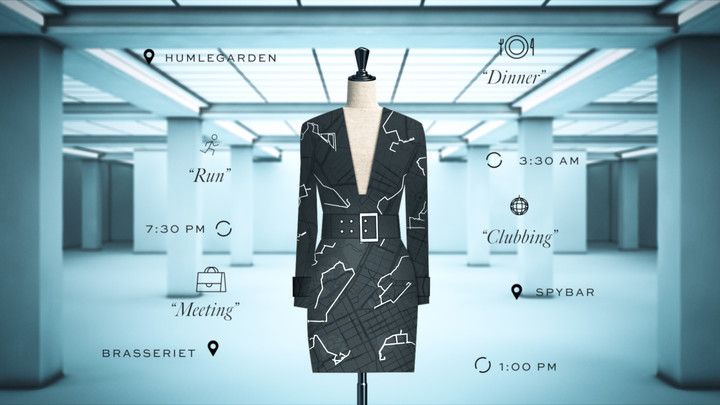
On Monday at Fashion Week in New York City, Google announced a partnership with online-only Swedish fashion house Ivyrevel to “bring couture into the digital age.” The first fruit of the collaboration is the Data Dress, a custom gown with a design reflecting the would-be wearer’s habits and history.
The Data Dress’s embroidery will reflect your daily activity. Over the course of the week, you’ll be able to watch the design unfold as the app gets to know you better.
More: Google’s high-tech Googles used to shoot New York Fashion week documentary
It is core to Ivyrevel’s ambition to “merge fashion creativity with technological innovation,” co-founder Aleksandar Subosic said. The digital retailer’s skunkworks Fashion Tech Lab, which counts PayPal and H&M Group among its backers, uses trend analysis to develop algorithms that “enhance the direction” of the clothing’s design.
“It’s such an exciting moment,” Subosic said. “The only option today is to buy custom clothing or design it yourself, but many can’t afford to or lack design skills.”
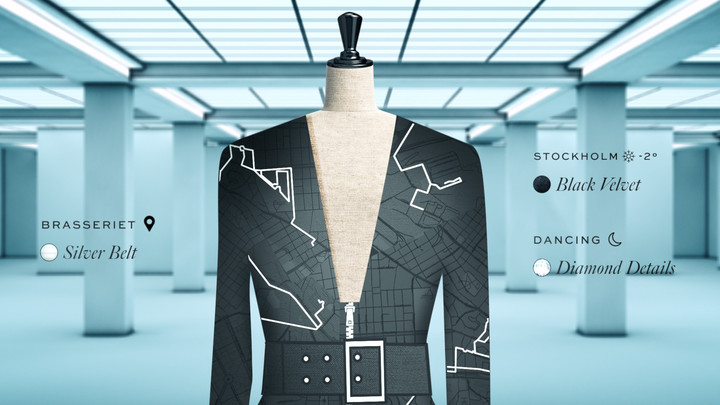
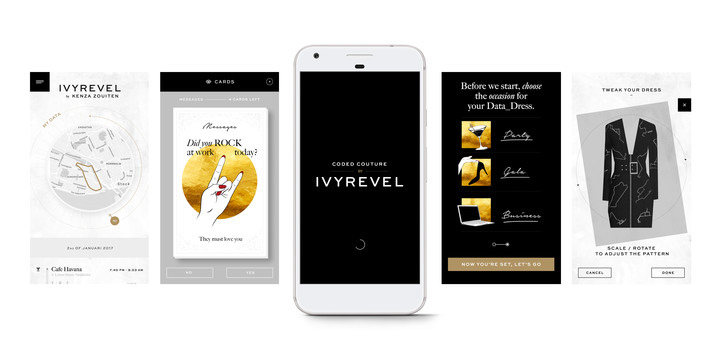
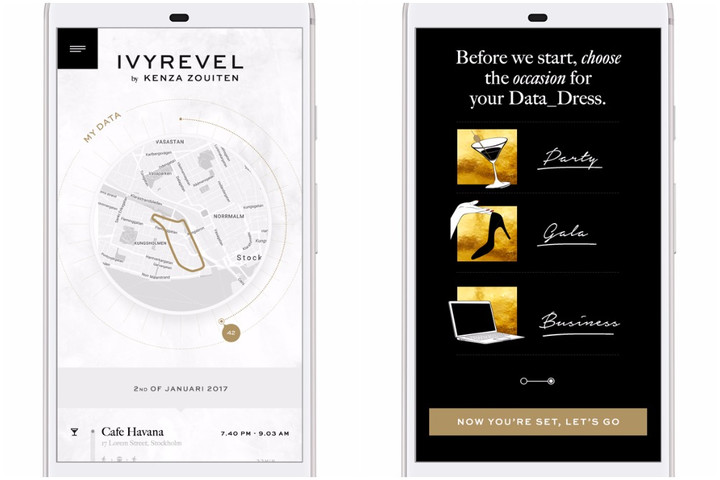
You’ll have to get Google’s Coded Couture app to get started. Once you’ve completed that step, you must grant it permission to monitor you daily activity. Finally, choose the occasion for your Data Dress — Party, Gala, or Business — and the app will take care of the rest, recording context signals like your location, physical activity, weather, and nearby locations over the course of a week. It’ll note where you eat out for dinner or hang out with friends, for example, and whether the meetups are casual or formal.
More: Why smart clothes, not watches, are the future of wearables
A dashboard presents those data points in an easy-to-read timeline. You’ll see the locations you’ve visited over the past seven days and a top-down map of your movements.
At the heart of the Coded Couture app is Google’s Awareness API, a platform that lets developers program reactions on contexts. Trulia, an online real estate app, uses it to suggest open house listings when the weather is pleasant. SuperPlayer Music suggests playlists to match your mood.
But Coded Couture is the first to tap that data for a tangible product. And it’s on trend: A survey of 1,000 shoppers by Bain & Company found that 25-30 percent were interested in designing their own clothing, and that one-of-a-kind products lower return rates, fetch higher prices, and create a “deeper connection” between shoppers and retailers. “While it’s hard to gauge customization, if 25 percent of online sales of footwear were customized, that would equate to a market of $2 billion per year,” Bain partners Elizabeth Spaulding and Christoper Perry wrote in their report.
More: This sports bra is not only comfortable, it can track your fitness data
Ivyrevel hasn’t announced the price of the Data Dress, and the Coded Couture app won’t be made broadly available until fall. It’s launching in “closed alpha stage,” Google said, and is currently being tested by “a selected group of global style influencers” who will post stories over the next few months as their Data Dresses are created. You can sign up for a future trial, if you’re interested.
The Data Dress isn’t Google’s first foray into fashion. In September 2016, it launched Shop the Look, a search tool that surfaces photos of fashion bloggers, brands, and retailers and their corresponding clothing and accessories. Additionally, the company’s Project Jaquard, a pioneering method of interweaving touch panels with conventional fabrics, produces textiles that can respond to taps and swipes like a smartphone touchscreen.
Levi’s Commuter jacket will be the first to feature the technology technology. A touch-sensitive tag will and pair with a phone to perform functions like pinning a location to Google Maps, answering calls, and more. It’s expected to hit retail in the Spring of 2017.
More: Dress smart: An entire connected outfit, from smart shoes to a breath-tracking top
“We’re about to change the fashion industry by bringing the wearer’s personality into the design process through data technology,” Subosic said. “The Data Dress enables women around the world to order a dress made completely for them, that reflects the way they live their lives.”
Following Galaxy Note 7 disaster, S. Korea seeks to ensure history doesn’t repeat
Why it matters to you
Lithium-ion batteries have proven to be potentially dangerous, but the South Korean government is taking steps to ensure their safety going forward.
South Korea has no interest in allowing history to repeat itself. On Monday, the nation announced that it would bolster lithium-ion battery safety requirements and carry out regular inspections in order to avoid a repeat of the Galaxy Note 7 debacle, in which mobile handsets would spontaneously combust as a result of faulty batteries.
According to a statement from the Ministry of Trade, Industry, and Energy, lithium-ion battery manufacturers would be “subjected to greater oversight and regular inspections.” And given that these batteries are often found in portable, mobile devices (like smartphones and tablets), these pieces of technology would also have to undergo more consistent safety tests, the Ministry noted.
More: Samsung Galaxy Tab S3 news and rumors
“We ask that the industry shares the view that making efforts to ensure safety is equally as critical as developing new products through technological innovation,” Vice Minister Jeong Marn-ki said in the statement.
Samsung recently determined that battery issues from two distinct suppliers — Samsung SDI Co. Ltd. and Amperex Technology Ltd. — were the cause of the Galaxy Note 7 fires. Ultimately, the South Korean phone maker was forced to recall all shipments of the phone, resulting in a loss of around $5.4 billion in operating profit over the course of three quarters.
To ensure that Samsung learns from its mistakes, the South Korean government has also noted that it will keep a close watch on the company’s attempts to improve battery safety. Included in this strategy are tactics like x-ray testing and more robust standards in the design process.
Moreover, the government says it plans on expanding the sorts of “serious product defects” that companies ought to report to regulators, and will also implement legal changes to allow officials to warn customers not to use potentially dangerous devices, even if they haven’t been recalled.
So here’s hoping that the great Galaxy Note 7 disaster of 2016 is solidly in the past.
Sales of Apple’s iPhone declined in China despite overall worldwide growth
Why it matters to you
Apple’s next iPhone will have to ‘wow’ Chinese consumers if it wants to turn things around in the country.
Apple may have just come off a record quarter — the Cupertino, California-based company managed to sell a record 78 million iPhones in the first fiscal quarter of 2017 — but it’s struggling to maintain its market position in China. According to market researchers at IDC, annual Apple iPhone shipments fell for the first time in the country, dropping 23 percent in 2016 compared to the same period a year ago.
Strong local competition is to blame. Chinese smartphone makers Oppo, Huawei, and Vivo nabbed the top three slots in the country, and Vivo accounted for 48 percent of shipments in the country during 2016.
Conversely, Apple iPhone sales dipped 23.2 percent, shrinking Apple’s overall market share in the country to 9.6 percent — the lowest in two years. And analysts at Gartner report that the iPhone saw a year-on-year dip in market share from 13 percent to 11.5 percent in the third quarter, its lowest since 2009.
More: Chinese smartphone makers, not Apple, benefited from Samsung’s Note 7 disaster
“Even though the new black-colored iPhones caught the attention of consumers, overall, the new launches did not create as much of a frenzy compared to the past,” IDC said in its report.
It’s not for lack of a market. Oppo alone boosted annual number shipments from more than 35 million units in 2015 to 78.4 million last year, IDC said, and Vivo doubled sales. In the third quarter, sales from China made up 81 percent of Oppo’s profits. And Chinese smartphone makers dominated China’s list of vendors — Huawei ended the quarter with 9.3 percent market share, Oppo with 7 percent, and Vivo with 5.8 percent.
More: The iPhone 7 is about to hit a serious decline in demand, according to analyst
IDC credits “vast store networks,” “improve customer service,” and a “push to open their own retail stores” as key contributors to local brands’ growth. “We expect [Chinese] vendors to increase their shipments in the international market, with India as a key target for these top Chinese vendors,” IDC said.
It’s not all doom and gloom for Apple, though. According to IDC, the upcoming iPhone 7S/8 should mark an uptick in sales as Chinese consumers flock to what’s expected to be one of the biggest product launches in the company’s history.
“Apple’s 10-year anniversary iPhone will also likely attract some of the high-end Android users in China to convert to an iPhone, IDC said.
More: The iPhone 7 is about to hit a serious decline in demand, according to analyst
Apple’s not the only smartphone vendor that struggled to make inroads this year. Samsung’s Galaxy Note 7 debacle saw the Seoul, South Korea-based company’s market share fall from 23.6 percent to 19.2 percent, the biggest slide in the company’s history.
 AIVAnet