


The top 3 things Xiaomi can do to win 2017

Xiaomi needs to embrace the offline market in 2017.
When Xiaomi burst onto the scene in 2012, it did so with little fanfare and zero reliance on advertising. The company was the first to understand the potential of online-only sales, and in the following four years, it would grow to dominate this field.
However, Xiaomi’s competition has similarly latched onto online sales, and while the company still controls a majority of the mindshare in China and India — its two largest markets — it has seen its market share and sales numbers erode in 2016.
According to the latest IDC figures, Xiaomi managed to sell just 41.5 million smartphones in 2016 in China, a 36% decrease from the 64.9 million it sold in 2015. As a result, the company’s market share in China went down from 15.1% in 2015 to 8.9% at the end of 2016.
Here’s what the company needs to address this year to turn the tide.
Go offline

Most of Xiaomi’s fallacies in 2016 had nothing to do with the products it launched, but with the way it distributed them. While the company continued to excel at online sales, manufacturers like OPPO and Vivo focused their attention on the far more lucrative offline segment, resulting in both brands effectively doubling their sales from 2015 to 2016.
Xiaomi CEO Lei Jun admitted as much in a letter to employees at the end of last year, stating that the company needs to “upgrade” its retail strategy.
Jun outlined a vision wherein Xiaomi would launch over 1,000 retail stores in China over the course of the next three years, with the first 200 stores set to open this year. Although Xiaomi has a few stores in select locations in the country — particularly in urban centers — the brand needs to turn its attention to tier 2 and tier 3 cities, areas that are dominated by OPPO and Vivo.
Xiaomi needs to convert mindshare into market share.
Xiaomi won’t be able to set up an offline distribution network right away, and doing so doesn’t line up with the way the company functions. But by focusing on a few strategic locations and establishing a retail presence there would go a long way in securing new customers.
It needs to undertake the same strategy in India as well. While e-commerce is on the rise in the subcontinent, a majority of sales are conducted through offline stores. There’s no dearth of mindshare when it comes to the handset segment in India for Xiaomi, and by reaching out to consumers through offline stores, it will be able to translate that into market share.
Better after-sales service

The biggest issue that Xiaomi faces in India is after-sales service, or lack thereof. The company’s social media pages and forums are littered with complaints of unreliable customer service.
After-sales support is often a deciding factor for most buyers when picking up a phone in India, and for good reason. The recent influx of Chinese manufacturers and the e-commerce boom has made it easier to buy phones, but a severe lack of after-sales infrastructure and inadequate availability of spare parts has led to consumers being wary of new-age brands.
That’s one of the main reasons why Samsung is able to sell millions of Galaxy J devices in India despite the fact that most of the South Korean manufacturer’s entry-level handsets are utter garbage. There’s a lot of consumer trust in Samsung, and with the Note 7 never making its way to India, that trust is still intact.
Xiaomi, for its part, announced last month that it was partnering with customer care provider B2X to expand its service network in India. Xiaomi customers will be able to walk into 31 service centers across India for any assistance with either their phones or Mi-branded accessories.
Launch Mi Ecosystem everywhere

With sales in the smartphone segment plateauing, Xiaomi is looking to its Mi Ecosystem platform to be the growth driver in the future. With the ecosystem model, Xiaomi collaborates with hardware startups, providing them with financing and getting them in touch with its supply chain partners, and in return putting up the finished product for sale on its own portal.
For instance, the $15 Mi Band and its successor, the Mi Band 2, were made by Huami, and marketed by Xiaomi. Similarly, the $250 Mi Robot vacuum cleaner is made by Rockrobo and then sold on Xiaomi’s website in China.
We need more Mi Ecosystem products in other countries.
The ecosystem model offers Xiaomi new avenues of growth without having to dedicate its in-house resources on building new categories. The main issue with the ecosystem products is their availability. Over the course of 2016, Xiaomi introduced a smart rice cooker, the aforementioned robot vacuum, LED lighting for your home, and so much more. During the launch of the rice cooker, Xiaomi mentioned that in the 28 brands it has partnered with for the ecosystem model, two have crossed $1 billion in sales, with seven crossing $100 million.
While that’s a considerable figure, Xiaomi needs to bring its Mi Ecosystem products to other markets. Instead of launching all of its products at once, Xiaomi said that it would evaluate the feasibility on a per-product basis, ultimately making the decision based on whether that particular product would sell well in the country.
Xiaomi is already off to a great start in 2017 thanks to the Redmi Note 4, but for the brand to build momentum and attract new customers, it needs to target where the majority of the buyers are. And that means offline stores and the introduction of new product categories.
Huawei is launching its P10 flagship smartphone at MWC
Huawei has confirmed that it’s debuting its upcoming flagship handset at Mobile World Congress in Barcelona through a mysterious video teaser. Unfortunately, it doesn’t even show you a glimpse of the phone. What you do get are the words “Change the way the world sees you,” along with a photo of a hashtag and two eyes. That could be a hint that the P10 will have dual cameras, just like the iPhone 7 and its own predecessor, the Huawei P9.
You’ll find a lot of rumors about the P10 if you look around. It will reportedly have two variants: the P10 and the P10 Plus. Both will sport 5.5-inch qHD screen, except the Plus version will have curved sides like the Galaxy Edge. It will apparently be equipped with a better chipset, as well, along with 4 to 6GB of RAM and 32 to 128GB of storage. We’ll find out if any of those are true when the company reveals the device on February 26th.
Via: The Verge
Source: Huawei Mobile (YouTube)
Henrietta Lacks will be immortalized in an HBO special
Her name may not be widely known outside of medical research circles, but Henrietta Lacks — and the tumorous cell samples she left behind when she died of cervical cancer in 1951 — have been crucial to numerous experiments and medical breakthroughs. Although we have Henrietta’s HeLa line cells to thank for everything from Jonas Salk’s polio vaccine to hypoallergenic cosmetics, she’s about to be immortalized again in an HBO original biopic.
The Immortal Life of Henrietta Lacks is based on Rebecca Skloot’s nonfiction bestseller of the same name and stars Oprah Winfrey as Henrietta’s daughter Deborah and Rose Byrne as Skloot herself. According to HBO’s press materials, the film tells Henrietta’s story from Deborah’s perspective as she and Skloot “learn about the mother she never knew and understand how the unauthorized harvesting of Lacks’ cancerous cells in 1951 led to unprecedented medical breakthroughs, changing countless lives and the face of medicine forever.” Beyond just medicine, Henrietta’s story is one of an African American woman who unknowingly saved countless lives after her death and changed how we discuss the consent and privacy issues involved in using someone’s genetic material without their knowledge.
The Immortal Life of Henrietta Lacks will debut on HBO Saturday, April 22nd at 8 pm ET/PT.
Signal Privacy Messenger Users Advised to Turn Off CallKit Support in Latest Update
Encrypted communications app Signal received an update yesterday that enabled video calling for the first time, but the latest version also brings CallKit support to the platform, which may leave some privacy-conscious users wary.
Introduced in iOS 10, the CallKit SDK allows incoming calls from third-party VoIP apps to appear on the iOS lock screen and recent calls list, just like standard cellular IDs do. The concern among the privacy community is that their call data – including who they called and how long they spoke for – could be synced to iCloud.
In a blog post announcing the new beta features, Signal developers Open Whisper Systems noted that like video calling, CallKit integration is optional, and those concerned about data leakage can turn the support off in settings (Settings -> Advanced -> Use CallKit). The developers also told Wired that in the future, CallKit might only display “Signal users” in an iPhone’s call log, to prevent the disclosure of identifying information.
Back in August, Russian security firm Elcomsoft discovered that iPhones automatically send a user’s call history to the company’s servers if iCloud is enabled, but the data gets uploaded in many instances without any user notification. The fear among privacy-minded users is that state actors could theoretically gain access to this information through cooperation with Apple, or that hackers could crack iCloud passwords and break into accounts.
More recently Elcomsoft revealed that when iPhone and iPad users permanently deleted their Safari browser history off their devices, iCloud had been storing that history for several months to over a year, before Apple reportedly fixed the issue. Concerned users are advised to turn off iCloud backups to keep their browsing history private, and be sure to check out the MacRumors Safari privacy guide for more useful information regarding browser settings on iOS devices.
Signal Private Messenger is a free download [Direct Link] for iPhone and iPad available on the App Store.
Tags: privacy, Signal
Discuss this article in our forums
Elgato Eve 2.6 Update Enhances Lighting Control and HomeKit-Enabled Hardware Support
Elgato has updated its HomeKit-compatible Eve app with improved third-party accessory support and new features, including new lighting controls.
The Eve family of HomeKit accessories gathers data on air quality, temperature, humidity, air pressure, energy consumption and more, while the Eve app is where data from each Eve product is aggregated and where accessories can be grouped and organized by room for different Siri commands.
One big change to version 2.6 of the Eve app is the introduction of a new lighting control interface that allows users to set lamp and light strip colors more easily, and makes stored favorites for particular moods or occasions more accessible. Once stored, existing favorites can also now be applied to additional HomeKit-enabled lights.
In addition, the update brings support support for HomeKit-enabled cameras, including the ability to preview a snapshot in the Eve app’s “At a Glance” view, and the ability to access live video with optional intercom audio.
Elsewhere, support has been enhanced for Eve Thermo, with new support for third-party HomeKit-enabled accessories such as the Schlage Sense and Nanoleaf Aurora also included. The update also brings some general improvements to the app and a handful of HomeKit-related bug fixes, which have hampered the system in the past.
Elgato Eve is a free update for iPhone and iPad available on the App Store. [Direct Link]
Tags: HomeKit, Elgato
Discuss this article in our forums
Canon Connect Station media hub now supports mobile backups, non-Canon cameras
If there’s one thing casual photographers are guilty of, it’s leaving their images on a memory card. Sure, memory card capacities are so large that you may never have to offload them, but they end up becoming digital graveyards for your photos and videos. Canon has created a new device, called the Connect Station, that’s designed to put all that content on the big screen, and share it. The company debuted the new product category at the 2015 International CES Show.
First previewed at Photokina in 2014 (codenamed Cross Media Station), the Connect Station CS100 ($300) is essentially a network-attached storage (NAS) device, a 1TB portable hard drive connected to a home network that lets you archive, display, and share images and videos taken with a digital camera and camcorder.
Updated on February 14, 2017: Canon issued a firmware update that adds support for non-Canon cameras, improves smartphone compatibility, and allows for playback of videos that have been edited on a computer, making the device a bit more flexible.
Updated on July 14, 2016: Canon released a new mobile app for the CS100 that would allow users to view and back-up images from their phones or tablets. This article, originally published on January 5, 2015, has been updated to reflect the changes.

The idea for such a product isn’t new, as there are other similar media storage and sharing drives available (in fact, Canon had a prototype of it five years ago, although that early version used different technologies). But the CS100, with near-field communication (NFC) and Wi-Fi built in, was designed to help Canon camera and camcorder owners get content off their media cards and give them a viewing experience they can enjoy.
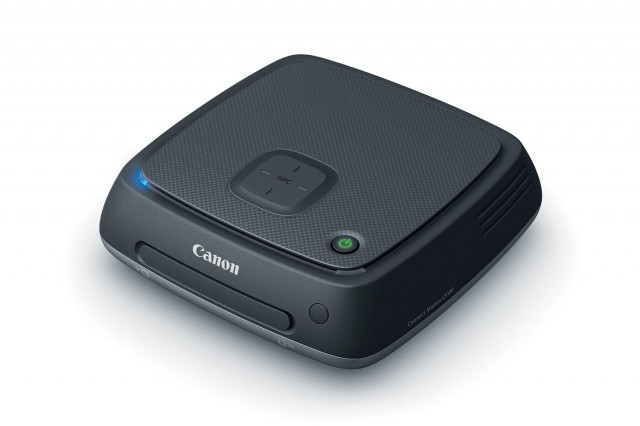
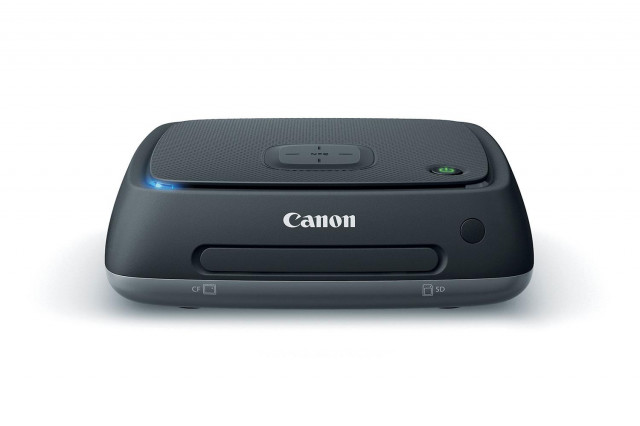
The CS100 is a standalone product that doesn’t require a computer to function, although it does need to be connected to a TV in order to view content and menus; it supports Full HD displays via HDMI. To add content, you can transfer photos and videos wirelessly from Wi-Fi-enabled Canon cameras and camcorders (NFC helps to facilitate the pairing and download processes quickly); directly off an SD or Compact Flash card through the built-in card reader; or from a compatible camera or flash drive through the USB port. Although it uses the 802.11n Wi-Fi protocol, it’s much faster to insert a memory card. The CS100 also has a mobile app (iOS and Android) that supports viewing and transferring of photos on smartphones and tablets.
The CS100’s onscreen display has an Apple TV-like menu system that you navigate through with the included remote control. As it is storing content, the CS100 automatically organizes photos and videos, and weeds out duplicates. What’s unique about the CS100 is it supports unprocessed RAW images from Canon’s advanced compacts and DSLRs, in addition to JPEG, MP4, MOV, and AVCHD file formats.
If the CS100 is connected to the Internet (Wi-Fi only), you can upload and download content to and from the device from smartphones, tablets, or computers (via a Web browser). You can also share content with other authorized CS100s via Canon’s Image Gateway online service. Image Gateway also lets you share content from a CS100 to social networking sites Facebook, Twitter, YouTube, Flickr, and Dropbox, as well as through email. Wi-Fi can also be used to connect to certain Canon Pixma and Selphy printers to print images.
With the Connect Station app, you can browse on TV the images stored on the phone, as well as upload and download images to/from the Connect Station with the drag-and-drop method (the phone or tablet must be connected to the same Wi-Fi network as the Connect Station). Canon says the Connect Station can save more than 1,000 images at one time, and it will remember what you’ve already downloaded. However, the Connect Station does not support video file transfers, nor Canon RAW (CR2) files.
The 1TB might seem like a lot, but content like images and videos – especially RAW ones – can take up space in no time. The hard drive, however, isn’t expandable, nor will there be higher capacity versions at launch. However, you can back up the content to another hard drive via USB, to make room.
The CS100 aims to please those looking for an easy solution to save and share content from their Canon cameras, like grandparents. But, at $300, it’s priced a bit high. And unlike media-centric devices like Apple TV, features are limited and there are no additional functionalities like Netflix streaming.
Buy on Amazon Buy on Walmart
Snapchat users are ignoring media outlets and ads on the app, reveals survey
Why it matters to you
Despite Snapchat’s efforts to add more news publishers and ads to its platform, these are exactly the types of content its users are not interested in seeing, according to a new survey
Snapchat publishers are having a hard time finding an audience for their content, according to a new survey from customer acquisition firm Fluent.
Despite the fact that Snapchat is home to traditional media outlets such as CNN, The Wall Street Journal, and The New York Times, its users are not seeking out news on the app. Overall, 61 percent of the 3,327 American adults surveyed by Fluent said they did not follow a news organization on Snapchat.
More: Musical.ly launches another video-centric app in the form of Ping Pong
There wasn’t much love for sports publishers either, with 50 percent of respondents claiming they don’t follow the likes of ESPN, NBA, or NFL on the app. An even larger portion (57 percent) said they shun entertainment brands such as The Daily Mail and E! The stats do not reflect Snapchat’s Discover section devoted to its media partners.
Just as worrying for the company is the revelation that people are skipping adds on its app. The survey claims that 69 percent of its respondents said they “always” or “often” skip adds on Snapchat. That number spikes to 80 percent for the app’s biggest demographic: 18-24 year olds. Despite touting that age group as a “big advertising opportunity” for marketers in its IPO filing, it seems younger users are not interested in watching promotional content on the platform. Snapchat earns the majority of its revenue (which totalled $404.5 million in 2016) from ads, including full-screen Snap ads and sponsored lenses and filters.
Fluent CMO Jordan Cohen told Digiday the following about user behavior on the app: “I asked lots of millennials this question. It’s really about exclusive short, fun content. In addition to communicating with friends, they follow celebrities. They don’t really engage with ads or mainstream news outlets.”
The statistics do not bode well for the company, which is busy trying to diversify its user base and increase ads on its platform before it goes public in March.
Jaguar and Shell partner for in-car fuel payments
Luxury automaker Jaguar Land Rover has partnered with Shell to make fueling up a touch more convenient. That’s because everyone who owns a vehicle equipped with the company’s InControl Apps will be able to pay for gas without ever leaving the driver’s seat. All you need is the Shell mobile app, either a PayPal or Apple Pay account and at least $40,000 for one of the supported cars and you too can take advantage of the new feature.
As the video below shows, it looks like all you need to do is connect your iPhone (Android support arrives sometimes later this year) to your Jag’s infotainment system via USB. From there, everything is handled via the car’s touchscreen. How this differs from other mobile payment tech, Jaguar says, is that this one uses geolocation in concert with PayPal or Apple Pay for transactions.
The functionality launches February 15th in the UK and additional availability will roll out over the course of this year. Jaguar says that additional applications of the tech could include drive-through restaurants and parking services. Which, to be honest, sound far more convenient than paying for gas. I mean, you still have to get out of your car for the former. The latter? It should eliminate the awkwardness of digging your wallet from a back pocket while you’re seated.
Source: Jaguar
‘Apocalypse Now’ game studio tries raising $5.9 million on its own
The plan to translate cult war horror film Apocalypse Now into a video game seemed ambitious in scope and public support when it launched a Kickstarter late in January with a $900,000 goal. But after raising only $172,000 with just 9 days left, the team decided to pivot its crowdfunding efforts. The new plan: open a fresh website dedicated to a 460-day long haul fundraising campaign with a much larger $5,900,000 aim. Assuming all goes well, the team will still release the game in 2020.
The funding switch hasn’t changed the title’s plan: A first-person survival horror trudge through the jungles of Vietnam, rooting the player in the boots of Captain Willard (Martin Sheen in the original film) on his mission to assassinate the rogue Colonel Kurtz (Marlon Brando). The new, standalone site aims to become a hub for community engagement during the game’s long development. According to the team’s post on the game’s Kickstarter, backers and fans can visit the site to “see real-time updates on the game through posts, livestreams and group community events” and enjoy direct communication with the team.
The reward options on the dedicated crowdfunding site are mostly the same as those on the game’s Kickstarter, though they also give access to an eventual beta version of the game. Legacy backers who opt to give again to the new campaign will automatically get bumped up a tier.
It should be noted that the Kickstarter campaign was never intended to fund the whole game — just raise about one-fifth of the production’s funding total before a second-longer term effort launched, according to The Verge. It’s unclear whether the Kickstarter campaign will stay up for a moonshot hope at funding the last $720,000 or be shut down before it ends in 9 days.
Backers will receive their rewards shortly after the larger funding goal has been met, according to an update on the Kickstarter campaign’s page, but that’s the extent of information on the crowdfunding transition. We’ve reached out to Apocalypse Now’s team and will update when we learn more.
Via: The Verge
Source: ‘Apocalypse Now’ game (Kickstarter)
Apple Considering Adding China’s BOE as OLED Supplier for 2018 iPhone
Apple is in discussions with China’s BOE Technology Group to supply OLED screens for the 2018 iPhone, reports Bloomberg. The Cupertino company is looking for ways to shore up its OLED supplies as the iPhone transitions from LCD to OLED displays.
Apple has been testing BOE’s OLED displays for months, according to Bloomberg, but it isn’t yet sure whether to add the company as a supplier. BOE is one of China’s largest display makers, recently spending about $14.5 billion on two AMOLED factories. Talks are too early to allow BOE to contribute displays for Apple’s 2017 OLED-based iPhone, known as the iPhone 8, but BOE is hoping to contribute to the 2018 iPhone supply.
If Apple and BOE agree to a deal, the Chinese manufacturer will become Apple’s first OLED supplier outside of South Korea and Japan. In November, it was reported that Apple’s OLED suppliers, which include Samsung, LG, Sharp and Japan Display, would not be able to meet demand for the 2017 iPhone. The worldwide shortage of OLED displays is thought to be one of the reasons why Apple is limiting the feature to the high-end device, while the regular iPhone 7s and 7s Plus are said to feature LCD displays.
One of BOE’s new factories will open this summer while another will open a couple years later. When they’re up to full capacity, BOE says they’ll be able to produce 1.6 million square-meters of flexible glass substrates (surfaces that displays are carved out of) a month.
Samsung will exclusively produce OLED displays for iPhones in 2017, with Apple opening up to LG, Sharp and Japan Display in 2018.
Related Roundup: iPhone 8 (2017)
Tags: bloomberg.com, OLED, BOE, 2018 iPhone
Discuss this article in our forums
 AIVAnet