


Amazon Echo and Google Home want to be your new house phone
Right now, you can order a pizza, manage your to-do list and call an Uber on Amazon Echo and Google Home. The latest development from the smart speakers would give us yet another reason to leave our phones in our pocket. The Wall Street Journal reports that Amazon and Google are considering adding telephone functionality to their devices, but it won’t be easy.
Citing “people familiar with the matter,” the Journal says Amazon and Google could introduce the ability to make and receive calls on their respective platforms later this year. The companies could make use of their existing communication platforms, since Amazon already has the business-focused videoconferencing tool Chime. Meanwhile, Google has Hangouts, Duo, and it recently recommitted to maintaining Google Voice. Incorporating existing VoIP services like Skype and Vonage into their devices may be another way to go. Echo and Home could also have their own phone numbers, or the option to sync an existing number and contacts list.
One of the most significant roadblocks Amazon and Google face in turning their devices into home phones is privacy concerns. As the Journal notes, the Echo and Home’s always-on microphones continuously record audio, locally saving a few seconds at a time, to monitor for activation commands like “Alexa” and “Hey Google.” Law enforcement in Arkansas has already requested access to this data to help with a murder investigation, which raises serious privacy questions about connected home devices. Amazon’s phone feature would only record call metadata, like phone numbers and call durations, while the Journal’s sources aren’t sure what data Google would keep.
The use of voice commands raises other problems. For instance, users might accidentally end a phone call by saying the hang up command in conversation. It could also be hard to move a call from the speakers to your phone, since the Echo and Home don’t have many physical inputs. The inability to make emergency calls is also a potential issue, since most VoIP services don’t allow users to make 911 calls.
The Wall Street Journal’s sources call phone capabilities “the logical next step for the artificial intelligence-powered speakers,” and they may be right. Still, it looks like there are substantial questions to address before Amazon and Google can set a firm release date on this new feature. Like other connected home technologies, there are real issues here that could scare off potential users interested in protecting their privacy.
Source: The Wall Street Journal
Siri’s latest Easter egg lets you become ‘Lego Batman’
Apple’s personal assistant Siri is known for its Easter eggs and its oddball answers to questions like, “What is the meaning of life?” Now, its latest trick will help you get in touch with your inner Dark Knight.
The Lego Batman Movie, released last Friday, features the voice of Siri as the Batcave’s computer. So, naturally, Apple has teamed up with Warner Bros. to cross-promote the animated film. If you say, “Hey, computer!” or “Hey, ‘puter!” into Siri, she responds to you as if you’re the tiny, plastic Caped Crusader.
Once Siri is activated, greet her with the key phrase and she’ll answer with a number of cute Batman-flavored replies. Our faves include:
“Hello, sir. I’ve heated up your lobster thermidor in the microwave. I’m one step ahead of you, Alfred.”
“Hello, sir. Alfred is on the 17th floor, caulking the tiles in the second bathroom of the fifth master bedroom.”
“Welcome home, sir. I have your rom coms queued up, sorted by decade.”
This isn’t the first time Apple has used its virtual assistant to promote a film. When The Secret Life of Pets debuted last July, Siri offered canned responses to the question, “What do my pets do when I’m not at home?” Apparently, they ask for directions, send your messages, call you an Uber and calculate tips. But do they ever get a pat on the head? No.
Source: Mac Rumors
Amazon simplifies self-published paperback printing
Amazon has a program in place allowing people to self-publish both printed and electronic books, but until now the workflow has been clunky as authors were forced to use a different tool for each format. The company is now streamlining the experience through a new beta initiative within its Kindle Direct Publishing (KDP) program, which used to be only for e-book publishing.
Previously, authors looking to publish a printed book with Amazon had to use its CreateSpace system. They would then need to format their e-book manuscripts through KDP, making for a complex workflow. Though the feature set of the older system is much more robust, including physical proofs and author copies, the new beta KDP process will eventually offer similar tools as well. As it is, the move to a single point of entry will likely help streamline the process of publishing books in both print and digital formats.
Hopefully, then, this new initiative will help authors (and presumably Amazon) reach customers who prefer books on paper. Authors won’t need to spend any extra money up front for print runs, as KDP will take printing fees from resulting sales. Self-publishers will receive a 60 percent royalty on all paperbacks sold, which is 10 percent lower than the highest e-book rate. They will never need to worry about running out of copies either, as the books will be printed on demand.
While publishers and distributors struggle over the pricing of e-books, the more traditional format shows a remarkable resilience to the onslaught of electronic versions. This represents a market for self-published creators that has been difficult to break into. Reaching those who prefer print books in the US, Europe and Japan with this new KDP system could be a significant boost to an author’s bottom line.
Source: Amazon
BlackBerry Hits ‘0%’ Market Share Nearly Ten Years After iPhone Launched
Nearly ten years after Apple launched the iPhone, which completely upended the smartphone industry, the device has effectively helped to wipe out one of its major predecessors: the BlackBerry.
BlackBerry has at last fallen to a rounded 0.0% share among smartphone operating systems after shipping just 207,000 smartphones last quarter, following an over seven year decline from its peak market share of approximately 20% in 2009, according to the latest quarterly data from research firm Gartner.
The demise of the smartphone that was once the poster child of Canadian innovation has been a long one in the making, but one that was inevitable now that BlackBerry has shifted its focus to software and sold the global rights to future BlackBerry-branded smartphones to Chinese company TCL Communication.
BlackBerry actually continued to grow for around two years after the iPhone launched in June 2007, taking market share away from then-leader Nokia. BlackBerry’s market share among all smartphone operating systems was 9.6% in 2007, 16.6% in 2008, and 19.9% in 2009, according to Gartner. Then, the decline started.
By 2011, the surging popularity of iPhones and Samsung Galaxy smartphones led iOS and Android to leapfrog BlackBerry and Nokia to form a duopoly in the smartphone market that exists to this day. iOS and Android combined for a record 99.6% market share last quarter, according to Gartner.
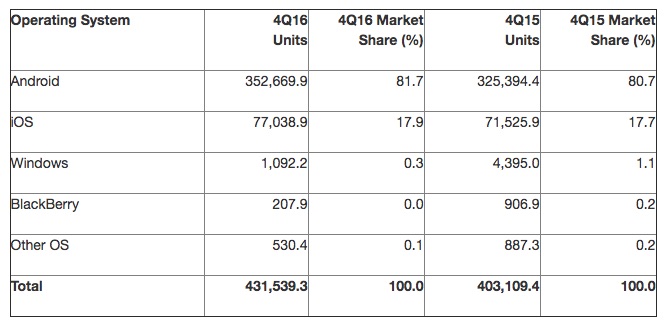 Worldwide Smartphone Sales to End Users by Operating System in 4Q16 (Gartner)
Windows 10 Mobile was the only other platform to make any sort of dent last quarter, recording an insignificant 0.3% market share, according to Gartner. Windows 10 Mobile fell from 1.1% in the year-ago quarter. A group of unnamed “other” operating systems captured the remaining 0.1% share.
iOS adoption is still low compared to Android, with the platforms capturing 17.9% and 81.7% worldwide market share respectively in the fourth quarter. iPhones mainly target the premium smartphone market, however, while there are Android-based smartphones at all price points sold by dozens of brands.
What’s next for BlackBerry? In addition to focusing on software, the company is also doing self-driving vehicle research, while its rumored “Mercury” smartphone by TCL will be unveiled on February 25 at Mobile World Congress.
Tags: Gartner, BlackBerry
Discuss this article in our forums
Amazon and Google Want to Turn Their Smart Home Speakers Into Telephone Replacements
Both Amazon and Google are working on turning their popular AI-based speaker products into replacements for a home telephone, reports The Wall Street Journal.
The Amazon Echo and/or the Google Home could be used to make and receive phone calls, with the two companies planning to add the updated functionality as soon as this year. Smart home products like the Amazon Echo have become a staple in the lives of many people and the ability to make phone calls directly from the device would be a valuable addition.
Google and Amazon are said to be working to overcome concerns about privacy, telecom regulations, and emergency services, plus the “inherent awkwardness” of making phone conversations via a speaker. The two companies are worried consumers won’t want to speak on a device that is able to record conversations. Both the Echo and the Home continuously record audio to enable AI responses.
One source that spoke to The Wall Street Journal said that Amazon would only collect metadata from phone calls rather than conversations themselves, and while it’s unclear what Google would retain, a Home-based call service would likely resemble Google Voice, which does not record phone calls.
Amazon is considering multiple options for how the phone feature could work, the people said. The Echo could get its own phone number. Call forwarding could enable calls to that number to be answered remotely on a cellphone, and vice versa.
Another option is to sync a user’s existing phone number and contacts with the Echo. Incoming calls would ring on the user’s cellphone.
Amazon and Google could develop the calling tool themselves, or they could allow external providers such as Skype or Vonage onto their platforms.
The news is of interest to Apple followers because Apple is also rumored to be working on a connected smart home device that would compete with Amazon’s Echo and Google’s Home. It’s reasonable to assume that when and if Apple releases its rumored home hub, it would be on par with already existing products. If the Amazon Echo and Google Home are set to gain calling capabilities, we can perhaps expect the same thing from an Apple product.
Rumors thus far suggest Apple’s smart home device will be powered by Siri, Apple’s voice-based personal assistant that’s already built into iPhones and Macs. It would reportedly be used to control HomeKit-enabled accessories while also offering “advanced microphone and speaker technology.” The device, in addition to serving as a hub for smart products, would also be able to respond to typical Siri questions and do things like play music, answer queries, and more.
The device is said to be in the prototype testing phase of development, without an official finalized plan for release. Apple could still decide not to move forward with the project should the testing phase not pan out.
Tags: Google, Amazon, Amazon Echo, Google Home
Discuss this article in our forums
TwIM is a New App for Communicating via Twitter Direct Message
TwIM, released today, is a new app that turns Twitter’s Direct Messages function into a dedicated chat app, ignoring all other Twitter features for a clean, simple DM chat experience.
Because it is based on Twitter’s Direct Messages feature, TwIM can be used to chat with any Twitter user through a search function that can locate people via name or username.
Messages are turned into in-line content previews with support for tweets, photos, GIFs, emoji, maps, and websites, plus the app has its own built-in face emojis called TwiMoji.
iPhone features like 3D Touch are supported, and the app includes built-in Siri functionality for sending messages through Apple’s voice assistant. Push notifications for incoming messages are supported, as are rich notifications, and there’s a useful share extension for quickly sharing text, photos, URLs, maps, and more from other apps.
For people who often use Twitter’s DM feature to communicate with friends and family, TwIM is worth checking out.
TwIM can be downloaded from the App Store for free. [Direct Link]
Tag: Twitter
Discuss this article in our forums
Huawei Developing New Voice Assistant to Take On Siri
Huawei, currently the world’s third largest smartphone manufacturer, is planning on developing its own voice assistant to compete with Apple’s Siri, Amazon’s Alexa, and Alphabet’s Google Assistant, reports Bloomberg.
The company is said to have more than a hundred engineers that are in the early stages of developing the AI assistant. Sources that spoke to Bloomberg say Huawei plans to implement Chinese language support and target domestic users while Huawei smartphones continue to work with Google Assistant and Amazon Alexa outside of China.
Huawei has been stepping up its efforts to compete with Apple, Samsung, and other major smartphone players in recent months. After dethroning Xiaomi to become the world’s third largest smartphone maker, Huawei has now set its sights on Apple, and its own voice assistant could help set it apart.
According to Huawei consumer head Richard Yu, the company wants to become the number one smartphone manufacturer in the world by 2021. To do that, Huawei will need to break into the U.S. market, something that it hasn’t yet managed to do.
Huawei does not currently have carrier agreements with the four major carriers in the United States, making it difficult for customers to acquire Huawei smartphones, but Huawei executives are aiming to change that in the future.
To better compete with Apple, Huawei recently launched an ad campaign that uses Justin Long, well known for his role in Apple’s popular “Get a Mac” campaign. Long is currently promoting Huawei’s most recent device, the Mate 9.
Tag: Huawei
Discuss this article in our forums
Sit down and relax in our favorite office chairs
Anyone who works a typical 9-to-5 job knows that sitting is the bane of their existence. Our backs and overall body structure aren’t made to withstand hours sitting at a desk, but work often demands just that. Opting for the proper office chair, one designed to cradle you as you work and provide you with the ample comfort, is a practical and well-advised solution.
More: Don’t just sit there, check out the best standing desks you can buy
The best chairs go beyond what you’d expect. Many offer resounding ergonomic benefits, breathable mesh backing, and excellent lumbar support, while simultaneously granting you a swath of customization options spanning everything from colors to contours. None of them are going to be a cure-all for your workday woes — at least, not in the way a standing desk might be — but customized suspension and the appropriate aesthetics go far in the long haul.
The Best: Herman Miller Embody

So, what is it about the Embody we hold so revered? It’s a fair question, sure, especially considering the Embody’s lofty price tag and accompanying shipping costs. Well, for starters, the chair offers a dynamic matrix of “pixels” that allow the seat and back to automatically conform to your body’s every movement, while the chair’s central spine and flexible ribs work to maintain proper posture regardless if you lean forward or recline. Said movement capabilities help promote better blood and oxygen flow, and if that wasn’t enough, the advanced tilt mechanism helps combat unwanted hip, neck, and lumbar strain. The chair even sizes to fit your body perfectly, comes in a swath of colors, and features a skin-like covering for increased airflow.
Price: $1,160+
Buy one now from:
Amazon Office Designs
Common Google Pixel problems and the solutions to deal with them
So you’re having a few problems with your new Google Pixel? There’s no need to panic. All smartphones, especially new ones, have their fair share of issues, bugs, and glitches, from the unique to the familiar. Of course, if you’ve just spent a large sum of money to acquire Google’s phone, there’s no doubt you want it to be in perfect, working condition. We can help with that.
More: 20 Google Pixel and Pixel XL tips and tricks
Below, we’ve detailed multiple problems that Google Pixel owners have experienced, as well as as a few potential solutions and workarounds to deal with them. If you’re having a Pixel problem, this list will help you get your smartphone back in working order.
Problem: Pixel won’t charge or isn’t charging correctly
Some Pixel owners on Google’s product forums have reportedly been unable to charge their Pixel phones. In other cases, the phone does begin charging, but it’s not as responsive or quick as it should be.
Potential solutions:
- Try a different wall outlet, the one you’ve been using may be faulty.
- Try your charger with another device. If it doesn’t charge the other device, the charger may be faulty and you’ll need a replacement.
- Restart your Google Pixel.
- Clean the Pixel’s charging port.
- Connect your phone to power and wait about a minute:
- If you see a battery icon, your phone is currently off, but is charging. You can restart it.
- If there’s a red light, the battery is fully discharged. Charge your phone for at least 30 minutes before restarting it.
- Press and hold the Volume down and Power buttons for about 20 seconds. If you see the Android mascot and the word “Start” with an arrow around it, press and hold the Volume down button until you see “Power Off.” Use the Power button to select it, then charge your device for 30 mins. Restart your Pixel.
- If none of the above solves your issue, reach out to Google.
At long last, ‘Pokémon Go’ adds monsters from ‘Gold’ and ‘Silver’
Why it matters to you
Lapsed Pokémon trainers may now finally have a reason to go back to Pokémon Go
Tired of catching 37 Weedles whenever you go outside to play Pokémon Go? Thanks to the game’s next content update, fans will have an additional 80 monsters to catch from the Gold and Silver games, and it just might be what developer Niantic needs to draw former players back into its world.
“Starting later this week, you’ll have the opportunity to catch more than 80 Pokémon originals discovered in the Johto region in the Pokémon Gold and Pokémon Silver games,” said Niantic in the announcement.
This, coupled with the “baby” second-generation Pokémon added to the game late last year, mean that nearly every new monster introduced in Gold and Silver will soon be available in Pokémon Go. The update also adds “gender-specific variations” to give more diversity to the Pokémon we’ve already seen, and the Kanto-region monster that previously couldn’t evolve will now be able to do so thanks to additional items available at PokéStops.
More: Pokémon Go sprints to $1 billion milestone ahead of generation 2 update
The update also includes a few changes to the game’s interface — berries and Poké Balls will now be easier to select — and wild creatures will now “react in new ways as you’re trying to catch them.” If you’re getting bored with the look of your trainer, you can also trick them out with a selection of new cosmetic items.
But for all the new content this update includes, what’s just as important is what it doesn’t include. Though mentioned as a potential feature by Niantic back in September, trainers still can’t trade Pokémon with each other, unlike every “main” game in the series. Battles are also still limited to gyms, and fans have been pleading since the game’s launch for one-versus-one matches to be implemented.
Are the new Pokémon enough to get you back into Pokémon Go? Let us know in the comments!
 AIVAnet