


Google’s ride-sharing platform is expanding beyond the Bay Area
After successful tests of its casual carpool service in the Bay Area and Tel Aviv, Alphabet’s combination navigation app and ride-sharing platform Waze is ready to expand beyond its first two test markets. According to a new report from the Wall Street Journal, the Waze Rider companion app will launch new service in “several US cities” as well as Latin America over the next few months.
While Waze’s carpool service is likely to take a chunk of Uber’s business (which Alphabet is also invested in through it’s venture capital arm Google Ventures), the Waze approach to ride-sharing is a little more casual. As Waze CEO Noam Bardin told the Wall Street Journal, “can we get the average person on his way to work to pick someone up and drop them off once in a while? That’s the biggest challenge.”
Because riders are technically only reimbursing the driver for mileage, trips in the Bay Area are much cheaper than a comparable Lyft or Uber ride: $4.50 to get from Oakland to downtown San Francisco for Waze versus $10-12 minimum for the competition, according to the Journal. The downside is that Waze rides need to be booked further in advance and the service has a less consistent base of drivers. At the moment, riders only pay 54 cents per mile, all of which goes directly to the driver, but the company says it is planning to charge riders an extra 15 percent fee if the service catches on.
Although Waze has not yet announced which cities will be adding the service, any congested city with a large commuter population is a likely target. The service is already available in Tel Aviv, where Waze was originally based, but the Journal hints that further global expansion could come to São Paulo, Brazil and the service could eventually factor into Alphabet’s self-driving Waymo project as well.
Source: Wall Street Journal
New York City expands program linking students to tech jobs
If you ask New York City, the Tech Talent Pipeline is a shining star in its technology education efforts. The program helps students find internships and training that get them cushier tech jobs when they graduate, and it appears to be paying off — the average starting salary among participants has gone up 34 percent, and 96 percent of first-wave graduates landed jobs. Accordingly, the city is expanding the partnerships for the Pipeline to give more students a chance. The wider participation includes new schools, companies and charitable donations.
To begin with, the program is adding Lehman College in the Bronx. An alliance between Cornell Tech, CUNY and New York City companies will expand internship opportunities for women in computer science by 60 percent, while companies like the New York Times, Time Inc., Jet and Urban Outfitters are committing to either expanding or offering tech-oriented fellowships, internships and junior-level jobs. There’s also a total of $675,000 in renewed charitable commitments, $500,000 of it from JPMorgan Chase.
The expansion isn’t coming as a huge surprise. Mayor de Blasio is making a big push for more middle class jobs, and NYC’s burgeoning tech sector is a large part of it. Even a modestly expanded Tech Talent Pipeline program could keep that going by not only producing more qualified workers, but by giving companies an incentive to stick around instead of moving to more established tech havens like Silicon Valley.
Via: Daily News
Source: New York City
‘EVE Online’ is crowdsourcing the search for real exoplanets
EVE Online players will help scientists look for other planets from the comfort of their computer desks later this year. The game’s developer, CCP Games, is teaming up with Massively Multiplayer Online Science (MMOS), the University of Reykjavik and the University of Geneva to crowdsource space exploration within EVE’s virtual universe.
Players will hunt for planets outside of our solar system, called exoplanets, through a mini-game called Project Discovery. They’ll receive real-world astronomical data to study during space flights, which can take up to a few minutes depending on the distance between space stations. If enough players reach a comparative consensus on the data’s classification, it’ll be sent back to the University of Geneva to help refine its search. Michel Mayor, winner of the 2017 Wolf Prize for Physics and discoverer of the first exoplanet, will give a full presentation on the project during this year’s EVE Fanfest in Reykjavik, Iceland.
This is not CCP Games’ first foray into “citizen science.” EVE Online players used Project Discovery last year to contribute to the Human Protein Atlas. They helped scientists understand the role of proteins in the human body by analyzing patterns in images of human cells. That project yielded incredible results in a short amount of time, according to CCP Games. Over 25 million classifications of human cells were sent back to the database.
“In searching for the next dataset for our massive player community to tackle, the stars aligned for players to have the opportunity to directly contribute to the search for new planets with a world-renowned scientific team,” said EVE Online Executive Producer Andie Nordgren said in a statement. “Real people around the world collaborating in a virtual universe to explore the real universe is the stuff science fiction, and soon science fact, is made of.”
Source: CCP Games
YouTube and PewDiePie aren’t breaking up any time soon
It’s been a week since YouTube sensation Felix Kjellberg (better known as PewDiePie) had to face the music for the anti-Semitic jokes he made in several of his videos. In the fallout, PewDiePie lost his deal with Disney’s Maker Studios, but the bigger blow came from YouTube directly. The company cancelled his original series Scare PewDiePie and also removed his channel from Google Preferred. That platform aggregates YouTube’s top creators and makes it easier for brands to sponsor them. While PewDiePie can still run ads on his videos, his earnings will still likely be negatively affected.
However, despite the storm of outrage that surrounded YouTube’s biggest star last week, it seems PewDiePie may get out of this not much worse for the wear. He’s published five videos to YouTube in the last week, one of which was an apology for his tasteless jokes. Each of these has pulled in millions of views, just like normal. If his subscriber numbers have gone down, it’s been a drop in the bucket. He still has well over 53 million followers, making his channel the most popular on YouTube. To put it in perspective, megastars Justin Bieber and Taylor Swift have just 27 million and 21 million followers, respectively.
This massive popularity means that we shouldn’t expect to see PewDiePie abandon YouTube any time soon, despite the fact he was complaining about the platform even before last week’s dust-up. Similarly, YouTube didn’t take the stronger step of banning PewDiePie after his anti-Semitic videos, even though he probably did indeed violate the site’s terms of service. PewDiePie is too valuable to YouTube, and YouTube too valuable to PewDiePie for this couple to really break up.
Kjellberg said he made $7 million in 2014, and Forbes estimated that he made $12 million in 2015 thanks to his YouTube Red series as well as his book which came out that year. Even though his earnings will likely decline as a result of his YouTube breakup, it’s still good business for him to stay on the platform and keep doing what he does. In the short term, it doesn’t seem his popularity has been affected by all this bad attention. Indeed, his Facebook and YouTube pages are filled with the sort of “screw the haters” commentary you might expect from people who don’t mind Nazi jokes.

Sure, Kjellberg could head to a new platform and get some attention for doing so — Facebook, with its video push, would be a logical destination. But there’s no guarantee that his millions of followers would automatically follow him. He’d definitely suffer a viewership decline in the short term, and maybe forever. That translates into more money left on the table. As much of an issues as Pewds might have with YouTube, it’s probably not severe enough to go through the trouble and cost of establishing his brand somewhere else.
As for YouTube’s role in this, it’s no surprise that it dropped PewDiePie’s show and removed him from Google Preferred. But it’s also not surprising that the company didn’t take a stronger action. His channel isn’t just the most popular out there — it’s number one by a huge margin. (This list is unofficial, but it checks out — YouTube itself doesn’t publicly release its most popular channels.) The second-most popular channel, HolaSoyGerman, has 31 million followers. And PewDiePie’s is the only independently run channel in the top 10.
All this is to say that, like it or not, PewDiePie is a big deal — and that clout has helped him stay afloat through this controversy. YouTube might have banned a lower-profile user, but there’s an incentive for the company to have him stick around, even if he’s no longer officially endorsed. The company’s guidelines say that it prohibits “gratuitous violence, nudity, dangerous and illegal activities, and hate speech,” and you could certainly make the argument that PewDiePie’s “jokes” fall into that last category.
YouTube also says that it quickly removes flagged material and will terminate the account of repeat violators. While PewDiePie has included some tasteless Nazi references in now-deleted videos, it feels like YouTube cancelling his show came as a direct result of his video in which he hired a pair of Indian men from quick-task service Fiverr to hold a banner that said “Death to all Jews.”
YouTube declined to comment on specific moderation for specific accounts, but while the company would be within its rights to shut his channel down, banning the platform’s most popular user is no small matter. It would have made the controversy much more public and newsworthy and would have energized PewDiePie’s army of followers. It’s not hard to imagine YouTube being cast in the role of the overbearing censor stepping on free speech. What’s best for YouTube’s business here is to remove the offending videos, sever its professional relationship with PewDiePie and just move on.
That’s exactly what has happened, and it looks like things will be business as usual for both parties. At least for now: PewDiePie’s propensity for shooting his mouth off and attracting negative attention means YouTube is going to have to keep a close eye on him. The next time careless or insensitive video he posts could be bad enough that YouTube will have to make the difficult decision of banning its most popular creator. However, there’s enough money on the table that we’re guessing PewDiePie plays it straight for the time being.
Apple SIM Partner AlwaysOnline Wireless Drops Data Prices for UK Users
AlwaysOnline Wireless, one of the data providers for the Apple SIM built into newer iPads, today announced new, more affordable pricing for its LTE data plans in the United Kingdom, which can be used by both domestic UK residents and travelers who visit the UK.
The company offers a range of short-term data plans for iPads equipped with an Apple SIM, providing plans by the day, hour, or megabyte. AlwaysOnline Wireless offers connectivity in 74 countries, but today’s price drop is limited to the UK. Pricing in other countries varies.
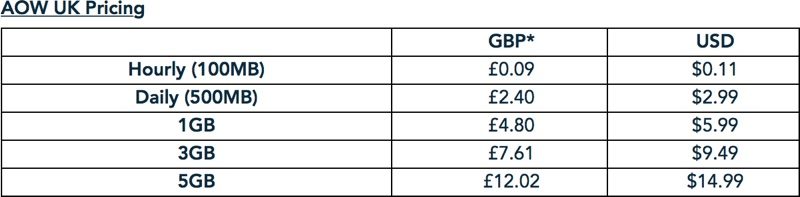
An hour of connectivity with 100MB of data is now priced at $0.11 in the United Kingdom, a significant price drop from the original cost of $0.49. A daily plan, with 500MB, now costs $2.99 (down from $5.99), and 1GB, 3GB, and 5GB plans with a 30 day limit are available for $5.99, $9.49, and $14.99, respectively. Previous pricing was at $10.99, $18.99, and $29.99.
“More travellers are increasingly turning to iPad as their preferred device while travelling or on-the-go,” says Emir Aboulhosn, CEO and Founder of AOW parent company, Otono Networks. “Now iPad users around the world can benefit from the most aggressive cellular data pricing in the UK and stay connected for less than the price of a cup of tea.”
The Apple SIM, introduced in 2014, works with cellular models of the iPad Air 2, iPad mini 3, iPad mini 4, 12.9-inch iPad Pro, and 9.7-inch iPad Pro. It is designed to support wireless service across multiple carriers, making it easy for customers to switch cellular providers, something that’s especially useful for travelers.
Apple SIM is supported by AT&T, Sprint, and T-Mobile in the United States, along with EE in the UK, au and SoftBank in Japan, Deutsche Telekom in Germany, and Three in Hong Kong. GigSky and AlwaysOnline Wireless, two companies that offer coverage around the world, also support Apple SIM.
Apple SIM connectivity is available in more than 140 countries, primarily through Apple’s partnerships with GigSky and AlwaysOnline Wireless.
Tags: Apple SIM, United Kingdom, AlwaysOnline Wireless
Discuss this article in our forums
 AIVAnet