


You are what you tweet: Twitter reveals how America eats and exercises
Why it matters to you
The analysis tool can offer insight when measuring how fit and healthy citizens are in certain cities and comparing them to the laws proposed to help promote that lifestyle.
Twitter, it turns out, isn’t just about wacky hashtags and slandering celebrities anonymously.
A new tool developed by researchers at the University of Vermont’s Computational Story Lab — along with those at the University of California, Berkeley, Massachusetts Institute of Technology, and several others universities — is using the social network to track how America is eating and exercising.
Called the Lexicocalorimeter, it searches for thousands of activities and foods, and assigns them approximate calorie number, with the broad idea being that tagged phrases are split into “caloric input” and “caloric output” categories. These aren’t just your everyday “running” and “pushups” type exercises, either: the researchers have included the likes of “pole dancing” and “alligator hunting” among the things it’s looking for. Case in point: One of America’s favorite “activities” is watching television.
The goal is to see what kind of caloric balance exists around the United States, with positive examples being set by places like Colorado (“running” as activity, and “noodles” as food), while Mississippi sadly ranks at the other end of the spectrum (“eating” and “cake.”)
True, it’s not super accurate, but it’s the kind of insight that is only possible to start exploring in an age of social media.
More: Twitter kills off latest safety update after wave of negative feedback
“We’ve had an amazing explosion of information, with people expressing themselves online through social media,” Peter Dodds, a scientist at the University of Vermont, told Digital Trends. “This research is an attempt to use that to look at population health patterns on a country, state, and city basis.” He describes the results as a “dashboard of society.”
Eventually, it will be possible to monitor everything in real time but for now, you will have to settle for looking at the results of 50 million geo-tagged tweets from 2011 and 2012.
“On an individual level, I think this can be interesting because it allows you to compare yourself or your state to people living elsewhere in the country, for example,” Dodds continued. “You could also do the same over a period of time, which allows you to reflect on whether things are getting better or worse. From a city planner or policy-making perspective, it could also be incredibly important. If you can see these numbers in front of you, it would be possible to look at what happened in another city when they introduced a particular program to see whether it was effective.”
In all, it’s another amazing demonstration of the way that even seemingly throwaway social media comments are helping document the age we live in.
“Just imagine if we had these tools going back 100 years,” Dodds said. “You would see remarkable transformations taking place in the kinds of food and exercise that people talked about. Going forward, we hope that this lasts for a very long time.”
You can check out the Lexicocalorimeter here.
You are what you tweet: Twitter reveals how America eats and exercises
Why it matters to you
The analysis tool can offer insight when measuring how fit and healthy citizens are in certain cities and comparing them to the laws proposed to help promote that lifestyle.
Twitter, it turns out, isn’t just about wacky hashtags and slandering celebrities anonymously.
A new tool developed by researchers at the University of Vermont’s Computational Story Lab — along with those at the University of California, Berkeley, Massachusetts Institute of Technology, and several others universities — is using the social network to track how America is eating and exercising.
Called the Lexicocalorimeter, it searches for thousands of activities and foods, and assigns them approximate calorie number, with the broad idea being that tagged phrases are split into “caloric input” and “caloric output” categories. These aren’t just your everyday “running” and “pushups” type exercises, either: the researchers have included the likes of “pole dancing” and “alligator hunting” among the things it’s looking for. Case in point: One of America’s favorite “activities” is watching television.
The goal is to see what kind of caloric balance exists around the United States, with positive examples being set by places like Colorado (“running” as activity, and “noodles” as food), while Mississippi sadly ranks at the other end of the spectrum (“eating” and “cake.”)
True, it’s not super accurate, but it’s the kind of insight that is only possible to start exploring in an age of social media.
More: Twitter kills off latest safety update after wave of negative feedback
“We’ve had an amazing explosion of information, with people expressing themselves online through social media,” Peter Dodds, a scientist at the University of Vermont, told Digital Trends. “This research is an attempt to use that to look at population health patterns on a country, state, and city basis.” He describes the results as a “dashboard of society.”
Eventually, it will be possible to monitor everything in real time but for now, you will have to settle for looking at the results of 50 million geo-tagged tweets from 2011 and 2012.
“On an individual level, I think this can be interesting because it allows you to compare yourself or your state to people living elsewhere in the country, for example,” Dodds continued. “You could also do the same over a period of time, which allows you to reflect on whether things are getting better or worse. From a city planner or policy-making perspective, it could also be incredibly important. If you can see these numbers in front of you, it would be possible to look at what happened in another city when they introduced a particular program to see whether it was effective.”
In all, it’s another amazing demonstration of the way that even seemingly throwaway social media comments are helping document the age we live in.
“Just imagine if we had these tools going back 100 years,” Dodds said. “You would see remarkable transformations taking place in the kinds of food and exercise that people talked about. Going forward, we hope that this lasts for a very long time.”
You can check out the Lexicocalorimeter here.
Verizon gets $250M break on its deal to buy Yahoo following data breaches
Why it matters to you
Yahoo is an example of just how costly getting hacked can be. Verizon is paying $250 million less for the company than previously agreed upon after renegotiating the deal in the wake of a data breach.
Yahoo’s security breaches are costing the company a cool quarter of a billion dollars. According to a Bloomberg report, Verizon Communications, which previously agreed to pay $4.8 billion for the tech giant, has now renegotiated the price as a result of the highly publicized hacks that rocked Yahoo late last year. Bloomberg further notes that in addition to the new terms of the deal, Verizon and Yahoo (which will be renamed Altaba, Inc.) will “share any ongoing legal responsibilities related to the breaches.” Finalized details are expected to be announced in the coming days or weeks, sources said.
While a $250 million price drop may seem like a hard pill to swallow, it’s likely better for Yahoo than having Verizon renege on the deal altogether, which briefly seemed like a possibility. “It looks like they’re going to get a price cut — but it’s not dramatic,” Brett Harriss, an analyst at Gabelli & Co, told Bloomberg. He added that there’s now “more certainty around there actually being a sale.”
More: The SEC opens an investigation into Yahoo regarding its data breaches
Yahoo and Verizon have not commented on these latest reports.
The embattled tech company has already been forced to deal with a number of hurdles surrounding its imminent sale to Verizon. While the deal was initially announced in July 2016 and was set to close in the first quarter of this year, it’s since been delayed to the second quarter. This, Yahoo says, will give the company time to evaluate the effects of the data breaches and meet closing conditions.
Verizon hopes that its new acquisition will help it move outside its traditional telecommunications role and into the mobile media and advertising world, while Yahoo simply seems eager for some relief from it’s many problems.
Verizon gets $250M break on its deal to buy Yahoo following data breaches
Why it matters to you
Yahoo is an example of just how costly getting hacked can be. Verizon is paying $250 million less for the company than previously agreed upon after renegotiating the deal in the wake of a data breach.
Yahoo’s security breaches are costing the company a cool quarter of a billion dollars. According to a Bloomberg report, Verizon Communications, which previously agreed to pay $4.8 billion for the tech giant, has now renegotiated the price as a result of the highly publicized hacks that rocked Yahoo late last year. Bloomberg further notes that in addition to the new terms of the deal, Verizon and Yahoo (which will be renamed Altaba, Inc.) will “share any ongoing legal responsibilities related to the breaches.” Finalized details are expected to be announced in the coming days or weeks, sources said.
While a $250 million price drop may seem like a hard pill to swallow, it’s likely better for Yahoo than having Verizon renege on the deal altogether, which briefly seemed like a possibility. “It looks like they’re going to get a price cut — but it’s not dramatic,” Brett Harriss, an analyst at Gabelli & Co, told Bloomberg. He added that there’s now “more certainty around there actually being a sale.”
More: The SEC opens an investigation into Yahoo regarding its data breaches
Yahoo and Verizon have not commented on these latest reports.
The embattled tech company has already been forced to deal with a number of hurdles surrounding its imminent sale to Verizon. While the deal was initially announced in July 2016 and was set to close in the first quarter of this year, it’s since been delayed to the second quarter. This, Yahoo says, will give the company time to evaluate the effects of the data breaches and meet closing conditions.
Verizon hopes that its new acquisition will help it move outside its traditional telecommunications role and into the mobile media and advertising world, while Yahoo simply seems eager for some relief from it’s many problems.
White House among more than a million websites people have asked Google to remove
Why it matters to you
If some people had their way, more than a million websites would be removed from Google, including the White House, NASA, Netflix, and the New York Times.
Think people ask too much of you? Google knows how you feel. The internet giant has quite a bit of experience when it comes to handling requests, and it’s not just about its search engine.
According to Google’s most recent transparency report, the company has been asked to take down more than a million different sites. In fact, individual URL removal requests now number in the billions, and the number of takedown requests has increased notably since last year, largely due to a more automated process of identifying copyright infringement, which makes up a significant chunk of the type of removal requests Google receives.
More: The Great Firewall in China just got stronger, and is now keeping out VPNs
It’s not just pirated sites that show up on Google’s list — rather, a number of legitimate sites have also been flagged for removal. The White House, the U.S. Department of Justice., NASA, Netflix, the BBC, and the New York Times are often accused of having content that is worthy of a takedown.
Naturally, Google doesn’t comply with all these requests. IMDb, for example, frequently has URLs reported to Google, which isn’t planning on taking down the popular movie database anytime soon. As Google noted, “We push back on these requests when they fail to include the necessary information or we suspect they are fraudulent.”
So what’s going on here? Is it just an innocent mistake? A glitch in the system? In some cases, perhaps, but in others, Google’s transparency report suggests that certain governments are increasingly hoping to crack down on content on the web.
You can check out the full contents of Google’s latest transparency report here.
Facebook now lets you find and apply for jobs on mobile and desktop
Why it matters to you
Facebook’s new updates aimed at job seekers could transform the way you use its service.
Looking for work? You can now add Facebook to the long list of career sites that can help you find a new job.
On Wednesday, the company announced it is launching a new jobs bookmark on its mobile apps and the web. Businesses with a Facebook presence can now add job openings to their page on the social network. The two updates combined allow users to discover and apply for jobs directly on Facebook.
More: New LinkedIn feature makes it easier for contractors to connect with recruiters
Page admins can publish job openings in a matter of minutes, according to Facebook. A typical vacancy post must include a photo, job title, location, job type (i.e. full-time, part-time), and a detailed description, along with optional info such as a summary, and salary. The post is then published to the company’s page and will also appear on the News Feed of their followers. Businesses will also have the option to boost the post (by paying a premium) to reach a larger or more targeted audience.
Facebook users can find jobs via the site’s new bookmark, which offers filters to help cater your search to match your criteria. You can also seek out jobs manually by visiting a company’s page and clicking on the jobs tab, located alongside other sections such as “home,” “posts,” and “photos.”
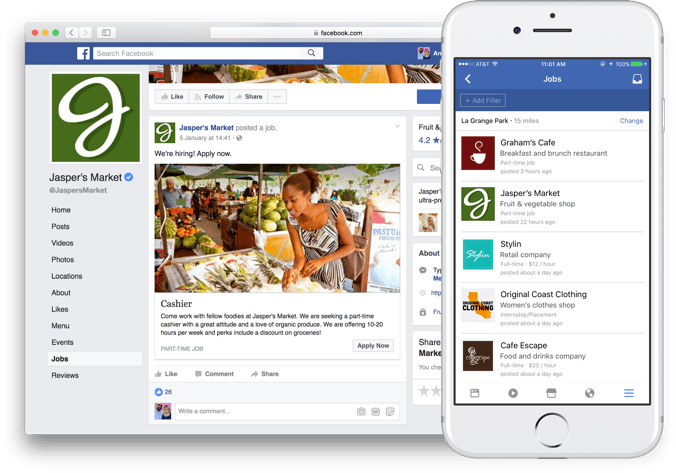
To apply for a vacancy, select the “apply now” button on the post. This action will open up an application form pre-populated with the info you have available on your profile (such as name, city, email). Here you will also be required to add more job-specific info about yourself. You can then submit the application via Messenger: the service will be the first port of call for all your future communications with the business in regard to the opening. Page admins will then be able to review your info and message you back about the status of your application.
Facebook began testing its new feature in November and claims that a number of businesses have already used it to fill roles. Seeing as 1 billion people visit business pages every month, the update should generate plenty of interest.
For the platform itself, it may also prove a boost in terms of accumulating personal data. Who knows, you may end up treating Facebook as you would LinkedIn (one of the platforms that could feel the direct impact of the big blue social network’s latest venture). After all, anyone searching for a job via Facebook would be advised to update their personal profile to make it look more professional. That would mean adding more photos, and educational and work experience info — sections you may have neglected in the past. Additionally, pages on Facebook could see higher rates of engagement as more people start following the companies they want to work for.
The job openings updates are currently only available to users and businesses in the United States and Canada.
Huawei Watch 2: What’s the story so far?
Remember the Huawei Watch?
We wouldn’t blame you if you didn’t — considering it first launched nearly two years ago. But it is one of the best-looking Android Wear watches to ever debut, and fans have been patiently waiting for a second-generation model. Although last year came and went without any hardware upgrades, Google recently released the Android Wear 2.0 update, so now is the perfect time for Huawei Watch 2.
Luckily, thanks to a couple leaks and a strategic social media post from Huawei itself, the launch of Huawei Watch 2 seems to be just around the corner. But what will it look like and how will it differ from the original Huawei Watch? Here’s everything we know so far.
- Best smartwatches to look forward to in 2017
- Mobile World Congress 2017: Nokia, Sony, Huawei, and more
Huawei Watch 2: Release date
Android Wear seems to be making a comeback this year. Determined not to be left out, Huawei is planning to unveil a newer, sportier Huawei Watch. Venture Beat said you can expect it to be unveiled at Mobile World Congress at the end of February. Richard Yu, Huawei’s CEO of Huawei Technologies Consumer Business, also officially confirmed the watch is coming via a Weibo.
Yu didn’t specifically announce that the smartwatch will be unveiled at MWC 2017, but his Weibo post contained the hashtag “#MWC2017”. The annual mobile trade show is scheduled to kick off 27 February and will extend until 2 March. Huawei has already announced it is holding a press briefing in Barcelona on 26 February.
Huawei Watch 2: Name
The second-generation Huawei Watch will be called Huawei Watch 2, according to Venture Beat’s Evan Blass, a well-known leakster.
Huawei Watch 2: Design
The existence of Huawei’s plans for a new smartwatch have only recently surfaced, but in his announcement post on Weibo, Huawei CEO Yu released an image (above) of a person wearing the watch, though it’s hard to determine how it looks like in the image.
Venture Beat’s Evan Blass claimed it’ll have a slightly sportier yet still classic design, as opposed to the Huawei Watch 2. It will also have a 1.4-inch display and both leather and stainless steel straps.
Huawei Watch 2: Features
Cellular connectivity and built-in SIM
At least one model of the Huawei Watch 2 will reportedly offer a cellular connection. Venture Beat also noted a model with a built-in SIM will be available. If any of this is true, you’ll be able to place calls and won’t need to connect it to a smartphone. You’ll basically be able to take advantage of some standalone functionality in Android Wear 2.0.
Want to know more?
See Pocket-lint’s Huawei hub for related news.
Denon AH-C160W wireless sports in-ears are built to last and sound great too
Denon is targeting the more active among you with its latest pair of in-ears, the AH-C160W. They’re a wireless pair of in-ear headphones that connect to a phone or portable music player via Bluetooth, of the more powerful Class 1 variety.
Class 1 Bluetooth has great signal strength, so you won’t need to worry if your phone isn’t within touching distance of the headphones, you’ll still get top-notch sound quality.
And the sound quality is something Denon is keen to shout about. The company’s entire 50+ years of audio expertise has gone into the C160Ws, so you know they’re not just a pair that’s been thrown together in a week.
Inside the earpieces is Denon’s own digital signal processing (DSP) technology and Clear Voice Capture, which is a technology that promises to reduce external noise when you take phone calls, so you can clearly hear every word. It also provides voice prompts for things such as battery life, and can support a number of different languages.
If you’re out running, cycling or in the gym, you won’t need to worry about the headphones coming out your ears, as they benefit from Denon’s carefully designed Earhook technology, and come supplied with three different sizes of ring, four pairs of silicone ear tips and a pair of Comply Foam eartips, so a tight seal is guaranteed.
And being sports headphones, they’re moisture and sweat resistant up to IPX5/7 standards. Denon’s AH-C160W sports in-ears are available now in black, blue and white for £149 via Denon’s own website.
‘Street Fighter’ on Nintendo Switch flings first-person hadokens
News keeps trickling in for the Switch as we await its public release next month. Befitting a Nintendo console, they range from exciting to bizarre, often taking the system’s novel points and running into unpredictable territory. Such is the case with the upcoming Ultra Street Fighter II, as a new video emerged confirming rumors that we will, at last, get a first-person hadoken-throwing experience.
Alright, it’s not perfect. The latest episode of Capcom TV showcased the new mode, “Way Of The Hado,” which looks more like a House Of The Dead-style rail shooter than the fluid combat Street Fighter is known for. The host ends up flinging his motion-control Joy-Con controllers around to erratically activate Ryu’s trademark fireball, uppercut and spin-kick special moves to take down waves of Shadaloo grunts. Maybe the activation gestures will get tightened up before release, but the video gave me flashbacks to the controller-flailing heydey of Wii Sports when precision took a backseat to spastic jabs and prayers.
Via: Nintendo Life
Source: Capcom TV
Elon Musk accidentally tweets that Trump’s ban is ‘not right’
If you’ve been tweeting for a while, then your drafts folder is probably full of too-hot takes that you eventually thought better of and dialed back for public consumption. Of course, you’re probably not a billionaire tech CEO with a position on a presidential advisory council like Elon Musk. That’s why it’s news when his drafts folder apparently let loose several tweets with more pointed criticism of Donald Trump’s “Muslim immigration ban” (as Musk referred to it in the now-deleted tweets) than Musk’s other public statements.

Musk’s companies SpaceX and Tesla both joined a legal brief opposing the order, and in tweets last week, the exec called it “still bad,” and that a “blanket entry ban on citizens from certain primarily Muslim countries is not the best way to address the country’s challenges.” The tweets he didn’t send were less subtle, stating clearly that “The Muslim immigration ban is not right.”
In a follow-up (while announcing that Tesla would provide free repairs for a customer who used his Model S to safely stop an out of control car on the highway), Musk confirmed the deleted tweets were “earlier drafts.”
Many people negatively affected by this policy are strong supporters of the US. They’ve done right,not wrong & don’t deserve to be rejected.
— Elon Musk (@elonmusk) January 29, 2017
Regarding the meeting at the White House: pic.twitter.com/8b1XH4oW6h
— Elon Musk (@elonmusk) February 3, 2017
Source: Elon Musk (Twitter)
 AIVAnet