


Developers are free to make feature-rich Windows 10 Creators Update apps
Why it matters to you
Developers can now start making awesome apps for Windows 10 Creators Update, coming in April 2017.
The next big thing in Windows 10 is the upcoming Creators Update, which will introduce a number of new features including Game Mode, better 3D support, and more. Creators Update is expected in April 2017, so it’s only a couple of months away.
Microsoft kicked off its second Creators Update Bug Bash last week, which at this point could be taken to imply that the update is feature-complete. The company announced on Wednesday that the Creators Update software development kit (SDK) is officially feature-complete, as MSPU reports.
More: Everything you must know about Windows 10 Creators Update and Surface Studio
The SDK is what developers will use to create apps that take advantage of all of the new features to be introduced in Windows 10 Creators Update. If Microsoft is finished adding features to the SDK, then that some support to the idea that the company is done adding features to the update as well. Developers can download the latest Windows 10 Creators Update SDK here.
As a refresher, Creators Update will be adding new features aimed at creative professionals, such as enhanced 3D support, a new 3D Paint app, and a new portal where new 3D creations can be saved and shared. Microsoft will also be enhancing the Windows 10’s Windows Holographic virtual reality (VR) and augmented reality (AR) subsystem, in support of new lower-cost VR/AR systems on their way from the company’s OEM partners.
Gamers will also get a number of new features, including a new Game Mode to help optimize game performance and integrated Beam game streaming, and will be able to more easily created tournaments via Xbox Live Arena, inviting their friends on both Windows 10 PCs and Xbox One.
The latest Windows Insider preview builds have incorporated many of these new features, and if you’re using the last build then you likely already have an idea of what the ultimate Creators Update is going to look like. If you’re not an Insider, then you don’t have too much more time to wait before Creators Update hits your Windows 10 devices.
‘Lab on a chip’ diagnosis tool costs just one cent, could save countless lives
Why it matters to you
Making medical diagnosis more affordable can go a long way to treating worldwide epidemic diseases.
It’s one thing to invent impressive technology and another entirely to do it at a price point that truly makes it accessible to people around the world.
Researchers at Stanford University have achieved both with an impressive new “lab on a chip” system which, by their estimation, costs just one cent to make — but could help diagnose diseases as wide-ranging as malaria, tuberculosis, and HIV.
More: Harvard’s 3D-printed heart on a chip hopes to make drug testing safer
“The motivation was how to export technology, how to decrease the cost of medical diagnosis, and how to democratize medical research,” researcher Rahim Esfandyarpour, an engineering associate at the Stanford Technology Center, told Digital Trends. “We hope to bring affordable and accessible technology-based solutions to medicine by designing something that everyone can use to create their own required instrumentation.”
The lab on a chip is made up of two parts. There is a transparent silicone microfluidic chamber that is used for housing cells and a reusable electronic strip. Then there is a standard inkjet printer (sold separately) with which an electronic strip can be printed onto a sheet of flexible polyester using conductive nanoparticle ink.
The process requires no fancy “clean room” and printing takes just 20 minutes.
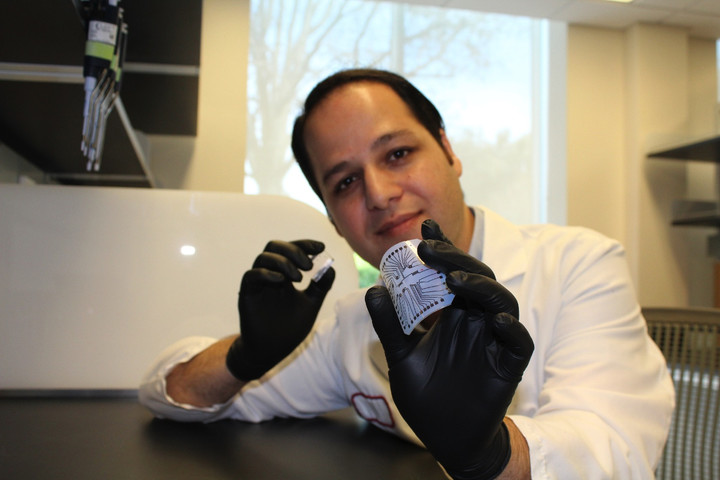
Rahim Esfandyarpour helped to develop a way to create a diagnostic “lab on a chip” for just a penny.
Zahra Koochak/Stanford School of Medicine
The idea is that it can analyze cell types based on how they are pulled in different directions in the microfluidic chamber when an electrical field is applied. Using it, researchers can isolate individual cells and much more — with a price point that, in some cases, is literally $100,000 less than a commercial lab-standard machine would cost to do the same thing.
“Enabling early detection of disease is honestly one of the greatest opportunities that we have for developing treatment and prevention strategy, as well as for reducing the cost of healthcare,” Esfandyarpour continued.
It all sounds complicated and, from a design perspective, it is, but the way in which it can be used makes it accessible to people even with minimal training.
As to when it will be available, Esfandyarpour said there may be a bit of a wait, however. “Although we have very interesting results, it still requires more work in order to carry out commercialization of the solution,” he said. “We’re doing our best to get it ready as soon as possible, but it’s hard to give a specific date because there are some many factors involved — including the funding.”
Nearly half the Oculus Rift kiosks in Best Buy stores are going bye-bye
Why it matters to you
The removal of Oculus Rift kiosks from Best Buy stores may be a signal of the product’s declining status, as well as an impediment to curious customers seeking a demo.
Just under half of the Oculus Rift demo kiosks in Best Buy stores across the U.S. are being shut down, according to a report from Business Insider. The reason? It could be a lack of interest from shoppers.
Apparently, it wasn’t uncommon for Best Buy employees “to go days without giving a single demonstration,” the website said. A memo between a third-party company and store employees reportedly confirmed that the move is due to poor “store performance.” An Oculus spokesperson later confirmed with the website that the Best Buy Rift pop-ups are closing, but said the shift is due to “seasonal changes” and that Oculus is “prioritizing demos … in larger markets.”
More: These 12 Oculus Rift games are the best way to experience virtual reality
The move will reportedly affect 200 of the 500 Best Buy locations in the U.S. that currently have Oculus Rift demo stations. “We still believe the best way to learn about VR is through a live demo,” the spokesperson, Andrea Schubert, said. “We’re going to find opportunities to do regular events and pop-ups in retail locations and local communities throughout the year.” She mentioned that stores in Canada will still have the demo kiosks as well.
Business Insider’s report cited multiple unnamed sources who said that the demo stations were often too buggy to use and demos were infrequent even during the holidays. Another of the site’s sources said that Facebook, which owns Oculus, has considered opening dedicated storefronts to sell the headset, but that those talks are still in the early stage.
Best Buy stores will continue to carry the Rift headsets even if their kiosks get shut down, a Best Buy spokesperson told the site. The Oculus Rift stations first appeared in Best Buy stores early in 2016, with only 48 stores getting units. The partnership later expanded to 500 stores. That number will scale back down to 300.
The Rift kickstarted the current virtual reality craze, but since launching last year has faced stiff competition from the higher-end HTC Vive and the more accessible PlayStation VR.
MrMobile’s best Android tablet (is from 2015)
It’s been 15 months since Google’s Pixel C launched, and it hasn’t diminished in quality (or price). It still has some annoying bugs, and there’s still software that just won’t work in landscape mode, but after over a year since release, I still find myself gravitating toward it whenever I’m able to leave my bigger machines behind.
I’m Michael Fisher, alias MrMobile, and it’d be ridiculous for me to suggest you buy the Pixel C … at full price. But when it goes on sale, or it comes bundled with the attachable keyboard, I’m in enthusiastic agreement with what Jerry Hildenbrand said: the Pixel C is a handy piece of hardware, and it’s (still) my favorite Android tablet of the year (so far). Hit play on this video, and let me tell you what’s great (and not-so) about the Pixel C in 2017.
Featured Products
- Pixel C
- Pixel C Keyboard
Stay social, my friends
- YouTube
- The Web
- Snapchat
Flipboard redesign encourages curation and sharing content with friends

Flipboard attempts a revival with new features, including the ability to curate your own publication and share it with friends.

If the Flipboard app interface was starting to feel a little dated to you, there’s good news. The company has launched a massive re-design of its news aggregation app, with a particular focus on design.
Flipboard 4.0 is introduced as the response to the company’s “ever-growing ecosystem” of sources, the idea being that if you catch up on all the news and social media happenings through one specific app, that it should be easy to parse. To that end, Flipboard’s new interface prioritizes topics over sources. The new algorithm will continually fine tune what you like to read as long as you interact with it by liking stories or following publications. You can go even deeper by selection those very specific topics you keep up with daily (mine would be alumni actors of out-of-commission TV shows).
Flipboard also introduced a collaborative new Smart Magazines feature, which lets you share a curated publication of sorts. You choose what goes into the Smart Magazine and then you can invite your pals to also read the content — like a shared RSS feed. They can make their own, too.
There’s more information about what the update entails at the official blog post, including a how-to on honing your Flipboard so that you rely on it for daily reading.
Open Signal: Verizon and T-Mobile are in a virtual tie for the best network in the U.S.
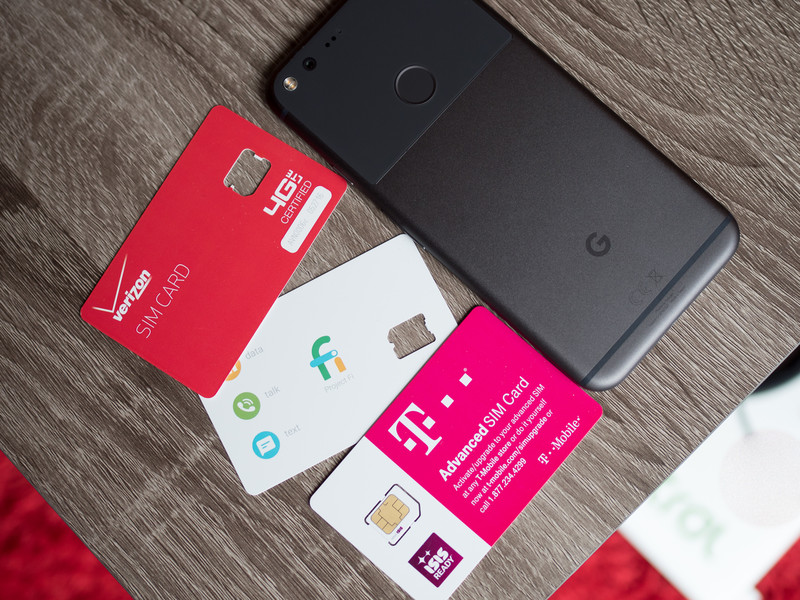
Verizon is a little bit faster, and T-Mobile’s network is growing like a weed.
Open Signal has released their State of Mobile Networks: USA report and they say Verizon has now tied T-Mobile for the fastest carrier in the United States, and the results are so close between the two that they are virtually tied for the “best.”
Using data collected from 169,683 users, 4,599,231,167 data points were used to measure network speeds on both 4G and 3G, network availability and latency. The data is collected by users installing the Open Signal app from Google Play or the App Store and going about their daily routine.
In their analysis of the collected data, they say that Verizon has improved their 4G network speeds to pull even with T-Mobile who has traditionally done well in this category. They also mention that the average overall network speeds in the U.S. have risen slightly, and over 81% of U.S. residents have access to LTE networks.

Availability of high-speed data services shows that all four carriers have improved, but T-Mobile (86.6%) is now within two percentage points of Verizon (88.2%) when it comes to finding an LTE signal. The company with the most improvement here is Sprint, who jumped from covering 69.9% in August to 76.8% in February 2017.
Verizon or T-Mobile performed the best in every category tested, and the final results show that any measurable advantage T-Mobile or Verizon previously held in nationwide network testing has shrunk to the point of being insignificant. You still need to pick the carrier service that works bets for you, but overall either Red or Magenta should have you covered.
The best part is that they now need to fight even harder for our dollars.
How the Withings Wireless Blood Pressure Monitor helped save Modern Dad
Fun fact: Seven years of running Android Central might well leave you with high blood pressure. Or maybe it was just a coincidence. …
That’s the bad news. … The good news is that 2016 was the year I decided to take my health a little more seriously. Step 1: Get a doctor. That led to Step 2: Find out that I indeed had high blood pressure, and start dealing with that. And that led to Step 3: Keep track of how the ol’ blood beater is beating on a daily basis.
Subscribe to Modern Dad on YouTube
So it was time to snag a blood pressure monitor. I started with your basic Amazon best-seller. And that was fine. It did the job, and it even had a little bit of smarts to it. But I wanted something even smarter, even more connected.
So I turned to Withings, whose connected scaled I’d already been using for some time. And their wireless blood pressure monitor has served me very well since I started keeping track of things. Probably as impressive as anything is that in the six months or so that I’ve been using it, I still haven’t had to change out the batteries. (Which, strangely, was my biggest concern.)
This one works excellently with Android and Google Fit, as well as iOS and HealthKit.
See at Amazon
Modern Dad
- Subscribe on YouTube
- Snapchat
- See the gear
Pinterest Lens uses a camera to search items around you in real time
Ever see a piece of decor and wish you could search it on Pinterest?
The service is designed to let you find things related to what really intrigues you. However, if you want to use Pinterest, you must recall what you once wanted to look up, or you need to grab your phone in the moment and start searching keywords, which is time consuming, especially if you prefer to casually browse and find relevant pins to save. Well, Pinterest has launched a game-changing feature that streamlines this process.
Called Pinterest Lens, the feature is described as something people can use if they happen to spot an item out in the world that looks interesting, but when they try to search for it online later, words fail them: “You have this rich, colorful picture in your mind, but you can’t translate it into the words you need to find it,” Pinterest explained in a 8 February post, which announced Lens is available in beta.
Lens lets you use the camera in your Pinterest app to search for objects you see out in the real world. Just point Lens at a table, then tap to see related styles or even ideas for how you can build something similar yourself. Or try it on a pair of shoes. You can also use Lens with food to find recipes. Pinterest said Lens currently works best for finding “home decor ideas, things to wear, and food to eat.”
However, as more people use Lens, which is based on a visual search technology that Pinterest introduced in 2015, the range of objects Lens recognises will grow wider. Lens will roll out in the US in “the coming weeks” in the Pinterest for iPhone or Android app. To complement this feature, Pinterest also introduced Shop the Look, a tool that identifies clothing items in pins that can be bought through partners.
Shop the Look is currently available for brands including CB2, Macy’s, Target, Neiman Marcus, and Wayfair.
Windows 10 Creature Update adds picture-in-picture, is feature-complete for April roll out
Two months before the release of the Creators Update, Microsoft has announced a new feature included in the upcoming upgrade.
PC owners who run the Creators Update will get picture-in-picture support. Microsoft is calling the feature “Compact Overlay”. It will be available for all app developers making Universal Windows apps, and it’ll be available in built-in apps like Movies & TV or Skype. The feature essentially allows you to watch something like a Skype video call in a window that can hover above another window or app you may be using.
Microsoft Windows 10 Creators Update: What’s new?
Microsoft is currently testing Compact Overlay as part of the latest Windows 10 build 15031, which the company made available for fast ring insiders on 8 February. Microsoft also revealed Wednesday that Windows 10 Creators Update is feature-complete, meaning all of the new features are finished – apart from any bugs that may be found – for the update’s official release coming to consumers this spring.
Microsoft will make the Windows 10 Creators Update available to new and existing PCs in April.
Facebook’s ‘Lite’ app has over 200 million users (updated)
Just because you’re using Facebook Lite, it doesn’t mean you want to compromise on features. Neither do any of the 200 million users worldwide taking advantage of the bare-bones version of the app. Fortunately, there’s an update that rolls out many missing features today such as the ability to Like, Comment and Share posts. Facebook created Lite as a pared down version of its main app in 2015 for lower-end Android phones with spotty network connections. COO Sheryl Sandberg was keen to outline the benefits that users of the standalone app are getting. Business users, for example, can use the more feature-rich update to reach mobile-only and mobile-first customers while using less data.
Performance improvements are a given with any update, especially when the company wants to assure a fast, reliable connection to the social network no matter what. Facebook has also found that people who use Facebook Lite tend to share phones, so it has provided an easier way to log on and off their accounts in this new update.
The update brings Facebook Lite to more regions, including the definitely not emerging markets of South Korea, Israel, the United Arab Emirates, and Italy. It’s available in 150 countries in addition to the original eight of Bangladesh, Vietnam, Nigeria, Nepal, South Africa, Sudan, Sri Lanka and Zimbabwe.
Update: Contrary to the information we initially received, Facebook has confirmed it added Like/Comment/Share support to the Lite app last March, when it announced over 100 million monthly active users. We have updated this post to reflect that.
Source: Sheryl Sandberg (Facebook), Facebook Lite
 AIVAnet