


Morgan made a £6,662 kid version of its all-electric EV3 vehicle
Less than a year after unveiling the three-wheel, all-electric EV3, British car company Morgan has announced a version for kids.
Morgan’s first all-electric vehicle — which launched last year with a 62bhp electric motor fed by lithium ion batteries, allowing it to go 0-62mph in eight seconds — has a top speed of 115mph and a range of 150 miles. But enough about that £25,950 retro-looking ride; Morgan owners can now buy the matching £6,662 EV3 Junior to essentially get their kids hooked on a zero-emissions lifestyle too.
The EV3 Junior is a smaller version of the EV3. It has a 10-mile range and a top speed of 10 miles per hour, making it a lot like Radio Flyer’s $500 Tesla Model S. It’s made of carbon fiber and features a wooden dashboard and hand-stitched leather. It also offers suspension and headlights. Morgan actually advertises that each car can be custom built to order, which explains that hefty price tag.
The Morgan EV3 Junior looks like something out of the past with those thin wheels mounted on that round edged bonnet. It can be purchased from the Morgan online shop or from Morgan official dealerships and the factory shop in Malvern Link, UK.
FCC stops defending caps on prison phone call rates
The Federal Communications Commission’s new anti-regulation stance is now affecting prisons. BuzzFeed News reports that the FCC is no longer defending two key parts of its caps on prison phone call rates: limits on intrastate call rates and the methods used to determine those rates. Ultimately, it’s expected to push for eliminating the caps altogether. While this doesn’t end litigation from phone service providers attempting to overturn the caps (they’re merely on hold, not scrapped), it finds the FCC supporting the very companies it was challenging just weeks earlier.
The telcos have argued that the previous FCC administration had misinterpreted federal law. A clause requiring that providers be “fairly compensated” was meant to give the companies their due, according to attorneys, not to keep rates artificially low. The caps were supposedly so dire that the service operators were taking losses.
However, that still raises a question: what, if anything, will the FCC do to keep the call rates in check if the current rules go away? The limits came about precisely because rates were being used as a roundabout way of discouraging prisoners from calling. If there are no limits in place, it may be prohibitively expensive for inmates to stay in touch with family and friends. While there is the potential for abuse, fewer calls could isolate prisoners and increase the chances that they’ll be maladjusted if and when they’re set free.
Source: BuzzFeed News
DIY lace-tightening shoes are where Lego meets ‘Back to the Future Part II’
Why it matters to you
Always dreamed of ‘Back to the Future II’-style shoes? Vimal Patel created his own with Lego, old sneakers, and a glue gun.
When you think about the exciting tech that 1989’s Back to the Future Part II promised us, self-lacing shoes have to be right up there with hover boards.
Since that movie was made, we’ve had a few real-life tributes to self-lacing shoes from giant companies like Nike. However, industrial designer Vimal Patel has come up with his own, low-fi take on Marty McFly’s iconic footwear — and it just so happens to be made out of Lego.
More: They’re real. We slipped on Nike’s HyperAdapt 1.0 self-lacing sneakers
“It is just what it says on the tin: a self-lacing shoe hacked together with glue and bricks,” Patel told Digital Trends. “It uses standard Lego Power Functions components — remote, receiver, battery box, and motor — to wind and unwind shoelaces.”
Patel said that he built the shoe for fun as a way of exploring practical uses for Lego, combined with other materials. The Lego mechanism itself is attached to the shoe laces at the side. When Patel turns on the power at the battery box, the winding axle cranks into gear and tightens the laces for him.
Being made of Lego, of course, don’t expect to go tramping around the city while wearing these (or, indeed, whipping around Hill Valley avoiding goons), but it’s certainly a fun hack. It was also as Patel put it, a chance to, “bring some life into a worn-out shoe that I would have otherwise thrown out.”
If you want to get hold of your own pair, you’ll have to show a bit of ingenuity, though.
“I don’t have plans to make more of these or sell them — like I said, it was purely for fun,” Patel continued. “I think the best thing your readers can do is to try making their own. The shoe only has three permanent Lego connection points, so those three parts are all I had to ‘lose’ with this experiment.”
All you need then are to find some old shoes headed for the trash, and you’re ready to go!
Swarm AI correctly predicted the outcome of Super Bowl LI, right down to the final score
Why it matters to you
If you believe it was impossible to predict the outcome of this year’s Super Bowl, you would be wrong. You may want to consult with the AI before your next sporting wager.
The New England Patriots’ win over the Atlanta Falcons was nothing short of amazing. The Pats rallied back from a 25-point deficit to tie the game in the final minutes of regulation and secured the win with a decisive touchdown drive in overtime. You may still be reeling from the comeback, but here’s something else that will blow your mind: Even before the first ball was snapped, an artificial intelligence platform accurately predicted the outcome of the game, right down to the 34-28 win by the Patriots.
Created by Unanimous, Swarm AI is a prediction engine that combines swarming algorithms with human input. The company’s AI software allows real, live human users to gather in artificial swarms, The software monitored the conversations in these swarms and collected group intelligence data that is used to make predictions. The company has a string of success accurately predicting the top four winning horses in a recent Kentucky Derby, the last two Stanley Cup winners, and nine out of 10 NFL playoff games.

Being able to predict the final score of the Super Bowl is not an easy task, though. Of the 1,641 Super Bow final score predictions published by Scripps Howard over the past 19 years, only two have been correct regarding Super Bowl final score predictions. For the Super Bowl, Unanimous took on this challenge by creating wars with 40 football fans and connected them online. The platform then used the swarm’s group intelligence to make its own predictions about how many points each team would score.
More: Suggestic wants to use artificial intelligence to help you stick to your diet
So when the Patriots ended up winning the Super Bowl with the predicted 34-28 score, the folks at Unanimous (and everywhere else) were blown away by this uncanny prediction. Now that the Super Bowl is out of the way, Unanimous is eyeing the NHL’s Stanley Cup and the NCAA March Madness tournament.
Britain’s largest network operator defends Google in EU Android antitrust case
Why it matters to you
BT’s public support could pave the way for other groups to chime in on the Android antitrust case, the result of which could have far-reaching implications for Google.
BT, a telecommunications provider in the United Kingdom, has sent a letter to the European Commission announcing its support for Google in an ongoing antitrust case involving Android, the world’s largest mobile operating system.
The European Commission alleges that Google is using Android’s dominant market share as a way to push its own apps and services, like Search, Drive, YouTube, and Google Maps. Anyone is free to use Android, but if a manufacturer wants access to the Google Play Store — where about 2.6 million apps reside — they have to sign the Mobile Application Distribution Agreement and prioritize Google’s apps.
More: Microsoft’s unified user interface may be the namesake of Google’s hybrid OS
Manufacturers can still preload their own apps or ones from competing services like Microsoft — this is one of the points BT calls out in its letter to the European Union. According to Reuters, BT said the carrier is “free to preinstall its own or third-party apps on devices alongside preloaded Google apps.”
“We also said that, as an app provider, we value the ongoing stability and compatibility of operating systems, whether they are ‘open source’ or ‘closed source,’” a BT spokesperson told Reuters.
If a manufacturer wants to preload Google apps, they must sign the Anti-Fragmentation Agreement and not sell devices running a modified version of Android — Google says this ensures that apps are able to work across a wide number of Android devices.
More: Goodbye static backgrounds: Our favorite free live wallpapers for Android
“Our voluntary compatibility agreements enable variety while giving developers confidence to create apps that run seamlessly across thousands of different phones and tablets,” Kent Walker, Google’s general counsel, previously wrote in a blog post. “This balance stimulates competition between Android devices as well as between Android and Apple’s iPhone.”
It’s unclear why exactly BT decided to send a letter announcing its position on the case, but it is Britain’s largest operator so its words likely won’t be taken for granted.
Uber’s newest hire aims to help the company make flying vehicles a reality
Why it matters to you
Uger’s big plans to create flying vehicles are no secret, but a recent hire illustrates just how serious the company is.
Uber is betting big on flying vehicles. In October, the company released a white paper detailing its plans for the Uber Elevate project, which, as it sounds, is an attempt to overcome competition by flying over traffic. Its plan is to utilize small, fixed-wing planes called vertical take-off and landing (VTOL) craft. Now, Uber made one of its most serious commitments to the project yet by hiring Mark Moore, a former NASA advanced aircraft engineer, to act as the director of engineering for the project, according to Bloomberg.
Moore’s interest in VTOLs goes way back, and his research for NASA reportedly inspired Google co-founder Larry Page to finance Zee Aero and Kitty Hawk, two Silicon Valley startups working on VTOL technology.
More: Study reveals Uber drivers earn more than taxi drivers, but they’re not displacing jobs
Moore himself was encouraged by Uber’s work in the field and, after helping the ridesharing giant craft its VTOL white paper in October, he decided to leave NASA after 30 years for a top spot at Uber.
“I can’t think of another company in a stronger position to be the leader for this new ecosystem and make the urban electric VTOL market real,” he told Bloomberg.
Moore admitted there are a number of technical and regulatory challenges to face. For one, Uber has yet to build its VTOL craft, having only detailed a vision of a future with short airborne transits. And Moore said VTOL craft companies would have to lobby politicians for more lenient air-traffic controls and quicker vehicle certifications.
Moore’s commitment to such a future is extremely apparent. He would have been eligible for retirement in a year if he stayed at NASA. By moving to Uber, he will forgo on a big percentage of his pension. He justified his decision to Bloomberg by saying he has a desire “to be in the right place at the right time to make this market real.”
Enjoy quality sound with the Panasonic ErgoFit in-ear headphones, now $8
Smartphones and other portable media players allow us to take our music, videos, and games anywhere, and having a good pair of earbuds is vital for getting the most out of our entertainment when we’re on the move. Unfortunately, many stock earphones are cheaply made and utilize undersized drivers that deliver tiny highs and a lackluster bass response. While there are many high-end earbud models available today, you don’t have to break the bank to get quality sound with budget-friendly options like the $8 Panasonic ErgoFit in-ear headphones.
The ErgoFit earbuds utilize generously-sized 9mm neodymium drivers. These are larger than those found in similar in-ear headphones, giving you improved sound with a frequency response of 10Hz to 24Hz. This wider frequency response offers crisp treble and heavier bass so you don’t have to sacrifice sound quality when listening to your music, playing games, and watching videos on your mobile device.
More: The best iPhone 7 deals for every carrier, including free offers
 True to their name, the Panasonic ErgoFit in-ear headphones are ergonomically designed for maximum comfort and noise isolation. The ErgoFit includes three different sets of earpads — small, medium, and large — for a tighter fit to your ear canal. The 3.6-foot long cord gives you enough length for daily activity and can easily be threaded through standard cable channels in a jacket or bag so it’s not getting caught up on things. Originally designed to match the fifth-generation iPod Nano, the ErgoFit comes in nine colors, eight of which are available on Amazon.
The Panasonic ErgoFit in-ear headphones have a 4.4-star rating on Amazon with almost 40,000 customer reviews and are currently available for just $8. According to the Cnet review, these among the best in-ear headphones that can be had for under $10, so if you have been disappointed with low-cost earbuds but don’t want to empty your wallet than the Panasonic ErgoFit is a solid and inexpensive alternative.
$8 on Amazon
Turn down for what! This innovative music app could actually improve your hearing
Why it matters to you
Having trouble hearing us? TSC Music is a smartphone music app that detects the worst key frequency of your hearing and stimulates it.
Here in 2017, there’s no shortage of music apps available for your smartphone. From exclusive tracks to sound quality to better compensation for artists, you’d be forgiven for asking what a new one could possibly add to the mix.
How about promising to improve your hearing?
That’s the bold ambition of Earlogic’s new TSC Music app, an iOS app which lets you play music via YouTube, SoundCloud, Spotify, or its own music library (Apple Music support apparently coming soon) — but does so in a way that your ears will thank you for.
More: Nuheara IQbuds are designed to give you control of your listening experience
“TSC Technology stands for Threshold Sound Conditioning, and it works as a physiotherapy for hearing,” Ji Hoon Won, Earlogic Managing Director and one of the app’s creators, told Digital Trends. “The TSC Music app offers five key frequencies to test your hearing. The app will detect the worst key frequency of your hearing and generates customized sound signals to stimulate them at threshold level, [referring to your minimal] audible level. The music app then stores the hearing data, to equalize your music based on your hearing capacity, and to offer charts to track your daily hearing condition.”
It’s definitely a smart idea, and one which Won claims should improve your hearing capacity after around one month of usage, for an hour or so each day. The technology has apparently been tested by Stanford University and an abstract about it published in Neurology Journal, which Won described as “one of the most prestigious journals in the field.”
“According to the study, Threshold Sound Conditioning showed that 7 out of 10 people showed some improvement of 10 Decibels and others had some improvement,” he continued.
If you’re interested in finding out more, you can download TSC Music from the App Store here. Or would you like us to repeat that a little bit louder?
This do-it-yourself project is a cheaper alternative to Razer’s Project Valerie
Why it matters to you
Want to make your own three-screen laptop? Be warned, the result is rather wobbly and eats up lots of space on airplanes.
During the CES 2017 technology convention in January, popular gaming peripheral maker Razer introduced a laptop concept called Project Valerie. It consisted of three displays instead of one, with the left and right displays sliding in and out from behind the main central screen. Given it’s just a prototype, there is no current information of when a retail model will hit the streets. That prompted one YouTube streamer to create his own.
For this home-built model, the screens are collapsible, as they are attached to the back of the laptop’s screen using door hinges costing $2 each. There are actually two hinges per display, enabling the user to fold the panels over the laptop’s main display when it’s closed.
More: Razer Project Valerie: Our First Take
According to YouTuber JerryRigEverything, the two AOC panels used in his makeshift three-display laptop setup cost $100 each. He is probably using the 15.6-inch E1659FWUX model, sold on Best Buy here, sporting a 1,366 x 768 resolution at 60Hz, a response time of 8 milliseconds, and a dynamic contrast ratio of 500:1. The important note here is that this panel connects via USB 3.0 only — no additional power and display cords are necessary.

The first step in mimicking Project Valerie was to figure out where the door hinges needed to reside. He did this by taping one side of the two hinges along the backside of each monitor and then taping the other side of the hinges to the backside of the laptop’s panel. Once everything looked right, he used a blade to etch the outline of the hinges into the plastic of each display. He then used the epoxy glue to mount the hinges onto the back of the laptop followed by the back of the first AOC display.
Attaching the second AOC display was a bit tricky. While the two door hinges could be glued to the back of the laptop, the hinges weren’t long/wide enough to attach to the back of the AOC display when all three displays are stacked. Instead, these hinges had to be glued to the thin bezel on the AOC display’s side. Note that no display was harmed in this process from drilled holes and screwed in bolts.
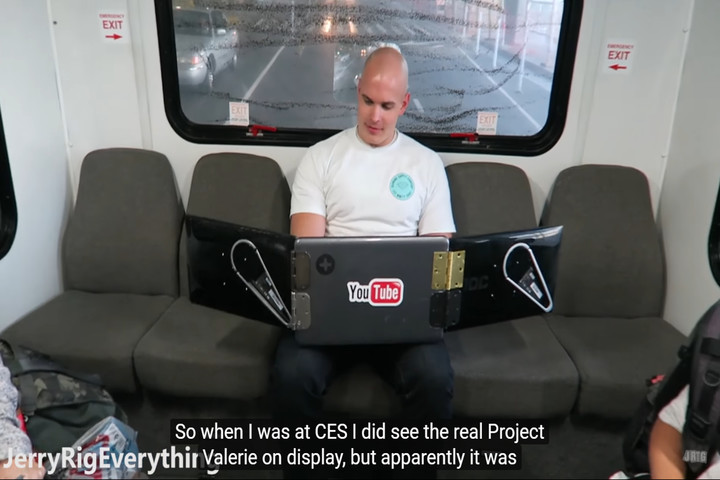
Ultimately what this project shows is just how silly a three-panel laptop can look out in public. On an airplane, this setup ate up the physical space of three drop-down trays, which would undoubtedly infuriate passengers sitting to the user’s left and right. On a bus, the setup looks huge not to mention wobbly as the bus continuously rolls over uneven pavement.
At home or in the office, this setup makes sense, as three screens can make users highly productive. However, Project Valerie aims to bring multi-display PC gaming to mobile users. This do-it-yourself copycat is a cheaper alternative although the use of epoxy glue doesn’t promise much stability. If anything, this at-home method just goes to show all the engineering Razer dumped into its Project Valerie prototype for a sturdy, immersive on-the-go experience.
Developer shows off ‘Final Fantasy XIV’ gameplay on Microsoft’s HoloLens
Why it matters to you
The concept shows how augmented reality can be used to do just that: Augment a traditional gaming experience.
Microsoft’s HoloLens augmented reality glasses are getting some love with a new demo of a developer showing off a concept for HoloLens support in Final Fantasy XIV. That’s 2010 MMORPG FFXIV, mind you, not the more recent Final Fantasy XV.
The video, tweeted by a user named @tanufuku, shows the game’s many peripheral menus, like maps and inventory, relegated to cyberspace all around a laptop’s screen. The laptop itself is dedicated entirely to showing the actual game, while all extraneous menus are banished to HoloLens view. A user wearing the headset would be able to focus on gameplay when they want, then simply move their head to view the space around their monitor or laptop screen to manage inventory, check stats and more.
HoloLens専用ゲームも楽しいけど、既存のゲームをHoloLens対応にしても面白いんじゃないかなーと思ってFF14で雰囲気だけ試してみた。UI系を画面の外に置くことで、よりゲームに没頭しやすくなるんじゃないかな?狭い画面でも広く使えそう。#HoloLens #FF14 pic.twitter.com/pjTrg0T2Z4
— たぬ 福 (@tanufuku) February 5, 2017
Translated by Google, tanufuku’s tweet says something like “I enjoy HoloLens exclusive games, but I tried the atmosphere with FF14 thinking it would be interesting to make existing games compatible with HoloLens. By placing the UI system outside the screen, will it become easier for you to become more immersed in the game?”
More: Microsoft explains why it’s happy selling only ‘thousands’ of Hololens headsets
Without more context it’s hard to know whether they’ve actually modded Final Fantasy XIV to make it compatible with HoloLens, or if this is simply a concept video from a wishful player. Either way it certainly shows the potential for augmented reality as a second-screen experience where less crucial information is displayed around the edges of your vision, although with HoloLens’s extremely narrow field of view this would require a lot of neck movement.
This wasn’t the only demo to debut recently, as another developer showed off a version of beloved puzzle game Portal in augmented reality. The video shows the player walking around an office or apartment building creating portals and dropping a companion cube through them, all with finger motions and head movements.
 AIVAnet