


Qatar Airways has just broken a record with a flight you probably wouldn’t want to take
Why it matters to you
Airlines are constantly experimenting with new routes, but here’s one that may be several hours too long for most travelers.
Long flights, really long flights, can be a proper pain in the neck in every sense of the expression, so brace yourself when we tell you of a new service launched this weekend by Qatar Airways.
It flies from its base in Doha in the Middle East all the way to Auckland, New Zealand, a distance that makes it the longest scheduled flight ever in terms of time spent in the air.
The outward journey landed on Monday morning Auckland time, 16 hours and 20 minutes after taking off. However, due to the prevailing headwinds, the return flight, which departs Monday afternoon, will take even longer: 17 hours and 30 minutes.
We’ve officially landed in New Zealand, the ‘Land of the Long White Cloud.’ Kia ora! #AucklandTogether pic.twitter.com/d0BNsWRU9f
— Qatar Airways (@qatarairways) February 5, 2017
The aircraft, a Boeing 777-200LR, crossed 10 time zones on its record-breaking flight. Four pilots worked in pairs to break up the colossal journey, while 15 cabin crew served around “1,100 cups of tea and coffee, 2,000 cold drinks, and 1,036 meals,” according to the NZ Herald.
The plane was met at Auckland international airport by a bunch of fire trucks. No, they weren’t there to help gently extricate the possibly stiff-limbed passengers from their seats, but instead to hose the jet in a so-called “water salute,” customary for an inaugural flight.
More: Get comfy in that coach seat with the best gear for long-haul travel
Qatar Airways’ new service takes the longest-scheduled-flight crown from its Gulf neighbor, Emirates, which held the top spot with its Dubai-to-New Zealand service that launched last spring.
But Singapore Airlines is likely to brush Qatar aside next year with the relaunch of its Newark, NJ, service, which takes a posterior-numbing 19 hours to complete. Singapore canceled the service in 2013 due to falling revenue but is almost ready to put it back in the sky.
In terms of distance traveled, the Air India service between Delhi and San Francisco, at 9,505 miles (15,298 km), is currently the longest, and takes around 14 hours and 30 minutes.
Lenovo Yoga A12 is a budget, portable laptop with a touchscreen keyboard
Lenovo has introduced the Yoga A-series of tablets, a new range of wallet-friendly tablets whose first model is the A12. The Yoga A12 runs on Android and has been designed to “pair the mobility of tablets and smartphones with productivity features to enable a versatile experience.”
- Lenovo Yoga Book review: A keyless laptop from the future…that’s stuck in the past
While Lenovo hasn’t told us the weight of the A12, we can assume it will be easily portable thanks to a maximum thickness of 5.4mm and a 12.2-inch full HD display. Inside you’ll find an Intel Atom x5 processor, 2GB RAM and 32GB internal storage with no obvious mention of a Micro SD card slot for expansion. The A12 also features Dolby Atmos for “cinema-like audio”.
The keyboard is the same one found on Yoga Book. Lenovo calls it a Halo keyboard and rather than use physical keys, it’s a touch display with virtual keys laid out in a regular QWERTY style. Lenovo says the Halo keyboard provides haptic feedback and is able to learn your typing style over time to become more accurate. We’ve previously had some hands-on time with the Yoga Book’s Halo keyboard and found it incredibly had to get to grips with. However, after some considerable learning time, it did provide a rather lovely typing experience.
- Lenovo Miix 720 preview: The ultra-powerful portable 2-in-1
The Yoga A12 can be folded and moved into virtually any position you like thanks to a 360-degree rotating hinge and will be available from 8 February for $299 in Gunmetal Grey and Rose Gold finishes. Global pricing details have yet to be revealed.
‘Official’ Samsung Galaxy S8 cases confirm fingerprint sensor and Bixby locations
Images of what appear to be official cases for the Samsung Galaxy S8 and Galaxy S8 Plus have been obtained by AndroidPure and appear to confirm a previous rumours relating to the fingerprint sensor and a dedicated Bixby button.
- Samsung Galaxy S8 and S8 Plus: Release date, rumours and everything you need to know
On the back of the cases there is a clear cut-out for what will be the camera and alongside it, the fingerprint scanner. At the beginning of February we saw leaked schematics of both Galaxy S8 smartphones, accompanied by a quote from an official Samsung spokesperson. It was claimed the sensor would be next to the camera because it’s where Samsung believes your right index finger will naturally lie. It can’t go on the front, that’s for sure, as the majority of the front of the phone will be taken up by screen.
The cases also show a cut-out on the right hand side that is expected to be for the dedicated Bixby button. Bixby is Samsung’s own personal voice-assistant that is expected to be usable within every pre-installed app on the Galaxy S8 and will be able to provide contextual information, in a similar way to Google Assistant.
- Leaked drawings show Samsung Galaxy S8 with a rear-mounted fingerprint scanner
- What is Bixby? Everything you need to know
- Samsung Galaxy S8 release date: 26 February, 29 March, 15 April, 18 April, take your pick
Finally, the cases do have slight sides to them, so while we’re still expecting them to come with curved edged screens, they probably won’t be any more curved than the Galaxy S7 Edge. With the leak of these cases, along with several other renders, videos and drawings, we’re getting a pretty good idea of what the Samsung Galaxy S8 will look like before its expected launch on either 29 March or 15 April.
Scientists may have discovered a lost continent
As much as we humans think we know about Earth’s ancient composition, it’s clear we have a lot to learn. Researchers now say they have evidence of a lost continent, Mauritia. The team found rocks on Mauritius with embedded zircon crystals that were almost 2 billion years old, or far older than the island itself (“just” 9 million years old) — a hint that there’s a continental crust lurking miles underneath. Most likely, the crystals were carried up to the surface by volcanic magma.
Not surprisingly, the discoverers don’t know much more about Mauritia besides its location in what’s now the Indian Ocean. There are a few clues, as Popular Science notes: the crystals are similarly aged to those in Madagascar, suggesting that the modern-day island may have been connected to Mauritia in the distant past. It’s entirely possible that the continent might have come to be when the supercontinent Gondwana broke up.
There would be much more work necessary to piece together what happened, and that may be difficult when Mauritia is likely scattered in pieces across the ocean floor. Even if the work stops here, though, it’s still important — it suggests that continental breakups are more complex than expected, and that Earth may be in for some surprises in the long run.
Via: Popular Science
Source: Nature
97 tech firms team up against Trump’s immigration ban
As expected, Intel, Google, Microsoft, Apple and 93 other tech firms have filed an amicus brief in support of lawsuits against President Donald Trump’s executive order barring immigrants from seven countries. “The Executive Order abandons these principals [of tolerance, equality and openness],” the brief, spotted by Ars Technica, states. “[It] inflicts significant harm on American business, innovation and growth as a result.”
After suits were filed against the order in Washington and other states, US District Judge James Robart blocked the order, effective immediately. The Department of Homeland Security said it would return to normal screening procedures, so many immigrants, including students with visas, green-card holders and others scrambled to get flights in case the restrictive rules were reinstated.
However, the US Justice Department under Trump has vowed to appeal. “We’ll win. For the safety of the country, we’ll win,” Trump told reporters at the Mar-a-Lago golf club in Florida. The new president also criticized Robart in a series of tweets, saying “the opinion of this so-called judge … is ridiculous and will be overturned.”
The opinion of this so-called judge, which essentially takes law-enforcement away from our country, is ridiculous and will be overturned!
— Donald J. Trump (@realDonaldTrump) February 4, 2017
The letter, which has been in the works since before the order was overturned, aims to convince appeal courts that reinstating the rules would be illegal and harmful to their businesses. “The Order makes it more difficult and expensive for US companies to recruit, hire and retain some of the world’s best employees,” they wrote. “It disrupts ongoing business operations. And it threatens companies ability to attract talent, business and investment to the United States.”
According to a recent Reuters/Ipsos poll, the public is in favor of Trump’s order by 49 percent against 41 percent who aren’t. However, a legal expert told Reuters that tweets criticizing the judge — a highly unusual action for a president — may “poison the well” for future litigation. “It’s hard for the president to demand that courts respect his inherent authority when he is disrespecting the inherent authority of the judiciary,” legal expert Jonathan Turley told Reuters.
This instability and uncertainty will make it far more difficult and expensive for US companies to hire some of the world’s best talent — and impede them from competing in the global marketplace.
The tech companies added that the order could cause talented employees from other nations to simply go elsewhere, causing a brain-drain from the US. “This instability and uncertainty will make it far more difficult and expensive for US companies to hire some of the world’s best talent — and impede them from competing in the global marketplace,” according to the brief.
What’s more, other nations could see the actions as hostile and simply take their balls and go home, the firms believe. “[It] could well lead to retaliatory actions by other countries, which would seriously hinder US companies ability to do business or negotiate business deals abroad.”
There are some notable exceptions. Amazon and Tesla, whose bosses both sit on Trump’s business advisory board, notably didn’t sign the order. However, Tesla’s Musk has vowed to take the immigration issue up with the President directly.
Source: Cyrius Farivar (Twitter)
Intel drones form US flag for Lady Gaga’s halftime show
Remember when quadcopter drones juggled balls and formed up into a Star Trek logo? That seems downright quaint compared to what we just saw at Lady Gaga’s elaborately produced Super Bowl halftime show. During her first number, 300 Intel drones formed the shape of an American flag, punctuating the singer’s wire-assisted fall to the stage below.
Ok… Gaga using Drones for the synchronized sky lighting was impressive 😎👍🏾 #SuperBowl #PepsiHalftime pic.twitter.com/SIxuMp3OT1
— James Kimbrough (@JamesKimbrough) February 6, 2017
The “Shooting Star” drones Intel introduced last year are a foot across and weigh just eight ounces, thanks to a foam body designed to soften impacts. Each is equipped with a special LED that can produce four billion color combinations including, obviously, red, white and blue.
The performance is coordinated by a central computer that can do unlimited UAV animations in three dimension. Intel recently set a world record by flying 500 of them together (video, below) and said “we hope this experience inspires other creatives, artists and innovators to really think about how they can incorporate drone technology in new ways.” The sophisticated algorithms even check the battery levels and assign lesser roles to weaker drones — if one should drop out, a reserve unit automatically takes its place within a few seconds.
If you’re wondering how Intel pulled this off in a huge crowd under airtight security with strict FAA flight regulations, the answer is slightly disappointing. The drone performance was actually taped on an earlier night, and didn’t appear live to the crowd at Houston’s NRG Stadium (except on the Jumbotron). Nevertheless, as Intel refines quadcopter performers, you can expect to see them providing grand-scale spectacle in place of, say, fireworks or skydivers. And while might be a waste of their true potential, the algorithms it’s developing might eventually help make rescue, delivery and other tech possible.
Via: Wired
Source: Intel
Lenovo’s Yoga A12 offers the Halo keyboard at a low price
Why it matters to you
Need a low-cost laptop replacement? Lenovo’s Yoga A12 makes new concepts — such as the Halo keyboard — budget friendly.
If you liked the look of Lenovo’s Halo keyboard from the Yoga Book but found the $500 price point a little high, the Yoga A12 may be an affordable alternative.
The newly-announced Yoga A12 is slightly larger at 12.2-inches compared to the 10.1-inch Yoga Book, which was introduced last fall. But like the Yoga Book, it runs Android and features the futuristic-looking Halo keyboard. The keyboard doesn’t have any raised keys — it’s flat and offers haptic feedback on touch. It also adapts to your typing habits like keyboards on most smartphones thanks to built-in prediction and artificial learning software.
More: Lenovo’s Tab3 8 Plus might be the midrange Android tablet you’re looking for
The Halo keyboard on the Yoga A12 does not support the same stylus features as the Yoga Book — there’s no pen or digitizer pad.
The Yoga A12’s 12.2-inch display boasts a “HD” display, which means a 1,280 x 800-pixel resolution. It packs 32GB of internal storage and unfortunately only comes with 2GB of RAM. All of this is powered by the Intel Atom X5 processor, which should be powerful enough to handle most tasks on Android 6.0.1 Marshmallow. A 10,500mAh battery life reportedly keeps the tablet running for 13 hours, though we’ll have to test those claims.
Lenovo’s A12 uses a modified “multi-tasking hybrid UI” that makes Android a little more productive on a larger, tablet-size screen. It’s unclear when or if this device will be upgraded to Android 7.1.1 Nougat.
More: Lenovo spices up ThinkPad ‘P’ workstations with seventh-gen Intel CPUs, more
The device can be flipped like the Yoga Book thanks to the 360-degree hinge. It comes in grey and rose gold, and Lenovo says it will be available for purchase on February on the company’s website. The Yoga A12 starts at $300.
Lenovo announces a cheaper version of its innovative Yoga Book
Lenovo has announced a cheaper version of its innovative, mostly excellent Yoga Book, the aptly-named Yoga A12.
Aimed at emerging markets and people not looking for the power and extra expense of the Yoga Book itself, the Yoga A12 pares back the power — it has an Intel Atom x5 chip, 2GB of RAM and 32GB of storage by default — to go along with the 12.2-inch HD screen, though it’s unclear whether it’s 720p or 1080p (I’d venture to say the former).
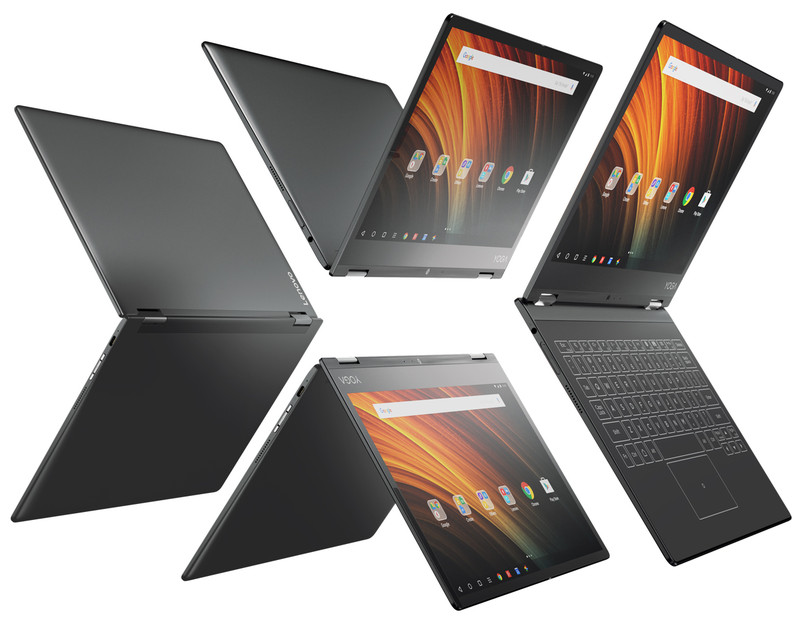
The Yoga Book’s keystone feature, the Halo keyboard, makes a return on the Yoga A12, which the company says has been improved and thinned out since its first iteration. That the Yoga A12 runs Android out of the box is a given, but this version will not come with a Windows option unlike its more expensive counterpart. There’s also no stylus input support, which leant the Yoga Book something of a productivity win with a certain demographic, but the tablet does have a 360-hinge that can be positioned in many ways.
The Yoga 12 goes on sale Friday, February 8 for $299 in one of two colors: Gunmetal Grey or Rose Gold.
See at Lenovo
Lenovo’s latest Android tablet is really a budget laptop
The tablet market is increasingly skewing toward laptop replacements, but what if you want a replacement for a low-cost laptop? Lenovo thinks it has the answer. It’s introducing the Yoga A12, a 12.2-inch tablet that’s really a budget convertible laptop for the Android crowd. Think of it as a lower-priced but larger alternative to the Yoga Book. You won’t find the earlier model’s pen input or Windows 10 option, but you’ll still get a very portable design (it’s 0.21 inches thick at its slimmest point) that can fold into a slate when you’re watching Netflix, or a laptop when you need to get work done. The trick, as with the Yoga Book, is a flat touch-sensitive keyboard that eliminates some of the usual physical bulk. We found the Book’s keyboard hard to get used to, but it might be easier on the A12’s larger, more comfortable surface.
The A12 still has an Atom x5 chip powering things, although Lenovo has cut the memory and storage in half to 2GB and 32GB respectively. You’ll also get a 13-hour claimed battery life. This is clearly meant more for browsing and the occasional productivity app than someone intending to use the tablet as their main computer. You might not mind so much when you see the price, though: the new Yoga will start at $299 when it goes on sale February 8th. That’s just inexpensive enough that it could be a compelling alternative to a conventional entry-level laptop — it doesn’t have the performance or software of Windows portables, but it’ll be easier to carry and more flexible.
Source: Lenovo
Google clamors for voice tech recognition, according to CEO
Why it matters to you
If Google doesn’t come up with a new strategy beyond on-screen ad revenue, it could lose massively to competitor Amazon as voice-based computation takes lead.
Sundar Pichai insists the company has relevancy in voice-based computing, despite Amazon’s upper hand. The Google CEO told Wall Street analysts that Google wasn’t threatened about the company’s development trajectory for voice-based technologies at the fourth-quarter’s earning conference on Thursday, Business Insider reports.
No details were given during the call in terms of a competitive ad-business plan for Google to gain footing in the voice-based software and devices game it’s currently losing to Amazon.
More: Google’s teleconferencing drone patent has now been made public
Heavily relied upon screen ads were the topic of scrutiny, since neither voice-activated devices such as Amazon Echo or Google Home use screens. Pichai said Google won’t nix screens entirely from the company’s voice-based technologies.
Sundar says that voice will be only “one mode,” and that “Users will have many different ways by which they interact” with computers, reports Business Insider.
Ad revenue is the biggest obstacle Google faces. It’s questionable whether the company can sustain without it.
“We think about it from a long-term perspective,” Pichai said. “So I see more opportunity than challenge when I think about voice search.”
When asked about comparative sales lagging behind rivalry Amazon Echo, Pichai reminded RBC Analyst Mark Mahaney that Google Home has only been on the market since November, reports Geek Wire.
“We just launched it in Q4,” said Pichai, as reported by Geek Wire. “We had a very strong quarter there and we are going to invest a lot in it over 2017. It’s very early days. When I look at what it would take to do voice search well, our years of progress … in areas like natural language processing come into play and I think there’s a lot of work ahead to make all of this work well for users. This is a core area we have invested in for the very long term. So I feel very comfortable about how this will play out in the future.”
 AIVAnet