


Just hope it doesn’t ring: Hitler’s personal phone is up for auction
Why it matters to you
If you’re a history buff with deep pockets, this is a unique item that is unlikely to go on sale again.
Alexander Historical Auctions, located in Maryland, has a unique lot available on its website right now: Adolf Hitler’s personal bunker phone. The chipped, red, rotary handset was taken right from the German leader’s bunker following the capture of Berlin in 1945 and is expected to fetch as much as $300,000 from a specialist collector.
While most people might shy away from items owned by history’s most notorious war criminal, some like an off-beat, creepy vibe with their collectibles. And there’s no denying that this is an important piece of history.
The story of how the phone ended up on the auction block is an interesting bit of history in itself, though. Following the Allied occupation of Berlin, Brigadier Sir Ralph Rayner entered the city and was given a tour by the Soviets. Purportedly, they offered him Eva Braun’s phone as a souvenir, but eventually offered him this one instead, when he claimed his favorite color was red.
More: The ‘world’s first sports car’ has just auctioned for $650,000
That phone went home with him, and Rayner continued as a British politician after the war. When he eventually died in 1977, the phone was passed on to his son, Ranulf, who is now auctioning off the one-of-a-kind artifact because the insurance costs for it have become too great. He hopes that a museum will purchase it and preserve it for posterity.
In his interview video, Ranulf explains that Hitler used the phone as a portable device, taking it everywhere with him. It was used not only in the bunker, but in trains and cars and in his field headquarters. As the auction listing points out, an argument could be made that this phone is one of the most macabre historical pieces in the world, having borne the wishes of a man who ordered the extermination of millions.
To confirm the device’s authenticity, the auctioneers have collated reports from Hitler’s own personal telephonist, as well as historical images of Brigadier Rayner and the handset in newspapers and private collections.
Along with the handset itself, the lot comes with the original case that Sir Rayner used to bring the phone back from Germany, along with some of its wartime tags and stickers.
Just hope it doesn’t ring: Hitler’s personal phone is up for auction
Why it matters to you
If you’re a history buff with deep pockets, this is a unique item that is unlikely to go on sale again.
Alexander Historical Auctions, located in Maryland, has a unique lot available on its website right now: Adolf Hitler’s personal bunker phone. The chipped, red, rotary handset was taken right from the German leader’s bunker following the capture of Berlin in 1945 and is expected to fetch as much as $300,000 from a specialist collector.
While most people might shy away from items owned by history’s most notorious war criminal, some like an off-beat, creepy vibe with their collectibles. And there’s no denying that this is an important piece of history.
The story of how the phone ended up on the auction block is an interesting bit of history in itself, though. Following the Allied occupation of Berlin, Brigadier Sir Ralph Rayner entered the city and was given a tour by the Soviets. Purportedly, they offered him Eva Braun’s phone as a souvenir, but eventually offered him this one instead, when he claimed his favorite color was red.
More: The ‘world’s first sports car’ has just auctioned for $650,000
That phone went home with him, and Rayner continued as a British politician after the war. When he eventually died in 1977, the phone was passed on to his son, Ranulf, who is now auctioning off the one-of-a-kind artifact because the insurance costs for it have become too great. He hopes that a museum will purchase it and preserve it for posterity.
In his interview video, Ranulf explains that Hitler used the phone as a portable device, taking it everywhere with him. It was used not only in the bunker, but in trains and cars and in his field headquarters. As the auction listing points out, an argument could be made that this phone is one of the most macabre historical pieces in the world, having borne the wishes of a man who ordered the extermination of millions.
To confirm the device’s authenticity, the auctioneers have collated reports from Hitler’s own personal telephonist, as well as historical images of Brigadier Rayner and the handset in newspapers and private collections.
Along with the handset itself, the lot comes with the original case that Sir Rayner used to bring the phone back from Germany, along with some of its wartime tags and stickers.
‘Windows Cloud’ looks like Microsoft’s answer to Chrome OS
To date, Microsoft has had a simple strategy for fighting Chromebooks: make low-cost Windows laptops that negate Google’s price advantage. However, it now looks to be extending that strategy to the operating system itself. Both Windows Blog Italia and Thurrott have gotten a peek at Windows Cloud (or Windows 10 Cloud, depending on who you ask), a spin on Windows 10 that appears focused on beating Google’s Chrome OS. It largely behaves the same as Windows 10, but its stand-out feature is what it doesn’t do — namely, run conventional Windows apps.
At least right now, Cloud will only run Universal Windows Platform apps found in the Windows Store. Try to run anything else and you’ll get a stern warning. Most likely, this is to court schools and other institutions who see Chrome OS’ lack of native apps as a security advantage. Educators may be more likely to stick to Windows PCs if they know that kids can’t infect a machine with malware or install an unapproved game. It’s possible that Microsoft’s “Centennial” bridge (which brings Win32 apps to the Windows Store) should work, but there are conflicting reports about compatibility.
It’s not certain when Windows Cloud might show up. With that said, there are mentions of the OS in current Windows Insider preview releases. That suggests Microsoft intends to release Cloud relatively soon, and could ship it (or just talk about it) when Windows 10’s Creators Update arrives in the spring. The timing would certainly be right. Schools tend to prepare their tech budgets months before the start of classes, and Microsoft will need Windows Cloud-equipped PCs on the market very soon if it’s going to lure the educational crowd away from Google’s offerings.
Via: ZDNet, The Verge
Source: Windows Blog Italia (translated), Thurrott
Dark net black markets are turning to bug bounty programs
Dark net black markets are taking a leaf out of many legit companies’ book and turning to bounty hunters to find security flaws in their systems. Hansa Market is one of them. According to CyberScoop, the marketplace, which brought in $3 million last year, has launched a bug bounty program offering rewards worth up to 10 BTC or around $10,000. Considering marketplaces like Hansa sell drugs, illegal firearms, log-ins and other data, the websites likely want to amp up their security measures to protect their sellers from law enforcement. They also likely want to protect all the log-in/password dumps and other data for sale from other hackers who might break into their system to steal them.
In fact, Hansa launched the program after a bug that infected AlphaBay, the biggest active online black marketplace, allowed outsiders to read private messages on the site. Hansa’s spokesperson told CyberScoop that they’ve received reports about “numerous non-critical and simple bugs” since the program launched on January 30th. Those are worth 0.05 to 1BTC or around $500 to $1,000. The biggest bounty worth 10k is reserved for “vulnerabilities that could severely disrupt HANSA’s integrity.”
However, Sarah Jamie Lewis, a privacy researcher who worked on Dark Web security tool OnionScan, doesn’t believe bug bounty programs could help dark net websites much. She says they need to go much deeper if they want to solve their security problems:
“The problems pervading onions [the nickname for websites accessed on the Tor network] are caused by bad assumptions at the software design level — the reliance on web technologies designed for an Internet without consideration for privacy. Bug bounties are only a patch, what we really need are new privacy-oriented software stacks, servers, blog platforms, etc.”
Source: CyberScoop
Google ordered to turn over foreign emails
So much for Microsoft’s court win providing a neat and tidy defense against law enforcement requests for foreign data. As part of an FBI fraud investigation, a Philadelphia judge has ordered Google to obey search warrants for emails stored on servers outside the US. The court ruled that transferring the messages to the US didn’t count as seizing foreign information, since there was no “meaningful” damage to the email account holder’s “possessory interest” in that data. The privacy violation occurs when emails are disclosed in the US, the judge says.
Needless to say, Google isn’t pleased. It directly cited Microsoft’s victory as precedent, and argued that it had obeyed the warrant by handing over info that was stored in the US. The company believes that the judge “departed” from that precedent and intends to appeal the decision.
It wouldn’t be surprising if the appeal works given that Microsoft’s own case managed to survive legal scrutiny. It successfully contended that users outside the US would assume that their data was governed by local laws, and that police couldn’t override those protections just because an American company is hosting the data. Either way, the ruling shows that there isn’t yet a final answer on handling data beyond US borders.
Source: Reuters
Lady Gaga’s Super Bowl show will tout ‘hundreds’ of drones
It’s easy to be cynical about the Super Bowl’s halftime show: unless you’re a fan of the artists, it’s often an excuse for a bathroom break… or at least, to gawk at the ridiculousness of the American cultural zeitgeist. Lady Gaga might give even the jaded a reason to tune in this year, though. CNN sources hear that the “Bad Romance” singer (who’s rather fond of tech) is planning a show using “hundreds” of lit-up drones, marking the first time that robotic fliers have graced the Big Game. Gaga and crew aren’t spoiling the show, but people in the Houston area have witnessed drones swarming over the football stadium like a horde of glitzy UFOs.
One thing’s for sure: those will be the only drones you’ll see flying anywhere near the field. The FAA has established a “No Drone Zone” in a 34.5-mile radius around NRG Stadium. That’s not at all shocking given the FAA’s aversion to seeing drones near sporting events, but it also means that Gaga is getting a big exception. Clearly, you get to fudge the rules a bit when you’ve sold millions of albums.
And you might even know what to expect besides Ms. Germanotta’s flair for dramatic, socially conscious singing. Remember how Intel recently unveiled a drone built just for complicated light shows like this? There’s no guarantee that you’ll see those exact bots, but they’re the most likely candidates. Whoever’s behind the tech, let’s just hope they’ve accounted for the mountains of wireless traffic at the game — falling drones could make the performance a little too memorable.
Via: The Verge
Source: CNN Tech
Vtech Star Wars Watch and Stormtrooper Camera: Our first take
Kids get to have all the fun! These smart Star Wars toys made us want adult versions for ourselves.
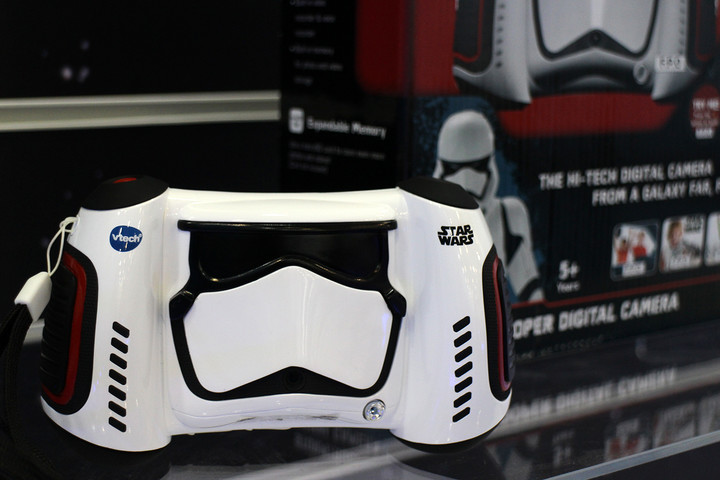
Another year, another Star Wars movie, which means plenty of new Star Wars merchandise will be released between now and the release of The Last Jedi’. It’s not all collectibles or spurious branding exercises, as these two cool new products from kids-tech company Vtech prove. We tried out the new Star Wars Watch and Star Wars Stormtrooper camera, and conclude they’re just the thing for any young Star Wars fan.
The watch comes in either BB8 or First Order trooper color schemes with matching straps, and although isn’t an actual smartwatch — it doesn’t connect to your phone or have GPS tracking for your kids — it does come with some cool features. The most notable is a camera, that not only takes photos, but video, too. No, it’s not going to challenge the one on your phone, but it’s not meant to. This is for fun. The screen is touch operated, and there is a menu button on the side of the device, making switching modes simple.
While the watch is fun, the camera is even better.
You can play games on the small screen, plus it has a built-in accelerometer that plays a lightsaber sound effect with every sweep of your arm. The volume isn’t irritatingly loud, which will please parents, but probably not kids. A swipe across the screen changes the watch face, and a tap changes the background. Like many other Star Wars products, even the packaging looks great.
You can see in the photos I’m wearing the watch, and am definitely not the target age group, but it’s still pretty large, and I could easily control the touchscreen. Now, I’m not suggesting many adults will wear it (there will be some, obviously), but just be aware it’s a large watch and may be pretty big on kids’ wrists.
Stormtrooper camera
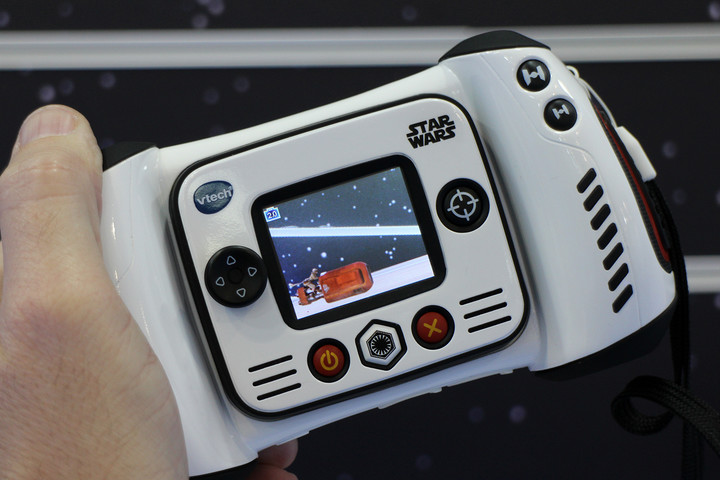
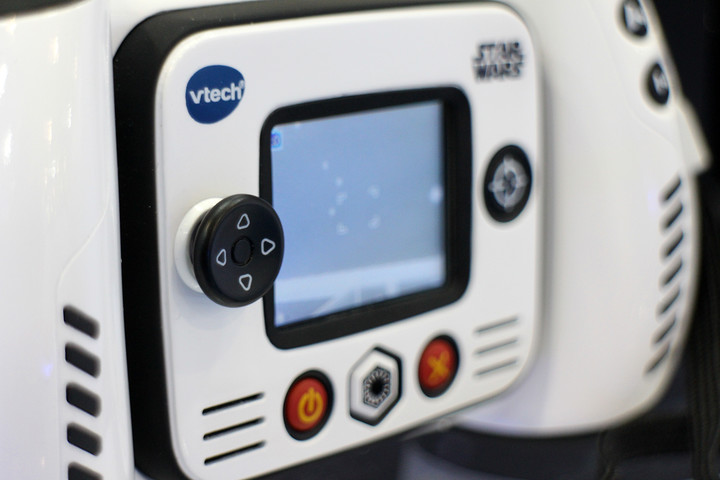
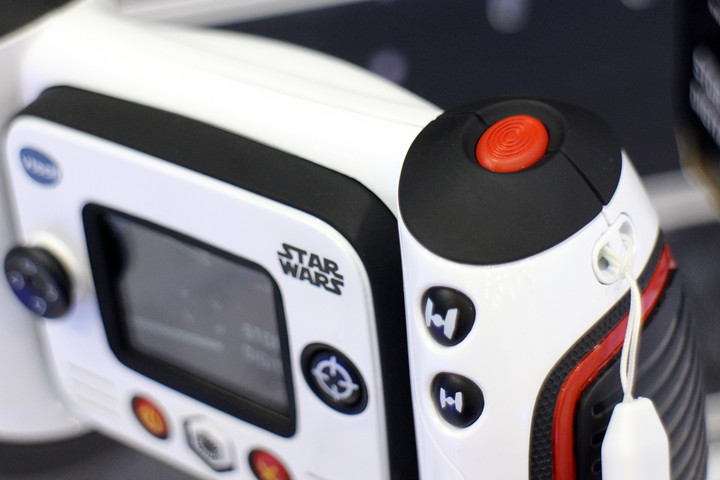
However, while the watch is fun, the camera is even better. Chunky grips on either side of the small screen mean even little hands will find it easy to hold, while the tough body should resist a few accidental drops. It takes photos and video with the 2-megapixel sensor, and the results are shown in the display. However, it’s the augmented reality games that make the camera way more fun than the watch.
 Andy Boxall/Digital Trends
 Andy Boxall/Digital Trends
 Andy Boxall/Digital Trends
 Andy Boxall/Digital Trends
There are several, but we loved the fighter battle, where AR Imperial ships appear on the screen, ready to be shot down. The sound effects are spot on, the game’s not too difficult, and the buttons are large and easy to press. We spent way too long “testing” the game, and have the feeling young Star Wars fans will do exactly the same.
Vtech will put both the watch and the camera on sale after July this year, and while it expects the watch to be sold in the U.K. and the U.S., the camera is sadly not going to be released in the U.S. at this time. The watch will cost around $60, or about 50 British pounds, the same price as the Stormtrooper camera.
Highs
- Camera AR games are fun
- The watch has an unusual camera feature
- Plenty of Star Wars fun
Lows
- Camera isn’t scheduled for U.S. release
- No version for adults
Here’s 15 weird Japanese toys that should’ve never existed in the first place
Japan is a nation with an undeniably unique culture. The art, technology, and cuisine the country produces posses certain attributes that are distinctly Japanese. That said, it’s often easy to tell when something is made in Japan. While Japanese culture is often very fun and expressive, it can also be strange to an outsider who has little knowledge of the region’s customs. Certain taboos that exist in American culture are absent in Japanese culture, and vice versa. So certain things that might not fly here in the States — such as a children’s toy modeled after a dead cat, for instance — are a normal occurrence in Japan. Still, the 15 toys below have left us scratching our heads.
More: The 20 best tech toys for kids will make you wish you were 10 again
Editors note: Some may find a handful of the products below offensive, or graphic in nature. Please keep this in mind if you intend to read on.
Bandai Periperi Infinite Shipping Envelope Keychain Toy

Bandai’s offering is exactly what it sounds like: a keychain that allows you to experience the pure tactile nirvana that is opening an envelope. This little gadget isn’t a one trick pony, however, as there’s also a speaker on the bottom that produces the rich sound of an envelope opening with each subsequent “tear.” For about $10, you too can have the limitless enjoyment of opening an envelope without the risk of getting a paper cut. Sounds like a win-win.
Pachi Pachi Clappy

The Pachi Pachi Clappy takes the grunt work out of the act of applauding. Simply squeeze the trigger on your Clappy and the two plush hands will slap against one another. Yes, that’s right, thanks to the creators of the Pachi Pachi Clappy, the act of applause is now a low-impact endeavor. Is this at all necessary? No, but at least we now have the answer to the age-old Zen riddle: What is the sound of one hand clapping?
Barack Obama Action Figure

There are many of people out there who like to call President Obama a puppet, and Japanese manufacturer Gamu Toys has seemingly taken the ramblings of conspiracy theorists and made them a reality. The Barack Obama action figure comes with several interchangeable heads and hands, as well as full articulation, so you can deck out the 44th President of the United States with an assortment weapons and position him in whatever badass pose you see fit for our nation’s previous leader. The Obama presidency may have come to a close, but that doesn’t mean ol’ Barack “The Chop” Obama is done slaying injustice two katanas at a time.
Kappa Kick

All the fun of Russian Roulette with none of the mess! This gun-shaped toy is actually a hippo that will kick you in the head if you happen to pull the (un)lucky trigger . We’re a bit concerned at the idea of Russian Roulette being marketed to kids, no matter what adorable animals the toy is centered around. I mean, when’s the last time you sat down to watch The Deer Hunter?
Robot Cat

For those who have cat hair allergies, and don’t mind the cold dead stare of a machine, you’re in luck. The Yume Neko Venus Robotic Cat will give you the sensation of petting a tuft of moving, purring fur with none of the added benefits of owning a real cat whatsoever. No shots required.
Did your last laptop break too soon? Here’s where you can find a reliable replacement
When looking for a new laptop, you want a machine that you won’t have to drag back in for repairs for at least several years. Reliability and dependable performanice rank high on buyer’s lists, but which brands are the best?
Related: Looking to buy a new laptop? The answer is Dell’s XPS 13
To find the answer for all you laptop shoppers, we’ve scanned the pages of Consumer Reports, studied surveys of how often laptops were taken back for repairs, read expert opinions, analyzed crowdsourced voting, and much more. Overall, we’ve piece together a consensus on the most reliable brands, and why they work.
Type of laptop
Before we start naming names, we’re going to point on a general rule: the smaller the laptop, the higher the failure rate appears to be.
There are several reasons for this. Small laptops are harder to take apart and repair yourself, so official repairs may be more common. They are also more portable, and therefore more likely to be dropped or banged around. There could also be manufacturing reasons for their shorter lifespans.
So, if you want an especially durable laptop, go for larger models when possible.
Most reliable: Apple

MacBook Pro 13 with Retina
Bill Roberson/Digital Trends
If there’s one thing that nearly everyone agrees on, it’s that Apple laptops are the most reliable of the bunch. When you buy a MacBook, you know what to expect, and that rarely involves failures or returns. Part of this is due to Apple’s solid design philosophy. MacBooks, Airs, and Pros are consistently growing thinner and more powerful, but the overall design style remains the same. The aluminum frame and tightly packed electronics also likely help reduce damage and failure rates. In fact, Apple’s devices tend to get more reliable with later generations, as design becomes tighter. Removing ports, for example, is not a popular move — but it does decrease what can break.
It’s also worth noting that Apple does many of the smaller things well. The keyboards are snappy, pleasant to use, and nigh unbreakable under usual circumstances. The battery life of Macbooks tends to be high, too, and doesn’t suffer from swift performance drop-offs or fluctuation. Displays issues tend to be rare, and in Consumer Reports, Apple beat out nine other laptop brands when it came to needing repairs within the first three years of ownership.
On the other hand, MacBooks are a definite blow to your wallet, ranging from $1,000 to $1,800 for the most popular models. That’s a lot of money for the average laptop buyer. Despite the high price, the default warranty lasts only one year, as with other more affordable brands. But Apple has on multiple occasions offered free warranty extensions for common manufacturing issues, a practice other brands rarely emulate.
Available at: Apple Best Buy
Second Pick: Dell

Dell’s work, particularly in the ultrabook field, had yielded an incredible new crop of ultraportable laptops that work great, have powerful specs, and don’t give up the ghost without a fight. If you need a PC for work or school, and want it to last for as long as possible, Dell’s machines are a great choice, especially with their latest XPS models that do a little of everything, and do it anywhere. That includes the latest screen resolutions, connections, and software.
More: The best laptop you can buy
Another important reason Dell gets such high marks for reliability isn’t because the company’s computers never break–they have a good track record, but not as good as MacBooks–but because Dell’s customer support is easily the best you’ll find outside of Apple. If something goes wrong, a quick customer service call with Dell is more likely to yield a solution, or at least a repair plan, than with other brands. Sometimes the most important factor in reliability isn’t the computer itself, but the company you are dealing with.
Available at: Dell Microsoft
Third Pick: Asus

Asus ZenBook UX305UA
Bill Roberson/Digital Trends
If you want an extra-reliable computer, but don’t want to pay too much for it, then you’ll be pleased to see that Asus also makes it on our list of the most reliable laptop brands. The company has consistently scored well in surveys, though it usually doesn’t take top marks.
Asus computers tend to be sleeker and lighter than a lot of brands on the market, so if you are less interested in a desktop replacement and more interested in a portable option, this is the path to follow. Asus also tends to lean toward extremes, with laptops of many varying sizes. There’s a good deal of experimentation and joint ventures in this brand, which makes it an interesting option to explore.
More: Asus achieves ultrabook enlightenment with the near-perfect Zenbook UX305
The downside to Asus is its customer support, which is hit-or-miss. The company receives average to below-average marks in customer service surveys we’ve seen. Web support is a particular sore spot. Navigating the Asus website can be confusing — though the company is not the worst in this regard.
Available at: Amazon Asus Newegg
Runner-up: Toshiba
Toshiba is in an interesting position when it comes to laptop offerings. On one hand, the company has tied with Asus in some surveys as being one of the most reliable brands around, with some of the fewest repairs required. On the other hand, Toshiba has also scored very poorly in other brand studies, due in part just-okay customer service, and product models that haven’t made an effort to stand out from the crowd.
However, there are signs that Toshiba is increasing laptop quality and focusing even more on durability – they even devoted a section in a 2017 press release to talk about the durable chassis and honeycomb reinforcement of their latest models.
Toshiba’s Portege and Tecra laptop lines tend to be workhouse-like product lines, more affordable versions of common business laptops. They include the latest features (fingerprint sensors, USB Type-C, etc.), but focus on lower prices than other brands, making them similar to Asus in many ways, only with fewer choices. If you’ve looked at other business-oriented laptops and haven’t found anything in your price range or ideal feature set yet, give Toshiba a try.
More: Toshiba unveils a robust 1-in-1 PC aimed at professional users
Available at: Amazon Toshiba
Final note: Extended warranties
When it comes to repairs and malfunctions, one of the most important computer components is that warranty document. So, what’s the deal with warranties today? Basically, don’t worry too much.
Extended warranties, as a general rule, exist to make extra money for companies. Buying one doesn’t tend to do much good — only about 8 percent of people who have extended warranties ever use them, according to Consumer Reports.
Additionally, the normal warranty that comes with a new machine is likely to cover around 75 percent of common repairs or problems anyway. Yes, it will suck if you don’t buy the warranty and you happen to have a problem. But, over the long haul, the extended warranty tends to cost more than it’s worth.
This article was updated on January 31, 2017 with the latest survey information, and a runner up category was added.
10 tips to free up storage space on your Android phone or tablet
Many people save cash by opting for the lower-storage model when they buy a new Android smartphone or tablet. Manufacturers tend to overcharge for extra storage, so it often seems like a good place to save money. But apps and games are getting bigger all the time, and we all like to take photos and shoot video. The unfortunate truth is that 16GB, or even 32GB, of storage can fill up alarmingly fast. What do you do when there’s no room left on your device? How do you free up additional space? Our guide has the answers.
More: The best Android apps for almost any occassion
Use a MicroSD card

One of the easiest ways to increase storage space on your Android device is to buy a MicroSD card. Many smartphone manufacturers have ditched the slot, but if you’re lucky enough to have one, a MicroSD card is definitely the easiest way to add storage space to your device. If you can use a MicroSD card, you can snag an extra 64GB for less than $30. It’s important to choose a fast card with decent read and write speeds, however. Don’t be tempted to pick a card solely on the price tag, and make sure that you get a Class 10 card.
You won’t be able to move every app onto your new card, but with older versions of Android — Android 5.1.1 Lollipop and earlier — you can probably move some. To do so, go to Settings > Apps and tap on each app listed under Downloaded. Then, tap Move to SD Card, if the choice is available. Keep in mind that some phones house the option to Transfer data to SD card under Settings > Storage.
If you’re running Android 6.0 Marshmallow or later, then you can also choose to format your card as internal storage during the setup process by selecting Use as internal storage. This is a good idea if you intend to keep the card permanently in your Android device, however, this also means that it won’t work with your PC or other devices. If you want to remove it and use it to transfer files, then opt for the Use as portable storage option. If you do format it as internal storage, then Android will automatically copy some apps and other data onto it. The operating system will also save new apps and files onto it by default when it decides that’s the best option.
Additionally, devices running Android 6.0 Marshmallow and later feature built-in file management, which you can access via Settings > Storage > Explore. If you have a device running an older version of Android, then you’ll need a file manager app such as ES File Explorer. You may also find it easier to simply plug your device into your computer or laptop and drag and drop files from your phone to your computer and then onto your MicroSD card. This is a good opportunity to back them up, too.
 AIVAnet