


Pebble introduces Quick Looks, Fast Actions and more
Pebble has introduced version 4.0 of its Pebble Time software focusing on speed and making it work better for you. From a faster launcher with app glances to an all-new Pebble Health app, there is a whole lot of changes in this update. The new health app brings redesigned cards that give quick glances to your stats, and from there you can dive deeper into the stats if you want. The timeline has quick views and the 4-button quick launch lets you access your favorite apps in just seconds.

Pebble detailed some of the update features as:
- All-New Pebble Health App. Press Up from your watchface to review your Pebble Health activity and sleep. Enjoy redesigned cards for quick glances at your current step and sleep performance. Press Right from each activity to dive deeper into your historical performance data.
- Timeline with Quick Views. Press Down from your watchface for current and future views of your personal Timeline. Gaze up to three days into the future. Enjoy Quick Views—peeks at what’s coming up next—from your watchface. Press Down on a Quick View to see more about it, or press Back to dismiss it.
- Better, Faster Launcher with App Glances. Press Select from your watchface for a new Launcher menu that’s built for speed. The banner design shows more items at once. App Glances show preview info without even opening an app.
- 4-Button Quick Launch. Your favorite Pebble apps are just a press and hold away from your watchface. Assign a Quick Launch favorite to the Up, Down, Back, and Select buttons and blast off.
- Built for Speed. New system animations make the overall watch experience faster.
You can grab the latest Pebble Time update from Google Play now. Once running the latest version of the app, you can update the software on your Pebble by launching the app and heading to Menu » Support » Update Your Pebble.
Best cases for Galaxy Note 5

What’s the best case for Galaxy Note 5? Here are a few of our favorites!
Your Galaxy Note 5 is a big phone, which means more phone to love, but more phone to break. Protect it with a decent case – from rugged, armored types to thin, low-profile cases, there are a ton to choose from.
We’ve curated the best of the best, just for you.
UPDATE: We’re constant researching the absolute best cases for the Galaxy Note 5. This latest update on August 30th, 2016, represents the best of the best.
- Abacus 24-7 wallet case
- Ringke Fusion Crystal
- Poetic Affinity
- SUPCASE Heavy Duty Case and Holster
- Spigen Slim Armor Case
- Urban Armor Gear Case
- Spigen Ultra Hybrid
- Caseology Wavelength Series
Abacus 24-7 wallet case

Your Note 5 is a BIG phone and there isn’t much sense in carrying around both a wallet and your phone, so combine the two with the Abacus 24-7 wallet case!
You have three spots for cards and a little slot for some cash, so grab your essentials and ditch the extra bulk in your pockets. The Abacus 24-7 is made of synthetic leather, which makes it nice and flexible, so folding it back into a stand is easy and hands-free viewing is comfortable – you won’t have to constantly adjust.
Comes in black, brown, blue, or purple.
For around $10, you really can’t go wrong with this one from Abacus.
See at Amazon
Ringke Fusion Crystal

The Ringke Fusion comes out on top for a solid clear case for the Galaxy Note 5. Not only is this hard case slim, but it shows off the Note 5’s good looks through its transparent plastic. Although it features a scratch resistant coating, it’s likely you’re going to pick up some imperfections on the case over time, but better on the case than your Note! You’ll find TPU plugs on the bottom that keep debris from infiltrating your ports, and a bonus screen protector is included in case you haven’t picked one up yet.
See at Amazon
Poetic Affinity

Poetic’s hybrid Affinity case has a hard polycarbonate back with a TPU bumper around the edge, so you’re covered from bumps, dings, scratches, and drops all around. The raised bezel on the front prevents your Note 5’s screen from getting scratched if you lay it face-down, and you still have access to all buttons, ports, and the S Pen.
You can also add a sense of your personal style to your Affinity, since you can opt for black, blue, pink, or clear TPU.
The TPU bumper around the edge of your Note 5 is ridged, allowing you to securely grip the phone and making it pretty hard for it to slide out of your hand.
If you want to maintain your Note 5’s natural beauty, but also want a protective case with a little something extra in terms of style, go for the Poetic Affinity.
See at Amazon
SUPCASE Heavy Duty Case and Holster

Just because you want superior protection for your Galaxy Note 5 doesn’t mean you need to drop big bucks on an OtterBox. SUPCASE’s Heavy Duty Combo provides that next-level protection at a fraction of the price. A built-in screen protector shields your display from scratches and the polycarbonate shell with a flexible TPU enhances grip while handling impacts like a boss. Its rugged design looks tough in any color — especially matched with the included belt clip holster.
See at Amazon
Spigen Slim Armor Case

Rocking a built-in kickstand and dual-layers that do a lot for impact control, the Spigen Slim Armor Case for Galaxy Note 5 is a great choice for protection and functionality. The TPU core helps to enhance grip around the edges while the smooth polycarbonate shell looks and feels great in the hand. While side buttons are raised, they sit flush with the rest of the case to retain a slim design. The Slim Armor Case comes in gunmetal, champagne gold, metal slate, or violet.
See at Amazon
Urban Armor Gear Case

Offering a rugged design that doesn’t bulk up your Galaxy Note 5 any more than it should is the Urban Armor Gear Case. This slim hard cover snaps around your new Note and features a feather-light way to protect against even some of the harshest drops. Constructed to meet military standards, the hybrid design features both TPU and polycarbonate materials fused into one solid solution. There’s plenty of texture to enjoy on this case along with reinforced corners for optimal impact control. Colors include black, clear, gray, orange, red, and white.
See at Amazon
Spigen Ultra Hybrid

The Spigen Ultra Hybrid case is the perfect blend of a hard polycarbonate back and flexible TPU bumper that makes for excellent protection from bumps and scratches and helps to prevent shattering, thanks to the shock-absorbing air cushions in each of its corners.
The best part of this clear case is how well it fits – it feels sturdy and strong on your Note 5 and fits very snugly, so you don’t feel your phone moving around inside.
Don’t worry about the smooth polycarbonate either – the TPU bumper is textured and won’t slip out of your hand.
If you’re after a well-fitting clear case that amps up protection better than some other clear cases, then check out the Spigen Ultra Hybrid.
See at Amazon
Caseology Wavelength Series

This unique hybrid cover has grip written all over it. The Caseology Wavelength Series Case for Galaxy Note 5 adds a bit of flare to your device while shielding it from impacts and scratches. There’s a durable polycarbonate frame that’s smooth to the touch, but the matching TPU that surrounds most of it is what adds a firm grip when held. Side buttons are raised through the plastic frame for an easier press, while the camera and ports are left open. The Wavelength Case comes in black, pink, navy blue, or mint.
See at Amazon
What’s on your Note 5?
Are you using a great case for your Note 5 that I didn’t mention? Let us know in the comments below!
Google might axe Nexus brand, including for new HTC-made phones
Google’s next Nexus smartphones won’t actually carry the “Nexus” brand.
According to Android Central, Google will ditch the Nexus branding for its upcoming, HTC-made smartphones, with the idea that it will market the duo under a different name and really focus on the Google brand instead. Keep in mind Android Police also said earlier this year that Google would ditch Nexus from the 5-inch and 5.5-inch devices, codenamed Marlin and Sailfish, respectively, and would instead use its own “G” logo.
Google usually only uses its brand name for software services, so the change would be a dramatic shift. And it’s currently unclear why Google would go that route, though the report mentioned Google plans to give the HTC phones a special version of Android Nougat rather than the standard version of the latest Android, which always ships with Nexus devices. It’s also unclear what makes this special version different.
Does this mean that Google is killing the Nexus brand? All we know for sure is that Sundar Pichai, Google’s CEO, said at the Code Conference in June that Google plans to become “more opinionated about the design of [Nexus] phones”, adding that the company is hoping to add more features on top of Android on Nexus phones in the future. So maybe that’s what Google is now doing with these upcoming HTC phones.
Android Central seems to think the end of Nexus is near, and that Google has begun to forge a new path in terms of phones that it helps develop to showcase both its design chops and mobile operating system.
The resurrection of ‘Allison Road’
When Chris Kesler was six years old, he sat just outside his cousin’s room and peered at the flickering TV through a crack in the doorway. On-screen, in grainy VHS quality, a murderous red-haired doll in Cabbage Patch overalls laughed as it attempted to murder anyone in its path. Kesler was enraptured. He technically wasn’t allowed to watch Child’s Play, but he was drawn to its terror the way other kids gravitated toward Saturday morning cartoons.
“I was scared for days, but there was something really fascinating about it,” Kesler recalls. “I think one of the major draws of horror is that there’s a whole range of emotions that you can experience from the comfort and safety of your home.”
Kesler’s fascination with terror followed him into adulthood. He’s the creator and lead developer of Allison Road, a first-person horror game that fans have been looking forward to since its reveal in late 2015. Allison Road gained early traction largely because of its similarities to P.T., a high-profile mini-game from Hideo Kojima and Guillermo del Toro that served as the prequel to Silent Hills. The Silent Hill franchise is revered among horror fans, and at the time, its resurrection from two masters of storytelling was exciting news.
However, Silent Hills was canceled shortly after P.T.’s popularity crescendoed in mid-2015, leaving fans hungry for more.
Here’s where Allison Road comes in. It expands on the format laid out by P.T., which is a first-person horror game set solely in a tidy suburban house. In P.T., players loop around and around the same series of hallways as they become distorted with blood, bugs and a demonic presence, the story dripping in as new clues appear. Similarly, Allison Road is a first-person game set in a single house, but it takes advantage of the full floor plan, allowing players to explore every room in any order as a sinister, otherworldly being slowly consumes everything.
Aside from the setting and perspective, Allison Road and Silent Hills have one more thing in common: They’ve both been canned.
Allison Road hit Kickstarter in September 2015 and was immediately heralded by horror fans as P.T.’s second coming. In Allison Road, players wake up alone in a British townhouse and have to figure out what happened to their family, investigating all of the creepy noises, unsettling visuals and demonic specters that pop up along the way. Early trailers showed a polished and robust 3D environment packed with dark hallways and accessories to interact with, complete with spine-tingling audio direction.
The Kickstarter campaign raised £146,000 ($226,000) before Kesler canceled it in October. This was good news: Allison Road had picked up a publisher, Worms developer Team17, which meant funding was handled. It seemed like an ideal situation, and Kesler celebrated it as such in the game’s final Kickstarter update.
However, by June 2016, the deal had fallen apart and Kesler shut down development on Allison Road altogether.
“We have reached a mutual agreement to end our collaboration on publishing Allison Road under Team17’s Games label,” Kesler wrote in a Facebook post. “Sometime [sic] things pan out differently than expected as game development and publishing have so many layers of complexity.”
Kesler took a few months’ break from the public eye. Allison Road was his passion project, and its cancellation wasn’t bittersweet — it was only bitter.
“I was really sad about it, to be honest,” Kesler says.
He picked up his day job as a concept artist once again and continued quietly working on Allison Road in his spare time. Kesler tweaked the story and figured out how big the game could realistically be if he continued working on it with limited resources.
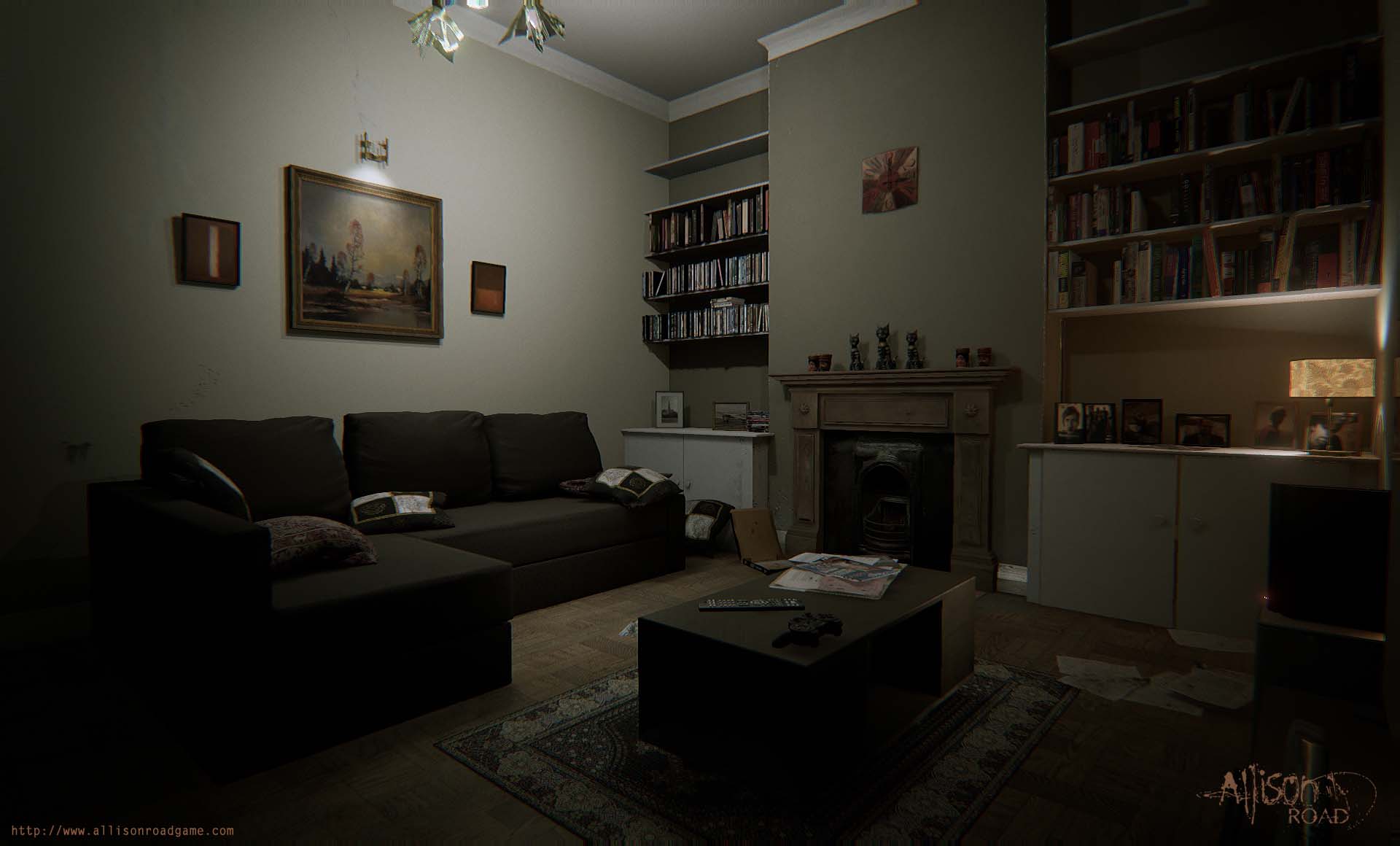
And then, on August 22nd, he felt confident enough to bring Allison Road back from the dead. The game is in development again with Kesler’s new studio, Far From Home, which he co-founded with his wife.
“Because this game started as a hobby project, I feel quite attached to it,” Kesler says. “The thing with personal projects is that you don’t really do them because you have to, so to speak. You do them because you want to. That makes a huge difference when it comes to pushing through slightly more challenging times.”
Without Team17’s backing, Allison Road has to be smaller in scope, but Kesler doesn’t see that as a downside.
“Better to have something shortish but high-quality and tight, rather than artificially long and then in the end low-quality and boring,” he says.
Allison Road has come full circle, in a weird way. Kesler is now working on it in his free time, just like he was before the Kickstarter campaign went live. It’s a comfortable situation.
“Since I already worked on Allison Road for quite a long time that same way in the past, it wasn’t much of an issue, really,” he says.

In a few months Kesler plans to start actively searching for funding or support, and down the line he might revisit some of the funding tiers that were promised in the original Kickstarter campaign, specifically ones that gave fans a chance to be in the game. However, there won’t be another full-blown Kickstarter for Allison Road.
“Kickstarter is really all about trusting someone with your hard-earned money to deliver a good product and support its creation,” Kesler says. “Without a track record, it’s a tough sell, and there are a lot of Kickstarter projects that never see the light of day or go south in some other way.”
He doesn’t have any regrets, even though Allison Road has taken a long and winding path through development so far. There’s no release window for the game just yet, but Kesler is steadily working away, trying to ensure Allison Road will be the most horrifying experience possible.
“It’s really easy to dwell on the past, but the important thing now is to look forward and keep going,” he says.
Parrot’s hybrid drone looks ready to blast a Death Star
Remember when drones used to be fun toys, not a serious business regulated by the Feds? Parrot does, judging by its two latest models, the Mambo and Swing. The $139 Swing looks a lot like an X-Wing fighter, but the wings aren’t just for show. After a regular vertical takeoff, you can make like a V22 Osprey and transition to horizontal flight, hitting speeds of up to 18 mph. It then does high-speed aerobatics including turns, U-turns, half-flips and loops, “all with amazing fluidity and stability,” Parrot says.
Though it’s built for free-flying thrills, it’s also equipped with a 3-axis accelerometer and gyroscope that keep it at a steady altitude in plane mode. Meanwhile, an on-board 480 x 640 camera gauges the drone’s forward speed and can save photos to a 1GB flash memory chip (no live view, though). When you’re ready to land, an ultrasound sensor detects the ground from less than 13 feet away, helping it set down gently. And it does all this while looking like it can blast a Tie fighter out of the sky.
Speaking of blasting, what if you married a tiny Nerf gun and a drone? That’s the premise behind Parrot’s other new drone, the $119 Mambo. It’s a very small, 2.2 ounce UAV that comes with two accessories: the Cannon and Grabber. The Cannon carries six “pellets” that you can fire up to six feet, while the Grabber lets you pick up and drop very small objects (up to 4 ounces) like a sugar cube. For $15 extra, you can also get the “Illuminator” LED accessory, with controllable intensity and flashing.
The Mambo can also do aerobatics at up to 18 mph, and has a built-in 3-axis gyro and accelerometer. Like the Swing, there’s a vertical camera that measures speed and snaps photos, and it packs an identical autopilot and landing features.
Both devices can fly for 8 minutes and come with a new app, the FreeFlight Mini. It lets you set up custom commands and parameters for the drones, and fly them at up to 65 feet away using Bluetooth LE. However, you’ll probably want the new $39 FlyPad joystick controller, which should make piloting a lot easier. It extends the range of both drones to 196 feet and comes with a smartphone holder. Both drones and the Flypad arrive in September.
Konami announces ‘Metal Gear Solid: The Definitive Collection’
Konami is bundling Metal Gear Solid V: Ground Zeroes, Metal Gear Solid V: The Phantom Pain and Metal Gear Online in a special package called Metal Gear Solid V: The Definitive Experience.
If you missed out on the demo-length prequel Ground Zeroes or the opus that was Metal Gear Solid V: The Phantom Pain, it’s well worth picking up this time around for $49.99. In addition to the full games, it’ll also come with all of the downloadable content previously made available, including Ground Zeroes mission packs, The Phantom Pain’s items, and expansions for Metal Gear Online.
This may be the latest re-release of classic Kojima-helmed Metal Gear projects, but Konami is venturing out on its own, as announced during Gamescom, with the decidedly different Metal Gear Survive. It’s a stark change in direction for the Metal Gear name, but it does look intriguing at the very least.
The collection is coming October 11th and will be available for PlayStation 4, Xbox One and PC via Steam.
Via: Polygon
EU net neutrality guidelines close key ‘fast lane’ loopholes
When the European Union passed its net neutrality laws in 2015, it left a few big loopholes that many were worried would undermine the rules. Would your internet provider have free rein to exempt its own services from data caps, for example, or slow down competing services? You might not have to worry quite so much. The EU’s electronic communications regulators have posted guidelines that, for the most part, rule out the potential abuses that came from the laws’ vague wording.
To begin with, your ISP can’t block or slow down any internet traffic “except where necessary,” such as when the network is bogging down or a legal order requires it. They also can’t exempt services from data caps in situations where service is either blocked or throttled at the limit, and even caps with overages may be a concern if officials believe the exemptions are sincerely anti-competitive.
And those fears that providers would be allowed to prioritize what they want as “specialized services?” They’re somewhat overblown. The guidelines note that these would be services on networks that aren’t connected to the internet, such as some forms of linear IPTV, remote surgery and voice calls over LTE.
This doesn’t mean that net neutrality regulation is now airtight. Will ISPs try to cheat in subtler ways, such as exempting just enough from caps to avoid raising alarm bells? Even if they do, though, it’s clear that the EU isn’t implementing a “net neutrality lite” that can easily be defeated.
Via: The Verge
Source: BEREC
Chris Brown turns to Instagram amid police standoff
Singer Chris Brown’s Instagram account got a lot more interesting today. With police outside of his Los Angeles home, who were following up on a report that Brown pulled a gun on an unnamed woman, the singer started posting Instagram videos criticizing the LAPD. Meanwhile, local news stations have been broadcasting footage of the standoff on Facebook Live for much of the day.
It’s not unusual for local news stations to turn situations like this into a media circus, but this is a rare instance where we actually got to hear from the person who’s actually being pursued by the police. In the Instagram posts, Brown evoked the Black Lives Matter movement and painted himself as a victim of police harassment. “I don’t care y’all going to stay playing with me like I’m the villain out here, like I’m going crazy,” he said.
“Right now we’re getting cooperation from everybody who’s involved in this,” an LAPD representative said during a news briefing. The police are currently evacuating the home, after issuing a search warrant, and are interviewing everyone who was inside.
Via: Fox News, TMZ
Source: Chris Brown (Instagram)
Report: Google is turning Waze into a ride-sharing platform
According to the Wall Street Journal, Google is planning to launch a carpool-based ride-sharing service using Waze in the Bay Area. The new feature would connect drivers and potential passengers going along the same route via the navigation app.
The new Waze Commute will launch this fall and unlike Lyft and Uber, won’t act like an on-demand hailing platform for trips around town. Instead it’ll be similar to the ad-hoc casual carpool system where someone gets a ride from another person based on their commute route. The service is already available in Israel.
In the Bay Area, the pilot is currently limited to select employers that have signed up for the service. While drivers would use the same app they currently employ to get directions, potential passengers would use the Waze Rider app.
According to the WSJ, the drivers will only make about $.54 a mile. Not exactly the kind of money you would make driving for Uber or Lyft. Instead, Google is hoping to gramt commuters a way to make giving strangers a ride a bit more formal.
Source: Wall Street Journal
Twitter’s making it easy for content creators to show you ads
Twitter’s finally giving creators a good reason to upload videos to its platform rather than YouTube by allowing individuals to monetize content.
The move is an extension of its existing Amplify program, which previously allowed only registered media outlets to display ads before videos. It’s also a direct push to try and grow its video platform in the same way that YouTube attracted millions of creators.
Without offering paid incentives to upload content, there was no reason not to upload to YouTube and then just share that video to other networks.
Whether Twitter will deliver on that ambition is another question. It already struggles to retain users and is still working out ways to monetize its products. Making it easy for creators to show ads before videos is great for them, but could potentially upset the network’s users.
You do still need to be an approved user before you get the option to tick the box for pre-roll ads, but there are non-exclusivity options that also let you monetize the same content on other networks without penalties. It’s a smart move on Twitter’s part, asking creators to leap to a new platform would be a tough sell, but offering an additional revenue stream shouldn’t be.
Creators will also get the option to work with brands on specific campaigns in some cases, using the expertise it acquired with its purchase of Niche last year.
Source: Twitter Blog
 AIVAnet