


JBL Charge 3 and Clip 2 prove there’s still innovation in Bluetooth speakers
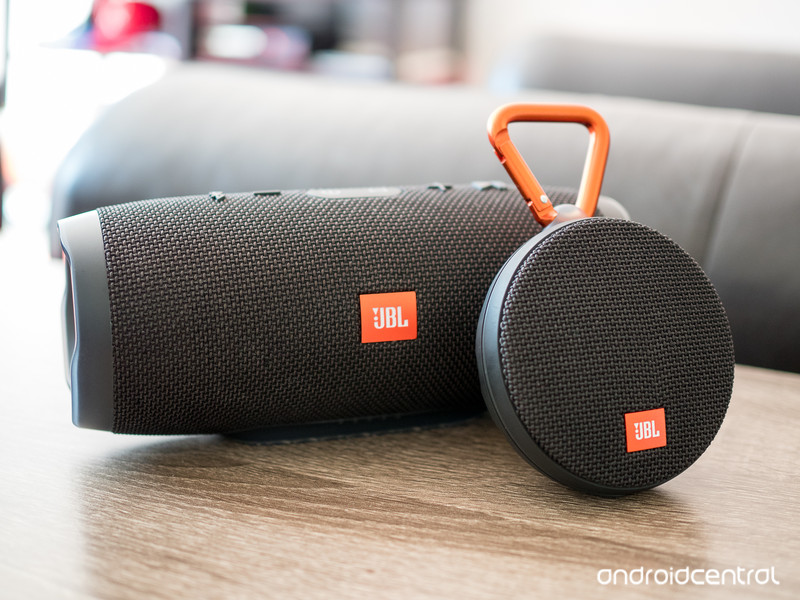
You can find Bluetooth speakers anywhere — but JBL’s latest stand out.
No matter your needs, there’s a Bluetooth speaker out there to match — and you don’t have to look hard to find one, either. For most people, their only real need is “the cheapest price possible” — but many will pay a bit for better features, quality and sound. And that’s where JBL comes in, with the latest iterations of two of its Bluetooth speakers — the Charge 3 and Clip 2.
JBL isn’t in the race to the bottom. It’s hoping to stay on the higher end with high quality materials and of course sound, with some great features that can help turn a Bluetooth speaker experience from an “every once and a while” thing to an every-day useful accessory. Let’s take a look at the JBL Charge 3 and Clip 2 speakers.
JBL Charge 3
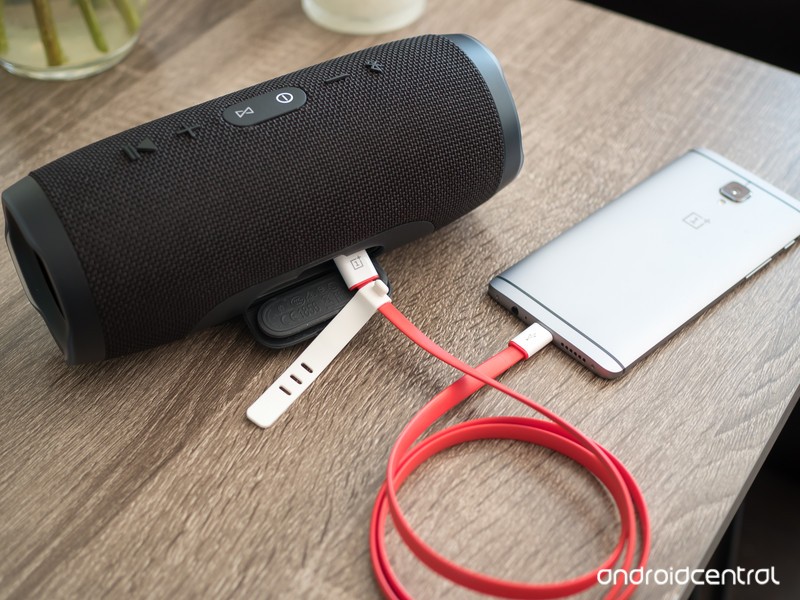
The JBL Charge 3 is designed to be the center of the party or fill a room with sound, and that’s immediately apparent with its size — larger than your average reusable water bottle, and weighing in at about 1.75 pounds. That weight comes from a sturdy, IPX7 waterproof enclosure that protects dual 10W speakers along with huge passive radiators on the ends that drive up the bass level.
With this much output you shouldn’t be surprised that the Charge 3 has a 6000 mAh battery inside, which can offer you 20 hours of playback over Bluetooth. You probably aren’t going to use it for that long (or heck, even half that long) between charges, so JBL also gives you the option of tapping into that power with a full-sized USB port on the back that can be used to charge your phone at 2A from 5V, which is a typical rate for a non-Fast Charge AC adapter.
It’s extremely handy if you’ve been streaming music from your phone to the speaker, but also nice to have for anyone else who’s with you that needs a quick top-up. The speaker gives you a visual indication of its charge state with a set of LEDs in the base, and charges itself over Micro-USB with a cable and 5V/2.3A wall plug in the box if you need one.
Because of its size and weight you aren’t likely to be carrying the Charge 3 around much — it’s mostly going to stay put on a coffee table or brought out to the pool or picnic table when you need music for a group. I actually mostly kept it at my desk for daily music listening, both from my computer over a 3.5mm cable and my phone over Bluetooth — and it performed far better than my set of Logitech computer speakers, at a fraction of the size and complexity. Indoors there was no reason to ever get it above about 50% volume, and I rarely needed to max it out to get the music loud enough outside, even for a big group of people.
It sounds as good as you’d expect at $150, and has a bunch of extra features.
At $150 this isn’t exactly an impulse purchase (nor is it JBL’s most expensive Bluetooth speaker), but if there’s one thing that companies like JBL, Jawbone, Bose and countless others have shown us it’s that people are willing to pay a pretty penny for a really good, loud wireless speaker with some extra features. That’s exactly what you get with the Charge 3. Not only does it produce full sound with lots of bass out of a relatively small package (compared to big wired speakers), it’s also tough and completely waterproof so you never have to worry about what happens to it. It also goes above and beyond to let you tap into its battery to charge your phone, which can prove pivotal in keeping the tunes going late into the night.
It won’t be worth the money to everyone, but it’s hard to argue that JBL isn’t giving you plenty for your money here if you’re looking for a big wireless speaker. (And if you want to save a bit, maybe consider the last-gen Charge 2+ for about $99.)
See at Amazon
JBL Clip 2
For as cool as the Charge 3 speaker is, I’m a bigger fan of the small JBL Clip 2 and I think it’ll be one that more people will actually consider buying and using on a regular basis.
This little $60 speaker is roughly the size of a hockey puck but still offers some great sound from its single 3W speaker — even up to high volumes without distorting. It connects over Bluetooth, of course, and offers easy-to-press buttons around the edges for play/pause and volume control — you can also use a built-in microphone for calls via your connected phone. Better yet, there’s also a built-in foot-long 3.5mm cable to plug in — that neatly wraps around and stores in the speaker — which is super useful when you’re passing the speaker around at a get-together and or don’t want to deal with Bluetooth pairing.
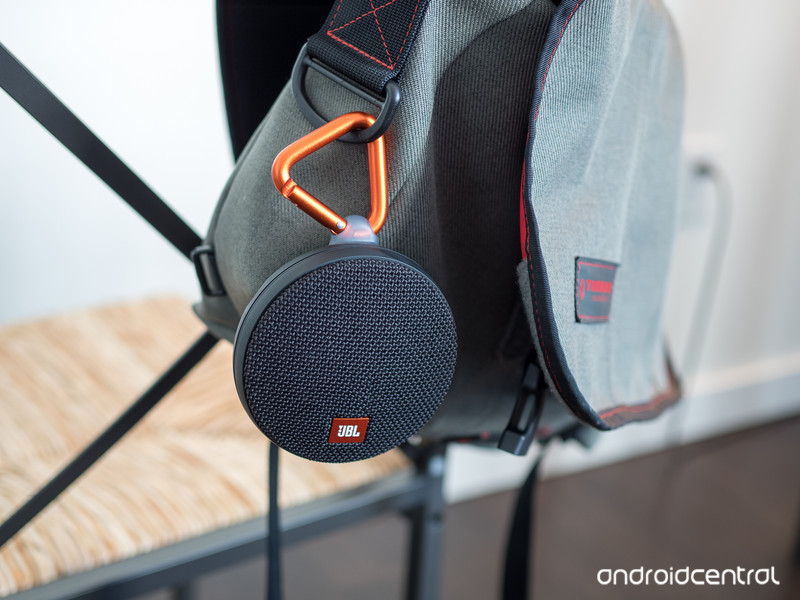
The speaker is built to take a beating, and feels like you could drive a nail with it if you needed to (but seriously, don’t do that). It’s also fully IPX7 waterproof, with a robust rubber door over the Micro-USB charging port, allowing it to handle dirt and even full submersion in water. Its rugged abilities are exemplified by the carabiner that’s attached to the side of the Clip 2 (the name makes more sense now, huh?) that lets you hook it on things wherever you go.
When a speaker is built this well, it goes with you and you use it more.
I clipped it on the outside of my messenger bag or backpack to carry it places, not being worried about it getting bumped and knocked around. I clipped it to my pants pocket so I could listen to music around the house as I took care of some chores, and found it particularly useful to hook on the shower curtain in the morning for podcast listening in the shower.
JBL claims eight hours of music playback, and I found that to be perfect for a week’s worth of casual listening off and on around the house. It also powered through several hours of Bluetooth music streaming for my Fourth of July party with battery to spare — and again, I never had to worry about it getting bumped or dropped.
I found the rugged Clip 2 to be infinitely more useful than other standard Bluetooth speakers that are more fragile and don’t have a clip, and because of its design elements I carried it around and used it more than any other speaker I’ve had. It’s more expensive than the dime-a-dozen Bluetooth speakers online, but you get something for it — and with how much more you’re likely to use it, it’s worth it.
See at Amazon
Netflix to stream Mystery Science Theater 3000 reboot in U.S. and other countries
Netflix has announced it has bought the rights to stream the upcoming reboot of Mystery Science Theater 3000 in the U.S., Canada, the UK, Ireland, Australia and New Zealand.

The revival of the classic comedy TV series, where its stars make fun of really bad movies while the film is running, first received funding in 2015 via a highly successful crowdfunding campaign. It ended up wth over $6 million to spend for 14 new episodes. Netflix stated:
Original creator Joel Hodgson will be joined by comedian Jonah Ray (“Jonah Heston”) as the new host and Felicia Day (Geek & Sundry) as “Kinga Forrester.” Joel McHale and Dan Harmon have attached as writers. Additionally, Mary Jo Pehl (“Pearl Forrester”), Bill Corbett (“Crow T. Robot”) and Kevin Murphy (“Tom Servo”) from the original cast will reprise their roles in the new series. Elliott Kalan, Emmy-winning former head writer of The Daily Show, will serve as the new head writer on the revival.
Netflix will begin streaming the new MST3K show “in the Not-Too-Distant Future”.
‘Star Trek: Discovery’ gets its first teaser at Comic-Con
At last, CBS is offering a glimpse of what its streaming-oriented Star Trek series will be like… if only just. The broadcaster used its San Diego Comic-Con panel to reveal that the show will be titled Star Trek: Discovery, and will revolve around the adventures of the crew of its namesake, the USS Discovery (no doubt inspired by the Space Shuttle of the same name). While the teaser trailer below shows only the starship in question, it’s enough to confirm that the visual language of Star Trek will remain intact when Discovery premieres in January.
Executive Producer Bryan Fuller didn’t dive into the specifics of the show at the panel. However, he noted that it’ll maintain the Star Trek legacy of optimistic, socially conscious tales while shifting to a more novel-like format. Don’t expect the classic formula where nearly every crisis is resolved by the end of an episode — as with many modern shows (especially online-only shows), there will strong incentives to go on a viewing spree. This is very much a Star Trek built for streaming services like CBS All Access and Netflix, where stories aren’t dictated by the limitations of conventional TV.
Witness the test flight of #StarTrekDiscovery, coming to #CBSAllAccess & CBS in January 2017 https://t.co/qLYrEF4ed7https://t.co/sROKlnAyXl
— Star Trek: Discovery (@startrekcbs) July 23, 2016
Via: Hollywood Reporter
Source: StarTrek.com, CBS
The After Math: She blinded me with science
This was a pretty good week for all but VHS enthusiasts. NASA tested a new lightweight rocket material. The Kepler space telescope found a couple of potentially habitable exoplanets. Researchers built a robot out of a sea slug. And scientists at TU Delft went ahead and solved that whole nanoscale data storage issue. Numbers, because it’s “rocket science”, not “rocket art”.
Solar Impulse 2 starts the last leg of its round-the-world flight
It’s all coming down to this. Well over a year after beginning its round-the-world trip, Solar Impulse 2 has embarked on the final leg of its journey. The solar-powered aircraft left Cairo early on the morning of July 24th and should reach its original starting point, Abu Dhabi, within 2 to 3 days. This certainly isn’t the most arduous part of the adventure (the Pacific crossing was far more challenging). However, it’ll likely be the one that everybody remembers — it’ll be the definitive proof that clean energy can be used to accomplish impressive feats.
And this isn’t strictly the end. Bertrand PIccard, the pilot on this last stint and the architect of Solar Impulse, stressed to Reuters that the project isn’t done once the aircraft touches down. To him, the flight has created an “international community” that will endure after the buzz is over. It’s far too soon to say what Solar Impulse’s legacy will be, but it’ll at least get a page in the history books.
BREAKING @bertrandpiccard has taken off from #Cairo for the last flight of the journey to #AbuDhabi #futureisclean pic.twitter.com/2ufDjAS5VK
— SOLAR IMPULSE (@solarimpulse) July 23, 2016
Via: Reuters
Source: Solar Impulse, Twitter
SpeedX Leopard Pro Release Date, Price and Specs – CNET
In March, a new bike company known as SpeedX launched a crowdfunding campaign on Kickstarter. The company was looking to raise $50,000 to help launch the first-ever smart aero road bike. Within two hours, the campaign surpassed the initial financing goal, going on to raise over $2.3 million from over 1,200 backers. This made it the most funded bike in Kickstarter’s history.
SpeedX was offering a high-end road bike with better components than brands such as Trek, Cannondale and Cervelo for thousands less. The campaign and product were both intriguing. I was close to becoming a backer myself, but had second thoughts. There was no way this no-name company would be able to deliver the bike on time, let alone deliver a product that lives up to the hype.
I was wrong. The SpeedX Leopard Pro is as elegant as the campaign originally promised. Even more impressive, the company will begin shipping the bike to backers this August.
The SpeedX Leopard Pro is available for preorder now through the SpeedX website for $2,500 (about £1,900, AU$3,350). A more affordable model with a slightly different components, called the SpeedX Leopard, can be had for $1,400 (about £1,000, AU$1,875). Preorders are slated to ship in September.
What are the specs?
Despite the $2,500 price tag, the SpeedX Leopard Pro seems like an incredible value. The frame and fork are made from a mix of T1000 and T800 carbon fiber. The handlebars and seat post are also made from carbon. This makes the bike incredibly light, with a weight of just over 17 pounds.

Dan Graziano/CNET
As for the groupset, it’s Shimano Ultegra Di2, which features electronic shifting. My only complaint about the bike is that it lacks disc brakes, which I prefer for better stopping power, although a few commenters were quick to point out that most racing bikes don’t include them.
The more affordable Leopard model swaps out the Ultegra groupset for a Shimano 105 groupset. The handlebars are also aluminum rather than carbon fiber, although the bike still has the same carbon frame as the more expensive model, with a weight of about 19lbs.
I’m a big fan of the overall look of the bike. Both models feature full internal wiring to give them that clean look. There’s also an integrated rear LED light that will automatically turn on when it gets dark, which I thought was a great idea.

Dan Graziano/CNET
What makes this bike smart?
You may hear the word “smart bike” and assume there’s an electric motor, but that’s not the case. What makes the Leopard smart is the built-in GPS, altimeter and speed sensors, which essentially replaces the need for a separate Garmin or Polar bike computer.
These sensors are used to measure moving time, distance, speed, altitude, cadence, calorie burn and can provide navigation. There’s also Bluetooth and ANT+ built-in for connecting a power meter or heart-rate sensor. All of this data can be viewed in real time on the 2.4-inch color screen, which can also display incoming calls and notifications when your smartphone is connected.

Dan Graziano/CNET
Post-ride data can be viewed in the SpeedX mobile app. In addition to viewing a map of the ride and all of the recorded data, the app is similar to Strava and includes online challenges and leaderboards.
What about battery life?
Yes, the bike has to be charged, but it won’t be very often. The battery, which powers the built-in display, will last up to 40 hours of continuous usage. Charging is done through a small microUSB port on the back of the bike (our model didn’t have a protective flap covering it but the company says the final ones will).
This isn’t the kind of bike you would leave outside, at least not in New York City, and it only takes 30 minutes for a full charge, but it would have been cool if you could charge it simply by pedaling.

Dan Graziano/CNET
Is it too good to be true?
I didn’t get to ride the bike for an extended period, but I was impressed with the ride in the short time I did spend with it. The electronic shifting was smooth, and it felt as if I could really get some speed on the bike. The seat wasn’t the most comfortable, but that’s pretty standard. While my first impressions were positive, further testing will be needed to make a final conclusion.
My only concern is with the company itself. While SpeedX offers a lifetime warranty on the frame and a 30-day money back guarantee on the entire purchase, this is still a company we know little about. A lifetime warranty could mean only a few months if business were to go south.
The Leopard and Leopard Pro are an incredible value. SpeedX has said it can offer these low prices by cutting out the middleman to deliver high-quality bikes cheaper than the competition, but a part of me wonders if you are better off going with a true and tested bike from a reliable brand.
Only time will tell how SpeedX and the Leopard bikes continue to perform, but it is a company I plan to keep my eye on.
Jabra Halo Smart review – CNET
The Good The Jabra Halo Smart is a sturdily built neck-band style headphone that performs very well as a headset for making cell phone calls, offers good battery life, and decent sound for music if you get a tight seal. Neckband vibrates when a call comes in.
The Bad You may not get a secure, tight seal from any of the included ear tips, which leads to a poor fit and a reduction in sound quality.
The Bottom Line While it doesn’t do much to distinguish itself from other neckband-style headphones from a design standpoint, the Jabra Halo Smart seems sturdily built, performs very well as a headset for making calls and offers decent sound quality for music if you get a tight seal.
Welcome another neckband-style headphone to the world: the Jabra Halo Smart, which retails for $80 (sorry, UK and Australian readers, no word on international pricing yet).
What’s special about it? Well, since it’s from Jabra, you’d hope it would work really well as a headset for making calls. And it does, with multiple microphones and noise reduction technology that helps tamp down ambient noise like wind. It’s also water-resistant and has very good battery life, with up to 17 hours of talk time and 15 hours of music listening.

What you get in the box.
Sarah Tew/CNET
It also has a few notable extra features. The ear buds adhere magnetically to each other, which keeps them from flopping around when they’re not in your ears. You end up wearing them sort of like a pendant or you can affix the buds to a spot on the neckband to eliminate any dangling altogether (the manual shows you exactly where on the neckband the tips can be pinned magnetically).
When a call comes in, there’s a vibrate feature in the neckband, and you can answer the call by pulling the ear buds apart. You then stick one or both buds in your ears.
The free Jabra Assist app for iOS and Android works with the Halo Smart. It doesn’t do all that much, but you can enable a message readout feature that allows you to hear incoming notifications. These include calendar events and incoming emails (just the subject name and subject). There’s also a “Find my Jabra” feature that allows you to locate your headset should you lose it.
Three sizes of ear tips are included, but I was a little disappointed that I couldn’t get a tight seal and secure fit with any of them. I had to pull off a set of extra large tips from another in-ear headphone I was testing. Those bigger tips made a big difference.
The tip issue was really my only major gripe. Otherwise, the headphone performed well, and I encountered only a minimal amount of Bluetooth hiccups.
GE GTW485ASJWS review – CNET
The Good At $650, the GTW485ASJWS is one of GE’s most entry-level washers. It also boasts 13 cleaning modes and a Deep Fill feature that lets you add as much water to a cycle as you want.
The Bad Its traditional agitator wasn’t gentle on clothes.
The Bottom Line The GE GTW485ASJWS is fine if you’re looking for an affordable top-load washer — just keep in mind that its agitator isn’t forgiving when it comes to wear and tear.
The $650 GE GTW485ASJWS might be one of the simplest washing machines you can buy today. It doesn’t have a ton of advanced settings, an LED-bedazzled digital display, or on-board Wi-Fi connectivity. You won’t find a second washer tucked inside a hidden compartment like the LG Twin Wash or a built-in sink like the Samsung WA52J8700.
But what the 485 lacks in pizazz, it makes up for with a traditional agitator — something folks nostalgic for the days of laundry-past will like. The downside, of course, is that agitators tend to be tougher on fabric than the impeller-style designs you’ll find on most pricier top-loaders. It did do a decent job removing stains, though. Yes, GE’s GTW485ASJWS will do fine overall, but you might want to spend a little more for an impeller washing machine if you’re concerned about wear and tear.
A budget washing machine for laundry traditionalists
See full gallery


1 – 5 of 7
Next
Prev
A simpler wash
While the 485 doesn’t exactly do anything innovative in terms of design, it’s a nice looking machine considering its price. Available in a glossy white finish, it features the same 13 cleaning cycles as more expensive GE washers. They include:
- Active Wear
- Bulky Items
- Casuals
In other washer news:
- How we test washing machines
- The tech behind our washing machine testing
- 16 washers to help you clean up your laundry routine
- This Samsung washer has everything, including the kitchen sink
- Cold Wash
- Colors/Normals
- Dark Colors
- Delicates
- Drain + Spin
- Heavy Duty
- Jeans
- Speed Wash
- Towels & Sheets
- Whites
It also has a Deep Fill setting, which lets you add more water to a cycle. This isn’t great in terms of efficiency, but it does let you customize the fill level if you think the washer isn’t adding enough water on its own. Press the Deep Fill button at the top of the display panel either before a cycle begins or after it has finished auto-filling. Press it again to stop it.
The straightforward display features one dial each for soil level, temperature, cleaning cycles, options (this includes things like Auto Soak and Extra Spin), and stain pre-treat.
Here’s a look at the 485’s basic specs compared to other top-load washers:
Comparing washers
| $650 | $900 | $1,200 | $1,199 |
| White | White, metallic (for $1,000) | Metallic, white (for $1,100) | Stainless platinum |
| 4.2 cubic feet | 5.1 cubic feet | 5.1 cubic feet | 5.2 cubic feet |
| 13 | 13 | 13 | 15 |
| 152 kWh/year | 152 kWh/year | 152 kWh/year | 165 kWh/year |
| 27 x 44 x 27 inches | 28 x 44.5 x 29 inches | 28 x 44.5 x 29 inches | 27 x 46 x 29.3 inches |
| 1 year, limited | 1 year, limited | 1 year, limited | 1 year, limited |
| 120V 60Hz | 120V 60Hz | 120V 60Hz | 120V 60Hz |
| No | Yes, Android and iPhone | Yes, Android and iPhone | No |
The main difference here is bin capacity. Where models like the GE GTW810SSJWS, the GE GTW860SPJMC, and Samsung’s WA52J8700 all have capacities over 5 cubic feet, the 485 has just 4.2 cubic feet of space. This is mainly due to the built-in agitator, although its dimensions are also slightly smaller.
Tesla’s plan for world domination, and more in the week that was
Tesla is known for producing some of the world’s best electric cars, but founder Elon Musk has even bigger plans for the company: world domination. Musk’s new masterplan will grow the company to produce trucks and buses while using battery technology and solar infrastructure to transition the world away from fossil fuels. Meanwhile, the world’s first “Tesla Town” is coming to Australia, and every home in it will feature solar panels and a powerwall. Driverless cars are almost here: This week Mercedes-Benz unveiled the fully autonomous bus of the future, while a GM exec confirmed plans to launch a self-driving Chevy Bolt EV with Lyft. And we spotted a crazy truck that’s able to lay its own road across treacherous terrain in just six minutes.
The heatwave surging across the US is putting a serious drain on the nation’s grid, but what if your air conditioner actually generated energy instead of just sucking it up? That’s the idea behind the BeCool, a new HVAC system that cools or heats the air while charging up a fuel cell at the same time. In other energy news, Facebook just launched its solar-powered internet drone for the first time and Obama set a target of 1 gigawatt of solar energy for low-income homes by the year 2020. A team of researchers developed a new osmosis technology that generates electricity from saltwater, and California shattered a solar power record by hitting 8,030 megawatts — enough energy to power 20 million households.
The best emergency shelters can be quickly deployed and constructed — like the uLite, a modular, inflatable dwelling that can be set up in 30 minutes flat. In other design developments, Conceptos Plásticos has developed a set of LEGO-like building blocks that allow anyone to build a home for just $5,200. WASP launched a 3D printer that uses dirt to build durable, affordable homes. Morocco debuted the longest cable-stayed bridge in Africa, which is lit up with LED lights. Mexico City unveiled a high-tech LEED platinum skyscraper that’s built to last for 2,500 years. And Denmark transformed a century-old lighthouse into a gigantic kaleidoscope that collects light instead of sending it out.
Galaxy Note 7 might have a smaller battery than GS7 edge
Latest leak points to a 3,500mAh battery for Samsung’s upcoming Note.
There’s been no shortage of Samsung Galaxy Note 7 leakage of late, and the latest details to sneak out of a Korean carrier gives some intriguing info on the phone’s battery capacity.

A prematurely published spec listing by mobile operator SKT lists the Note 7 with a 3,500mAh battery — an increase over the 3,000mAh cell of the Note 5, but a decrease of 100mAh compared to the Galaxy S7 edge. Other details in the listing include dimensions: 73.9 x 153.5 x 7.9mm — a small increase in thickness compared to both the S7 edge and Note 5 — and a weight of 169 grams — down 2 grams from last year’s Note.

However small it is, a drop in battery capacity relative to the S7 edge may disappoint enthusiasts hoping for a beefier battery in what’s likely to be a 5.7-inch handset. (One possible explanation is that space that would otherwise have been occupied by the battery is instead take up by the S Pen.)
In any case, if the specs listed here are accurate, the Note 7 should still pack a decent bump in battery life compared to the previous model. And there’s no telling how Samsung might be saving power elsewhere, for example with more efficient internals or display tech.
MORE: Samsung Galaxy Note 7 preview
Would a tiny difference in battery capacity sway your smartphone purchasing decision? Shout out in the comments!
via: SamMobile
 AIVAnet