


Kodi jumps into hardware with a Raspberry Pi case
As the app formerly known as XBMC prepares to launch version 17, the folks at Kodi are diving into something completely new: hardware. It’s not a smart TV box on its own however, instead the project has teamed up with Flirc on a custom case for the Raspberry Pi 3, 2 and B+. It has an aluminum core to help keep your Pi cool while running the media streaming software, and sports the official Kodi logo to let everyone know your box is legit. It’s available for about $20 from Flirc in the US and The Pi Hut in the UK, so you can get it in time to load up the Krypton alpha when it’s released July 1st.
Source: Kodi Blog
Xiaomi’s foldable electric bicycle costs just $460
Xiaomi may not yet have a drone that can carry people, but at least it has an electric bicycle now, and it’ll only cost you 2,999 yuan or about $460/£307. The Mi Qicycle is the second product from the Xiaomi-backed startup, iRiding, who released the premium 19,999 yuan (about $3,000/£2045) Qicycle R1 just back in March. This time round, iRiding is able to slap Xiaomi’s “Mi” brand on its latest ride to target the mass market. While the Mi Qicycle weighs a total of 14.5kg (almost twice that of the carbon fiber-made R1), it can be folded into half its size for easier storage. It comes with a 3-speed hub plus a 250W motor which offers pedal assist, and that’s good for up to 45km (about 28 miles) on a single charge.

Since the Mi Qicycle is a smart bike, there’s Bluetooth connection for your smartphone’s companion app to check on the bike’s status, ride stats and GPS navigation. It also has its own little display on the handlebar to show you the time, speed, distance, dynamic power and battery charge, as well as to let you toggle between these modes: “Fitness,” Power-saving,” “Balanced” and “Extra power.” And as you’d expect, the bike has a front light and a red brake light at the back.

As with many of the best products from Xiaomi, chances are you won’t be able to buy the Mi Qicycle outside of China. If you’re lucky enough to live there or know someone who does, then you can already head over to Xiaomi’s Mijia app to back this bike’s crowdfunding campaign.
Source: Xiaomi
Apple Invents Touch-Sensitive Stylus, Mobile That Knows Which Hand You’re Using
Apple has submitted a patent application for a next-generation stylus with a touch-sensitive body (via Apple Insider).
Details of the invention were published by the U.S. Patent and Trademark Office today under the title “Stylus with touch sensor”, describing an input device with an array of capacitive touch sensors along the instrument’s body.
The sensors determine the position of the user’s fingers and this information can be interpreted as gestures to control aspects of the user interface on the display device.
In some versions, electrodes are installed around the body of the stylus to improve the accuracy of touch detection, including single- and multi-touch gestures.
Apple claims that the sensor design is such that it can detect when the user is rotating the stylus based on the location of two fingers. This data can then be used to perform functions like rotating a virtual object on the display, selecting a brush size in a drawing app, or changing a zoom level.
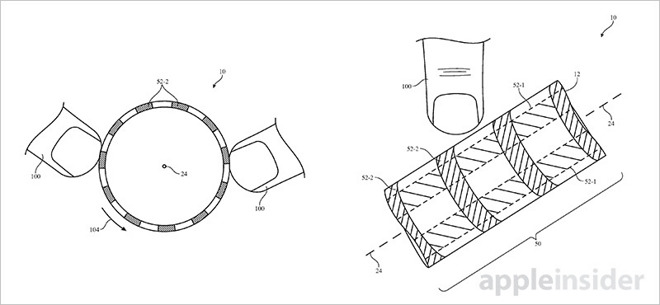
Motion gestures are also described in the application. Running a finger up or down the stylus body could control UI window scrolling, for instance. Meanwhile, support for force gestures enables the user to, say, squeeze the stylus to invoke virtual buttons on screen, or increase drawing precision by tightening grip, for instance.
While Apple’s idea for a touch-sensitive stylus is impressive in concept, in practice it would likely be a highly challenging technological undertaking, given the variability in the way users grip pens as well as differences in hand size. Whether Apple plans to use the invention in a future consumer product like the Apple Pencil remains to be seen.

Another Apple patent application was also published on Thursday, called “Electronic devices with hand detection circuitry”, which describes how special sensors on an iPhone-like device could distinguish between left- and right-handed use, or “handedness”.
The ambidextrous invention details how motion sensors could be used to detect rotation and movement, and inform the position of virtual buttons and icons displayed on-screen to increase ease of reach.
The invention harks back to Apple’s introduction of the Reachability feature for iPhones with 4.7-inch and 5.5-inch screens, in which a double tap on the home button shifts the screen content downwards to bring it within thumb’s reach.
Tag: patent
Discuss this article in our forums
Next Google Nexus (2016) aka HTC Marlin should feature Snapdragon 821 CPU
The next Google Nexus smartphone has begun to leak with more details than just the simple codenames we’ve had so far.
Two Nexus smartphones are expected to be made this year, one for average users and another more high-end device – just like last year. So far leaks have suggested that they are codenamed Marlin and Sailfish, or M1 and S1. The Marlin handset is expected to be built by HTC.
Now India Today has leaked details of the handset. The publication claims that the HTC 10 will be the basis on which the Nexus phone will be built but with an upgraded processor and some more tweaks. It says the latest Qualcomm Snapdragon 821 processor will appear as well as a “tweaked” fingerprint sensor.
The Snapdragon 821 is expected to have a slightly higher top speed but to also offer better heat efficiency and power management.
Google is expected to reveal the 2016 Nexus smartphones later in the year around September for an October release. The Android N operating system will also launch on these devices. Other expected specs include a QHD screen plus 4GB of RAM to better support Google Cardboard and VR in general.
Little else is known at this stage but expect more leaks to follow as that reveal date approaches. For now check out the Next Nexus feature in the read link below to learn everything that’s expected from Google’s next major hardware and software launch.
READ: Next Nexus (2016): Release date, rumours and everything you need to know
Seven cool features of the Sony XD93 TV
Television technology is going through an unprecedented period of change right now. The combination of new Ultra HD screens, high dynamic range technology (HDR) and ever-changing, ever-expanding smart TV features has made it harder than ever for consumers to feel confident that any TV they buy is ready, willing and able to get the best out of everything the AV world now offers.
Cue Sony’s XD9305 BRAVIA TV range. These new televisions leave no stone unturned in their bid to deliver the most up to the minute performance possible, even going so far as to introduce a completely new lighting technology designed to take HDR to exceptional heights.
To make it easier to understand just how cutting edge the Sony XD9305 TVs really are, here are eight of their most exciting features.
1. Stunning design
Whether it’s the incredible slimness, the beautifully minimalistic lines, the high quality finish or the gorgeous infusion of a sliver of gold into the frame’s outer edge, everything about the XD9305’s design oozes quality and enhances the look of any living room.
To combine the sort of ultra-thin TV designs everybody wants to own with the exceptional picture quality we expect from the latest Ultra HD and high dynamic range sources, Sony’s engineers have created a new way of lighting the TVs’ pictures. The Slim Backlight Drive combines edge LED lighting that helps keep the TV design trim with a double light-plate system that allows the TV to deliver light with much more local accuracy and control than a traditional edge LED TV. In other words, the TV can deliver bright picture areas alongside dark ones with much less chance of light pollution between the two – an essential feature for HDR playback.
2. Native 4K Resolution
The Sony XD9305 fits 3840×2160 pixels onto the screen versus the 1920×1080 you’re used to seeing with high definition TVs. This means the XD9305 TVs can deliver pictures with four times as much resolution, resulting in ultra-detailed, ultra- sharp images that make you feel like you’re looking through a window rather than just watching a TV.
3. Triluminos colour
Sony’s proprietary Triluminos technology has been setting LCD colour standards for a couple of years now, and its impact is more dramatic than ever on the XD9305 range.
Triluminos is essentially a proprietary combination of powerful processing and wide colour phosphors that’s tailor made to unlock the full colour dynamism but also the subtlety you get with the new wide colour spectrum pictures available from Ultra HD Blu-rays and the Amazon/Netflix online streaming platforms.
4. The X1 Processor
To get the best from features like the Slim Backlight Drive, native 4K resolution and Triluminos colour system, Sony has developed a unique X1 chipset that gets the optimal picture quality out of any source you throw at it. At the heart of this chipset is a huge database of picture experience and scenarios that helps the TV identify different sources more quickly and deliver the most appropriate picture settings more accurately in real time for every single frame.
5. Android TV
There are smart TV systems and then there’s Android TV. Building Google’s latest smart TV platform into the XD9305 TVs is a masterstroke, as it opens up access to a wider range of apps. Video streaming services, games, information providers, content management systems… you want it, Android TV has it.
6. YouView
Sitting alongside the Android TV smart system in the XD9305’s smart menus is YouView. As well as adding the catch-up TV apps for all of the UK’s ‘big four’ broadcasters – the BBC iPlayer, the ITV Player, All 4 and Demand 5 – YouView lets you access on-demand content via a brilliantly simple electronic programme guide system that scrolls back through time
7. Premium High Dynamic Range playback
Most experts agree that the single most impactful new TV picture technology is high dynamic range (HDR). This introduces a far more expansive brightness range to pictures than we’ve become accustomed to seeing for the past few decades, and most HDR sources we’re seeing are accompanied by much wider colour ranges than we’ve seen before. The result is pictures that look much more punchy and far more like our eyes experience in the real world.
The various lighting, processing and colour talents discussed previously make Sony’s XD9305 TVs exceptionally qualified to unlock HDR’s potential. So much so that once you’ve witnessed HDR on an XD9305, you just can’t live without it.
Infinite Arms for iPad preview: Skylanders for Halo fans
Infinite Arms is a toy-game cross over aimed at fans of Gears of War, Halo and big Transformers style mechs. It’s a sophisticated RPG for iPad and iOS generally, where adding weapons to model robots instantly sees them appear in the game. It aims to tick both boxes: Skylanders for Halo fans and Halo for Skylanders fans.
When Skylanders Spyro’s Adventure exploded into living rooms in 2011 a new genre of game was created. Combining physical and virtual play it convinced young players that the figurines were not just a key to unlock digital content but in fact were an extension of the on-screen character. The toys magically saved progress, lit up and were something you wanted to hold and keep with you while not playing.
Financial success led to other manufacturers joining the toys-to-life arms race. Disney Infinity and Lego Dimensions each brought their franchise-rich weight to the formula and saw similar success. But the toy tide is now turning, signified not just by Disney’s withdrawal from the sector but the rise of new innovative start-up competitors to these incumbent behemoths.
Pocket-lint
Anki Overdrive combined toys-to-life gaming with Scalextric style real-world racing. Sick Bricks injected irreverent character play controlled by mix and match Lego style heads and leg bricks. Angry Birds Telepods offered toy cars and projectile playsets that also unlocked in-game characters. And Osmo combine character recognition with educational play.
Infinite Arms is a new player in the sector but with quite different ambitions. Not only does it leverage talent from traditional console games like Gears of War, Halo and cult classic Gitaroo Man, but also toy expertise from Transformers and Tamogotchi.
Infinite Arms preview: Not just for kids
Spending just a couple of hours with the game it’s clear this isn’t just for children. The toys are huge articulated robots that cross a Transformers and Mech aesthetic. Snap on up to four of the 10s of weapons initially available and they instantly appear on the screen of the tablet game.
Talking to CEO Keiichi Yano at E3 he outlined the importance of escaping the need for a portal and for both the toys and the game to be valid in their own right: “We’ve been working on this idea for three years,” he said. “Toys-to-life as a segment could be much more than we’ve seen in the past. Now we have the technology to take Star Wars style toys out of the physical and seamlessly work with mobile games.
“That bridge between the physical reality and the virtual reality, the closer you can get them out of sync and into sync the more you feel like those lines are blurred. The speed that accessories get reflected in the game was super important for us.”
Chris Esaki, chief creative officer at Yano, expanded on why its robots needed to be free from wires and tethers to create a convincing connection between them and the game: “It’s not just an extension of the game but it’s a part of the whole. Being able to play, pose, customise and put weapons on the physical toy was really important,” he explained.
“Being artificially tethered to something just didn’t work for us, they had to be autonomous action figures like we grew up with. That unlocks all the play possibility of a real action figure.”
Infinite Arms preview: Toys-to-life for gamers
Infinite Arms leverages this technology to create a deep and complex experience aimed at an older player with the sophistication and strategic thinking to do more than simply grind through levels. It forces players to make intelligent choices about load-outs and upgrades.
“We set out to make an experience we ourselves wanted to play, with older tastes,” said Esaki. “The sophistication of the game skews more to Call of Duty, Halo and Gears of War, both in terms of the gameplay and the detailed figures.”
What this doesn’t get across is just how deep the gameplay is. Working through the early levels of the campaign with Esaki and Yano at my side I soon found my mind boggling at the sheer number of combinations and upgrades to choose from.
While the robots impress in both size and articulation it’s the weapons that are the star. Each weapons has multiple branching upgrade trees that effect how they perform and interact with each other. Beyond this, players can fuse different upgrade elements to create further refinements.
Equipping your robot from this finely honed arsenal becomes like picking a deck for a card battle, only here you have customised each of the cards to work perfectly with each other.
Infinite Arms
Infinite Arms preview: Console gameplay on a tablet
The game itself revolves around a battle system where waves of enemies must be brought down leading into boss encounters. Each round is unique and offers a different challenge. By completing these you can earn a variety of items to then further upgrade your weapons.
It’s played on tablets but looks much more like a console game. The large depictions of the robots perfectly match the physical toy, both in scale and currently equipped weapons. The iOS version we tested felt snappy and intuitive to control although it did take a little getting used to.
We played some one-player levels in the room but you can also jump into online multiplayer games where two of you bring in customised robots to the fray and battle through the different enemies. There were many more modes and challenges in the menu we didn’t get a chance to test.
Infinite Arms preview: Rebooting toy retail
Existing as a tablet rather than console game is a risky strategy for Infinite Arms, but one that is taken knowingly. There’s a tension between the fast turn around of updates and in-app purchases in tablet games and the slow pace of toy development.
Here we find Infinite Arms’ real innovation. It solves this problem by offering players new physical toys, the weapons and add-ons, via Amazon and other online outlets on a bi-weekly basis. It seems almost unbelievable at first with toys usually taking 6 months to a year to bring to market but Yano was robust in this part of the experience.
“It’s very accelerated, we wanted to have a service-based model that means releasing toys on a bi-weekly basis. It’s a lot like card games when new cards would come out,” he revealed.
Grasping this nettle not only means that the company can avoid over-producing any one toy (and the over-stocking problems that are rumoured to have hampered Disney Infinity), but it can also iterate the most popular items that players want based on real-time stats from the game.
It can also offer short time limited runs of special weapons that are only available for two weeks. Special editions based around different real world events are also a strong possibility, something that could fit well with licensed partnerships with other brands.
Provided the virtual and physical prices for these weapons are easy to understand and offer good value, this could be a popular way to expand the experience when launched. This clarity will become more challenging as the product matures and multiple variants are in the wild, so a long term plan will also be important along with a clear way to communicate how this all fits together to consumers.
First Impressions
All this is poised to take the toys-to-life world by storm. It just needs to be discovered by players who fit its older demographic of sophisticated, avid toy collector and game fan. It works for either those who have outgrown Skylanders and want something more substantial or fans of games like Halo and Gears who want more toy action in their hardcore gaming.
Of course, the road from here to there is paved with challenges but first impressions suggest that Infinite Arms could create another Skylanders moment – either way it looks like we need a new name for these games because toys-to-life simply no longer does them justice.
At internetmatters.org parents can find all the advice they will need to keep their children safe online. Designed specifically for parents, the site offers a wealth of up-to-date, unbiased information and advice about how to deal with online safety. Parents can learn about the latest issues and technologies, get great tips on how to talk about online safety with their children and get the best advice on dealing with issues and taking action. Created with experts, Internet Matters provides detailed information, but also signposts to best-in-class resources from individual expert organisations. Our goal is to ensure parents can always access the information that they need, in a format that is clear and concise.
Google Fiber is acquiring gigabit internet provider Webpass
Google Fiber is acquiring San Francisco-based gigabit internet provider Webpass for an undisclosed amount. Founded in 2003, Webpass is focused on providing businesses — along with select residential markets — with gigabit internet connectivity, and its acquisition will aid Google Fiber’s expansion. The acquisition is expected to close this summer following regulatory approvals.

Webpass currently lists over 20,000 customers, and is active in five cities: San Francisco, San Diego, Chicago, Boston, and Miami. In a blog post announcing the acquisition, Webpass president and founder Charles Barr wrote:
By joining forces, we can accelerate the deployment of superfast Internet connections for customers across the U.S. Webpass will remain focused on rapid deployment of high speed Internet connections for residential and commercial buildings, primarily using point to point wireless.
Today, Webpass has tens of thousands of customers across 5 major markets in the U.S., and we hope to reach many more in our next chapter with Google Fiber. Webpass will continue to grow its service in current operational cities of San Francisco, Oakland, Emeryville, Berkeley, San Diego, Miami, Miami Beach, Coral Gables, Chicago, and Boston, adding to Google Fiber’s growing list of operational cities.
Joining Google Fiber will be a great development for our users because the companies share the same vision of the future and commitment to the customer. Google Fiber’s resources will enable Webpass to grow faster and reach many more customers than we could as a standalone company.
Currently, Google offers Fiber in select condos and apartment buildings in San Francisco, but the acquisition should greatly expand rollout in the city.
Instagram is adding a text translation feature
After announcing that it has over 500 million users, Instagram has shared that it is working on a text translation feature that will go live next month. Once enabled, you’ll see a “See Translation” button that automatically translates text in posts, comments or bios to your preferred language. At launch, 24 languages will be supported, and while there isn’t a clear-cut timeline, the feature will be rolling out to all users globally within a month.
In the coming month, you’ll see a translation button on feed stories and profile bios written in languages different from your own. The Instagram community has grown faster and become more global than we ever imagined. And we’re excited that you’ll soon be able to understand the full story of a moment, no matter what language you speak. To learn more about translation on Instagram, check out help.instagram.com.
A photo posted by Instagram (@instagram) on Jun 22, 2016 at 10:00am PDT
The feature won’t be available for older comments, as Instagram has started using machine learning to translate text recently.
Apple left iOS 10’s core code unencrypted on purpose
Apple is infamous for guarding its secrets tightly, so it came as a big surprise that the preview version of iOS 10 it released at WWDC has an unencrypted kernel. According to a spokesperson, though, Cupertino did it on purpose, because by leaving it unencrypted, the company was “able to optimize the operating system’s performance without compromising security.” The kernel is the heart of an operating system, and on iOS, it’s in charge of security and managing what parts of an iPhone or an iPad apps can access. Apple used to keep it under several layers of protection — now that security researchers can examine it more closely, bugs could come to light more quickly than before.
iOS security expert Jonathan Zdziarski told MIT Technology Review that “Opening up the OS might help other researchers to find and report bugs, by giving everyone just as much visibility as an advanced and well-funded research team might have.” Tech Review points out that this could prevent law enforcement agencies from exploiting flaws to crack locked devices, like what the FBI did to get into the San Bernardino shooter’s iPhone. After all, if there are more eyes looking for bugs, they can be found and patched much sooner. For the rest of us, this could translate to greater security and phones or tablets that run more smoothly.
Source: MIT Tech Review
The best way to play ‘Splatoon’ is with a hacked water gun
Researchers and makers over at Kougaku Navi in Japan have been working hard on a playable Splatoon gun since March, and the latest model really looks the part. It combines a Wii U GamePad, controls transplanted inside a Splatoon-themed water pistol and Sony’s head-mounted display to give you at least a little bit of movement freedom. It’s not perfect, but if you really want to play the game with a gun, it possibly the closest we’ll get.
#スプラトゥーン の新しいインタフェース作った pic.twitter.com/rqedtePWAY
— kougaku (@kougaku) June 20, 2016
While it may look like a fantastical VR version of the Nintendo’s hit shooter, it doesn’t go quite that far. However, that’s not to say it’s not brilliant on its own merit: Let’s break it down. The GamePad is the lynchpin here: it’s strapped to the player’s back to deliver vibrations to your very soul body as well as gyroscopic movement of your view to the HMD. Why is it on the back? It’s the best way of approximating where you’re aiming the gun. (Especially if you’re holding it two-handed — like a good ghostbuster.)
The gun contains controls to move forward, backwards and to shoot of course. It’s wirelessly connected to the pad, one of several major upgrades that came in after their second creation. It looks surprisingly playable for a very low-fi solution. Now I want to play. Can I play it? Guess I’ll dust off my Japanese dictionary and shoot the researchers an email. Take a more detailed (Google-translated) tour of the development process right here.
Via: Buzzfeed Japan
Source: Kougaku Navi
 AIVAnet