


NASA tasks the Hubble Telescope with five more years of service
Despite its successor launching in 2018, NASA is extending duty for the Hubble Space Telescope for another five years. The imaging spacecraft will continue to capture breathtaking photos from orbit until 2021 with the Space Telescope Science Institute in Baltimore. The final servicing mission to the telescope took place in 2009, and now it’s set to provide images from our solar system and beyond into the next decade.
In 2018, NASA plans to launch the James Webb Space Telescope to be the primary observation tool for the 2020s. It should be interesting to see how astronomers leverage two imaging spacecraft for the short time both are in use. While the Hubble uses visible and ultraviolet light, the JWST uses infrared, so employing the two in tandem could provide some super detailed views. The Hubble Telescope turned 25 last year, and we compiled some of its greatest images right here.
Via: New Scientist
Source: NASA
The clownish fight over who hacked the DNC
A war of words has erupted over whether the DNC hack was an act of espionage by the Russian government, between soundbite-ready security firm CrowdStrike and a lone hacker who’s unkindly claiming credit. And the conspiracy theory fans went wild.
It all began with a Washington Post article many infosec denizens thought was a thinly-disguised PR puff piece for CrowdStrike.
The June 14 piece Russian government hackers penetrated DNC, stole opposition research on Trump was definitive. It was also singled out for being overly-fawning, without doubt, and lacking in technical details. The article refrained from using the word “sophisticated,” but did echo Cold War rhetoric about the Russian government’s intent on evil like the Reagan 80’s were back in style.
“The depth of the penetration reflects the skill and determination of the United States’ top cyber-adversary as Russia goes after strategic targets, from the White House and State Department to political campaign organizations.”
Using the Post like a TV commercial hand puppet, CrowdStrike said it was two different threat actors who broke into the Democratic National Convention’s systems. The security firm is known for many things, and its painfully xenophobic naming structure is top of the list. Names of the two attackers were given as “Cozy Bear” and “Fancy Bear.”
“Bear,” as in Russia. And yeah, they use “Panda” when it’s China, which is totally weird, right? Perhaps CrowdStrike would do well to have some Asian friends.

CrowdStrike Chief Executive George Kurtz (Image: LA Times via Getty Images)
Anyway, press immediately parroted the rhetoric about fancy bears and Russian spycraft. It drifted on up to the Capitol, where Senator Feinstein said such Russian cyber-attacks were “expected,” and waxed about Watergate. Conspiracy theories blossomed.
This was all ‘let’s bring back the Cold War’ fun-and-games until last week. A hacker came forward saying, LOL no, it was actually me.
Calling themselves “Guccifer 2.0,” in reference to the attacker busted for accessing Hillary Clinton’s email server (among other things), the hacker then published research snatched from the DNC.
Namely, the DNC’s opposition intel files on Donald Trump. Now the fly in CrowdStrike’s ointment, Guccifer 2.0 proceeded to pick apart the company’s claims that hacking the DNC was super-hard and sophisticated, dropping minor technical tidbits in here and there to season the pot.
Guccifer 2.0’s criticisms were subtle. “I’m very pleased the company appreciated my skills so highly,” they wrote in a blog post. “But in fact, it was easy, very easy […] Fuck the Illuminati and their conspiracies!!!!!!!!! Fuck CrowdStrike!!!!!!!!!”
That made CrowdStrike pretty mad. The company basically called the hacker a dirty dirty liar, saying that “CrowdStrike stands fully by its analysis and findings identifying two separate Russian intelligence-affiliated adversaries present in the DNC network in May 2016.”
CrowdStrike said the hacker and their claims are actually an elaborate coverup by the sneaky Russians. Having interviewed Guccifer 2.0, Vice decided the Russian coverup narrative was the truthiest of the truths. The reasons put forth included that CrowdStrike and WaPo said it was Russia, the hacker’s pseudonym is new, incorrect use of an emoticon, an instance of the username “Iron Felix” in the leaked docs, and they at some point used a cracked version of Office 2007. They also said it was because Russia obviously wants Trump to win.
The security firm would not confirm to press whether the file was indeed original stolen material. But it did call on friends, Mandiant/FireEye and Fidelis Cybersecurity to back them up in another Washington Post piece. A third company, ThreatConnect, hopped on the train, saying that it found evidence of a phishing technique (a misspelled domain name) in its analysis. CrowdStrike said that this very common thing that countless phishers do is exactly what one of those Bears does all the time. So, it’s obvious.
But then the Post made us wonder just who was driving this crazy clown car. They wrote, “It is also possible, researchers said, that someone else besides the Russians were inside the DNC’s network and had access to the same documents.”
But isn’t that exactly what Russian spies would want us to think?
Guccifer 2.0 came back out swinging this week, proceeding to dump piles and piles of docs. According to The Smoking Gun, among the more than 250 files are “Hillary Clinton’s prior travel on private jets, the Clinton Foundation’s investments, and the Democratic presidential candidate’s speech contracts.” Guccifer 2.0 has turned over the rest of the docs to Wikileaks, which will purportedly publish them soon.
While I’m not sure how this proves anything other than someone got hacked docs, and it could totally be an evil Putin-y plot, I’m also not sure how exactly one goes about proving they’re not a Russian hacker-decoy.
The question is, how far does this have to go until someone calls shenanigans?
Because right now, something that could constitute an act of war has been reduced to little more than a pissing contest for public attention.
Judge says the FBI can hack your computer without a warrant
The FBI did not need a warrant to hack a US citizen’s computer, according to a ruling handed down on Tuesday by Senior US District Court Judge Henry Coke Morgan, Jr. If the decision is upheld, it may have ripple effects that essentially allow government agencies to remotely search and seize information from any computer in the US without a warrant, probable cause or suspicion, the EFF argues.
The ruling relates to a worldwide FBI sting dubbed Operation Pacifier that targeted child pornography sites on anonymity networks such as Tor. The FBI deployed hacking tools across computers in the US, Chile, Denmark and Greece, and caught 1,500 pedophiles on the Dark Web. As part of Operation Pacifier, authorities briefly seized and continued running a server that hosted the child pornography site Playpen, meanwhile deploying a hacking tool known internally as a network investigative technique. The NIT collected roughly 1,500 IP addresses of visitors to the site.
Judge Morgan, Jr. wrote on Tuesday that the FBI’s actions did not violate the Fourth Amendment, which protects US citizens from unreasonable search and seizure. “The Court finds that no Fourth Amendment violation occurred here because the government did not need a warrant to capture Defendant’s IP address” and other information from the suspect’s computer, he wrote.
“Generally, one has no reasonable expectation of privacy in an IP address when using the internet,” Morgan, Jr. said. “Even an internet user who employs the Tor network in an attempt to mask his or her IP address lacks a reasonable expectation of privacy in his or her IP address.”
Basically, the judge argued, computers are hacked every day and no one should expect privacy while operating online.
“The rise of computer hacking via the internet has changed the public’s reasonable expectations of privacy,” he wrote. “Now, it seems unreasonable to think that a computer connected to the web is immune from invasion. Indeed, the opposite holds true: In today’s digital world, it appears to be a virtual certainty that computers accessing the internet can — and eventually will — be hacked.”
A Massachusetts court previously threw out evidence gathered by the FBI in one Playpen case, ruling that the operation relied on an invalid warrant. The bureau has moved to keep its NIT software classified, citing national security concerns if it were made public.
In April, the Supreme Court upheld the FBI’s proposed changes to Rule 41, allowing judges to approve remote access to suspects’ computers that fall outside their jurisdiction. Under the new rules, a judge in New York can authorize hacking a computer in Alaska, for example. A bipartisan Senate bill called the Stop Mass Hacking Act aims to block these expanded powers. There’s a similar bill making its way through the House of Representatives, as well, according to Reuters. Congress has until December 1st to reject or amend the Supreme Court’s ruling — if it doesn’t, the changes to Rule 41 will take effect as planned.
Via: Motherboard, Techdirt
Source: Joseph Cox, DocumentCloud
FBI moves to keep its Tor hacking tool secret
In the legal back-and-forth surrounding the FBI’s hack and subsequent arrest of 1,500 users of a dark web child pornography site called Playpen, the FBI has now moved to classify the Tor Browser exploit they used, Motherboard reports, citing reasons of national security. Last month, Mozilla — whose code much of the Tor Browser is based on — asked the FBI to identify the exploit the agency used to install location-tracking malware on users’ computers. That request was approved and then quickly thrown out by a judge in Washington state, who reversed his decision when the Justice Department also convinced him that the exploit was a matter of national security.
“The FBI has derivatively classified portions of the tool, the exploits used in connection with the tool, and some of the operational aspects of the tool in accordance with the FBI’s National Security Information Classification Guide,” the government’s attorneys wrote in a filing made in response to one of the defendants earlier this month. As Motherboard points out, the FBI originally wanted to classify their reasons for not handing over the exploit, rather than the exploit itself. That filing has been amended and is simply waiting on a signature from the FBI Original Classification Authority to confirm it will be hidden from public view. While experts believe the national security excuse is tenuous, the Department of Justice does have a recorded history of classifying inappropriate information. A 2013 report from the DOJ’s own office of the Inspector General revealed several documents in which “unclassified information was inappropriately identified as being classified.”
If the FBI is successful in classifying their exploit tool, it would make it difficult to verify that their evidence, which affects over 1,500 related cases, was obtained through legal means. On the other hand, a legal loophole set in place by the Classified Information Procedures Act could allow the defense teams in these cases to review certain classified materials, although that’s not guaranteed.
As for the Tor Project, the problems here are clear: how can an open, yet unknown, security flaw endanger the lives or human rights of those around the world who legitimately rely on a browser built for privacy and security?
Apple’s differential privacy algorithm will require you to opt-in
The brief mention of differential privacy at WWDC earlier this month seemed to be in line with Apple’s image. When senior VP of software engineering Craig Federighi talked about the ways in which the company would continue to prioritize user privacy, he indicated that the use of the privacy technique would improve Apple’s predictive services while keeping user identities safe. According to a Recode report, the company has now said that its differential private algorithm will come with an opt-in feature.
Even though this particular data gathering method protects users in theory, it would eventually be up to the user to participate when the algorithm is introduced with MacOS Sierra. The technique, which is a well-established mathematical process employed by surveyors and statisticians, is expected to make Apple’s text, emoji and deep link suggestions better. In addition to the clarification about the privacy technique, the company also said that images from a user’s cloud storage are off-limits and are not being used to feed and improve image recognition algorithms. While Apple’s precise image-studying practices and other AI training ways are not known, the company is clearly stepping up its predictive algorithm game.
Read more about differential privacy from the co-creator of the technique here.
Source: Recode
Oculus stops preventing VR games from working with HTC’s Vive
In a big more for openness in the VR landscape, Oculus has stepped back from its position of blocking its games from working on the HTC Vive. The company quietly issued an update for its desktop software today which strips away the headset exclusivity check that has caused VR fans so much consternation, Ars Technica reports. That limitation pushed the developers of the Revive tool, which lets Vive owners play Oculus games, to completely crack Oculus’s DRM last month. But in response to today’s news, the Revive devs have dumped their DRM cracking technology.
“I’ve only just tested this and I’m still in disbelief, but it looks like Oculus removed the headset check from the DRM in Oculus Runtime 1.5,” a Revive developer wrote on GitHub. “As such I’ve reverted the DRM patch and removed all binaries from previous releases that contained the patch.”
While console gamers are used to games being exclusive to certain hardware, that’s new territory for PC gamers. It’s hard to blame PC fans for getting annoyed, though — even Oculus founder Palmer Luckey has said he doesn’t want to lock games to the Rift. Given that the VR landscape is so young, it makes more sense to encourage cross-compatibility. Oculus came under fire at E3 for striking deals to land exclusive games, but today’s update shows it’s actually listening to its critics.
Oculus confirmed to Ars that it removed the headset in today’s update, and it also added “we won’t use hardware checks as part of DRM on PC in the future.” Still, the company doesn’t plan to give up entirely on copy protection. “We believe protecting developer content is critical to the long-term success of the VR industry, and we’ll continue taking steps in the future to ensure that VR developers can keep investing in ground-breaking new VR content,”
Via: Ars Technica
MacRumors Giveaway: Win a USB-C Hub From Plugable
For this week’s giveaway, we’ve teamed up with Plugable to give MacRumors readers a chance to win a thin, light USB-C hub that’s perfect for when you need a small hub while on the go.
The Plugable USBC-HUB3P can deliver power to a MacBook from the MacBook’s included charger while also providing three USB ports that can be used with a range of accessories. It’s made from a lightweight silver aluminum that matches well with Apple’s aesthetic, and it is able to work with both 2015 and 2016 Retina MacBook models. Other USB-C systems, like the Chromebook Pixel 2, are also supported.

Measuring in at 9.5 inches long, the USBC-HUB3P fits neatly into a purse or backpack. We gave it a try and while it isn’t the most rugged USB-C hub we’ve seen, it’s a good option for travel. With USB 3.0 support, it offers transfer rates of up to 5Gb/s, and it ships with an included 6-inch USB-C cable to plug into the MacBook.
Apple sells its own Digital AV Multiport Adapter for the MacBook, but it’s priced at $79.99. For those who don’t need an HDMI port or want more USB-A ports, Plugable’s solution is more affordably priced at $32 and is available from Amazon.
Plugable is offering 50 of its hubs to MacRumors readers. To enter to win, use the Rafflecopter widget below and enter an email address. Email addresses will be used solely for contact purposes to reach the winner and send the prize.
You can earn additional entries by subscribing to our weekly newsletter, subscribing to our YouTube channel, following us on Twitter, or visiting the MacRumors Facebook page. Due to the complexities of international laws regarding giveaways, only U.S. residents who are 18 years of age or older are eligible to enter.
a Rafflecopter giveawayThe contest will run from today (June 24) at 11:00 a.m. Pacific Time through 11:00 a.m. Pacific Time on July 1. The winners will be chosen randomly on July 1 and will be contacted by email. The winners have 48 hours to respond and provide a shipping address before new winners are chosen.
Tag: Plugable
Discuss this article in our forums
Review: Ten One Design’s Clever ‘Blockhead’ Allows MacBook and iPad Chargers to Fit Behind Furniture
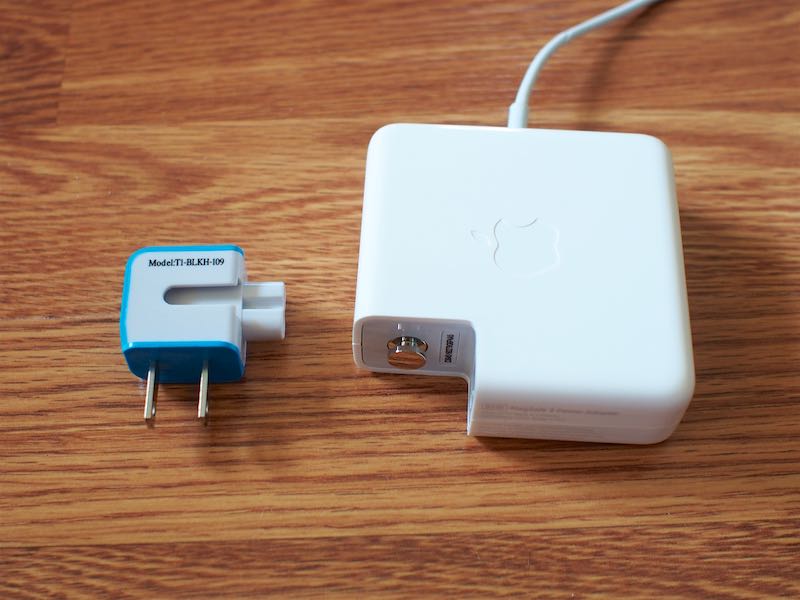
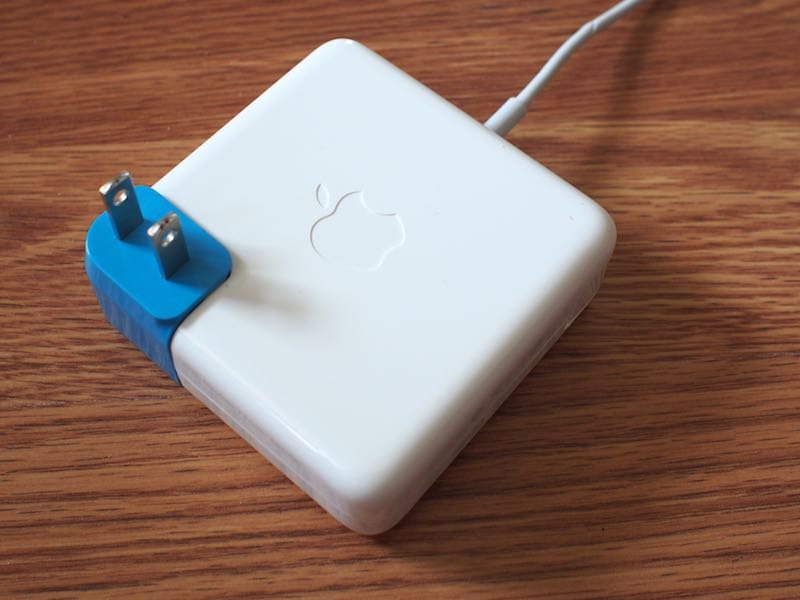
Created by Ten One Design, the Blockhead is a simple plug designed to rotate the orientation of the MacBook or iPad Power Adapter so it rests flush against a wall or power strip when it’s plugged in.
There are, occasionally, some products that are so simple and intuitive that you look at them and wonder why they didn’t already exist — the Blockhead is one of those products. Made from blue plastic, the Blockhead replaces the snap-in plug portion of the official chargers for Apple’s lineup of MacBooks and iPads.
There’s not a lot to say about the design of the Blockhead. It’s similar to the official AC wall adapter that can be snapped out of a MacBook or iPad Power Adapter, but its plugs are oriented in a different direction. Made of an attractive blue ABS plastic instead of white plastic, the Blockhead is otherwise functionally identical to Apple’s own power adapter bits.

The Blockhead, which is UL-approved, fits flush into the Power Adapter, but the fit isn’t quite as exact as the original adapter it replaces. The Blockhead sticks out slightly on the backside, but this is only noticeable when holding it and it doesn’t affect the functionality of the accessory. It works in the United States and Canada and fits in any socket able to accommodate a NEMA 1-15 plug with two parallel blades.
When plugged into an outlet, a Power Adapter with the Blockhead measures in at 1.2 inches thick, compared to the 3.8 inches a Power Adapter takes up with the standard Apple hardware installed. Two Blockheads can also be used side-by-side in a single two-socket outlet, with one positioned upside down and one positioned right side up.
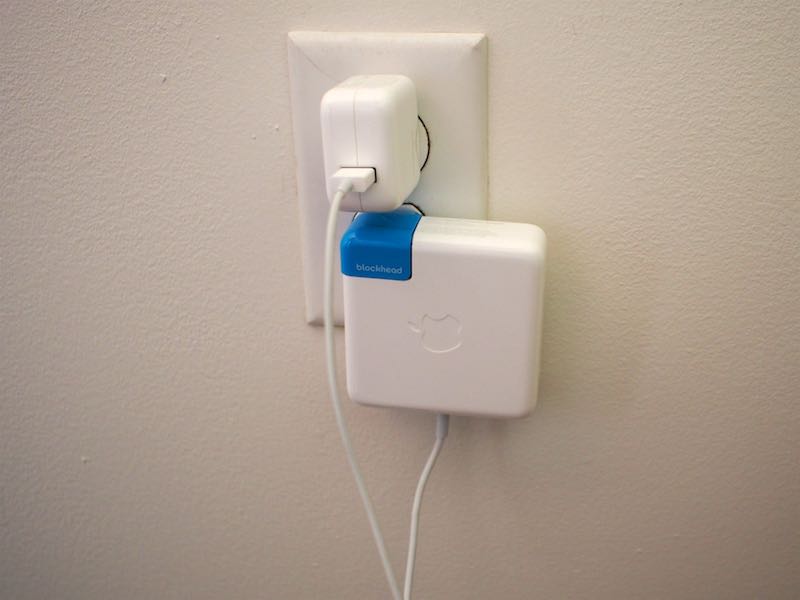
The Blockhead fits into outlets in a more logical way, and something I noticed was a tighter fit in outlets that have become looser over time. Even in an outlet where orientation wasn’t an issue, I was less likely to accidentally pull the Power Adapter out of the wall with the Blockhead attached, and I was also less likely to accidentally bump into it.
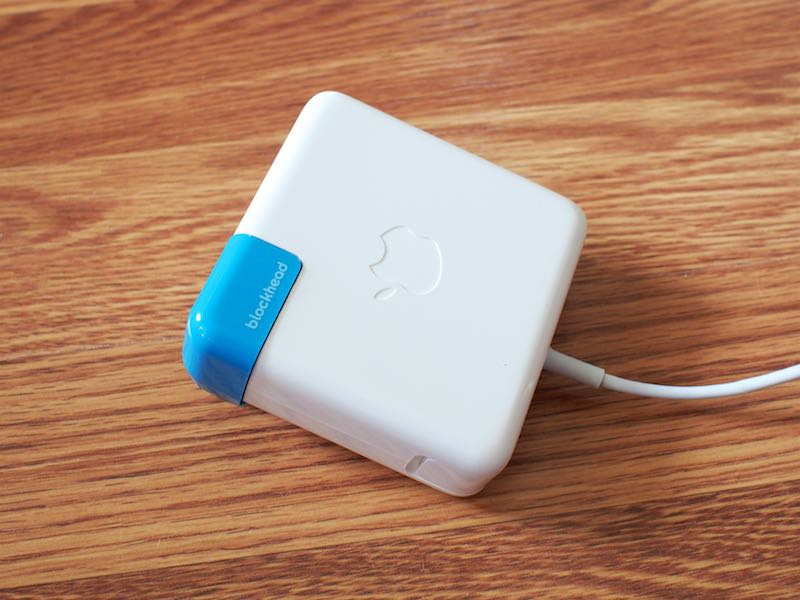
According to Ten One, the design of the Blockhead can protect against cord stress because it puts less tension on the plug, which makes sense because it changes the positioning of the cord to be closer to the ground. I’ve never damaged my cord near the Power Adapter because of stress, but I imagine this has the potential to be useful to some people who have run into trouble.

One clear negative to the Blockhead is non-retractable plugs. With the standard Apple adapter, the plugs can be folded inwards to make it more convenient for travel, but the Blockhead doesn’t work that way. It’s a small inconvenience, but an inconvenience nonetheless.
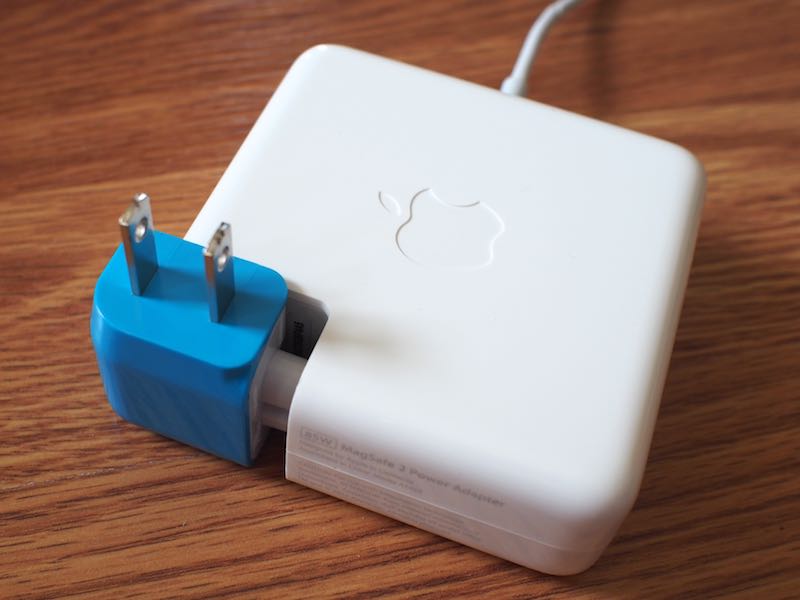
The Blockhead works with all MacBook chargers designed for the Retina MacBook, MacBook Air, and MacBook Pro, along with 10 and 12-watt chargers designed for the iPad. It fit well in each of the 13 and 15-inch Retina MacBook Pro and iPad Pro/iPad Air chargers I tested it with.
During the month and a half that I tested the Blockhead, I had no problems with heat, durability, or design, and ran into no issues that would prevent me from recommending it to anyone who wants to orient their MacBook or iPad charger in another direction when charging.
Bottom Line
If you have an outlet located behind furniture or in an area where a MacBook charger that sticks out of the wall is inconvenient, the Blockhead is well worth the purchase price. It’s $19.99, which sounds expensive for a piece of plastic, but it definitely improves the functionality of Apple’s Power Adapters for those who need it.
After using the Blockhead, I find myself wondering why Apple designs the Power Adapters to stick out from the wall. I prefer the look of a Power Adapter that sits flush with the wall, even in situations where my outlet isn’t blocked by furniture. It’s a cleaner design that makes more sense than a sideways-facing Power Adapter. Of course, it’s not symmetrical with the power outlet, which is one reason why the Apple design is superior, and it may not fit as well into a power strip.
The flat positioning of a Power Adapter equipped with the Blockhead has prevented me from accidentally pulling the adapter out of the wall by tugging on it or knocking it out accidentally when walking by, something that came in handy even when I didn’t need to fit my Power Adapter in a tight space. It was also more stable in outlets that are somewhat loose due to the weight distribution.
Given that most people use their MacBooks and Power Adapters for several years, $19.99 is a small price to pay for additional convenience.
Pros:
- Weight distribution makes it fit better in loose outlets
- Allows the Power Adapter to fit in tighter spaces
- Prevents Power Adapter from being knocked out of an outlet
- Saves space
- Better aesthetic appeal than standard adapter
Cons:
- Prongs are not collapsible for portability
- Fit is not as flush as standard Apple adapter piece
How to Buy
The Blockhead can be purchased from the Ten One Design website for $19.95. Two Blockheads are also available for a discounted price of $34.94 At the current time, the Blockhead is only certified for use in the U.S. and Canada, but Ten One is exploring a potential expansion to additional countries.
Tags: Ten One Design, Blockhead
Discuss this article in our forums
Some Users Experiencing Issues With App Store and iTunes Store
Some iOS and Mac users are currently unable to access the App Store, Mac App Store, and iTunes Store, according to reports from MacRumors readers and Twitter users.
When attempting to load the App Store on some devices, the Featured and Top Charts section are blank, and some users are reporting receiving “Cannot Connect to iTunes” messages when attempting to use the iTunes Store. App Store updates appear to be functional for some users despite the connectivity issues.
Apple’s system status page has not yet been updated to reflect any kind of outage and it is not clear how many users are affected.
Tag: App Store
Discuss this article in our forums
B!Sides Brain Challenge: The lost Tetris b-side (review)

THE BASICS
If Tetris and Sudoku spent one wild and crazy night together “punching numbers,” then surely B!Side Brain Challenge is the fruit of their passions.
 The goal is to arrange blocks of positive and negative numbers inside of a 5×5 grid into horizontal or vertical groups that have a combined sum of 0. As time passes, more numbers will appear on the grid. Play ends when numbered blocks fill the entire grid.
THE GOOD
Mental math is a dying art. B!Sides is a straightforward, entertaining game that will help exercise that simple math muscle and hopefully lead to a generation more readily equipped to count change at the register of your favorite lunch spot.
THE BAD
 There are no levels or save points for continuation of play, and no bonus awarded for clearing the grid at any point in the game. There are awards insofar as highlighted logos in the Achievements tab are considered adequate reward. Achievements are categorized by points earned in a single game and total number of games played.
THE UGLY
 Unless otherwise specified, stats and gamer ID are public through your Google account. Visit the Google Play Games app to change gamer ID privacy settings. For those wishing to reign anonymously as B!Side champion (your friends can’t prove it’s not true!) tap the settings menu and uncheck the appropriate boxes.
B!Warned! This game is addictive. You cannot win. You can only play until you lose. The absence of levels or save points gives way to an instinctive need to conquer B!Sides at every attempt, at the possible expense of hydration, hygiene and sleep.
Rating: 4.5 out of 5 (Google, show me a default of privacy and I’ll show you that last half of a star.)
 AIVAnet