


LG V10 vs. Samsung Galaxy S7 edge: Clash of the titans

They’re both big and bold, but which should you buy?
For a lot of people, the V10 is still LG’s flagship phone. I happen to be one of them, and it’s time to compare the best LG has to offer against the current darling of the smartphone industry, the Samsung Galaxy S7 edge.
Both are pricey, offer unique features and do everything you would want a smartphone to do in 2016. But they are also very different from one another, both on the surface and under the hood. While it’s difficult to try and tell someone how they should spend their money, we can compare how they stack up against each other to help you make that decision.
The hardware

The Galaxy S7 edge is a beautiful phone. The glass surfaces give it a very premium feel, stylish good looks and a futuristic design when paired with the curved edges of the display. Samsung took the design and construction we saw in 2015 with the Galaxy S6 edge, and refined it to perfection. Outside of the buttons and ports, there are no hard straight edges on the S7 edge, and everything looks and feels organic and fluid. Of course, this is all subjective, but I can’t think anyone would consider it ugly or the design off-putting.
The display is stunning, and one of the best in the industry. The 1440 x 2560 pixel, 5.5-inch AMOLED panel is bright and vibrant, with just a bit of over-saturation that we’ve come to know and love from AMOLED. You’ll be hard pressed to find any phone with a better display, and Samsung (as always) deserves the praise they receive over their screen technology.
The LG V10 is everything the Galaxy S7 edge is not. It’s big, and bulky and completely unapologetic about being either. The steel frame and “DuraSkin” coated back make the V10 feel substantial and solid, while still allowing for a removable battery. The polished steel sides look striking against the jet black exterior, while looking sleek and refined when paired with the antique white model. The rear power and volume buttons (the power button is also a fingerprint sensor) are something you’ll either love or hate, but they allow for an uninterrupted and smooth surface on both sides. Some are put off by the size and “weaponized” feel of the V10, but others — like myself — love the way it looks and feels.
The 5.7-inch QHD LCD display is no slouch. It can be a bit reflective in bright light and difficult to see in direct sunlight, but the colors are true and everything is crisp and sharp, though the display density makes for a bit less information on the screen with everything being a bit larger than many are used to. Atop the main display is what LG calls a “Second Screen” where notifications, shortcuts and other potentially useful information can live.

| Processor | Quad-core Snapdragon 820 or Octa-core Samsung Exynos 8 | Snapdragon 808 |
| Display | 5.5-inch QHD with dual edge design | 5.7-inch QHD with Second Screen |
| Storage | 32GB + microSD | 32/64GB + microSD |
| RAM | 4GB | 4GB |
| Rear camera | 12MP | 16MP |
| Front camera | 5MP | 5MP |
| Battery | 3,600mAh | 3,000mAh (removable) |
| Operating system | Android 6.0.1 Marshmallow | Android 6.0.1 Marshmallow |
| Size | 150.9 x 72.6 x 7.7 mm | 159.6 x 79.3 x 8.6 mm |
| Weight | 157 grams | 192 grams |
You won’t be able to find two phones that are this different when it comes to design. Samsung takes the elegant approach that leaves you feeling like you’re using a delicate yet powerful piece of equipment, while LG is more in your face and decidedly rugged feeling — this is the phone Bruce Willis would use while fighting international terrorists.
In the end though, both are well constructed and feel premium while using different materials and design language. I’ll readily admit I like the look and feel of both devices, and both are phones that the design teams should be proud of.
A final few words need to be said about the V10’s HiFi audio system. Using a high quality dedicated DAC and amplifier package, the V10 is one of the best sounding phones available in North America when you put on the headphones and fire up some local music. In contrast, the U.S. version of the Galaxy S7 edge is average at best, and audio is easily eclipsed by even some of Samsung’s earlier Galaxy phones. Much like the camera, this is an important feature to many, and LG deserves the praise heaped on the V10 in this area.
The software

Welcome to the meaning and idea of open-source. Samsung and LG are the undisputed kings of taking Android and molding it into something that bears just a hint of resemblance to the original. We don’t fault them for doing it, as this embodies the vision and ideals of providing a choice to users. Having everything follow a set pattern of design and appearance is available on other platforms for those that are more comfortable with it.
Both Samsung and LG software have learned to design software with a decidedly Asian DNA of abundant features and almost endless customization options, combined with a more flat and scaled back appearance in recent years. Users in the west have benefited immensely from this, and even more stoic offerings from Google and Apple are becoming more friendly and personal, following the lead from the two Korean smartphone powerhouse manufacturers.
Everything you would expect and need from an Android phone is there, and small differences in appearance and functionality are enough to make each feel unique in their own right. Both phones have full access to Google’s core application suite of Search, Gmail, Chrome, Maps and more, as well as access to a seemingly endless list of applications from Google Play. Brand specific features and software are also found in Samsung’s Galaxy Apps store or LG’s Smart World market.

Each phone has their own specific software quirks, but recent versions from both companies have managed to bring all the bells and whistles with minimal effect on performance. Of course, both devices are also modified at the whim of the carriers who are the prime customers for Samsung and LG. Both the S7 edge and V10 I’m using are T-Mobile branded, and you’ll find similar applications and modifications to the shipping software on each. One major difference for many is with the boot loader — the V10 is easily unlockable for software modification, while the S7 edge is locked and encrypted.
If pressed to choose the “better” software, I’d have to give a slight nod to the Galaxy S7 edge, but newer and faster hardware plays a big part in that observation. Depending on how you think about copious features and bold changes to Android, you’ll either think they are cluttered and aggressive or enjoy the amount of features and options that ship with the phones themselves. I fall into the former category, and am pleased that I’m able to turn things off or put them out of my way and make either phone work for me.
Newer and faster hardware makes the S7 edge the better performer
When it comes to performance, the Galaxy S7 edge is the clear winner here — again because of the latest hardware with more power to run all the things happening. That doesn’t mean the V10 offers a bad experience, but it’s not as fluid or snappy as the S7 edge. With 2016 hardware, Samsung has managed to make the S7 series as responsive as the minimal software on the Nexus 6P in most areas. Laggy keyboards and unresponsive messaging applications or gallery software is a thing of the past, and I say good riddance. On the LG side, the V10 will also be able to do any task thrown at it, but without the smooth operation we see from the S7 edge. It will be very interesting to see an updated V10 with newer and faster internals, and I certainly hope LG makes it happen.
A final word about updates, including Android security patches. The V10 has lagged behind here since it was released, while Samsung (so far) has shown commitment to keeping the S7 edge current and fixing issues with quick updates. Finger pointing at carriers aside, if this is an important issue for you, it’s hard to recommend the V10. We hope LG realizes the value in supporting devices and decides to honor their pledge for monthly software updates.
The camera

If you value a great camera on your smartphone, you’ll be pleased to know that both the V10 and the Galaxy S7 edge offer outstanding options here, complete with all manner of features and shooting modes in the stock applications.
The V10 (or the G4 which offers the same camera and most of the same options) still remains my choice when it comes to using a smartphone as a camera — setting up shots and adjusting settings — but the S7 edge offers a better point-and-shoot experience. In part, the camera app plays a part here and I’m familiar with the manual controls and features on the V10, while I find the Samsung offering takes a bit more time to dial in. This is likely a matter of familiarity, and either should be equally easy to learn and use.
LG V10 (left) and Samsung Galaxy S7 edge (right). Click to enlarge.
As you can see, the image processing is a little different, as are the default full resolution aspect ratios — 4:3 for the S7e, and 16:9 for the V10. Samsung brings just a hint more saturation and vibrancy to their images, while LG delivers an image where the colors are more true to life. This makes perfect sense when you consider the screen technology of the two devices. The Galaxy S7 edge’s AMOLED screen allows bright, over-saturated images to look bold, beautiful and almost pop out of the screen. Accuracy aside, it’s quite nice to view the images taken with the S7 edge on the S7 edge’s screen. Meanwhile. LG’s display is a more subdued and sharp view because they are using a high-quality LCD. Saturated and vibrancy-enhanced pictures wouldn’t look as good on the display and sharpness would suffer.
The good news here is that either phone can produce pictures that are easily adjusted by editing software, and can still look good on a 27-inch monitor if viewed at full resolution. We’re not to the point where any phone camera can replace an expensive Digital SLR, and neither company makes that claim. What each has done is deliver a great camera that can take pictures you’ll be proud to share with friends and family, in a package that likely always in your pocket. We’ve come to the point of diminishing returns in the camera department, either the S7 edge or the V10 will continue to be an excellent choice for mobile photography during their lifetime. I’ve used both cameras in my work here at Mobile Nations, and won’t hesitate to recommend either.
The battery

The Galaxy S7 edge and its 3,600 mAh battery wins.
The LG V10 and its removable 3,000 mAh battery wins.
Really, that’s what to take away from this. Both phones will last the average user a full day, yet both phones will likely require daily charging. When pushed hard, the S7 edge battery lasts longer than the V10 battery, but not longer than two batteries that can be changed as needed.
Both phones offer Qualcomm Quick Charge 2.0 over the micro USB port. The Galaxy S7 edge also offers wireless Qi charging out of the box, while the V10 requires a special OEM wireless charging back plate. The Galaxy S7 edge also allows for wireless Quick Charging, while the V10 doesn’t. But you can swap the battery.
All in all, this category really is a wash. The S7 edge uses a more power efficient processor and a larger battery to squeak a few more hours of use each day, while the V10 offers an easy to change battery and inexpensive spares. I lean towards the S7 edge here, because I don’t want to keep track of a spare battery and keep it charged. You’ll need to decide which suits you better and let it influence your decision accordingly.
The final word

I’m going to stretch my neck out for the inevitable chopping, but I would recommend the Galaxy S7 edge if you’re considering these two phones. And I’m saying this as someone who will continue to carry the V10 every day with a Project Fi data-only SIM as my secondary media device. But I’m a nerd who carries multiple phones.
Audio chops aside, the S7 edge is the better all-around choice. Nothing else about the V10 is remarkably better, and the Samsung is more future-proof simply because it uses the latest Snapdragon custom ARM chip in the 820. We also know Samsung is serious about their Galaxy S line, and future updates will happen even if they’re late arriving. The same can’t be said about the V10, which is a limited release phone in just a few markets. LG’s track record with software updates is already spotty at best, and there’s no guarantee that the V10 will receive the attention it deserves when it comes to keeping current.
Having said that, if you were to tell me that you love the V10 design or the excellent HiFi audio, I would agree completely. You’ll be happy with the purchase, as long as you know going in that the V10 is a niche product from LG and they may focus elsewhere.
For everyone else, the internet is right this time — buy the Samsung.
Samsung Galaxy S7 and S7 edge
- Galaxy S7 review
- Galaxy S7 edge review
- Here are all four Galaxy S7 colors
- Should you upgrade to the Galaxy S7?
- Learn about the Galaxy S7’s SD card slot
- Join our Galaxy S7 forums
AT&T
Sprint
T-Mobile
Verizon
LG V10
- Read our full review
- LG V10, a second opinion
- LG V10 specs
- All the latest LG V10 news
- Join the discussion in our forums
- LG V10 vs. the LG G4
Verizon
AT&T
T-Mobile
Amazon
Samsung’s Bedtime VR Stories could bring busy parents and their kids together
Virtual reality has the potential to transform the way we think about all kinds of interactions, and Samsung’s latest idea is a perfect example of that. Called Bedtime VR Stories, the in-development app seeks to bridge the divide between busy parents and their children by bringing the two together for story time in virtual reality.
From Samsung:
Sharing a bedtime story is incredibly special. But longer working days and hectic schedules make this harder to do. At Samsung we believe that technology should bring us closer together. That’s why we developed Bedtime VR Stories, so parents and children can enjoy a story together, even when they’re apart. Using individual VR headsets, the app creates a VR story environment where parent and child can see and interact with each other, for an immersive shared experience. Bedtime VR Stories is currently being developed for full release.
While it’s easy to get caught up in all of the technical aspects of VR, ideas like this are what could truly make the experience special. Of course, the notion of pumping light into your kids’ eyes via Gear VR right before bedtime could present a potential wrinkle for getting to sleep, but it’s an interesting example of the possibilities for VR nonetheless.
There’s no timeline on when Bedtime VR Stories may be available, but you can currently check out this 360-degree sample experience on YouTube for more:
The ‘Dark Souls’ franchise is over… for now
At what could be the height of the Dark Souls franchise’s popularity, developer From Software is ready to move on.
When speaking with GGN Gamer, Dark Souls director Hidetaka Miyazaki announced that the studio is already working on a brand new IP, saying “Dark Souls is over” and “development of a new IP has already begun.”
This isn’t a brand-new revelation by any means. Previously Miyazaki had announced that Dark Souls 3 would be the final game in the series, so fans have had time to come to terms. In previous interviews he’s also expressed the desire to move on and “try new things.” But despite his seemingly black and white statement about the series’ future, he’s not averse to returning to it at some point.
“There’s absolutely no plan right now for any sequels, spin-offs or tie-ins. But I can’t say for certain the possibility is zero percent,” he explained, stressing that what’s “certain for now” is that to him personally that Dark Souls is over.
As far as support for Dark Souls 3, however, Miyazaki did confirm that two additional DLC packs will be available later this year and early 2017. The Dark Souls franchise may have drawn to a close for now, but it’s certainly ripe for a return for some easy money five years down the road.
Source: IGN
Apple Marketing Chief Phil Schiller: ‘Never Pluralize Apple Product Names’
Apple executive Phil Schiller gave Apple users a grammar lesson on Twitter yesterday afternoon, explaining that it isn’t necessary to pluralize Apple product names.
Schiller’s instructions came after a discussion on pluralizing “iPad Pro” between Andreessen Horowitz partner Benedict Evans and iMore analyst Michael Gartenberg. Evans referred to more than one iPad Pro as “iPads Pro,” while Gartenberg said “iPad Pros.”
Schiller clarified that neither approach was correct. The proper way to refer to more than one iPad Pro is to call them “iPad Pro devices.”
@Gartenberg @BenedictEvans @stevesi @macintux One need never pluralize Apple product names. Ex: Mr. Evans used two iPad Pro devices.
— Philip Schiller (@pschiller) April 28, 2016
He went on to further state that it would be correct to say “I have 3 Macintosh,” or “I have 4 Macintosh computers” when referring to more than one Mac. “Words can be both singular and plural, such as deer and clothes,” he explained. By that logic, more than one iPhone would need to be referred to as iPhone devices or iPhone models rather than “iPhones.”
As Business Insider points out, Apple sometimes breaks its own naming rules. In press releases, the company has made mention of “iPhones” in the plural form.
Tag: Phil Schiller
Discuss this article in our forums
Flow is a new automation tool just like IFTTT – but Microsoft made it
Microsoft made an IFTTT-like tool. Unfortunately, it’s not quite ready to debut.
IFTTT, also known as If This Then That, is a popular tool that allows you to connect web services to get things done in an automated manner. For instance, you could implement a “recipe” so that whenever you tweet a photo, it gets saved to your Dropbox. The possibilities are endless.
Twitter user h0x0d discovered Microsoft Flow. It’s a preview service that also connects services together. You can connect, for instance, Twitter, Slack, Google Drive, Dropbox, and Office 365. Flow also suggests several “flows” (aka recipes), such as “save tweets to a CSV file in Dropbox”.
Microsoft published this blog post about the tool, which is called Flow, and then it removed the post (though you can still access it via cache). Interestingly, it also offers this “Getting started” FAQ page, which will walk you through how Flow works. That page hasn’t been removed yet.
Flow went live yesterday as a preview, and it’s not yet clear when it’ll go public. But you can go to the website now and browse through more than 35 services enabled in the Flow preview. Microsoft plans to add more every week.
READ: IFTTT explained
‘A Beautiful Planet’ offers a bold new look at Earth in IMAX 3D
IMAX films shot in space aren’t anything new, but with A Beautiful Planet, longtime IMAX director Toni Myers still manages to show us entirely new perspectives of Earth. Shot on the International Space Station by several crews (including internet sensation Scott Kelly) and narrated by Jennifer Lawrence, it’s a groundbreaking film in many respects: It’s the first IMAX space feature to use digital cameras as well as off-the shelf shooters (the Canon EOS C500 and 1D-C). And it’s also the first film from IMAX to use SpaceX’s Dragon spacecraft to ship equipment to the ISS.
While A Beautiful Planet uses converted 3D footage (it wasn’t shot with actual 3D cameras), there’s still an immense sense of depth to the imagery. The film also evokes the Spaceship Earth concept, which centers on the idea that we’re all traveling together on an organic craft with limited resources. It’s hard not to be taken aback when you see how dry the Colorado River Basin appears from space, which has led to droughts in California and surrounding states, or when you see how much of Brazil’s rainforests have been destroyed. In many ways, the film is a call to arms for the next generation of would-be environmentalists.
Back when the NASA’s space shuttle was running, IMAX was able to get its large 2D and 3D cameras sent up fairly easily. But these days it’s more difficult to get material into orbit, because there’s no space shuttle for sending up large cargo. Luckily, modern digital filmmaking equipment is also far less cumbersome to deal with than it was during the days of the shuttle program. Not only are the cameras significantly smaller, but there’s no need to handle large reels of IMAX film, which weighed around 10 pounds and could record only three minutes at a time. IMAX says the data packs used today are around the size of an iPhone and can record 30 minutes of 4K video. Astronauts were trained to use the cameras by cinematographer James Neihouse, and they were tasked with getting footage from more than 100 targets (though they were also told to “shoot what they saw”).

Though much more convenient, there was a bit of a tradeoff with the new hardware. IMAX’s older film cameras delivered stunning footage with a resolution comparable to 12K. But while the digital cameras might not pack in the same level of quality, their footage still looked astounding when projected in 3D on a full-size IMAX screen at Manhattan’s AMC Loews Lincoln Square theater. And despite the lower resolution, the digital cameras still managed to outdo their predecessors with their ability to handle low-light shots.
“We would not have the nighttime scenes without the digital dynamic range,” Myers said in a statement. “What the digital capture did was totally open up that night world to us, with stars, cities at night, lightning and other phenomena that you see at night, like aurora.”
Those night scenes are indeed stunning. Viewing Earth in daylight conveys the immensity of the natural world, but at night you also see the impact of human civilization in cities ablaze with electricity. It’s also a reminder of how different even neighboring societies can be: South Korea is one of the brightest spots on Earth at night, but it’s almost complete darkness over the border in North Korea. On the natural side of things, the brief glimpses we get of aurora dancing across Earth’s atmosphere look more like computer-generated effects than something organic.
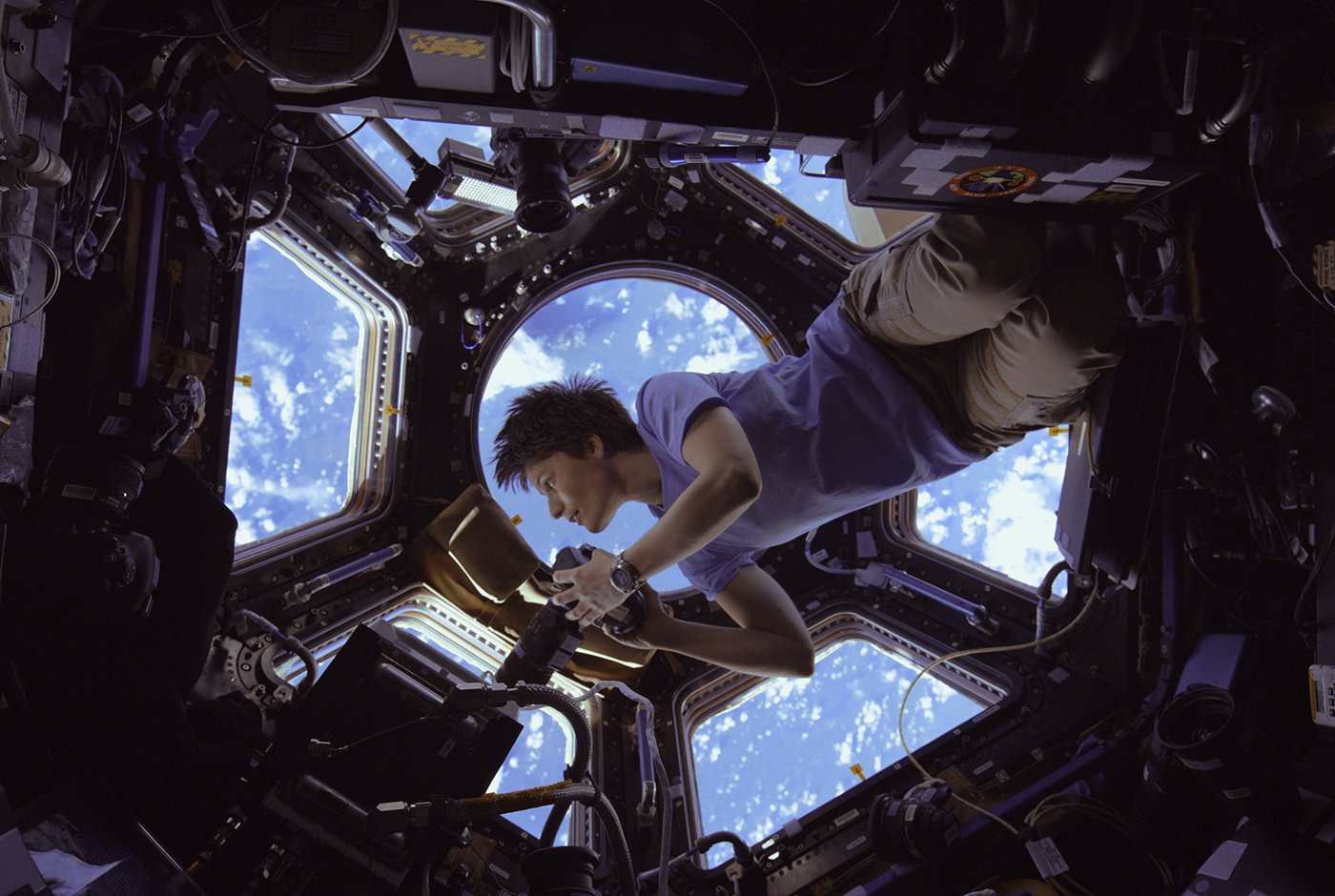
Another first for the film: It took advantage of the International Space Station’s “Cupola,” a dome-like arrangement of seven large windows, giving astronauts an incredibly wide view outside the craft. That was helpful for their own work taking care of the ISS, but it also allowed for a wide variety of angles for recording footage of Earth. IMAX also developed a special shield that protected the windows when they weren’t being used, which the astronauts were able to control.
A Beautiful Planet gives us a clear sense of what it’s like to be on the ISS working alongside some of Earth’s most talented astronauts. We see them exercise, shower and try to maintain a sense of normalcy in a zero-gravity environment. Sure, they’re in space, but their jobs aren’t exactly glamorous. Much of their time is spent running and maintaining experiments. The astronauts also didn’t get any time off to shoot the film — they worked with what little personal time they had.
At only 45 minutes, the film is more of a showcase for its incredible footage instead of a deep think piece. (At times it feels like it was written mainly for children.) Still, it makes a big impact: You’ll see things you’ve never seen before, and it gives you a broader sense of our impact on the environment. I’m sure we’ll get an even more immersive space experience with 360-degree video or virtual reality eventually (Adr1ft comes close), but at this point, it’s the closest thing to being in orbit.
20th Century Fox will skip Comic-Con to avoid trailer leaks
One of Comic-Con’s biggest draws is always the exclusive trailer screenings for upcoming superhero and science fiction flicks. But now more than ever, those teasers are being recorded and leaked online, much to the frustration of Hollywood studios. The situation is so bad that 20th Century Fox, according to TheWrap and the LA Times, has decided to pull out of this year’s convention. That means no sneaky-peeks of upcoming projects like Wolverine (3?), Maze Runner: The Death Cure or Assassin’s Creed.
A number of trailers leaked at the show last year, including Deadpool, X-Men: Apocalypse and Warner Bros’ Suicide Squad. Teasers that go out ahead of time supposedly hurt the studios in a few different ways: for one, they’re usually uploaded in a lower resolution, potentially sullying people’s perception of the film. For another, they break an otherwise perfectly planned marketing strategy, which again, studios fear dilute the film’s impact with viewers. The counterargument, of course, is that any fan interest should be seen as a positive. If millions watch a leaked trailer, that means millions are now aware and potentially interested in the movie.
A Comic-Con spokesperson told The Verge: “There are a great many things that go into making a great panel presentation. For TV networks and movie studios, sometimes that includes exclusive footage, and while we have been very diligent in trying to prevent footage from being leaked, the truth is today’s technology makes any guarantee difficult. We are working with our friends at the different studios and networks in hopes of finding a remedy that will be beneficial to them, us and most importantly the fans.”
Source: TheWrap, The Verge, LA Times
Cortana won’t let you search with Google in Windows 10
In what may come as no surprise, Microsoft won’t let you use Cortana to perform a Google search anymore. While the digital assistant was capable of using a third-party search engine on Windows 10, the company announced this week that the “result is a compromised experience that is less reliable and predictable.” So, to ensure that everything works well, Microsoft will only allow Cortana to launch the new Edge browser and find answers via Bing.
“Unfortunately, as Windows 10 has grown in adoption and usage, we have seen some software programs circumvent the design of Windows 10 and redirect you to search providers that were not designed to work with Cortana,” GM of search and Cortana Ryan Gavin explained in a blog post. “The continuity of these types of task completion scenarios is disrupted if Cortana can’t depend on Bing as the search provider and Microsoft Edge as the browser.” In other words, using other apps led to a less reliable experience.
This doesn’t mean you can’t continue to use Google search and Chrome as your primary browser on your Windows 10 machine. You can certainly still do that, and set those and other third-party apps as the default option to hop around the internet. However, you’ll want to keep in mind that Cortana will only provide answers to questions and lend a hand with tasks through Microsoft Edge and Bing.
Source: Microsoft
The director of ‘Madagascar’ takes on the wild west of VR
As the writer/director behind DreamWorks Animation’s Madagascar, a blockbuster that spawned five sequels and one TV show, Eric Darnell could’ve easily hung up his hat and basked in his Hollywood legacy. But, instead, Darnell departed the studio he made famous last year to explore the “wild west” of virtual reality with Baobab, an animation studio he co-founded alongside Maureen Fan, the former VP of games at Zynga. At this year’s Tribeca Film Festival, the two debuted their first effort, Invasion!, a VR short featuring a lovable, alien-thwarting bunny rabbit and a prologue narrated by Ethan Hawke.
“He’s a big fan of VR, it turns out,” says Darnell of Hawke’s involvement.
Baobab’s six-minute long computer-animated short tells a simple tale: Aliens come to Earth intent on a hostile takeover and are unwittingly defeated by a cute bunny. With its family-friendly tone, charming characters and clever physical humor, Invasion! is not unlike Darnell’s past work. And it’s precisely that familiarity that should have parents taking off their VR headsets and eagerly placing them on their children’s heads.
“Our goal is to make stuff everybody can enjoy,” says Darnell. “There’s no reason to put in a dirty word or off-color joke if you can do something funny and appealing to a broad audience.”

Believe it or not, this fluffy bunny thwarts a hostile alien takeover
Darnell drew inspiration for Invasion! from two classic sources: the original The War of the Worlds movie and Laurel and Hardy. The mash-up is immediately evident as Hawke’s introductory narration is inspired by the H.G. Wells novel that inspired the original film and in the alien duo’s bumbling comedy of errors. But whereas the current version of Invasion! centers on the bunny as the unwitting hero, originally Darnell had built the piece around the two aliens. And in that earlier version, which was available as a preview on Gear VR, the bunny died. It was a decision Darnell chalks up to lack of production time. “We didn’t have time to animate it for the trailer,” he says.
It also proved to be a great lesson in the do’s and don’ts of VR filmmaking for Baobab. Early feedback from parents who’d seen the preview highlighted a key concern: Unlike watching a film in a theatre’s communal setting, VR is an isolated experience which means parents have no way of monitoring and consoling children who’ve witnessed upsetting imagery or storylines (e.g. a dead bunny). Thus making them less likely to allow their children to participate in these VR experiences. And so it was decided the bunny should live.
That commitment to all-ages entertainment forms the backbone of Baobab Studios, which boasts animator Glen Keane (The Little Mermaid, Aladdin) and founding members of Pixar, DreamWorks Animations and Twitch as advisors. With that considerable brain trust behind them, Darnell and Fan hope to replicate the high-quality visuals and storytelling-centric ethos Darnell helped foster while at DreamWorks Animation and, in the process, transform VR from a niche novelty to a form of popular entertainment. Currently, the Bay Area-based studio has a slate of 12 projects in various stages of development. But given the early positive responses to Invasion!, Fan says it’s likely the studio’s sophomore effort will be episode two.

Eric Darnell (front left), Maureen Fan (front right) and the Baobab Studios team
“The audience chooses the franchises. We aren’t the ones who choose the franchises,” says Fan. “So by putting out this first one and seeing how much people like it, that’s how we know whether or not we want to continue with additional episodes.”
Indeed, the bulk of Baobab’s output will rely on building strong episodic franchises the studio can continually revisit, though Darnell says longer-form, self-contained pieces are not out of the question. But, before Darnell can get to work on experiences that push past the 10-minute mark, he first needs to get viewers comfortable with the idea of spending time immersed in the virtual world.
“Our goal is to make stuff everybody can enjoy.”
Eric Darnell, Baobab Studios
Much like Oculus Story Studio and Penrose Studios, Baobab has its own suite of proprietary VR creation tools. But where Baobab branches off from the pack is in its in-development conferencing software. Darnell says his team is hard at work on a system that would allow multiple users to collaborate, sketch storyboards, draw models and work on blocking and set design all within the virtual world.
“…As a director, I can point to things and highlight things and ask the modeler to make it 20 percent bigger and move that rock over there,” he says. “And we’re all in the same world. We’re basically authoring our content, our VR experience inside of the medium. And that’s super powerful.”

The Baobab Studios team demos a build of Invasion!
Both Darnell and Fan are extremely bullish on VR’s consumer prospects and are positioning Baobab as a platform-agnostic studio. So when Invasion! and other projects are released, you can expect to see them hit every storefront from Vive to the Rift to PlayStation VR. Just don’t expect to see Baobab’s early shorts released with much controller-based interactivity. Both Darnell and Fan believe that, at least for now, VR viewers still want to be passively entertained at the end of a long day and not overwhelmed with control schemes and physical engagement.
“For me, the magic is really in inspiring the viewer to make their own choice and yet they’re getting the story I want them to get.”
Image credits: Baobab Studios
Netflix is giving the Punisher his own show
Shortly after The Walking Dead star Jon Bernthal was tapped as the Punisher in season 2 of Marvel’s Daredevil series, rumors circulated that the character would get its own show. Well, a few weeks after his debut, Netflix made the spin-off official. “The Punisher is back,” a tweet making the announcement reads. “Locked and loaded.”
The Punisher is back. Locked and loaded.https://t.co/nGKCa2taEV
— Netflix US (@netflix) April 29, 2016
Entertainment Weekly reports that Hannibal executive producer Steve Lightfoot will serve as showrunner and yes, Bernthal will return as Frank Castle for the series. Marvel and Netflix have certainly gotten cozy over the last year or so, with the debuts of Daredevil and Jessica Jones. The two also have Luke Cage and Iron Fist shows in the works, as well as a The Defenders miniseries. The addition of a standalone Punisher series brings the total number of projects between the comic publisher and the streaming service to six. Of course, details are scarce for now, so we’ll likely be waiting a bit on a premiere date.
Source: Netflix (Twitter)
 AIVAnet