


Apple open-sources CareKit to help us better understand our health
Forget the iPhone SE and the smaller iPad Pro: Apple’s biggest surprise at its most recent keynote might have been CareKit, a software framework meant to help iOS users more easily monitor and manage their illnesses. Some of you might have felt your eyes glaze over at the sight of “software framework,” so let’s put it this way: Apple wants to make it easy to assess your own health data and share that data with the people who can help you get even better. And starting today, CareKit is available on GitHub for developers to start playing with.
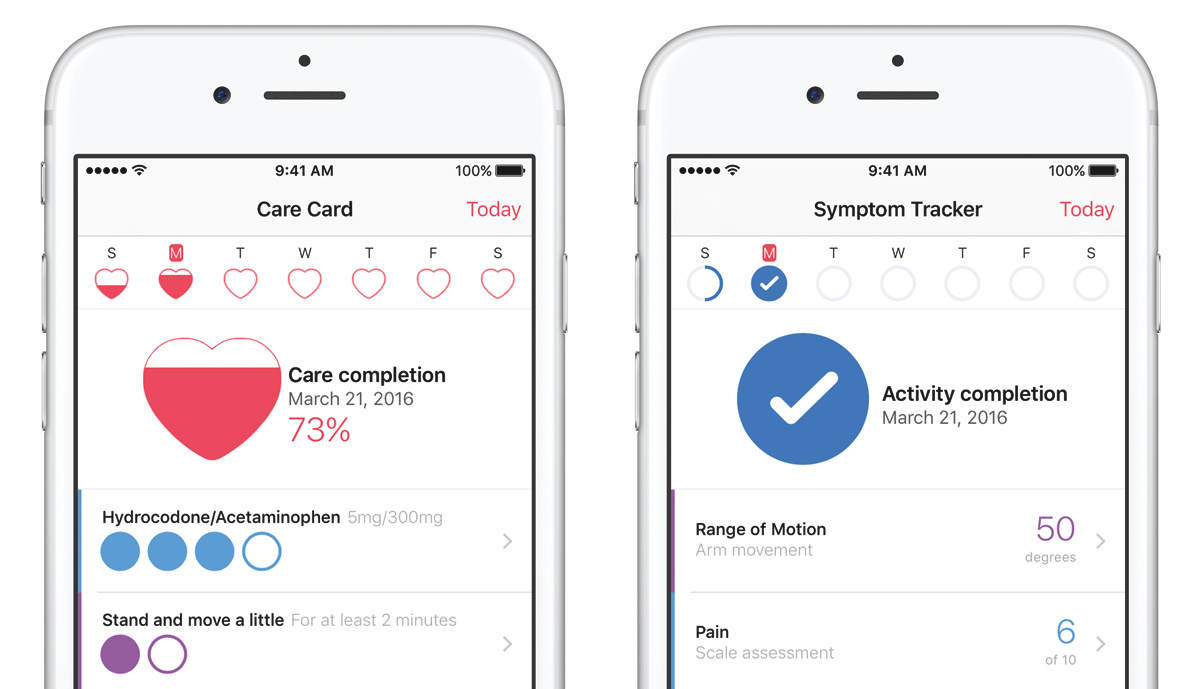
In case you missed the news the first time, CareKit currently has four modules that developers can deploy in their apps. Care Card is a mobile care plan where people can check off recovery or treatment tasks. The Symptom and Measurement Tracker does what the name implies: You can specify the amount of pain you’re in or perform specific activities meant to assess the progress of an illness. (Someone might tap the screen repeatedly to express how bad their Parkinson’s feels that day, for example.) Your progress with Care Card items is reflected in another module, called the Insight Dashboard, which illustrates those treatment measures against your symptoms. Last, and arguably most important, a Connect module lets you share all of this information with loved ones and medical professionals.
There are a few important things to take note of here. First, I’m hearing that it’s not terribly difficult to bake CareKit modules into an existing iOS app; it’s apparently a couple days of work at most. And if used properly, CareKit-enabled apps could help people get a more comprehensive understanding of their own health. It’s hard to overstate how helpful that could be. How you’re feeling can be plotted over time against what meds you were on or how active you were. These more nuanced portraits of health should hopefully lead to more informed people and more informed treatments.
More importantly, the information that flows in and out of CareKit plays nice with existing electronic health record systems like Epic, so hospitals and research facilities shouldn’t have too much trouble keeping up with the data that patients are sharing. Since that flow of information can ebb and flow far more frequently than scheduled checkups, the end result is that caretakers and physicians will hopefully have a better sense of a person’s overall health. It’s almost Apple’s attempt to end a legacy of short, uninformative doctor’s appointments and post-op check-ins.
This whole thing isn’t without its potential problems. In light of the FBI’s successful cracking of an iPhone, some will worry about the security of their health data. (For what it’s worth, Apple says all health information is encrypted and unreadable to the company.) Generational differences could mean some of the older patients who could most benefit from a clearer dialogue about health might not be willing to use smartphones. Still, CareKit is a first step in the right direction.
Speaking of first steps, Apple gave a few developers early access to the framework, as it frequently does ahead of a wider release. Glow, a startup focused on female health, updated its fertility and maternal health apps, as did Start, an app that tracks whether antidepressants are working on people as they should be. Meanwhile, One Drop, a diabetes management application that lets people track their activity, food and medicine intake, also got a CareKit update. All four will be available today, but — with any luck — they’re merely a harbinger of what’s to come.
Most Pinterest users are now from outside the US
Pinterest says one of its most important challenges when it transitioned from desktop to mobile in 2012 was to become a global brand. Things are going well for the company then, since majority of its users are now from outside the US. Two-thirds of new sign-ups are from outside the country, and Pinterest expects its next 100 million users to come from outside the United States, as well. The service grew the most in Germany over the past year, where pinners tripled in number. Users in France, Brazil and Japan doubled, and the company observed a significant increase in sign-ups from Russia, South Korea and Mexico. In an effort to cater to a growing worldwide audience, Pinterest is launching a new section called Featured Collections.
When users tap the explore icon, it’ll show local boards, topics trending in their countries and boards that might be relevant to their interests. For instance, someone from the UK might see style ideas from Burberry, while someone from France could see pins about singer Benjamin Biolay. Featured Collections is now live in the UK, France, Germany, Brazil and Japan. The rest of the world will have to wait a few more months to explore what their countrymen are currently into.
HIV antibodies guarded monkeys from the disease for six months
There’s no known vaccine for HIV, but researchers have a temporary preventative treatment in the works. A team of American and German scientists tested a quartet of injectable antibodies in monkeys that staved off the human immunodeficiency virus for up to six months, according to a paper published in Nature. The antibodies were harvested from HIV-infected people, cleaned and then given to macaques before they were dosed with a strain of simian HIV.
“This study is the first one to show that a single administration of these monoclonal antibodies can prevent infection, prevent disease and might be a viable alternative for a vaccine against HIV,” the National Institute of Allergy and Infectious Diseases’ Malcolm Martin tells The Verge. Beyond that the methods used in the experiment apparently mimic how HIV exposure usually occurs: the monkeys were repeatedly given low doses of HIV rather than one large dose at once; infection in humans doesn’t typically happen upon first exposure.
One of the antibodies from this experiment is already being tested domestically and in Brazil and Peru, and will expand to Botswana, South Africa and Tanzania. The Verge writes that, should the results from the trial (due in 2022) prove promising, these antibodies could lead to a preventative treatment.
Via: The Verge
Source: Nature
Philips Launches New ‘Hue’ App With Revamped Look and Support for Rooms
Philips today launched a new Hue app for its range of Hue HomeKit-connected smart lights and lightbulbs, introducing a fresh, intuitive layout that makes it easier to organize and control multiple lights at one time. While the app does not support third-party HomeKit accessories, it does incorporate HomeKit-style features like organization into rooms and more expansive scheduling tools.
The Hue Gen 2 app now features a main overview screen that separates lights based on what room they’re in, making it easier to set scenes by room, adjust the color or brightness of the lights in a room, or turn off all lights in a room at once. Before today, organizing HomeKit-enabled Hue lights into rooms had to be done through a third-party HomeKit app, but now it is available to all Hue users and directly within the Hue app.
Tapping on a room offers up individual controls for each light, along with options for managing scenes. Individual light colors can be changed by tapping on the color avatar for each light and selecting a color, a white light, or a Light Recipe. Scene creation is done in the same way it was with the previous app, through photographs or specific light settings.
Also included in the app is a dedicated “Routines” section that makes it easier to set specific lighting scenes for waking up, leaving home, arriving at home, and more. A Notification Center widget, Siri voice control, and accessory support are all available and can be accessed through the Settings section of the app, which is also where Rooms and Lights can be organized.

Up to 10 presets that combine multiple rooms and scenes at once can be added to the Notification Center widget for quick access, and Siri voice control with the HomeKit-enabled bridge is unchanged.

“Philips Hue was the world’s first connected lighting system for the home a little over three years ago, and since then it has become the system of choice for consumers,” says Sridhar Kumaraswamy, Business Leader Connected Home Systems at Philips Lighting. “As the Philips Hue ecosystem has grown with products, apps and partnerships with leading smart home platforms, so have our consumers. They want to do so much more with our connected lights, and with the new Philips Hue gen 2 app they can. It was designed for them, tested by them, taking their feedback onboard, and today’s new app gives them more control and creative freedom than ever before.”
Overall, Philips’ new Hue app is a lot more intuitive when it comes to managing a large number of Hue lights, especially those organized into several different rooms. Changing colors, dimming, turning lights on and off, and setting routines are all features that are easier to access in the revamped app.
Philips plans to keep both the original Hue app and the new Hue app available in the App Store, so users will be able to use the app they like best.
The new Hue app can be downloaded from the App Store for free starting today. [Direct Link]
Tag: Philips Hue
Discuss this article in our forums
Apple Launches CareKit Platform With Support for Four Health Apps
Apple’s new CareKit iOS framework goes live today, allowing app developers to create integrated software that helps patients and doctors to better track and manage medical conditions (via TechCrunch).
The open source platform was announced last month and aims to make it easer for developers to build health apps by offering a number of integrations, such as monitoring of medical symptoms, sending images of an injury, and keeping tabs on medication schedules. CareKit also offers two-way benefits, since it not only helps doctors monitor patients but also allows patients to observe their progress over time.
CareKit is made up of series of interactive modules. The Care Card can be configured to manage wellness tasks such as medication scheduling and exercise, while the Progress Card includes a Symptom and Measurement tracker for logging physical metrics like weight and heart-rate (with the potential for Apple Watch integration). The Connect module meanwhile lets users share their health data with medical professionals and family members, and can be viewed in tandem with Progress Card data in the Insight Dashboard module.
TechCrunch reports that the launch is limited to support for four iPhone apps at present: Glow Nurture fertility tracker, Glow Baby maternity app, diabetes monitor One Drop, and depression medication tracker Start. CareKit is compatible with existing healthcare record systems such as Epic and should be available on GitHub later today.
Apple’s other open source framework ResearchKit was made available to developers in April 2015, enabling them to create their own iPhone apps for medical research purposes. The framework has led to some significant gains in epilepsy and asthma research since its adoption among medical professionals and contributing patients.
Tag: CareKit
Discuss this article in our forums
Strong Galaxy S7 sales boost Samsung’s profits in Q1 2016
Strong demand for the Galaxy S7 and the S7 edge has allowed Samsung’s mobile division to record its highest profit in nearly two years. The South Korean manufacturer posted an overall revenue of 49.78 trillion won ($43.46 billion), an increase of 5.7% from the same period a year ago. Operating profit at 6.68 trillion won ($5.84 billion) was 12% more than what Samsung recorded in Q1 2015.

Profits from the mobile unit soared by 42%, with the business netting an operating profit of 3.89 trillion won ($3.4 billion) over revenues of 27.60 trillion won ($24.12 billion). Looking forward to the second quarter, Samsung is anticipating “softening demand in the smartphone market and negative growth in the tablet market,” and as such the vendor will focus its attention on the entry-level Galaxy J series and the budget Galaxy A series to drive up sales in emerging markets.
AT&T will shut down its 2G network by the end of 2016
AT&T has announced that it will decommission its 2G EDGE network by the end of 2016. CFO John Stevens told Wireless Week that the carrier has moved over 6 million subscribers off the legacy network over the last 12 months, with the remaining 2G userbase largely consisting of connected devices.

Stevens said that the cost played a major factor in the decision to shut down the 2G network:
There still is a lot of cost that is left just to operate even a piece of the 2G network. So we are anxious to capture that savings and use it to continue a strong EBITDA story for our wireless business.
AT&T has started repurposing the 2G network spectrum for LTE coverage, and will continue to do so over the course of the year.
Lenovo and Xiaomi pushed out of top five smartphone brands
Global smartphone sales figures for Q1 2016 are out, and it hasn’t been a great start to the year for Lenovo and Xiaomi. Both vendors have lost their sports as the fourth- and fifth-largest smartphone makers, conceding to Oppo and Vivo.

From IDC senior research manager Melissa Chau:
Along China’s maturing smartphone adoption curve, the companies most aligned with growth are those with products serving increasingly sophisticated consumers. Lenovo benefited with ASPs below US$150 in 2013, and Xiaomi picked up the mantle with ASPs below US$200 in 2014 and 2015. Now Huawei, OPPO, and vivo, which play mainly in the sub-US$250 range, are positioned for a strong 2016.
IDC says that Oppo netted over 18.5 million shipments in Q1 2016, a YoY growth of 153.2% that now sees the vendor in fourth place with a market share of 5.5%. With 14.3 million shipments and a YoY growth of 123.8%, Vivo clinched the fifth spot. Both Chinese manufacturers have set up a robust distribution network in emerging markets, catering to lower-tier cities. As the Chinese market is getting saturated, brands are looking to India for future growth. Both Oppo and Vivo have made large strides in the country this year, setting up manufacturing facilities and a strong retail presence.
Meanwhile, Samsung has maintained its lead as the number one smartphone vendor with 81.9 million shipments accounting for a market share of 24.5%, a minor decrease from the 24.6% the vendor registered during the same period last year. Apple is in second place with 51.2 million shipments, down from 61.2 million managed in Q1 2015. The decrease sees the vendor’s market share decline from 18.3% to 15.3%.
Huawei is in third place with 27.5 million shipments and an 8.2% market share, with a YoY increase of 58.4%.
Email privacy bill passes Congress with flying colors
Authorities might soon be required to get a search warrant if they want providers like Gmail to hand over your emails, even if they’re older than 180 days. The US House of Representatives has unanimously passed the Email Privacy Act, which updates the 1986 Electronic Communications Privacy Act (ECPA). Under ECPA, authorities are allowed to request for old emails with only a subpoena instead of a warrant. The new bill’s advocates argue that ECPA is incredibly outdated at this point in time and the subpoena loophole should be closed.
House Judiciary Committee Chairman Bob Goodlatte (R-Va.) said: “In 1896, mail was sent through the US Postal Service, a search engine was called a library, tweets were the sounds made by birds in the trees and clouds were found only in the sky. In 1986, computer storage was finite and expensive.”
The Hill notes, however, that authorities can still subpoena individuals relevant to their investigation. Users also aren’t notified if the government’s looking into their old emails, according to the EFF. Plus, the government still isn’t required to get a warrant when asking for people’s geolocation data. The good news is that tech service providers can choose to let you know if you’re the subject of an investigation.
Source: The Hill, EFF, Reuters
Cracker Jack ditches toys in favor of augmented reality
Ah yes, Cracker Jack. The classic American snack food and ballpark staple that offers the thrill of finding a cheap plastic toy at the bottom of the box. Well, I should say offered, since PepsiCo’s Frito-Lay division is modernizing snacking by nixing the toy in favor of a “baseball-inspired mobile digital experience.” What does that mean exactly? Rather than unwrapping a plastic figurine or trinket, you’ll find a sticker that you scan with your phone’s camera to “bring the ballpark to life” with a mobile game or photo treatment. Oh yeah, you’ll have to download the Blippar augmented reality app first.
Once you scan the included sticker, you’ll be greeted with one of four “experiences” that mimic activities at a real baseball game. There’s “Dance Cam” that allows you to pretend you’re up on the jumbotron, a “Dot Race” around the field and the ability to create both baseball cards and autographed photos of yourself. Those cards and photos can be traded among your family and friends, in case you were wondering. The changes coincide with the start of baseball season across a number of leagues, so don’t forget to take your phone when you head to the stadium this year.
Via: Polygon, San Francisco Chronicle
Source: Frito-Lay (PR Newswire)
 AIVAnet