


Gmail for Android rolls out Exchange support for all

In a win for unified inboxes everywhere, a fresh version of the Gmail app for Android is now rolling out with added support for Exchange accounts. Google announced the rollout on Twitter, while showing off Exchange support in action.

After installing the update, you should be able to add any Exchange account to Gmail with just a couple of steps. Simply select “Add Account” from the settings menu, select “Exchange” as the account type and enter your information.
For those unfamiliar, Microsoft’s Exchange is a type of email server that remains a popular choice for businesses. Now that Gmail includes baked-in support, those who are tied to Exchange for their work communications will be able to easily keep an eye on their work and personal email within the same app.
It should be noted that Exchange support appeared to be available on previous versions of the app on certain phones, but not others. Today’s update should mean Exchange accounts will work with Gmail across all phones.
HTC 10 vs. Samsung Galaxy S7 edge: The first big Android rivalry of 2016
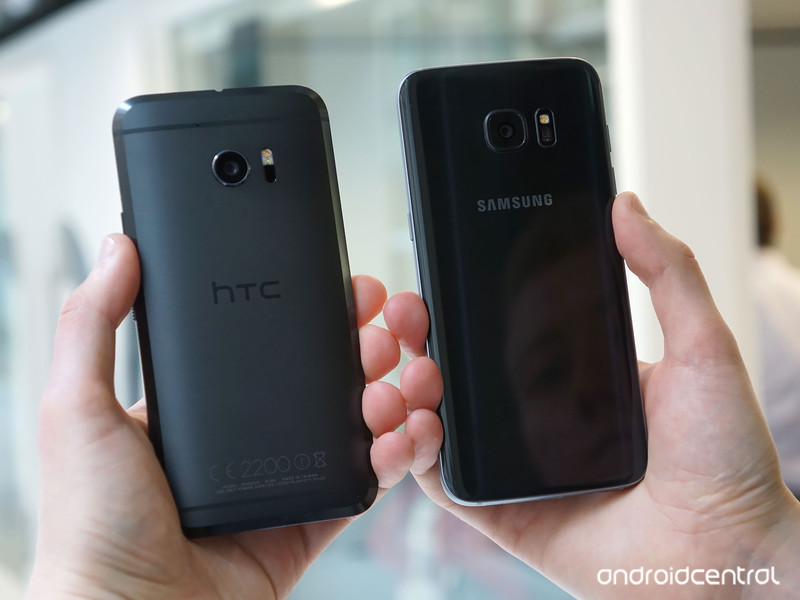
Is HTC’s best phone yet enough to challenge Samsung’s all-conquering GS7 edge?
There’s been more buzz around the HTC 10 than any recent phone from the Taiwanese company. Based on our review, it’s clear that HTC has finally addressed a couple of long standing weaknesses, and returned with a modern take on a classic metal-bodied design.
But the HTC 10 doesn’t exist in a bubble. It’ll have to go up against not only the Galaxy S7, but also its strikingly curvy sibling, the Galaxy S7 edge. As evidenced by Samsung’s marketing this time around, the “edge” is the real focus of this year’s Galaxy lineup, with a bigger battery, an impressive curved glass design and a larger 5.5-inch display.
So how do these two shape up? We’ll put them head to head after the break.
Hardware
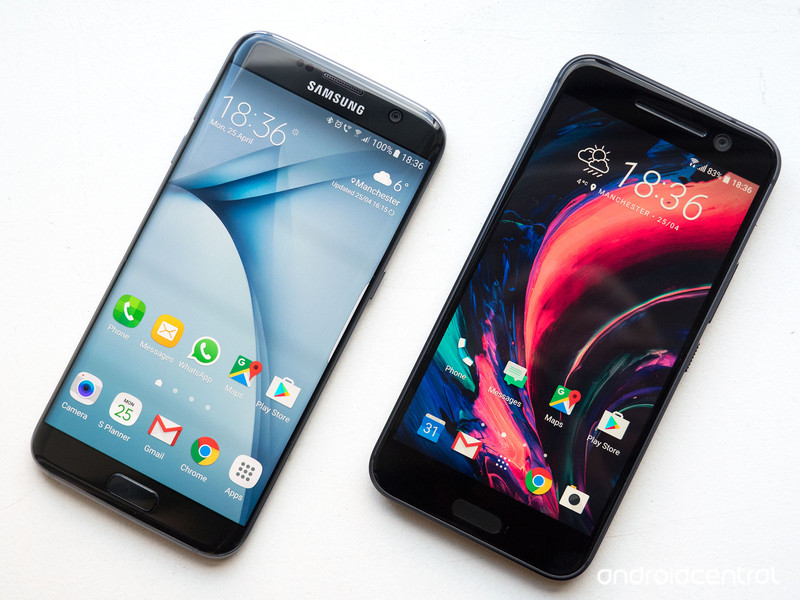
The Galaxy S7 edge and HTC 10 have come to embody their manufacturers’ respective design languages. For HTC, it’s all about the aluminum unibody — an HTC staple going back to the One M7 — brought up to date with a big, reflective chamfer around the back. For Samsung, the glass sandwich of the Galaxy S7 edge, with its curves on all sides, represent the culmination of what it started back with the Galaxy S6
The HTC 10 isn’t the thinnest or lightest Android phone you’ll find, but it is a sturdy, well-built handset that’s arguably easier to one-hand than the larger, more slippery GS7 edge. That said, the curved glass of the GS7, complemented by its svelte aluminum trim, makes for a phone that’s incredibly sleek. HTC’s design has more of an industrial look and feel, whereas Samsung’s aesthetic is closer to jewelry. The only downside is the GS7 edge’s fingerprint-magnet glass back.
The rear glass also allows for Samsung’s wireless charging capabilities — support for the Qi and PMA standards, including fast wireless charging if you fork out for Samsung’s first-party charger. For good old-fashioned cable charging, you’ve got a micro-USB port down below, paired with support for Samsung’s Adaptive Fast Charging — the Korean firm’s implementation of Qualcomm QuickCharge 2.
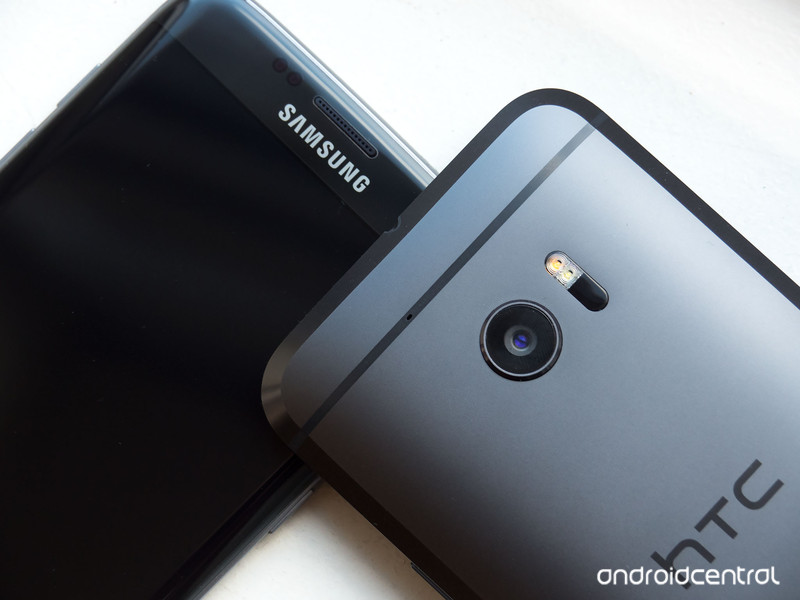
HTC can’t boast wireless charging, but it does tump Samsung in wired charging, with support for the latest QuickCharge 3 standard, along with a new USB Type-C port, which supports the latest USB 3.1 spec. (That means faster data transfers to and from supporting computers, among other things.)
When it comes to durability, the glass-backed GS7 edge obviously means you’ve got double the chance of smashing at least one of those panels should you drop the device. However Samsung clearly wins in another key area, with IP68-rated water and dust resistance, meaning it’s good under 1.5 meters of water for up to 30 minutes. The HTC 10 by comparison carries an IP53 rating, meaning it’s basically splashproof.
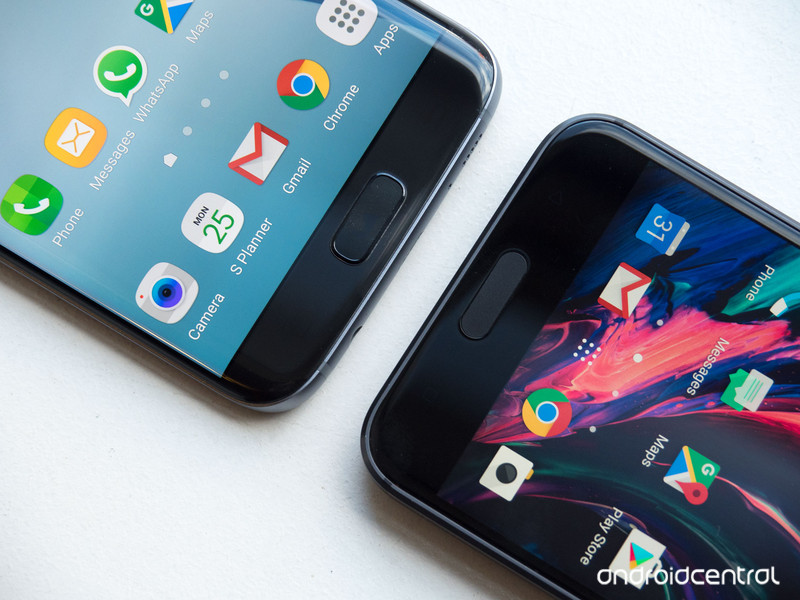
Around the front, both phones sport a similar arrangement button arrangement, with a handful of key differences — the GS7’s home key is a physical button, whereas the HTC 10’s is capacitive (touch-activated). Both double as fingerprint scanners, and on the whole, both handsets are incredibly quick to unlock. We’ve noticed fewer failures in the HTC 10’s scanner however, meaning less frustration in day-to-day use.
The most important part of any smartphone is the display, and although the HTC 10 and Galaxy S7 edge pack a Quad HD (2560×1440) resolution, that’s where the similarities end. Samsung uses its own SuperAMOLED technology in one of the very best phone displays available right now, with superlative brightness and daylight visibility, and colors that are vibrant but not obnoxiously over-saturated. Meanwhile HTC’s SuperLCD 5 is decent enough, but a tier below Samsung’s latest, particularly in daylight visibility.
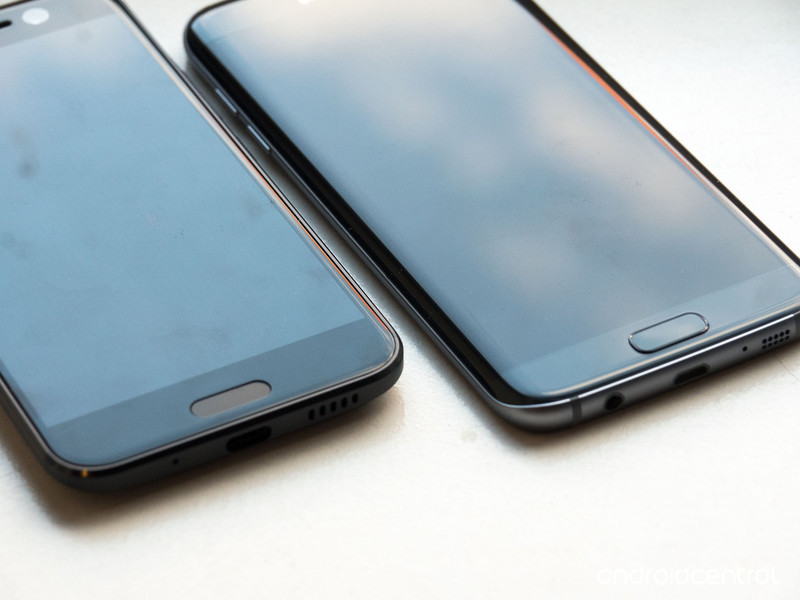
And true to its name, the Galaxy S7 edge includes Samsung’s Edge Screen — mainly a cosmetic feature, though one that’s become more useful with additional features like location-aware app shortcuts in Samsung’s latest release.
Despite the difference in size — the GS7 edge packs a 5.5-inch display, compared to the HTC 10’s 5.2-incher — the overall footprint of these two devices isn’t drastically different. Samsung’s flagship is ever so slightly taller, but the difference in width — a bigger deal for ease of use — is much more slight.
Internally, both phones pack an impressive assortment of high-end components, including the latest processors from Qualcomm and Samsung, capable camera setups and removable storage. The main internal difference is the GS7 edge’s 20 percent lead on battery capacity — 3,600mAh versus the HTC 10’s 3,000mAh.
| Operating System | Android 6.0.1 | Android 6.0.1 |
| CPU | Qualcomm Snapdragon 82064-bit Kryo quad-core | Snapdragon 820 quad-core or Exynos 8890 octa-core |
| RAM | 4GB | 4GB |
| Display | 5.2-inch QHD (2560×1440, 565 ppi)Super LCD 5 | 5.5-inch QHD (2560×1440, 534 ppi) Super AMOLED |
| Rear Camera | 12MP Ultrapixel + OIS, f/1.8 lens4K video, 120fps slow motion | 12MP + OIS, f/1.7 lens 4K video, 240fps slow motion |
| Front Camera | 5MP Ultrapixel + OIS, f/1.8 | 5MP, f/1.7 |
| Storage | 32GB + microSD | 32GB + microSD |
| Charging | USB Type-C Quick Charge 3.0 | microUSB Quick Charge 2.0 + wireless Qi & PMA |
| Battery | 3,000mAh | 3,600mAh |
| SIM | nanoSIM | nanoSIM |
| Waterproofing | No | IP68 waterproofing |
| Audio | HTC BoomSound Hi-Fi EditionTwo speakers | Downward-facing mono speaker |
| Dimensions | 145.9 x 71.9 x 9.0mm | 150.9 x 72.6 x 7.7 mm |
| Weight | 161g | 157g |
It’s also worth noting that although both phones feature removable storage via a micro-SD slot, only HTC supports Android 6.0’s Adoptable Storage feature, which allows you to treat your SD card as internal storage.
What’s more, HTC’s big focus on audio capabilities brings an impressive dual-speaker arrangement — a bottom-facing subwoofer and a single front-facing loudspeaker — along with a powerful amp behind the 3.5mm headphone jack.
Samsung can boast a few exclusive hardware features of its own, however — the aforementioned wireless charging and water resistance, together with a superlative display.
Both have a lot to offer from a hardware perspective, and the choice ultimately comes down to design preference, and whether HTC’s audio focus is worth more to you than the additional Samsung hardware goodies.
Software
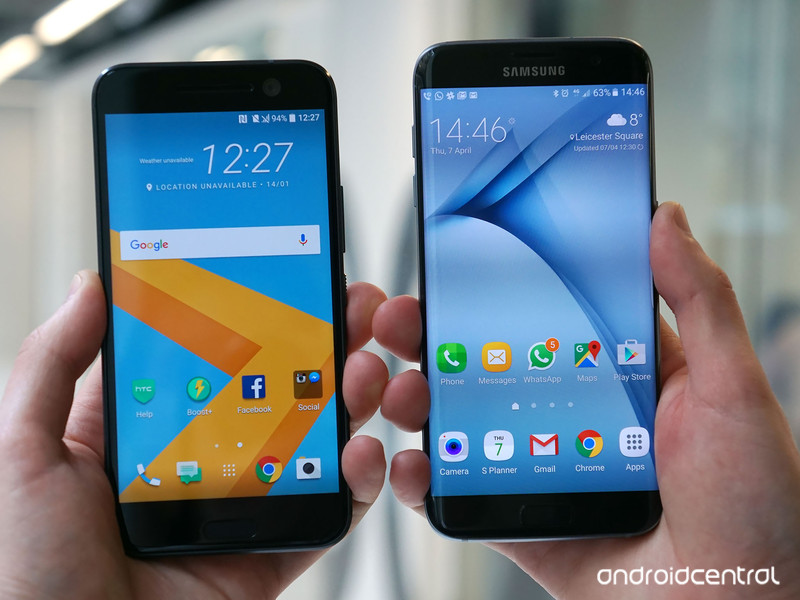
Just about all Android phones have moved closer to Google’s vision of the OS in recent years. But much variety remains between the major Android phone makers, including HTC and Samsung.
Both companies have moved away from numbered releases for their own software layers, which sit atop Android 6.0.1 Marshmallow on the HTC 10 and Galaxy S7 edge. Nevertheless, HTC Sense and Samsung’s TouchWiz are still worlds apart.
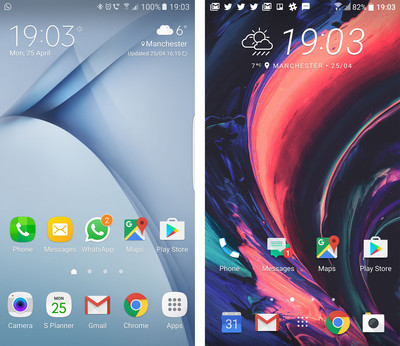
HTC has cut back considerably on its visual customizations to the OS, with a UI much closer to vanilla Android. Key Sense features like the BlinkFeed social and news reader remain, and HTC still has its own dialer, messaging and camera apps. But in other areas it’s moved away from its own in-house Android apps, instead bundling Google’s apps — for example Calendar, Photos and Docs.
HTC’s UI is much closer to vanilla Android this year; Samsung follows its own design rules.
Although HTC offers a much cleaner Android experience than in years past, it’s still possible to customize it to your own liking through the company’s extensive theming system. Like the One M9 before it, the HTC 10 has access to a wide variety of themes for customizing your home screens, fonts, buttons, sound effects, widgets and more. And new in the latest version of Sense, Freestyle mode lets you break free from the shackles of the icon grid, customizing your home screen with cartoonish stickers to launch your favorite apps.
Samsung too has its own theme store, but its base UI is far more visually differentiated, favoring light blues and greys, and rounded rectangular icons throughout. Even the motions of the app-switching menu have been tweaked, with big, swoopy animations when jumping between apps.
Unlike HTC, Samsung has an extensive suite of its own Android apps, from the S Planner calendar app, to its Gallery apps, with includes the ability to create “events” and re-discover past trips through video highlights — a feature handled through the separate Zoe Video Editor app on the HTC side. And of course Samsung also bundled its own Galaxy Apps store, a separate app marketplace for apps specifically designed with the company’s phones in mind. (It’s also where you’ll find apps for the company’s Gear wearables.)
Multi-window remains an important differentiator for Samsung.
One of Samsung’s most important differentiating features is multi-window — coming to other phones in Android N, but a major Samsung feature going back to 2012’s Galaxy Note 2. The GS7 edge’s larger display is an ideal fit for showing two apps side-by-side, or overlaying one as a floating window above other content.
Meanwhile, HTC’s major focus has been performance, with under-the-hood tweaks allowing the company to claim faster touch response and app-switching — a difference that’s there, but not excessively noticeable. Elsewhere, the HTC 10’s Boost+ app combines a few dubious functions — bumping apps out of memory as it desires — with more useful stuff like battery optimization for games, and the ability to lock sensitive apps behind fingerprint security.
The choice on the software side comes down to a decision between near-vanilla Android with a handful of differentiated apps on the HTC side, and a feature-rich, if slightly overbearing UI on the Samsung side.
Camera
With the HTC 10 and Samsung Galaxy S7 edge, both manufacturers are going all-in on smartphone photography, with 12-megapixel optically stabilized cameras around the back, and 5-megapixel selfie cameras.
That’s where the similarities end, though. The HTC 10 packs laser autofocus, dual-LED flash and an f/1.8 lens for its main “Ultrapixel 2” camera, which features large 1.55-micron pixels on the sensor for superior night photography. Over on the GS7, Samsung’s camera features 1.4-micron pixels, but behind a brighter f/1.7 lens. Both are reasonably close on paper, but the differences between the two come down to post-processing more than optics — an area in which Samsung still has a slight lead.
As a result, the GS7 is the more reliable shooter, even though HTC’s camera is impressive in its own right. While both perform well in a wide variety of situations, Samsung’s camera routinely captured more fine detail, especially in HDR mode. The HTC 10’s camera also produced generally softer looking images that could appear more washed out than Samsung’s in certain daylight conditions.
HTC has a slight lead in some low-light scenarios, with the HTC 10 being able to capture more realistic colors in night scenes, though with more chroma noise.












Any other year, HTC might have been able to boast of having the best Android phone camera.
That said, both phones can boast a place among the best phone cameras of 2016, with fast launch times, speedy captures and generally reliable performance across the board. If we were forced to choose, however, we’d have to go with the GS7 — mainly because of its slightly sharper focus, superior macro performance, and easy double-tap home shortcut for quickly loading the camera app.
Around the front, HTC pulls ahead with the first optically-stabilized selfie camera, which does a great job of capturing decent-looking pics even in low light. Like the HTC 10’s rear camera, focus can be a little soft, but the front camera’s all-round performance makes up for this.
All in all, we’re looking at two really great phone cameras, each suited to different kinds of photography.
Battery life
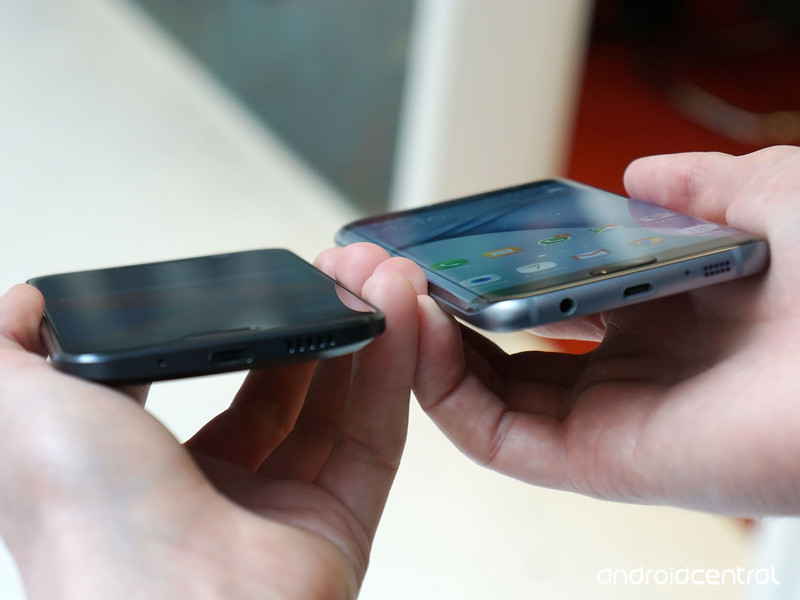
With an additional 600mAh of juice, Samsung has the lead on paper when it comes to battery capacity. And as we’ve found using the HTC 10 and Galaxy S7 edge as daily drivers in recent weeks, that advantage — perhaps combined with more efficient internals — translates into a noticeable lead in battery life for the Samsung device.
HTC claims two-day battery life, but that’s not realistic.
Whereas HTC markets the 10 as having “two-day” battery life, we’ve found this only plays out with light usage on Wifi. Once you start venturing out and using LTE with the screen brightness upped, it’s remarkably easy to kill off the HTC 10 in under a day. It’s hardly alone in that respect, but it’s worth pointing out that HTC’s battery life is far from the claimed breakthrough.
Meanwhile we’ve found the GS7 edge to be a reliable contender, particularly when travelling, or browsing over LTE for extended periods. (What’s more, Samsung’s camera setup seems far less punishing on its battery than HTC’s.)
Numbers-wise, we’re seeing between 12 and 14 hours per charge with heavy use from the HTC 10, with 3.5 to 4 hours of screen on time. By comparison, Samsung’s gotten us comfortably to the end of the day, with 16 to 17 hours per charge, and up to six hours of screen-on time.
When it comes time to charge, both phones benefit from rapid charging through Qualcomm QuickCharge, with the HTC 10 being one of the first to support QuickCharge 3 for even speedier charging than Samsung using the bundled brick.
Bottom line
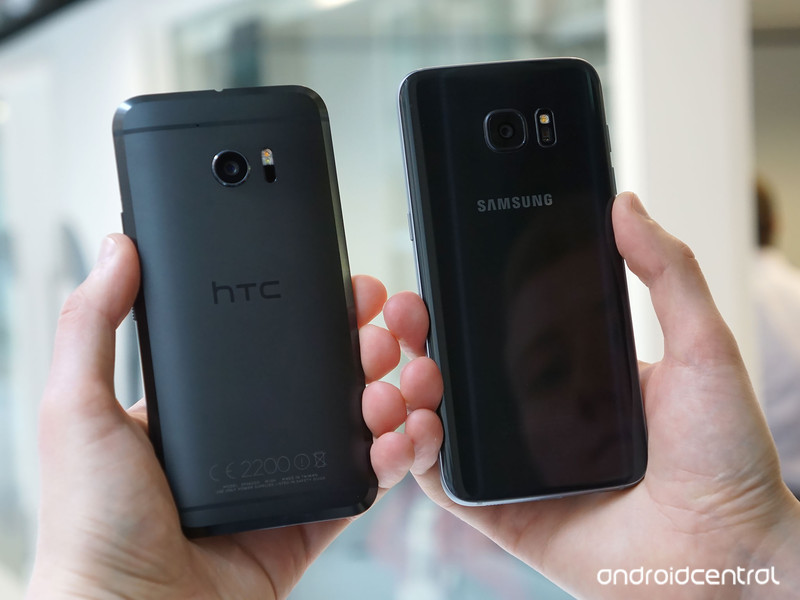
Both the HTC 10 and Samsung Galaxy S7 edge are great phones that perform well across the board. Both handsets are worth your cash, and either will provide a phenomenal, future-proof Android experience.
In our view though, Samsung’s phone has the lead in a few crucial areas, notably battery life, camera experience and display quality. That’s not to say HTC is disappointing in those areas, just that the Galaxy S7 edge has set the bar really high.
There are, however, a few areas of personal taste involved. The GS7’s fingerprint magnet back panel might be a turn-off for some, who may prefer the cold metal of the HTC 10. And at the same time, HTC’s doing a lot of impressive stuff with audio in its 2016 flagship.
HTC is the nearest Android rival Samsung has right now, and so the contest between these two handsets won’t be conclusively settled anytime soon. Nevertheless, our opinion is that Samsung’s still ahead — but with a serious competitor in the HTC 10.
Samsung Galaxy S7 and S7 edge
- Galaxy S7 review
- Galaxy S7 edge review
- Here are all four Galaxy S7 colors
- Should you upgrade to the Galaxy S7?
- Learn about the Galaxy S7’s SD card slot
- Join our Galaxy S7 forums
AT&T
Sprint
T-Mobile
Verizon
HTC 10
- HTC 10 review
- HTC 10 specs
- These are the HTC 10 colors
- Our first photo and video samples
- Meet the Ice View case
- Join our HTC 10 forums
HTC
Verizon
Facebook reportedly working on standalone camera app to encourage sharing
A new report claims Facebook is working on a standalone camera app for both photos and videos. The app is being made with the idea that users of the social network will share more content.

According to The Wall Street Journal:
A prototype of the app developed by Facebook’s “friend-sharing” team in London opens to a camera, similar to disappearing photo app Snapchat, the people said. Another planned feature allows a user recording video through the app to begin live streaming, they added.
The camera app is still in an early stage of development, according to the story, and there’s a chance it might not be released to the public. However, it adds that Facebook is working on it to encourage more of its users to create and share photos and videos with others. There are third-party reports that indicate Facebook users are not sharing or updating their pages as much as they have in the past, but that’s something the company itself seems to deny:
A Facebook spokeswoman declined to comment on product plans. The spokeswoman said the overall level of sharing on Facebook was strong and “similar to levels in prior years.”
Fenix pulled from Google Play after hitting Twitter token limit
Fenix, a popular third-party Twitter app for Android, has been pulled from the Google Play Store after hitting Twitter’s token limit. Token restrictions limit the number of users that a third-party Twitter app can have.

The official Fenix account announced the move on Twitter:
Unfortunately, starting from yesterday, Fenix cannot be used by any more new users (due to the infamous Twitter tokens limitation).
— Fenix (@fenix_app) April 25, 2016
The app has been removed from the Play Store, but current users can continue to use it with no issues.
— Fenix (@fenix_app) April 25, 2016
If you’re currently using the app, you’ll continue to be able to do so. You can also re-download Fenix from the “My apps & games” section in the Play Store if you need to.
Glympse bringing easy location sharing to the Samsung Gear S2
Location sharing company Glympse has announced a version of its app for the Samsung Gear S2 smartwatch. With the app, you will be able to easily share your location with just a couple of taps on your Gear S2.

In addition to location sharing, Glympse for Gear S2 will let you request a location from your friends that are using Glympse. You can also mark certain contacts as favorites, and view incoming Glympses right on your smartwatch. Glympse for the Gear S2 should be available in the Gear Store soon.
Glympse also recently collaborated with Samsung on the “Car Mode” in the Galaxy S7 and S7 edge to provide a better location sharing experience while driving.
Xiaomi CEO reveals Mi Band 2 and its LCD display, physical button
Chinese smartphone manufacturer Xiaomi, otherwise known as China’s Apple, is about to launch the second version of its very affordable wristband.
Called the Mi Band 2, it’s expected to be a follow-up to the Mi Band, Xiaomi’s original wristband that only costs £7.50. No – we didn’t forget to add a couple zeros. It doesn’t have a display nor nifty phone-enabled features, but you can use the MiBand to unlock a Mi phone without a password. It’ll also monitor your steps and sleeping habits, among other things.
Now, thanks to Lei Jun, Xiaomi’s founder and CEO, we know what the Mi Band 2 looks like, as he showed it off during a wearables conference in China via a photo posted to Weibo. The Mi Band 2 appears to feature both a LCD display and a physical button, and it should let you view your activity levels and heart rate. We’re only wondering if it’s just as cheap.
MyDrivers
Keep in mind Xiaomi in 2013 poached Hugo Barra from Google. He played a big role in Android and Nexus. Since then, Xiaomi has come up with several handset and wearables. It expected to officially unveil its new tracker alongside the 6.4-inch Mi Max and the latest version of MIUI on 10 May. The upcoming phone is thought to pack a Snapdragon 650.
#MIUI8 is coming soon on 10 May. Here’s a sneak preview of the new notification shade. Like it? https://t.co/kZyIAEw5gC
— Mi (@xiaomi) April 25, 2016
Gmail for Android adds Microsoft Exchange support for all devices
Google has updated Gmail for Android with support for Microsoft Exchange.
Stop wondering whether Gmail for Android already supported Exchange, because it did… but only on Nexus devices. The new update, which is available in the latest version of the app, expands the feature to all Android devices. More specifically, Exchange support covers mail, contacts, and calendar data in Android across all devices.
Exchange is known as a standard for work email, contacts, and calendar syncing: “Now, whether you’re on Google Apps or Exchange, you can use the Gmail app on any Android device to send and receive mail,” Google said.
By adding the functionality to the Gmail app for Android, businesses that use Exchange can now easily access their work email, contacts, and calendars on their Android devices, without needing to install an extra app just for work accounts. In addition to Exchange, Gmail for Android supports Outlook.com, Yahoo Mail, and other IMAP/POP accounts.
After installing the update, you should be able to add an Exchange account to Gmail simply by selecting “Add Account” from the settings menu, then choosing “Exchange” as the account type, and entering your information. We’re assuming employees will need to seek approval with their IT departments before using Gmail with Exchange.
Exchange support is expected to roll out over the next three days.
All your mail in one place. An update to the Android Gmail app is now rolling out with support for Exchange accounts pic.twitter.com/yV6zjI0e6U
— Gmail (@gmail) April 25, 2016
Creepy co-op game ‘Push Me Pull You’ comes to PS4 on May 3rd
Australian indie game developer House House announced on Monday that its highly anticipated (and cringe-inducing) sports game, Push Me Pull You, is finally being released for the PlayStation 4 on May 3rd. The game pits two pairs of opposing players in a weird, soccer-ish game where each team is joined at the waist. No, literally, each team operates both ends of a single torso or, as House House describes it, “you and your partner must use a shared body to wrap, writhe, and wrestle the ball into your half of the court.” Here, this new gameplay trailer might help explain.
Push Me Pull You was originally announced way back in 2014. However, after two additional years of development, it is finally being released at the start of next month. PlayStation 4 will be the first platform to get it, though Windows, Mac and Linux versions are reportedly also in the works.
Source: House House (Twitter)
Twitter lets you flag multiple abusive tweets in one report
Twitter has been continually improving the process for reporting abuse on the social channel, including simplifying the process a while back. The company is rolling out an update to the web, iOS and Android apps that will allow you to attach multiple tweets to the same abuse report. In other words, if there’s a string of harassment, you can give a lot more detail without having to file multiple complaints. Twitter says this will not only give it more info on a report, but will also help resolve issues faster.
Report abuse on Twitter more easily than ever. Find out how to protect yourself and others.https://t.co/1MEfTzkfFL
— Safety (@safety) April 25, 2016
Last April, the social network began using software to filter out tweets that show sings of abuse, including threats of violence, in addition to temporarily locking down those accounts. Twitter has been criticized for its rather soft treatment of trolls and those posting harassing content in the past, and rightfully so. The best way to combat abuse remains for us, the users, to report those statements directly. The company is trying to be more proactive, though, establishing a safety council earlier this year that’s charged with helping rid the platform of abusive statements and harassing behavior.
Source: Twitter
‘1666 Amsterdam’ is back in ‘Assassin’s Creed’ creator’s hands
Ubisoft and Patrice Désilets, the creative director of Assassin’s Creed and Assassin’s Creed 2, have reached an agreement that gives Désilets ownership of a mysterious original IP, 1666 Amsterdam. Désilets and Ubisoft have a rocky, winding history: Désilets is recognized as the creator of the studio’s most famous franchise, Assassin’s Creed, but he left the company in 2010.
Désilets joined THQ Montreal in 2011 where he started work on an original franchise that turned out to be 1666 Amsterdam. However, THQ famously went under in 2012 and sold off its assets in January 2013. The Montreal studio — complete with 1666, Désilets and all — was picked up by Ubisoft for $2.5 million. Désilets was right back where he started, but he didn’t stay long.
After firing Désilets, Ubisoft paused development on 1666 and in June 2013 Désilets sued the studio partially for the rights to the game. Today, Ubisoft gave Désilets the rights to 1666 Amsterdam and he withdrew his case.
“Putting aside our past differences, Patrice and I are above all interested in the creation of video games and the evolution of this medium of entertainment,” Ubisoft Montreal and Toronto CEO Yannis Mallat said. “This agreement is good news for everyone.”
Désilets said that, for now, he’ll continue working on Ancestors: The Humankind Odyssey, a AAA action-survival experience he’s developing with his own studio, Panache Digital Games.
“This is what matters most to me today: making the best games and showing the world the creative talent of Quebecers,” Désilets said. “I also wish every success to the Ubisoft teams.”
Friends, Ubi and I agreed, I got it back! 🙂 https://t.co/lKqj5enJth #1666Amsterdam pic.twitter.com/Z19MLwdgEY
— Patrice Desilets (@PatriceDez) April 25, 2016
Source: Panache Digital Games
 AIVAnet