


Instagram beefs up Explore tab with video channels

Instagram is looking to make it easier to find videos you might like thanks to an overhauled Explore tab that now features video channels. At the very top of your explore tab, you’ll now find a banner that highlights a personalized feed labeled “Videos You Might Like.” As you scroll through the Explore tab further, you’ll also see other video channels centered around different themes.
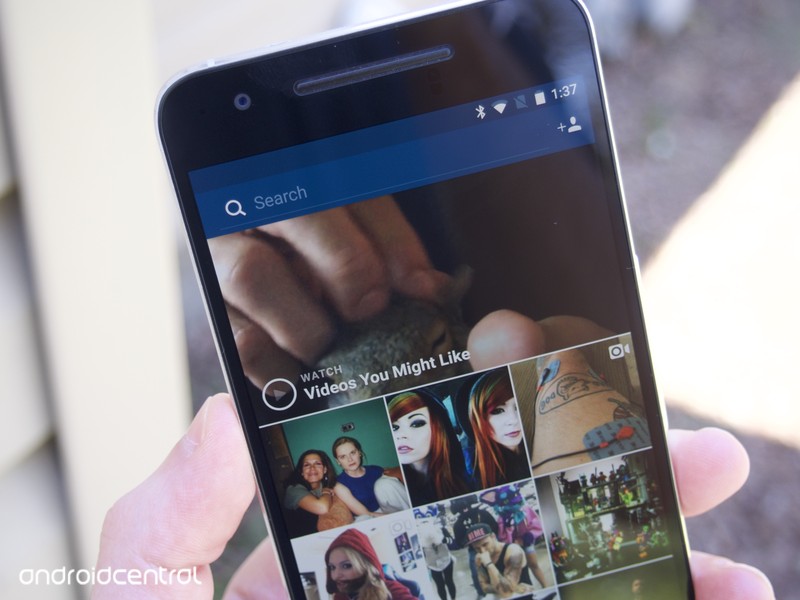
Instagram is quick to point out that the Explore tab still functions in the same way it did previously, highlighting photos you may be interested in with a continuous grid. However, you’ll now see that grid broken up by a banner-style video channel every so often.
Instagram says the feature is launching first in the U.S. with the latest version of the app, but it should come to the rest of the world soon.
Android Central 283: The HTC 10 special edition podcast!
The HTC 10 is here! We’ve been waiting with bated breath for the newest phone from the Taiwanese manufacturer, as it’s been some 14 months since the last flagship release. Expectations are high. Excitement has been building. And we’ve got a whole bunch of thoughts on the HTC 10. Enjoy. Audio-only this week, folks!
Podcast MP3 URL: http://traffic.libsyn.com/androidcentral/androidcentral283.mp3
Verizon offers up to 2GB of extra data when you use Android Pay
Verizon customers who use Android Pay are in for a bit of a treat. The carrier is offering up to 2GB of free data when you use Android Pay in stores with your Verizon phone. That data will be available to you for two billing cycles.
From Verizon:
Starting today, you can enjoy 2 GB of free Verizon data, good for two billing cycles, when using Android Pay. Simply open the app to get started. Tap anywhere in stores Android Pay is accepted and receive 1 GB of free data. On your third tap, we’ll throw in another free gig.


The offer is available for subscribers through June 14, 2016, and rewards will have to be redeemed by July 13. Additionally, the offer is only open to postpaid customers on either The Verizon Plan or older More Everything plans.
EU approves stricter data protection rules
The European Parliament today voted in favor of broad new data protection laws that apply to any company operating within the EU, regardless of where they are based. First proposed more than four years ago, they represent a significant modernization of previous regulations drawn up in 1995, long before the internet and digital services had matured to the point they’re at now. After various EU authorities agreed upon the rules late last year, they’ve been formally green-lit today, and at their heart, make companies more accountable for data protection and give citizens more control over the information held on them.
What it means for us
Under the General Data Protection Regulation (GDPR), companies are expected to make their products and services capture and process as little personal information as possible by default. Coined “privacy by design,” this forces services like social networks to ensure users have the strictest privacy settings right off the bat, instead of having to dig through menus to opt out of programs or features they were automatically included in when they signed up.
This is in tune with a general responsibility to be more transparent about data collection. Companies must receive the “clear and affirmative” consent of users to process their personal data, and offer a simple way to withdraw that consent. Furthermore, what the data is being used for must be stated in “clear and plain language”; dense and confusing privacy policies won’t fly. Any business that handles large volumes of personal data has to employ a data protection officer under the new rules, and any breach must be disclosed within 72 hours.

The European Parliament says the new rules will benefit companies by introducing a single set of laws to abide by (not the individual regulations of the 28 member states) and a single supervising authority to deal with. The GDPR is not to be taken lightly, though, as any company or organization that suffers a breach or is found to be generally non-compliant could be fined up to 4 percent of their global turnover. For a behemoth like Google, that would be an extremely significant sum.
In addition to these stricter rules for companies, the GDPR affords EU citizens greater control over their personal data, including the right to “data portability.” This is the power to move data between services, such as instructing your current internet service provider (ISP) to divulge certain information to a new ISP, for instance. It gets much more complicated than that, though. In theory, you’ll also be able to switch email providers, moving all your contacts and email history from, say, Google to Yahoo; or, set up a new social media account using data from an existing one. We’re a ways from knowing how this will work in practice, however.

The “right to be forgotten” is also integral to the new rules. As you may remember, in a landmark case the European Court of Justice ruled that one can request search engines remove links from results that contain “irrelevant” or “outdated” personal information. This legally binding decision is now not only part of EU law, but the right has been extended to cover all kinds of personal data. You could tell Facebook, for instance, to delete your account and all data associated with your activity; the social network would also have to action this anywhere your data has been replicated. There are certain caveats, of course, where “data is needed for historical, statistical and scientific purposes, for public health reasons or to exercise the right to freedom of expression.”
Children will have special protections under the right to be forgotten, and the GDPR also introduces a new rule requiring social networks to seek parental consent before letting kids open an account. Several EU member states have this provision already, and each country will set their own age threshold at which this no longer applies, from 13 to 16 years.
What it means for law enforcement
While not as relevant to your general internet user, the data protection “package” approved today also creates a blanket set of guidelines for the handling of personal data by EU law enforcement agencies. The Data Protection Directive lays out “minimum protection standards” for the movement of data between member states, such as safeguards that ensure personal information is “processed lawfully, fairly and only for a specific purpose.”

Essentially, the Data Protection Directive tries to balance the rights of individuals with the need for cross-border cooperation between law enforcement. With one set of guidelines, agencies no longer have to operate within the cumbersome patchwork of differing national regulations, which should allow for smoother and more efficient data transfer between member state authorities.
T-minus two years
Now that they’ve been approved, the GDPR and Data Protection Directive will soon become part of EU law, but the regulations won’t truly come into force until April 2018. That gives all member states two years to copy and paste the rules into their national laws and processes. The regulations are sure to have an impact way before then, though.
They will undoubtedly be key to discussions around an impending update to the EU e-Privacy Directive, which specifically deals with electronic communications data, including the use of cookies. What’s more, the EU and US are currently working on Privacy Shield, an agreement that governs the movement and use of personal data across the Atlantic, designed to replace the now-defunct Safe Harbor agreement.
[Images: Getty (Lead, 1, 2); Alamy (3 – Policja)]
Source: European Parliament (1), (2), European Commission
Facebook is poised to take the chatbot world by storm
Even though chatbots have been around for quite some time — remember the SmarterChild bot on AIM? — they’ve only recently become the darlings of the tech world. Just two weeks ago, Microsoft announced its Conversations as a Platform initiative, wherein it plans to build bots into Skype to help you do things like book hotels or order a pizza from Domino’s. This week, Facebook unveiled its own bot platform for Messenger, which aims to do the same things. At first glance, the two seem similar, but there is one big difference. While the demos we saw at Build are still being built, many of the ones shown at F8 are already live.
Of course, some of this is because Facebook was wise enough to seed its SDK to developers months in advance. But it’s also because the company laid out its groundwork for bots in Messenger as early as last year. In 2015, Facebook unveiled its Messenger for Businesses program, which would allow consumers like you and me to talk with businesses on Messenger. You could chat with Hyatt to ask for more towels in your room or with Sprint to find out why your network was slow. Of course, you’d be speaking to a customer-support agent rather than a bot, but it was a starting point. On top of that, Facebook has been working with partners like Uber, Lyft and KLM to try out an early version of a bot system where you could request a car or book a flight through Messenger.
“These [programs] really formed what is being built today,” said Peter Martinazzi, a product manager for Messenger. “We did a really slow and deliberate approach over the past year, learning along the way.” The Messenger for Businesses initiatives, he said, have been successful. “People have messaged businesses twice as much as they did before.”

The result is a healthy roster of partners right when Messenger’s bot platform launches. Big national brands like Bank of America and Burger King are already onboard while news outlets like CNN and The Wall Street Journal are already using the service to deliver headlines on the fly. Microsoft, on the other hand, only had a few Bing bots on Skype when it announced its platform. It seems that even though Microsoft announced its bot platform two weeks before Facebook did, the latter is already well ahead.
That’s not to say that Microsoft didn’t already have a few bot initiatives going: It’s experimented with Tay, the infamous Twitter bot, and it has deployed several thousand bots on WeChat, a popular chat app in China, before having them pulled down. Indeed, Tay is actually a spin-off of Xiaoice, a bot that’s been on WeChat, Weibo and Line (two other popular Asian chat apps) for a few years.
But none of that is useful if Microsoft doesn’t get help from developers. Facebook, on the other hand, already has a healthy relationship with plenty of companies and brands, thanks to Pages and advertising initiatives. So it wasn’t too much of a leap to get many of them onboard the Messenger bot plan, too. Companies already know that Facebook is where the money is. Developing bots for Messenger ahead of competitors like Skype is a no-brainer.
Stitch circuitry into your shirt for a better cell signal
Wearables are getting slimmer, but they’re still oblong lumps worn over normal outfits. That’s not enough for some tinkerers who are trying to make clothes themselves part of the computing (see: Drum Pants). Now, Ohio State University researchers are stitching conductive threads into clothing with precision that rivals printed circuit boards.
The researchers are still a ways away from the debut of “functional textiles”, as they term the burgeoning field of smart clothing. Integrating conductive threads in attire is promising, and could lead to smart clothing that does what real circuitry does: Gathering, storing, or transmitting data. Shirts could act as antennas for smartphones, workout gear could monitor health, and hats could monitor brain activity.
The latter could be a more lightweight and comfortable alternative to bulky external wiring for brain-tracking experiments, like this proposal that needs brain activity tracked for implants that would treat brain conditions like epilepsy and addiction.
And stitching circuitry is essentially the same as stitching thread. In one lab, researchers use tabletop sewing machines and swap in fine silver metal wire for thread. It’s the shape of the embroidery that determines the frequency of operation of the antenna or circuit. The photo above, for example, is an intricate circular design that’s great for antennas. Just like circuit printing, stitching is a versatile way to make ad-hoc designs.
Most importantly, those stitched antennas actually work: in tests, that circular design transmitted signals with near-perfect accuracy, and would be suitable for broadband internet or cellular communication. Wouldn’t it be nice to wear a shirt that boosted your smartphone reception or transmitted more accurate health data?
Via: TechCrunch
Source: Ohio State University
Building my perfect dictatorship in ‘Democracy 3: Africa’
Positech’s Democracy game series has always offered a grotesque caricature of politics. I’ve put tens of hours into Democracy 3 (D3) in recent years, and the lesson I’ve learned is that what starts as a nuanced game about balancing policies to keep a society happy more often than not devolves into a hilariously entertaining social engineering simulator. This week, the one-man British developer released a standalone expansion to the game titled Democracy 3: Africa (D3:A), and the changes it brings add a whole new dimension to the series.
At first glance, D3:A is just as utterly impenetrable as the game it’s based on. You’re presented with a wall of bubbles that can be roughly divided into three categories — policies, statistics and situations — and a central set of charts that represent each voter group. Hovering over each group shows what’s affecting it positively and negatively. Your job is to make everyone happy, while keeping your finances in order.
The key to understanding any Democracy title is to grasp that bubbles are deeply interconnected, and that each voter falls in more than one group. No individual is just liberal, or just religious; they’re many things, and keeping your electorate happy is all about equilibrium. You’ll never make every group totally happy, but you can make nuanced choices that’ll keep them content enough.
Sorry, your browser doesn’t support HTML5 video.Look at a problem, identify the cause, and implement a solution.
If people get extremely upset with you, they’ll peel away from regular activism groups into extremism. Think: Greenpeace versus the Earth Liberation Front. These activists are highly dangerous, and if their needs are left unchecked, you will be assassinated by them. On top of all that, there are also ministers to keep happy, random world events that affect your country, quarterly dilemmas to act on and international relationships to maintain. Oh, and there are global recessions that can destroy your country’s finances if you don’t pay attention to them. You haven’t felt dread until you’ve had your credit rating downgraded to a ‘B.’
So those are the core mechanics of D3. It’s not an accurate simulation of politics in any shape or form. Instead, it’s a political strategy game — one that takes an idealistic view of the world. The lure of striking those balances to push your ideals on a nation is what made D3 so popular (it sold 500,000 copies) that Positech could afford to build a school in Africa.
The reason D3:A is so different is because the needs and issues of developing nations are vastly different from the western countries featured in the original. Voter groups have been moved around, with urbanites, country-dwellers, the elderly and women now tracked for the first time. Press freedom, the right to protest and ideals of democracy itself are now modifiable and tracked, and you’ll face regional health issues, urbanisation problems and struggles with basic infrastructure.
To explain how this might pan out, in the original D3 you might start as prime minister of Britain and be tasked with fixing the dire situations of alcoholism, homelessness and an uncompetitive economy. Start D3:A, as I did, as the leader of Mauritius, and your immediate worry will be power blackouts, general strikes and a cynical natural disaster. And that’s the easiest country to manage by far.
After failing miserably several times — the first few in-game years in any D3:A campaign are severe — I eventually settled on the nation of Kenya as a site for my utopia. Among other concerns, my first issues as president were foreign intelligence destabilisation, an HIV epidemic, female genital mutilation, armed robbery, organized crime and even my own military interfering in daily rule. Let’s take my Kenya game as an example. People were very, very unhappy, and I needed to choose what to tackle and in what order.
 The start screen for the Kenya scenario. Red bubbles are negative situations, green positive.
This meant prioritising smaller problems over the big issues — fixing an HIV epidemic probably would be my first point of order in real life, but I knew it would take years to see any positive political effects there. Instead, I started with the armed robbery problem. I first increased the police’s budget — a change that goes through quickly — and also set community police force. Everyone will appreciate crime rates falling, but using more authoritarian tactics like armed police, security cameras, or torture would upset too many voters.
Over the next few turns (each turn represents a three-month period) both environmentalists and feminists began to radicalize, so I spent most of my time and political capital implementing low-cost policies to curb extremism. A nationwide door-to-door recycling service, (admittedly weak) gender diversity quotas and a ban on genital mutilation did the trick, but not before I’d survived two assassination attempts. I also invested heavily in science funding, which would ultimately help ease the HIV epidemic and improve the economy, and reacted to a random event by starting a campaign encouraging protected sex, which incidentally dropped HIV rates considerably.
Of course, religious types weren’t happy with with what they saw as encouraging casual sex, so I had to delay my plan to make abortions more accessible. Instead I focused on kickstarting the economy, offering up grants to small business owners, while at the same time tackling pollution by encouraging home renewable energy generation. Unfortunately, after a few quarters, I had more problems to solve, and some extremely unhappy patriots. Life’s tough when you’re running a developing nation, and D3:A is much tougher than its predecessor. It’s also more nuanced; where in D3 you could dial policies up to the max and quickly engender change, you need to be very careful here to keep a balance. Expect to be assassinated several times before you figure out how to make it into your second or third year as leader.
Expect to be assassinated several times before you figure this game out
This nuance leads to some tough decisions. Child labor was common in Kenya when I took over, but following my instinct to ban it entirely would have serious ramifications for poor people and those living in rural areas that relied on the income their children generated. Likewise, maternity leave was only at half pay when I took office, but giving women full pay — although great for solving gender inequality — would enable them to take more time off work, seriously reducing productivity. At the time, I was running a small deficit, and just couldn’t afford to take the hit.
If you can make it through your first term and get reelected, things settle down a little. It’s likely that more than half of your population (D3:A is based on a two-party system) is happy, and with those confidence levels you’ll have more political capital to implement policies. You’ll still be faced with tough decisions, but you can start being sneakier, and leading your electorate to change their views. Offer up rural development grants, and more people move to the countryside, meaning positive policies in that area will have a wider reach. Push evolution over creationism in schools, and the number of religious people in your society will decrease; boost funding to your national health service, and the number of state employees rises. By making little tweaks like this, you can completely change the political compass of your country.
But for this to work, you need time. I was approaching the end of my second and final term as president when I decided I wasn’t quite done implementing my grand vision for the country. I then made two decisions that sent me down a path of no return. First, I changed the constitution of Kenya, allowing me to run for president as many times as I deemed fit. This made liberals unhappy — and they were pretty miffed at some of my recent decisions already. The problem was, I didn’t really have any money in the budget to make a bold play at winning their favor back. And besides, anything I did to please them would only upset conservatives.
So, I clicked on the bubble that said “press freedom,” and set the slider within to “none.”
The liberals were not pleased. But, doing so boosted the happiness of everyone in the country so much that it didn’t even matter. The press were now peddling propaganda that boosted people’s opinion of me and our glorious country. One thing that both my changes did affect negatively was my Democracy score, which, you guessed it, feeds into the Dictatorship score — a new mechanic for D3:A. As uncomfortable as that made me, my citizens seemed happy, generally. I had some problems with trade unionists a few turns later, and decided to ban the right to demonstrate. Democracy was slowly slipping from my grasp, and the liberals, as silent as I’d made them, had never been unhappier. I then fell upon a novel thought: With my critics largely silenced, I could finally create the liberal, egalitarian society I dream of at night.
I could finally create the liberal, egalitarian society I dream of at night
As uncomfortable as that made me, my citizens seemed happy, generally. I had some problems with trade unionists a few turns later, and decided to ban the right to demonstrate. Democracy was slowly slipping from my grasp, and the liberals, as silent as I’d made them, had never been unhappier. I then fell upon a novel thought: With my critics largely silenced, I could finally create the liberal, egalitarian society I dream of at night.
 This simple dial sent me on a path of no return.
Luckily, becoming a dictator does wonders for your political capital, effectively doubling the number of policies you can implement each turn; no one’s going to stop you, after all. Rather than role-playing as an evil dictator, though, I made broad reforms, outlawing race discrimination, establishing a human rights and nature conservation authorities and even devolving many powers down to local governments.
I then invested heavily to boost the economy, establishing a large budget surplus and slowly improving our credit rating. I used the increased income to pump money into our schools and libraries, and beautiful things started to happen. Residential credit facilities began to spring up, responsibly lending to those with aspirations of a better life. A stock exchange was established, and we became a technological powerhouse. I then began to tackle the ails of the poorest in our society, outlawing child labor and introducing food stamps, free school meals and extensive legal aid to help families hit by the ban.
 In 2059, Kenya’s major problems have all been solved, thanks to my leadership.
I’m now in my forty-third year as president, looking out across my fine country. We haven’t quite gotten over the issues presented by mass urbanizaton and overcrowding, but our country has never been happier. Foreign aid might have dried up decades ago, but under my firm leadership we’ve erased public debt, and have $11 billion in the bank. In fact, we’re so prosperous that we’re giving out $51 million in foreign aid each year.
100 percent of our country’s employees work for the state, many on rockets and satellites for our new space program. Religion, trade unionists and crime have been eradicated almost entirely. Things couldn’t be better in Kenya. One day, I might decide to let people protest. Or re-establish the free press. Maybe I’ll even let families have more than one child. My citizens would never rebel against their fine leader, would they?
On second thought, I probably have a few more terms in me.
‘Democracy 3: Africa’ is available for PC, Mac and Linux now on Steam or through the developer’s website. It also supports creating actual democracies.
Canadian police used BlackBerry’s key to unlock BBM messages
BlackBerry’s big selling point is its stance on mobile security, but a report from Vice and Motherboard reveals at least one national police force were able to bypass that security. A cache of documents revealed that Canada’s Royal Canadian Mounted Police had the ability to intercept and crack encrypted messages sent through BlackBerry’s BBM service. The RCMP’s findings in an operation called Project Clemenza led to seven men confessing their roles in a murder conspiracy, but over 1 million messages were captured and unlocked by a server in Ottawa along the way.
The only people immune to that sort of potential snooping were those with BlackBerrys connected to an enterprise server. Corporate BlackBerry servers generate their own encryption keys, but devices that don’t use those servers — that is, all personal BlackBerrys — rely on an identical peer-to-peer encryption key loaded onto the phone when built. Somewhere along the way, the RCMP obtained that key and used it to unlock BBM messages in transit. And as you might have guessed, the juiciest questions this report raises don’t have satisfying answers.
How did the RCMP obtain that global key? No one is sure, though court documents obtained by Vice and Motherboard suggest BlackBerry has a some sort of working relationship with Canada’s federal police, at least when it came to intercepting BBM messages. In light of the FBI’s recent privacy dust-up with Apple, it’s possible the RCMP somehow obtained it with the help of a third party.
Still, the simplest, most logical answer is that BlackBerry gave Canadian authorities the access they wanted. The company, after all, counts multiple national governments among its customers. In fact, while the events of Project Clemenza were unfolding, the Indian government insisted that BlackBerry give officials a lawful way to monitor some of the company’s network data in the country. BlackBerry eventually relented, though the access given was limited to email and web traffic and the read-status of BBM messages.
Perhaps more important is whether or not the RCMP still has the key. Unless BlackBerry changed the key at the close of Project Clemenza — a process Motherboard points out would require handset updates on a massive scale — the RCMP likely still has the ability to decrypt BBM messages. We’ve reached out to BlackBerry for its side of the story and the company declined to comment. (We’ll update this article if they talk, but you shouldn’t hold your breath.)
Source: Vice, Motherboard
On the Brink of Greatness: Online Experts

Ah yes, the fabulous life of an aspiring YouTube star. Steve visits with Dan, the host of Catitude TV, to get the story behind his channel that’s chock-full of useful lifehacks. You know, things like the proper technique for screwing in a lightbulb, petting a cat and making a single cup of coffee. Let’s face it, watching a video is a lot funner than Google directions yourself.
Windows 10’s anniversary update goes big on education
In addition to upgrades for Cortana and improved pen support, the Windows 10 anniversary update will also include several apps and features to make life easier for schools. Likely taking a cue from the rising popularity of Chromebooks in the classroom, Microsoft is making Windows 10 setup faster for shared computers. Teachers will be able to configure devices on their own with a new “Set Up School PCs” app, and Microsoft says that logging into a new account for the first time should take around 26 seconds (afterwards, logins should take just 6 seconds). That’s not exactly zippy for a first-time login, but it sounds faster than previous versions of Windows.
Microsoft Classroom, a new part of Office 365 for education, will give teachers a single location to manage their entire classroom workflow. Schools can also use Microsoft School Data Sync (SDS) to integrate Classroom with their existing data systems. Additionally, there’s also a new “Take a Test” app to help teachers administer secure exams, which can be configured to standardize testing for an entire school. Microsoft Forms, another Office 365 app, will let teachers put together surveys and quizzes.
Honestly, it’s surprising that Microsoft didn’t deliver some of these features sooner — especially since most teachers and schools will need more than a month or two to integrate new tools into their curriculum. Still, for schools that are already locked into Windows, these could be some useful upgrades. Microsoft also reiterates that some Windows 10 devices, like HP’s Stream, are going as low as $200.
Source: Microsoft (1), (2)
 AIVAnet