


The best water filter pitcher
By John Holecek and Tim Heffernan
This post was done in partnership with The Sweethome, a buyer’s guide to the best things for your home. Read the full article here.
After more than 20 hours of in-house testing and two independent lab tests we’re confident the PUR Classic 11-Cup (aka PUR LED) is the best water filter pitcher for most people. The PUR removes more contaminants than any other filter we tested—far more than even the ubiquitous Brita. It’s also easy to use, pleasant to hold, and produces great-tasting water.
How we picked and tested

The arsenal of testing materials used to evaluate filtered water. Photo: John Holecek
We limited our search to the most affordable, lowest hassle, and (not coincidentally) most popular option: filter pitchers. We’ll likely also test another popular type—under-sink filters that connect directly to your plumbing—at some point as well. But for most people a filter pitcher is the first option because it’s inexpensive, it’s easy to clean and maintain, and it’s able to come with you when you move to a new home.
We also focused on filter pitchers that are certified by the National Safety Foundation or have met its certification requirements. “NSF Certified” means a filter has passed NSF tests. (Beware that filter makers whose products aren’t certified often use the misleading phrase “tested to NSF standards.”) It’s also important to note that no filter completely removes all contaminants, even those for which the filter is certified.
We evaluated each pitcher on two subjective measures—taste and ease of use—and several objective ones, including speed of filtration, filter capacity, and, of course, the quality of filtration itself. Because all our test pitchers had NSF 42 certification (for chlorine taste) and most had NSF 53 certification (for contaminant removal), we didn’t retest every single thing they can filter out. Instead, we limited our testing to a few factors we felt would matter most to readers. We focused on removal of chlorine, which has a big impact on water’s taste and smell, and we looked at the ability to remove “total dissolved solids”—basically, mineral salts and organic matter. For our top two picks, we added an independent test for lead removal.
Our pick

The PUR Classic removes the most contaminants among gravity-fed filters and has a comfortable handle, allowing for smooth, controlled pours. Photo: John Holecek
After more than 20 hours of in-house testing and two independent lab tests we’re confident the PUR Classic 11-Cup (aka PUR LED) is the best water filter pitcher for most people. At the heart of the matter is the filter itself: The PUR’s filter is certified by the National Safety Foundation to significantly reduce 10 contaminants, including several heavy metals and biocides. That’s more contaminants than any other pitcher of its type that we tested.
It also virtually eliminates chlorine (the chief contributor to bad-tasting tap water) and, according to PUR, also reduces levels of 12 pharmaceuticals—an emerging contaminant concern in the water supply—by at least 96 percent. Finally, in our independent lab test the PUR reduced the lead levels in an extremely lead-rich water sample by a remarkable 97 percent. Because the NSF hasn’t certified it for lead removal, we can’t officially state that it does so. But we like those unofficial results.
The PUR also simply produces great-tasting water. Add in its excellent ergonomics and ease of maintenance, wide availability, low upfront cost, and reasonable prices for replacement filters, and you have a winning pitcher.
Runner-up
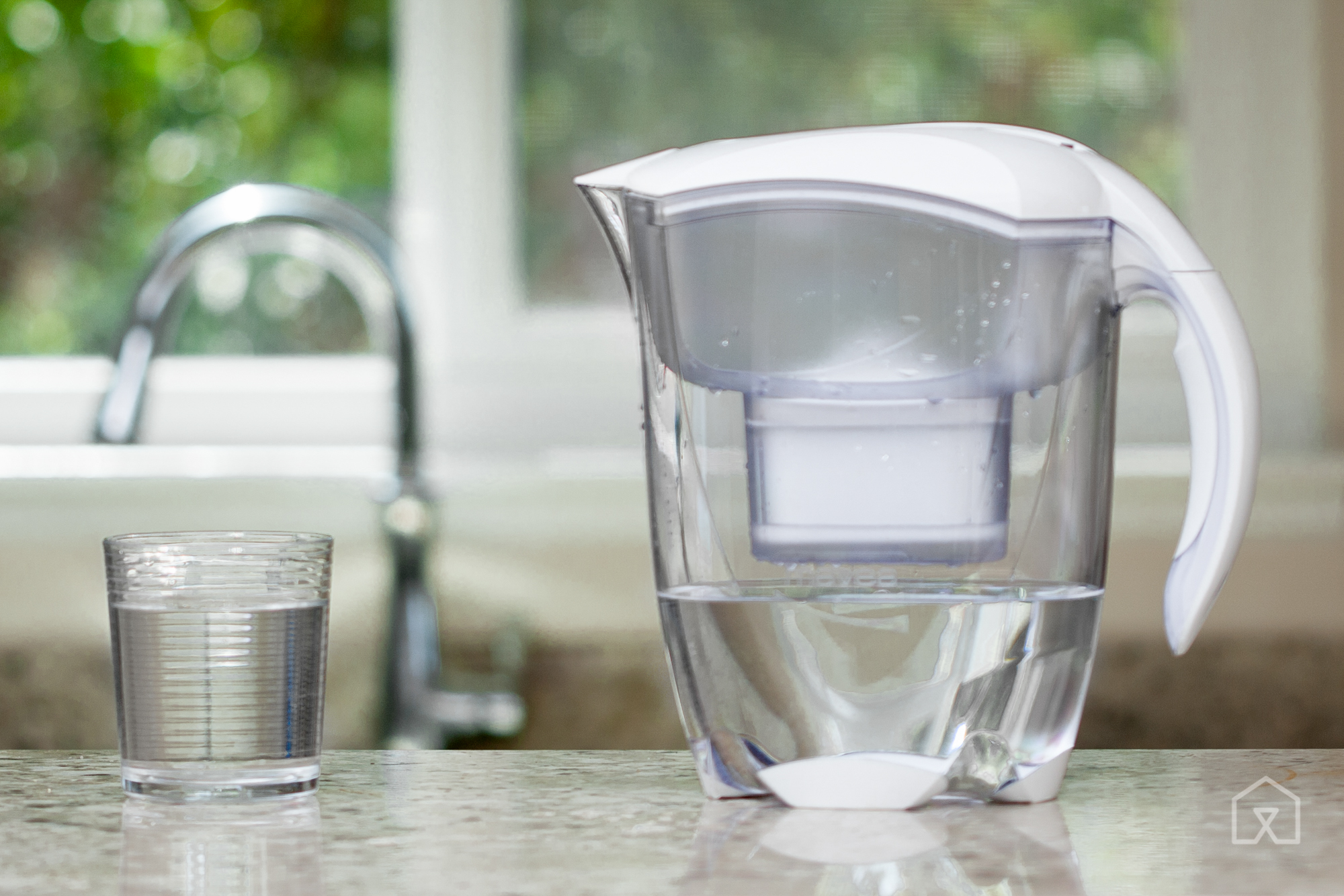
The MAVEA Elemaris XL has a convenient pour-through lid with a filter-life indicator and a comfortable handle, but filters out slightly fewer contaminants than the PUR. Photo: John Holecek
We also really like the MAVEA Elemaris XL, a nine-cup pitcher. Its filter eliminates seven contaminants to NSF standards, and in our independent test it reduced lead levels in the same extremely lead-rich sample as the PUR by a decent 73 percent. It has the best ergonomics of all the pitchers we tested and comes in a range of bright colors—an option not offered by many filter makers. Plus, it makes great-tasting water. Finally, though nearly every filter cartridge out there is recyclable, MAVEA uniquely offers both drop boxes and free return-shipping labels, so you can ensure that your used filters don’t go to a landfill. Initial and replacement-filter costs are a bit higher than the PUR’s, but compared with the rest of our test models, it’s still a far better product.
Oh, and before you ask about Brita, the dominant player in the market, both of our recommendations comprehensively outrank it on filtration performance, ergonomics, and ease of maintenance.
When to change your filter

Individual filters removed from the pitchers we tested. Photo: John Holecek
Many filter pitchers, including our pick and runner-up, feature an indicator (usually a little LED or LCD display) that tells you when the filter needs to be changed. But while filters are rated by the volume of water they can clean, the indicators are almost always simple clocks—they measure the amount of time a filter has been in use and use that as a proxy for volume. That’s the case for our pick and runner-up, the PUR and the MAVEA, respectively.
Typically, two months of use is assumed to equate to 40 gallons of water filtered, the most common rating capacity. But, of course, that’s just an estimate or average. Your usage may vary by a lot, depending on how many people use the pitcher, how much of a hydrator you are, and so on. If you really want to be sure, the only way is to measure your actual water usage. Try keeping track for a week, and divide the rated capacity (40 gallons for the PUR and MAVEA) by the gallons of water you actually used. That’ll tell you how many weeks you should use each filter before replacing it.
However, you should also know that the NSF forces filters that use a clock-based change-filter indicator, like the PUR and the MAVEA do, to perform to Standards 42 and 53 for twice their actual gallon rating.
The upshot? You can be pretty darn forgetful or lazy about replacing your filters—and really, who of us isn’t?—and still be confident you’re drinking clean water.
This guide may have been updated by The Sweethome. To see the current recommendation, please go here.
 AIVAnet