


WSJ: Hulu’s working on a premium tier with no ads

Would you kick in a few extra bucks to watch Hulu without those grating pre-roll ads, because it might become an option pretty soon. Anonymous tipsters have told the Wall Street Journal that the company is working on “Project NOAH,” which stands for “NO Ads Hulu,” a new pricing tier that ditches ads outright. The people familiar with the matter haven’t gone into specifics, but suggest that the offering could be priced between $12 and $14 a month, a fairly big leap from the $7.99 a regular subscription costs. Then again, considering that the Showtime add-on is a further $8.99 a month, we could easily imagine a premium Hulu package that went for a round $20.
The move is designed to Hulu better compete with its rivals, Netflix and Amazon Prime, both of which are proudly free of commercials. When rumors surfaced that Netflix was even considering adding commercials, there was plenty of uproar and the company was quick to issue a strong denial. Hulu could also do with raking in a little more cash since it splashed out the better part of $180 million for the streaming rights to Seinfeld.
The paper also reports that there’s some resistance to the ad-free tier coming from Hulu’s corporate parents. It’s suggested that these media companies feel resentful to Netflix for making people expect to binge TV shows without having to pause for a message from a sponsor. That’s a fact that puts plenty of executive noses out of joint, since they feel that ads remain a key component of the TV landscape (because: money). As a sop, it’s believed that Hulu will use its audience data to target relevant products to people since, you know, you only resent paying for the privilege of watching an advert if it’s for something you’re not likely to buy.
Filed under: Home Entertainment, Internet, HD
Source: WSJ
Inbox by Gmail receives new Snooze feature

Google’s Inbox by Gmail may now be available to all but that hasn’t stopped the updates coming. Inbox has just received a tweak to its Snooze options, which makes the system more flexible and convenient.
You are now able to quickly snooze emails and their notifications that contain dates or times until a more appropriate time. The smart thing is that Inbox now offers a quick suggestion, rather than having to set the time yourself. For example, you can snooze emails about products shipping until the day they are due to arrive, or offset emails about a reservation until an hour before you set-off. The little GIF below gives an example of how this feature works.
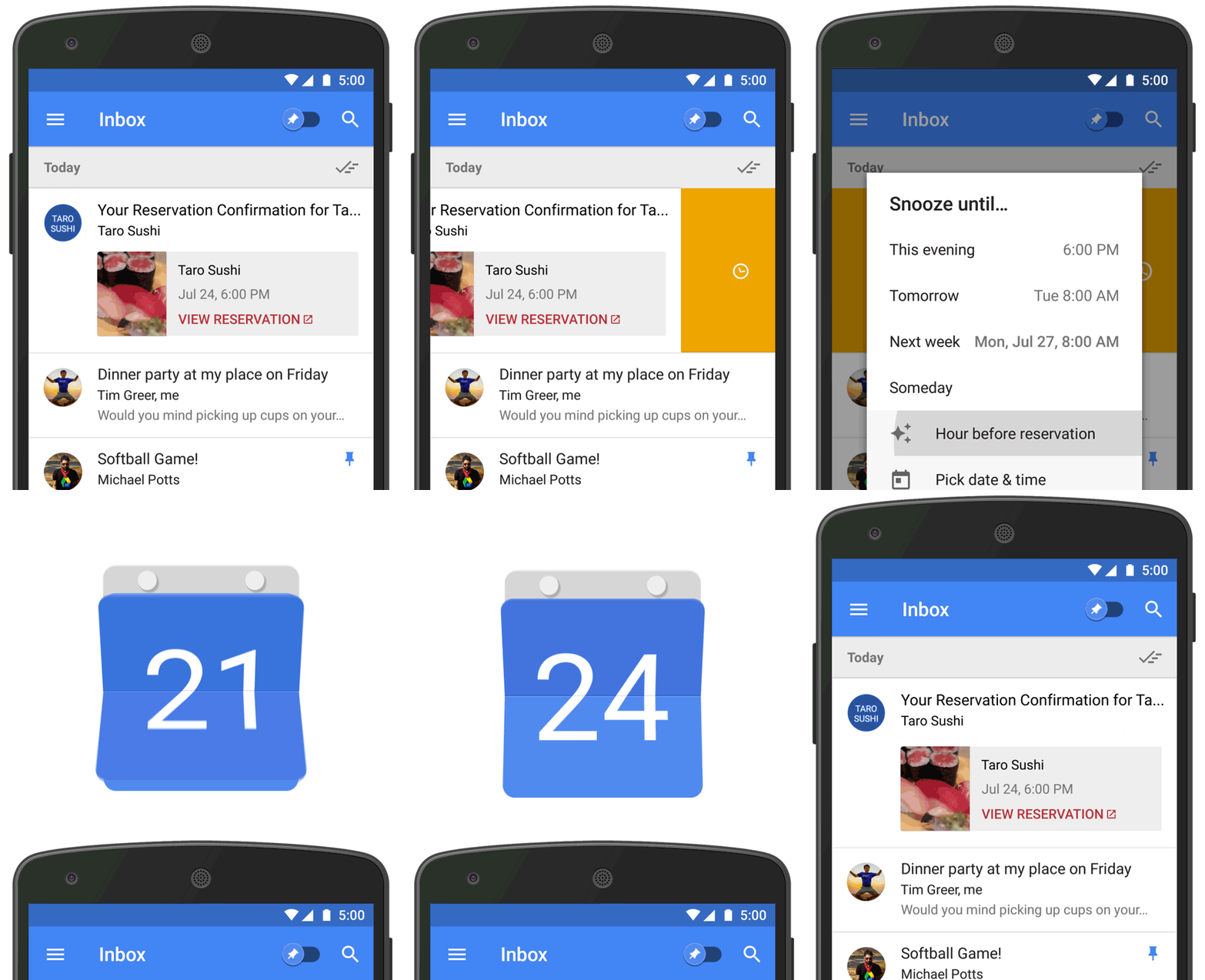
The simplified Snooze feature is accomplished via a simple one-tap option that automatically offers suggestions for when to snooze until, which is based on the email’s content. The feature should work for the majority of messages regarding package tracking, restaurant and event reservations, calendar invites, flight and hotel reservations, and car rentals.
If you haven’t tried out Inbox already, you can download the app for free from the Play Store with the button below.
Google’s profit jumps thanks to mobile and YouTube ad revenue

Yesterday, Google declared its financial results for Q2 2015, posting an impressive 11 percent increase in profits year over year. Further details have come to light which suggest that mobile and YouTube have been big winners this year for Google.
Specific numbers weren’t given out in the report, but Google CFO Ruth Porat states that the gap between mobile and desktop advertising revenue has continued to shrink. Mobile search results have apparently been a leading contributor to advertising revenue in the past year.
Much of the growth appears to have come from emerging markets, where mobile is the primary method of connecting to the Internet for many users. In 10 countries Google has noted that more searches are placed from mobile than from PC devices.
Overall, paid advertisement clicks have seen growth of 18-percent year over year. Paid clicks on Google websites saw a 30-percent year over year and 10-percent quarter over quarter increase.
It’s not just search results showing improvement, YouTube ad revenue has continued to grow, particularly in the mobile space. Porat pointed out that mobile YouTube watch time has more than doubled, which has helped to offset the falling cost per click. The number of companies placing YouTube advertisements has increased 40 percent and the average amount that a company spends is up by 60 percent.

YouTube is becoming an even bigger earner for Google, and services such as game streaming could attract new audiences.
Other Google services are also apparently playing a role in increasing the company’s mobile presence. Google Play is continuing to grow thanks to “deep linking”, which sees in-app ads link to other downloads. Google Play is also showing strong growth as a mobile gaming platform, which has become a hugely profitable industry.
Along with a boost to Google Photos and Android Pay, Google’s investments into additional mobile services appears to be paying off.
HTC launches the Desire 820G+ in India for INR 19,990

Following the successful release of its latest dual-SIM smartphone in Taiwan, HTC has today launched the Desire 820G+ in India, where it’s available to purchase from the company’s online portal for INR 19,990 ($315).
The 820G+ is a capable mid-range device, packing a 5.5-inch 720p display, a 1.7GHZ MediaTek MKT6592 octa-core processor, 1GB of RAM, 16GB of internal storage and a 13-megapixel camera.
Unboxed, the handset will run the latest build of Android 4.4 KitKat with HTC’s Sense 7 custom user interface plastered over the top. It is, however, expected to receive the much-anticipated Lollipop update in the not-too-distant future.
If you’re based in India, like the sound of the Desire 820G+ and would like to picking one up — hit the source link below.
Source: HTC
Come comment on this article: HTC launches the Desire 820G+ in India for INR 19,990
Samsung and Apple in advanced talks to join e-SIM launch

One of the things we do when we get a new smartphone is to check whether it will accept the SIM card used in the previous device. Current SIM cards are ‘locked’ to a specific carrier and sometimes a different sized SIM card than previously used is required by the new device. Those requirements could become unnecessary when the e-SIM becomes available in the relative near future though.
The e-SIM is an electronic SIM that removes the need for a physical SIM card to be present in the device, this would mean that consumers could switch between carriers with much less hassle, theoretically at least. Of course, for the e-SIM to make it to the consumer would require many, if not most, of the world’s top handset makers to be on board. Both Apple and Samsung are believed to be in advanced talks to join the e-SIM standard.
The mobile telecom industry association, GSMA, is apparently close to announcing an agreement for an e-SIM standard that would be implemented on mobile phones.
“We have got everyone back on one point, with Apple and Samsung agreeing to be part of that specification,” said Ms Bouverot, Chief Executive of the GSMA. “We have been working with them and others to create an industry solution for machines and will agree a solution for consumer electronics.”
Major carriers such as AT&T, Deutsche Telekom, Etisalat, Hutchison Whampoa, Orange, Telefonica, and Vodafone are expected to support the e-SIM plans, with all parties heading for a common architecture. The e-SIM is expected to be made available in 2016 at the earliest.
Source: Financial Times
Come comment on this article: Samsung and Apple in advanced talks to join e-SIM launch
Sony E5606 leaks packing a Snapdragon 808 chipset

According to a new report out, Sony is preparing to launch a second smartphone alongside its much-rumored Lavender next month. The handset has been internally codenamed the E5606 and is expected to launch under the branding ‘C5 Ultra’.
The report also contained a full list of the E5606’s specifications, which you can see below:
- 5.8-inch Full HD display (1920 x 1080 pixels)
- Snapdragon 808 chipset
- 3GB of RAM
- 16-megapixel rear-facing camera
- 8-megapixel front-facing camera
- Android 5.1.1 Lollipop
It certainly looks like this device is set to pack some pretty serious power under the hood, but, for now, none of these rumors have been officially confirmed, so best take them with a pinch of salt.
Are you eager for Sony’s announcement of the Lavender and E5606? Be sure to let us know your thoughts down below.
Come comment on this article: Sony E5606 leaks packing a Snapdragon 808 chipset
AT&T finally starts rolling out the Lollipop OTA for the HTC One M9

A day later than scheduled, AT&T has finally begun rolling out the long-awaited Lollipop update to its carrier-branded variants of the HTC One M9 located in the United States. In terms of added functionality, the upgrade brings the latest build of the Android operating system to the handset, together with a multitude of bug fixes and stability improvements.
Hit the break for the full changelog.
- OS Upgrade – Lollipop 5.1.1
- Security Enhancements
- Improved User Interface
- Stability Improvements
- Further Improvements to Performance
- Enhanced Features
As usual, the upgrade is being rolled out in stages, but if you don’t feel like waiting for a notification confirming that it’s ready for your device to hit your unit, you could always search for the update manually.
To do so follow the steps below:
- Open the “Settings” app
- Tap on “About Device”
- Hit “System Updates”
- Select “Check for updates”
Come comment on this article: AT&T finally starts rolling out the Lollipop OTA for the HTC One M9
Xiaomi stocks up on patents ahead of a US phone launch

Xiaomi has previously been rather evasive regarding details about bringing its smartphones to the US, but it appears that plans are finally kicking into gear. Speaking on Thursday, CEO Hugo Barra stated that the company is stocking up on patents ahead of a US launch, but that any release date could still be more than a year away.
There’s a lot of work to be done ahead of a US launch, including setting up localized customer services, tweaking hardware for the new market and, perhaps most importantly, stocking up on essential patents.
Firstly, Xiaomi needs to secure licenses for essential technologies, such as those contained in communications patents from the likes of Nokia and Qualcomm. Secondly, the company needs patents to protect its own designs and features, which are important to defend itself from copy-cat claims by other smartphone companies.
“if it’s a patent and it’s an essential patent then, of course, it needs to be licensed. Secondly, we’re building our own portfolio of patents, for defensive purposes” – Hugo Barra
Xiaomi is already being sued by Ericsson and the legal cases could stack up if the company were to enter markets where patents are more robustly enforced.
Barra had previously indicated that Xiaomi was considering a US launch at some point, but insisted that the company was focusing on building up infrastructure in the Indian market for now and gave no time frame for an appearance in the US. When pressed for details in his most recent interview, Barra suggested that a launch is “no less than a year away”, which at least gives us a rough idea of what to expect now.
We are still looking at a long road ahead before Xiaomi launches its first smartphones in the biggest Western market. Until then, we will just have to be content with the accessories available in the Xiaomi Store. You can see a snippet of the interview in the video below.
// <![CDATA[
BPlayer(null, "id":"iUV_Qso5Rr6p5ks7btbj0g","htmlChildId":"bbg-video-player-iUV_Qso5Rr6p5ks7btbj0g","serverUrl":"http://www.bloomberg.com/api/embed","idType":"BMMR","autoplay":false,"video_autoplay_on_page":false,"log_debug":false,"ui_controls_popout":false,"use_js_ads":true,"ad_code_prefix":"","ad_tag_gpt_preroll":true,"ad_tag_gpt_midroll":true,"ad_tag_sz_preroll":"1×7","ad_tag_sz_midroll":"1×7","ad_tag_sz_overlay":"1×7","ad_network_id_preroll":"5262","ad_network_id_midroll":"5262","ad_network_id_overlay":"5262","ad_tag_cust_params_preroll":"","ads_vast_timeout":10000,"ads_playback_timeout":10000,"wmode":"opaque","use_comscore":true,"comscore_ns_site":"bloomberg","comscore_page_level_tags":"bb_brand":"bbiz","bss_cont_play":0,"bb_region":"Europe","use_chartbeat":true,"chartbeat_uid":"15087","chartbeat_domain":"bloomberg.com","use_share_overlay":true,"share_metadata":"canonical_url":"http://bloom.bg/1TEOJju","vertical":"business","ad_tag_overlay":"business/videooverlay","zone":"video","source":"BBIZweb","module_conviva_insights":"enabled","conviva_account":"c3.Bloomberg","width":840,"height":440,"ad_tag":"","ad_tag_midroll":"","offsite_embed":true);
// ]]>
Et tu, Watson? IBM’s supercomputer can critique your writing

It’s bad enough that robots are writing professionally (albeit badly), but now they’re criticizing, too? IBM has unveiled the Watson Tone Analyzer, the latest tool in its “cognitive computing” suite of cooking, health, shopping and other apps. Once you input a piece of text, the system will perform a “tone check” to analyze three different aspects of it: emotional, social and writing style. Each of those is divided into further categories — for instance, it can tell you if your writing style is confident or tentative, and whether the emotional tone is cheerful, angry or negative. From there, it can give you a breakdown of the overall tone and suggest new words to “fix” it.

But why? IBM says in the same way that you spell-check a document, you can now “tone-check” it too. For instance, if you want an employee letter to be more “agreeable,” Watson suggests changing the word “disappointing” to “unsatisfactory,” and “difficult” to “challenging.” By swapping out enough words, you eventually get the right level of “agreeableness” or “cheerfulness” in a passage. IBM thinks this could help, say, advertisers, to make sure a marketing campaign matches “the personality attributes of target customers.” In other words, Watson can help companies hawk beer.
Playing around a bit, I found it occasionally helpful, but it fell down more often than not. The main problem is that Watson was missing context, especially for words that have multiple meanings. In the sentence “I know the times are difficult!” it nonsensically suggested “arithmetic operation” for “times.” It also doesn’t understand sarcasm, humor and other styles, and just picks out individual words to determine the tone.

That said, the Watson Tone Analyzer is impressive considering that it’s still experimental. For fun, I had it analyze a financial story generated by another robot, Automated Insights’ WordSmith. If you’ll recall, it wrote that story in a competition against an NPR staff writer, with readers judging the final result. Watson found Wordsmith’s article unremittingly cheerful (96 percent), conscientious (94 percent) and analytical (49 percent). In other words, you’ll get the facts, but you won’t have any fun reading them. In comparison, Watson found the same story from an NPR writer to be negative (90 percent), but it was overwhelming voted more enjoyable to read — by humans, anyway.
Filed under: Robots
Source: IBM
UK’s emergency surveillance law struck down by MPs

The High Court has ruled today that parts of the UK’s emergency surveillance legislation, the Data Retention and Investigatory Powers Act 2014 (DRIPA), is unlawful. Conservative MP David Davis and Labour MP Tom Watson, represented by the Liberty human rights organisation, have successfully argued that the law breaks the public’s right to a private life and to the protection of personal data, set out in the EU Charter of Fundamental Rights. Section 1 and 2 of DRIPA, which forces telecoms companies and internet providers to store customer data for up to 12 months, will now be abolished in March next year. The law is due to expire at the end of 2016 anyway, but bringing the date forward for these two crucial points could force the government to introduce replacement legislation earlier.
The government has slowly been increasing its powers to access people’s communications. In 2003, a code of practice was introduced that reimbursed companies for voluntarily storing customer data for longer than necessary. The Data Retention (EC Directive) Regulations 2006, incorporated into UK law in 2009, then made retention mandatory. The European Court of Justice ruled against it in 2014, however, so the UK government fast-tracked DRIPA to maintain its current surveillance powers.
While today’s court decision is a win for privacy advocates, it represents but one battle in their war. DRIPA was always going to be replaced, and the upcoming Investigatory Powers Bill is thought to be a stronger law similar to the panned Snooper’s Charter.
[Image credit: Gwenael Piaser, Flickr]
Filed under: Internet
Source: Liberty
 AIVAnet