



Google Now cards officially start showing up with latest Pandora update
 Pandora’s latest app update is bringing a pretty useful new feature, especially for those of you that frequently listen to Pandora radio. Now you’ll occasionally start seeing Google Now cards from the app suggesting different radio stations for you to listen to, which has been in the works since Google announced tons of third-party integration in January.
Updates like this make Google Now a one-stop interface for everything you could possibly need from your smartphone. Music, bills, important reminders, weather, you name it. Hopefully we see more radio apps start to implement cards similar to this.
Do you like seeing cards like this make their way into your Google Now stream? I’ve stuck with Google’s All Access since it was announced, but it has some pretty hit-or-miss Now cards. It’d be nice to have a quick way to start up radio stations while I’m viewing other info from that screen.
Come comment on this article: Google Now cards officially start showing up with latest Pandora update
Apple Raises Prices on Several Products in Many Countries Amid Strong U.S. Dollar
While Apple discounted the Apple TV to $69 in the United States this afternoon, it also raised the prices on several products across many countries due to the strength of the U.S. dollar. A wide selection of Apple products, including the iPhone, iPad, iPod touch, MacBook Air, MacBook Pro and Thunderbolt Display, are now more expensive in Canada, Australia, New Zealand, France, Denmark, Sweden, Finland, Portugal and multiple other countries to reflect currency adjustments.

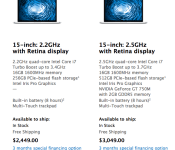
Apple now charges up to $3,049 for the 15-inch Retina MacBook Pro in Canada
A spot check of the Apple Online Store in Canada, for example, reveals that Apple has increased the price of the unlocked iPhone 6 from between $749-$969 to $839-$1,099, Thunderbolt Displays from $999 to $1,199, and 15-inch Retina MacBook Pros from between $2,099-$2,699 to $2,449-$3,049. Apple also hiked the price on the 15-inch MacBook Pro in France, with the base model now starting at €2,249 up from €1,999, and the higher-spec model up to €2,799 from €2,499.
Apple has made similar price adjustments in countries around the world today in order to ensure parity with United States pricing, following a period in which several Apple products were actually priced at a bargain compared to American prices. For instance, prior to the pricing adjustment, the Thunderbolt Display retailed for $999 in Canada, the same price as in the United States, which converts to around $799 in U.S. dollars based on the average conversion rate over the past month.
The updated prices went into effect following the return of the Apple Online Store at the conclusion of Apple’s “Spring Forward” media event in San Francisco this afternoon. Should the U.S. dollar weaken, as happened in July 2011, Apple will continue to make the necessary adjustments in order to ensure that its products and services are as consistently priced as possible throughout the world. In some cases, international prices will remain higher than U.S. prices as a buffer against currency fluctuations.

Ethiopia is hacking US journalists with commercial spyware

Ethiopia’s government is among the most oppressive political regimes on the African continent, only trailing Eritrea in its population of incarcerated journalists. And with the country’s recent implementation of off-the-shelf spyware from Italian security firm Hacking Team, Ethiopia’s leaders can–and have been–expanding their despotic reach far overseas.
Per a report from Citizen Lab, published February 12th, numerous journalists working for the Ethiopian Satellite Television Service (ESAT), a network of independent Ethiopian expat journalists operating out of Alexandria, Virginia were targeted by a member of Ethiopia’s internal information security apparatus: the Information Network Security Agency (INSA). Harassment from government officials is a regular occurrence for dissenting journalists in Ethiopia but this latest attack marks the second time that journalists outside of the East African nation have been targeted by the INSA.
What’s more, both attacks appears to have been carried out using Hacking Team’s Remote Control System (RCS) spyware. According to the Hacking Team product website, this software “is a solution designed to evade encryption by means of an agent directly installed on the device to monitor. Evidence collection on monitored devices is stealth and transmission of collected data from the device to the RCS server is encrypted and untraceable.”
Using RCS, the INSA could, in theory, be used to spy on the activities of ESAT journalists and lead authorities back to the journalist’s local sources. The target’s computer would of course first have to be infected with the RCS spyware. In this case, it came in the form of a bogus Word attachment sent to Managing Director of ESAT, Neamin Zeleke, in December of last year. Most troubling is that this sort of abuse should not even be possible using RCS as Hacking Team’s Customer Policy clearly states that:
We monitor the international geopolitical situation and we review potential customers before a sale to determine whether or not there is objective evidence or credible concerns that Hacking Team technology provided to the customer will be used to facilitate human rights violations.
However, Citizen Lab’s report suggests that not only did Hacking Team not suspend its service to Ethiopia’s government following a similar attack back in 2013, but the Italian firm may have even provided the INSA with software updates in the year since–despite published accusations against the government agency by targeted journalists and the government’s long and storied history of political repression. That’s a clear violation of the company’s internal policing policy.
Whether this latest attack against US-based journalists leads to any meaningful changes in the company’s policy remains to be seen–a front page expose in the Washington Post last year certainly wasn’t able to.
[Image credit: stereotyp-0815/Flickr]
Filed under: Internet
Via: Boing Boing
Source: Citizen Lab

Self-destructing site shows how long it takes Google to find you

Wondering how long it would take for Google’s search engine to find your website if you didn’t promote it? About 22 days, according to Matthew Rothenberg. He recently launched Unindexed, a purposefully short-lived web community that was set to self-destruct as soon as Google’s indexing technology made it searchable. While Rothenberg didn’t go out of his way to maintain the secret, participants knew that every view, post and shared link would bring the site closer to disaster — it only took 346 views and 31 contributions before everything came crashing down. Thankfully, you can recreate this experiment yourself. Rothenberg has posted the source code, so his commentary on the sad state of web anonymity should last for much longer than a few weeks.
[Image credit: Shutterstock]
Via: Motherboard

Favorites of MWC 2015 | The Friday Debate Podcast 007

MWC was incredibly busy but the guys got together to talk about their favorite things from the show. Youtube reviewer Lanh Nguyen joins Josh with the co-founder and Editor-in-Chief Darcy Lacouvee as they recount various happenings like HTC’s announcements and the Samsung Galaxy S6 Edge. Along the way, they reminisce about the beautiful and busy city of Barcelona, Spain, and even speak about video games. Darcy brings his business acumen to the podcast and gives us (and you) a look at some phone company inner workings.
It’s not often that the Android Authority guys can get together in a room and just hang out – so we hope you enjoy one of these opportunities via the Friday Debate Podcast!
The Friday Debate Podcast – discussing topics in Android every week.
Links to Podcast
RSS Feed
iTunes
Stitcher
Direct Download
Relevant Links
Samsung Galaxy S6 First Look!
Samsung Galaxy S6 Edge First Look!
HTC One M9 First Look!
HTC Vive Demo Reaction!
Follow our Hosts

Joshua Vergara
Twitter | Google+


Andrew Grush
Google+

Jonathan Feist
Twitter | Google+
Recorded on March 6, 2015 – Hosted and Produced by Joshua Vergara

VSCO Cam updated to version 3.2 – lets you copy and paste your edits to various photos

The popular photo editing app, VSCO Cam, has been updated to version 3.2 and brings forth a couple of new features and updates. The biggest update to mention would be the ability to copy and paste edits that you have made to a photo and apply it to any other photo that you wish. This new feature should be a godsend to avid VSCO users as editing a large batch of photos could be made easier and quicker.
The update also includes TIFF image import and various performance improvements such as editing times. QR code and a download link will be provided after the break!
Do you guys use VSCO? If not, what’s your favorite photo editing app?
Come comment on this article: VSCO Cam updated to version 3.2 – lets you copy and paste your edits to various photos
Analyst video roundtable: Bajarin, Dediu, Thompson on Apple Watch and new MacBook

What do some of the smartest minds in tech think of Apple’s latest announcements?

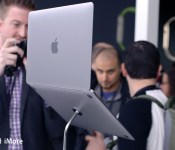
As soon as Apple’s Spring Forward event was over, and the demo area calmed down, I had the chance to talk to a few of the industry analysts in attendance. They graciously shared their thoughts on the Apple Watch, round two, and the all-new MacBook.
Ben Bajarin of techpinions.com.
Ben Thompson of stratechery.com
Thanks Ben, Horace, and Ben!

Apple Announces ‘ResearchKit’ Aimed at Medical Research [iOS Blog]
Apple SVP of Operations, Jeff Williams, today announced “ResearchKit”, a new open source software framework in the vein of HomeKit and HealthKit that will turn an iPhone into “powerful diagnostic tools for medical research.” The new software aims to assist doctors and scientist gather data at a faster and more accurate rate via the accessibility of the iPhone.
Williams mentioned multiple conditions that ResearchKit will be aimed at, including: Parkinson’s, Diabetes, Cardiovascular disease, Asthma and Breast cancer. Apple also promised it “will not see your data” when reiterating on Privacy of the new ResearchKit app.

“iOS apps already help millions of customers track and improve their health. With hundreds of millions of iPhones in use around the world, we saw an opportunity for Apple to have an even greater impact by empowering people to participate in and contribute to medical research,” said Jeff Williams, Apple’s senior vice president of Operations. “ResearchKit gives the scientific community access to a diverse, global population and more ways to collect data than ever before.”
When given permission, ResearchKit will attain user data like weight, blood pressure, glucose levels and asthma inhaler use, most measured thanks to third-party devices and apps. The service will also give researches a more streamlined experience in recruiting and gaining data from study participants, allowing users to answer surveys and input data right from the app.
ResearchKit will be released next month, and those first five apps mentioned by Williams at the conference are going to be available today.
Follow the rest of our March 2015 event coverage for the latest Apple Watch information.
Apple Announces 12-Inch Retina MacBook With Revamped Trackpad, Starting at $1,299
At today’s “Spring Forward” media event, Apple announced its much-anticipated ultra thin 12-inch MacBook, with prices starting at $1,299. The new notebook, which features a 12-inch Retina display with a resolution of 2304 x 1440, offers a full Mac experience in the lightest and thinnest Mac form factor to date

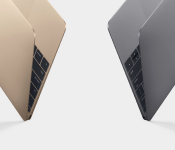
The 12-inch MacBook is separate from the company’s MacBook Air and MacBook Pro lines. It weighs 2 pounds and is 24 percent thinner than the existing MacBook Air at 13.1mm. It’s available in three iPhone and iPad-style colors: gold, silver, and space gray.
With the new MacBook, Apple has introduced a redesigned keyboard, featuring a new butterfly mechanism for the keys to make them both more stable and more precise. The edge-to-edge keyboard offers keys with 17 percent more surface area and a redesigned feel.
“Apple has reinvented the notebook with the new MacBook, and at just two pounds and 13.1 mm, it’s the thinnest and lightest Mac ever,” said Philip Schiller, Apple’s senior vice president of Worldwide Marketing. “Every component of the MacBook reveals a new innovation. From its fanless design, ultra-thin Retina display and full-size keyboard that’s 34 percent thinner, to its all-new Force Touch trackpad, versatile USB-C port and breakthrough terraced battery design, the new MacBook is the future of the notebook.”
Apple’s new MacBook also includes a completely revamped trackpad, with built-in Force Touch. Force Touch can detect the amount of pressure placed on the trackpad, introducing a whole range of gestures. For example, a hard press using Force Touch brings up a Map in mail, or a Wikipedia entry in Safari, much like right clicking does now. The trackpad also includes haptic feedback, giving users tactile feedback from the trackpad when using it. The trackpad is customizable, letting users choose how much pressure is required to initiate a force press.
The 12-inch MacBook uses an Intel Core-M processor that starts at 1.1GHz with Intel HD 5300 graphics. It has entirely silent operation because it’s the first MacBook to use a completely fanless design. Internally, the logic board is 67 percent smaller than the logic board in the MacBook Air, and Apple’s designed new custom-shaped batteries for the device to eke out as much battery life as possible.
According to Apple, the new MacBook has an “all-day battery” life at 9 hours of web browsing and 10 hours of iTunes movie playback.
To allow for its ultra thin design, Apple has used a single USB-C port in the MacBook, which combines several functions into a one port: power, USB data transfer, DisplayPort, HDMI, and VGA capabilities. The MacBook does not use the traditional MagSafe charging method that’s available in other MacBooks.
The entry-level MacBook is priced at $1,299 and includes a 1.1GHz dual-core Intel Core M processor, 8GB of memory, 256GB of flash storage, and Intel HD graphics 5300. There’s also a 1.2GHz version with 8GB of memory and 512GB of flash storage available for $1,599. There will be additional configure-to-order options as well.
The new MacBook will begin shipping on Friday, April 10 through the Apple Online Store and from Apple retail stores and Apple Authorized Resellers. 

MacBook Air and 13″ Retina MacBook Pro Updated to Improve Speed and Battery Life
Following the announcement of the brand new line of MacBooks, Apple today revealed a slight update to its MacBook Air and 13-inch Retina MacBook Pro lines.

Both the 11″ and 13″ MacBook Air models will be upgraded to 5th generation Intel Core i5 and i7 processors, Thunderbolt 2, and Intel HD Graphics 6000.
Today the popular 13-inch MacBook Pro with Retina display, 11-inch MacBook Air and 13-inch MacBook Air all received significant upgrades,” said Philip Schiller, Apple’s senior vice president of Worldwide Marketing. “The 13-inch MacBook Pro has been updated with the latest processors, more powerful graphics, faster flash, longer battery life and the all-new Force Touch trackpad. We’re also bringing the latest processors and graphics, and faster Thunderbolt 2 to the 11-inch and 13-inch MacBook Air, as well as up to two times faster flash to the 13-inch MacBook Air.”
The 13″ MacBook Pro will receive the brand new Force Touch trackpad introduced on the new MacBook today at the Spring Forward event. Other new additions to the Pro lineup include: 5th-gen Core i5 and i7 processors with Turbo Boost Speeds up to 3.4 GHz, 2x faster flash, “faster integrated” Intel Iris Graphics 6100, and an improved 10-hour battery life. There was no mention of an update to the 15″ MacBook Pro line at today’s event.
The updated MacBook Air and MacBook Pro lines can be purchased starting today on Apple’s online store, Apple’s retail stores, and various Apple authorized retailers.
Follow the rest of our March 2015 event coverage for the latest Apple Watch information.
 AIVAnet