


Google Drive update brings long press drag and drop functionality [APK Download]
Google Drive’s G+ page put some details about a Drive update that will soon grace your beloved Android devices. They state the update will bring an improved PDF viewer, key performance improvements and design improvements. While those are good things, it won’t be what will catch your attention. The biggest change to Drive on Android […]
The post Google Drive update brings long press drag and drop functionality [APK Download] appeared first on AndroidSPIN.

New Report Provides Look into Apple’s Secret Lab For Apple Watch Developers
Three weeks ago, it was reported that Apple was inviting developers to the company’s Cupertino headquarters to receive help finalizing Apple Watch apps. A new report from Bloomberg Business provides a look into the secret lab where Apple is helping developers, offering a look at Apple’s strategy for Apple Watch apps as well as the security around the project.

Developers from Facebook, BMW, Starwood Hotels and others have been making multiple trips to Cupertino, with each visit requiring confidentiality.
Apple, which will share more details about the gadget at a March 9 event, uses extreme measures to keep the work secret. Internet access is blocked inside the rooms, and no outside materials can be brought in to the labs with the test watches, a person who attended said. The companies, sometimes sharing a room, must bring in source code for their apps on a computer hard drive that can’t leave Apple’s headquarters. To prevent information from leaking out, Apple is storing the code and sending it to the companies closer to the watch’s introduction date, the person said.
The unreleased Apple Watch is also available for the developers to test out their apps, allowing them to check for glitches and optimize user experience for the Digital Crown and Force Touch, two of the watch’s unique interface options.
One of the challenges for both Apple and its developers has been to balance the apps so that they are useful but not annoying. Apple has recommended that developers be “judicious” about interrupting users with alerts that would constantly buzz or drain the battery. Instead, they suggest that apps should be used for no longer than 10 seconds at a time.
Another challenge for developers has been working on an unreleased product, as developers have noticed problems that still need to be worked through. One developer tells Bloomberg that the Bluetooth connection between the iPhone and Apple Watch caused lag with some applications. Additionally, some developers like Starwood have had to use computer simulations and cardboard cutouts to explain to the designers who weren’t invited to Cupertino how its app would work.
Apple is expected to show off the Apple Watch apps developers have been working on, as well as more information about the new device, at its “Spring Forward” event on Monday, March 9 at 10:00 a.m. Pacific Daylight Time. Apple plans to provide live coverage for the event on its website and through a channel on Apple TV, and MacRumors will also be covering the event with both a live blog on MacRumors.com and through our MacRumorsLive Twitter account.

WhatsApp banning users who install third-party messaging clients
 WhatsApp has been pretty strict about allowing users to download third-party clients, and they’ve slowly cleaned up access to those clients. They’re nearly impossible to find on Google Play or any other app store, and the company started banning users that used the apps earlier this year.
What started as a 24-hour ban turned into a three day ban, and now it looks like WhatsApp will permanently ban any user that’s caught using a third-party application to access WhatsApp. The ban pretty much blocks your phone number from the service, so anything short of getting an entirely new account with a new number won’t be enough to use the service again.
It seems a little extreme, but with how many warnings WhatsApp has given out, plus their effort in getting third-party clients removed from easily accessible channels, it’s very clear that if you want to use their service, you’ll have to play by their rules.
The third-party clients are useful for adding in features that WhatsApp doesn’t officially support, like tweaking the interface and sending longer video messages. But at the risk of getting your account completely banned, those apps probably don’t sound so appealing anymore.
source: Cult of Android
Come comment on this article: WhatsApp banning users who install third-party messaging clients

Google unveils car insurance comparison tool to help you save some money
Google has just introduced a new tool to help you save some money the next time you buy auto insurance. It’s called Google Compare for car insurance, and will display both national and local insurance providers in order to get you the best deal. There are only 14 partners on-board with the comparison tool so far, but the company hopes to add many more in the near future. 
Google explains:
You can highlight what makes your business unique, whether that’s an “A” rating in customer service or better discounts for safe drivers. And when users adjust their deductible or add additional cars to their quote, you can show updated pricing that matches their needs. They can then buy their policy online or over the phone through one of your agents.
The service is only launching in California at the start, but the company says they plan on rolling it out to other states in the future. Google plans on adding ratings, reviews and local agent support for providers with agent networks as Compare begins rolling out to more locations. If you live in California and want to check it out, follow the link below for some more information.
Google Compare for car insurance

Banks, retailers ‘stung’, Apple Pay still secure

Earlier this week we debunked sensational headlines mislabeling bank fraud as Apple Pay fraud. Now those same headlines are back, but with a new twist.
This time the headlines say Apple Pay has been “stung” by people using false credit card numbers obtained from last year’s Target and Home Depot breaches. Sadly, these headlines are just as inaccurate. Banks and retailers may have been “stung”, but Apple Pay is still as secure as ever. The Wall Street Journal:
Apple Inc. ‘s new mobile-payment system has been hit by a wave of fraudulent transactions using credit-card data stolen in recent breaches of big retailers, including Home Depot Inc. and Target Corp. , people familiar with the matter said.
Apple Pay security actually prevents just that kind of data from being stored by retailers. It will keep customers, banks, and stores safer. By spreading fear, uncertainty, and doubt (FUD) about Apple Pay, it actively hurts rather than helps transactional security.
Many people are already nervous about new technologies, even inclusive, enabling technologies like Apple Pay. To make them afraid rather than inform or empower them does them an extreme disservice.
The effects of those incidents are being felt for some time after the breaches in large part because financial institutions that issue cards typically don’t launch broad-scale replacements of the affected plastic after a merchant is hacked.
The card companies figure that the cost of potential fraud is often less than giving each customer a new card, according to payment experts and bank executives, and customers sometimes complain about the inconvenience of having to switch to new cards.
In other words the banks chose not to invalidate or flag that credit card data, and still approved it for use with Apple Pay, but it’s Apple Pay that was “stung”.
About 80% of the unauthorized purchases have been for big-ticket items bought with smartphones at Apple’s own stores, one person with knowledge of the situation said.
Again, that’s the banks and retailers, including Apple Retail, being stung, not Apple Pay. And what was the scope?
PNC Financial Services Group Inc. has seen 35 cases of fraud out of thousands of all Apple Pay customers, said a spokesman for the Pittsburgh-based bank. “We have looked at our processes and we believe we have very strong know-your-customer processes in place to prevent any additional cases,” he said.
While PNC doesn’t specify if it’s out of 1,000 or out of 999,999, even 35/1,000 cases still makes up a tiny percentage of transactions and certainly nothing to justify the alarmist focus and language used across mainstream media reports.
Here’s the comment Apple provided earlier this week:
“Apple Pay is designed to be extremely secure and protect a user’s personal information,” an Apple spokesperson told iMore. “During setup Apple Pay requires banks to verify each and every card and the bank then determines and approves whether a card can be added to Apple Pay. Banks are always reviewing and improving their approval process, which varies by bank.”
This is the second wave of high-profile this week casting blame on Apple Pay for what appears to be ages-old social engineering attacks targeted at banks and retailers. The first wave all sourced the same industry analyst’s blog post, with precious little indication of secondary or tertiary sourcing. The second seems no more than a rehash of the first, with some additional yet contradictory detail.
What rates Apple Pay getting this much of this kind of attention from these kinds of outlets this week?

Rinspeed reimagines the BMW i3 EV as a self-driving car

Rinspeed did a fantastic visual recreation of the Tesla Model S as a moving living room last year, and now it has given the BMW i3 EV a similar treatment. The Swiss car restorer and conjurer of futuristic concepts has reimagined the i3 as a self-driving car with rather far-out features in a new concept called “Buddi.” For instance, it’s equipped with a robotic arm that can move the steering wheel in front of either front-seat passenger or to the middle if nobody wants to drive. That robotic arm can curiously wind the in-car watch, as well, if the camera monitoring it determines that its battery is almost depleted.
Outside, the car has cameras to check and evaluate if it has to adjust the ride height suspension based on the terrain. Also, they keep an eye on traffic and environmental conditions in order for the car to come up with the best route while driving on its own. Other features include electric doors, semi-transparent panels, and a fancy heater controlled by a smartwatch or a smartphone. Rinspeed has presented the Buddi concept at the ongoing Geneva Motor Show, but those who didn’t get a chance to see it can look at more pictures in the gallery above.
Filed under: Transportation
Via: Autoblog
Source: Rinspeed
Oracle Now Bundling Ask.com Adware with Java for Mac
For years, Oracle has been bundling an Ask.com search toolbar with Java for Windows, relying on what some call deceptive methods to get users to install the add-on to their browsers. Now, the company has extended its adware strategy to Java for Mac, according to ZDNet.
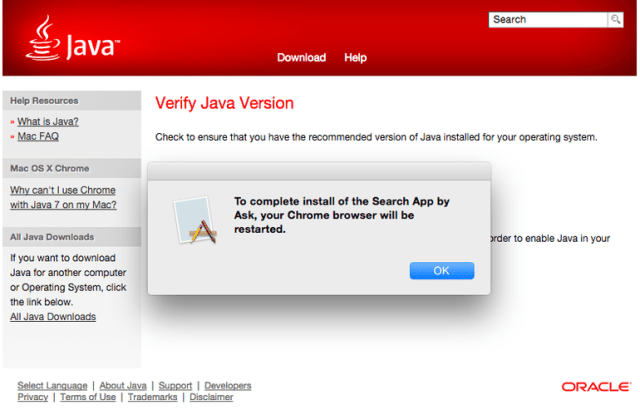 Image via ZDNet
The unwelcome Ask extension shows up as part of the installer if a Mac user downloads Java 8 Update 40 for the Mac. In my tests on a Mac running that latest release of OS X, the installer added an app to the current browser, Chrome version 41. (In a separate test, I installed Java using the latest version of Safari, where it behaved in a similar fashion.)
The Java installer selects the option to install the Ask extension by default, which means that users casually clicking through the dialogue boxes would find the extension installed and enabled on their browser of choice. Oracle has also updated its installation instructions for Mac to account for the change.
As noted by ZDNet, Ask.com typically provides low-quality search results and numerous ads with little distinction between ads and organic results. Ask.com parent company IAC pays a commission to Oracle and other companies that bundle the Ask extension with its products.
Users who want to remove the Ask toolbar can do so from the Help menu for the Ask toolbar on Chrome. Alternatively, users can go to the Chrome menu bar, then Preferences, then the settings page, then Manage Search Engines to remove Ask, followed by removing the extension from the Extension tab. Safari users can do so by going to Extensions in the Safari preferences and turning it off.
WSJ: Google’s wireless service will only work with the Nexus 6

We’ve heard rumors about Google launching its own wireless service for a few years now, and speculation has been gaining more and more momentum over the past few months. Then at MWC 2015, Google’s Sundar Pichai finally put those rumors to rest, confirming that the company is in fact launching its very own MVNO in the “coming months“. The only real details we have about Google’s plans came directly from Sundar, as he explained that Google is working with Verizon, AT&T and other “existing partners” to create its own service. Sundar also stated that he’ll have more details for us in the months ahead. But according to The Wall Street Journal, Google’s service may launch much sooner than that.
According to “people familiar with the matter”, Google’s wireless service may end up launching by the end of March, which would be way sooner than we expected. Additionally, the report states that the new wireless service will only be compatible with the Nexus 6, and no other Android devices. The report states:
The service, designed to switch among Wi-Fi and cellular networks, will initially be available only on the latest Nexus 6 smartphone designed by Google and made by Motorola Mobility, a former Google unit now owned by China’s Lenovo Group Ltd. , two people familiar with the matter said. One of the people said the service won’t work with older Nexus devices, such as LG Electronics Inc. ’s Nexus 5.
The sources claim that while there’s potential for the service to launch in the coming weeks, the start might be delayed. Also, the service will reportedly combine both T-Mobile and Sprint’s networks with available Wifi networks, in hopes to obtain the best signal from any location.
Pichai expressed to us at MWC that Google has no plans to be a “carrier at scale”, and that the company is looking to provide a proof of concept with the new wireless technologies. However, plans to only make the Nexus 6 compatible with the service, at least at the beginning, is extremely scaled back from what we were thinking.
Of course, like any other rumor, this should be taken with a grain of salt. And we won’t know anything for sure until Google makes an official announcement in the weeks to come.

HTC will replace Swype with TouchPal for its default keyboard engine
 HTC currently uses Swype as its input engine for its default keyboard, which has been a great engine so far. However, it looks like HTC is trying to find some greener pastures with another company, as TouchPal will be used for the input engine in the future, not Swype.
TouchPal has actually already worked with HTC for its keyboard engine in other parts of the world, including on the M8 in China, but now it’ll be the backbone for all of HTC’s current devices. Some employees of TouchPal speculate that HTC wanted to switch because of TouchPal’s better contextual predictions and wider language support, but we’ll know never for sure what causes some of these partnerships to happen.
If you’re excited to try out the new keyboard engine, the HTC One M9 will likely be the first official device to sport the change.
source: Engadget
Come comment on this article: HTC will replace Swype with TouchPal for its default keyboard engine

GDC 2015: Sneak peek at hack-and-slash game Dungeon Hunter 5
Gameloft’s freemium fantasy action title, Dungeon Hunter 5, is coming next week and we got a chance to check it out at GDC 2015.


The Dungeon Hunter series is well-known as a beautiful action-RPG, and its latest iteration changes things up quite a bit. For one, there aren’t any classes. Yep, an RPG with without classes. You start with your choice of weapon, be it dual crossbows, glaive, sword and shield, staff, and other classic set-ups, and take it from there. As you work through quests, you earn new gear represented as cards, which can be equipped or burned up to improve your existing weapons and armor. In-app purchases are employed to open special chests which have a better shot at providing higher-end equipment.
There’s also an asynchronous multiplayer element whereby an automated version of your character defends a stronghold, which you build and populate with minions to defend against other players. We didn’t get a chance to try that out, but it sounds very promising.
There’s not too much we can say about the storyline, but there are still demons romping around that need a good stabbing. Though the game looks just as fantastic as the last game, there’s a lot that’s refreshingly different. Dungeon Hunter 5 hits the App Store on March 12.
 AIVAnet


