


Huawei Nexus: would Google build one? Would you buy it?

An interesting rumor has been floating around the internet for the past few days, though it’d be easy to miss with all the commotion MWC 2015 has created. Hidden away, seemingly in a corner at the moment, is a fascinating assertion, one that has the potential to -if true- change the very landscape and mindset of the Western consumer. What could be so scandalous? What if I were to tell you that the next Nexus may be made by a Chinese OEM. And not like Motorola-Chinese mind you. No, the next Nexus is allegedly going to be manufactured by none other than Huawei.
Making sense of the Situation
Last week, GizmoChina published a story that suggested a Chinese OEM would be tasked with the next Nexus based on a post it had seen on Sina Weibo, the world’s largest country’s sprawling SNS. In the Weibo post, it was alleged that Google plans to partner with a Chinese phone maker for the release of a new Nexus, which could arrive sometime in the second half of this year. Earlier this week, the rumor was followed up by an unofficial confirmation that Huawei was the chosen company.
The confirmation came from neither Huawei or Google, instead Kevin Wang, the Director of China Research at market research firm iSuppli, asserted that Huawei had been picked as Google’s next partner. It is impossible to say where Wang is getting his information from, or if it is simply a bold prediction and nothing more. For that matter, we can’t say for sure that Google is even considering partnering with a Chinese company for a Nexus device. That said, we can understand some of the reasons why Google might consider working with a Chinese giant like Huawei for production of a new Nexus phone, or even tablet.
Why, China. Why? This is why.

Peak-a-boo, I might be coming for you!
China is the biggest market in the world. The potential money that companies like Google can earn from even a fraction of a segment of the population is so incredibly high that it just can not be ignored from a business/capital standpoint. This market has also been difficult for Google to crack in earnest and so it’s no secret that Mountain View is eager to make in-roads this year. While the Play Store exists in China technically, due to laws within the country, only free applications can be distributed. On the other hand, take a look at just how much competition there is within the (non Play) paid app marketplaces:

As you can see, Google Play isn’t even listed in the top 20, although Xiaomi is within the top 5, Huawei and Oppo in the top 10, and Lenovo in the top 15. If Google could even rank on this list period it would be a major boon not only for its own revenue purposes, but also for countless developers who could benefit from the sudden influx of a new market, especially one as plentiful as that in China. By producing a handset in partnership with a popular Chinese brand, Google might finally find the in it needs to lure Chinese consumers over to the Play Store and other Google services.
What might we expect from a Huawei Nexus

Obviously this early in the game we can’t say for sure what a Huawei Nexus might look like, but turning to recent Huawei devices, we can make a few assumptions. First, we can assume that a Chinese Nexus would probably be cheaper, something that is decidedly not true of last year’s unicorn, the Nexus 6. It’s widely accepted that the Nexus 4 and 5 were, while very affordable, not state-of-the-art devices, even during their honeymoon period. The Nexus 6 on the other hand, is a different beast (almost a whale, one might say) with its killer hardware and components, and sure enough the roughly $700 it costs serves as a reminder. Just imagine the new Nexus with bleeding edge hardware and a price tag more in line with the Nexus 4 or 5.
Look no further than devices like the Huawei Mate 7 and you’ll see that Huawei is clearly capable of producing a premium looking device that doesn’t break the bank, at least when compared to the competition. The Mate 7 features an excellent touch-based fingerprint scanner, a metallic body and is truly an eye-catching product, even if its size might be a little too big for some. One area where it is at its weakest? Software, which is where stock Android comes into play.
Look no further than devices like the Huawei Mate 7 and you’ll see that Huawei is clearly capable of producing a premium looking device that doesn’t break the bank.
Aside from the assumption of a cheaper price tag, there’s also the possibility that a Huawei Nexus would use its own in-house processor, as opposed to something more mainstream like a Qualcomm Snapdragon. This would certainly help further cut costs, though it’s unclear whether or not Google would risk using a relatively unknown chipset in its flagship Nexus devices.
For those that aren’t aware, Huawei’s chipset found in the Mate 7 is called the HiSilicon Kirin 925, which brings a 1.8GHz quad-core Cortex A15 together with another quad-core Cortex A7 clocked in at 1.3GHz, both working in conjunction, allowing for a very optimized performance that is very close in performance to a higher-end Snapdragon. One area of weakness, however, is in terms of graphics. The Mali-T628 has consistently done worse in graphics tests than other comparable GPUs. Granted, it still performs well, it’s just not the best available. Of course, Huawei could be ready to wow us in gaming/graphics performance with their next Kirin processor. You never know.
The Global Benefit for China

The long line of Nexus smartphones. All made in China but how many were designed there? (Hint: it’s none…so far).
Call it what you will, but the world-at-large is still content in seeking to relegate China to back-burner status when it comes to products. The sentiment is bitterly ironic considering just how many things are made there (or rather, how few aren’t) and yet, when it comes to Chinese OEMs, they are never cut the same break that companies like Sony or LG are.
In truth, Japan and South Korea are both unconditionally accepted as countries that make good technology and good products, whereas China is associated with spying, intellectual property infringement, and inferiority. (Whether or not those are true or not is a different matter entirely). Even Google itself is no longer immune to the callous charge of misdoings, perhaps offering it an honorary seat alongside Wallace and Dave, for the “do no” clause has sadly been broken.
The idea of a Chinese Nexus would do a lot to dispel this air of mistrust and inferiority that exists in the western world, at least if the launch was handled right.
Like it or not, companies like Huawei, Xiaomi, and even Lenovo, are growing bigger and bigger with seemingly each month that passes. How can they not really, when they sell to the two largest markets in the world (India and, of course, China) and offer devices with excellent specs at cutthroat pricing. It’s no wonder that Samsung can’t get a break in either territory anymore.
The idea of a Chinese Nexus would do a lot to dispel this air of mistrust and inferiority that exists in the western world, at least if the launch was handled right.
The Global Problem for China
Despite that which was just said above, China is seen as an entity that spies, lies, and steals. Huawei in particular has been the subject of much scrutiny even on a governmental level, as politicians and bureaucrats in the USA are concerned about the possible security ramifications that might occur were Huawei to be contracted with providing hardware for things such as official government use. Unfortunately with the recent scandal involving Lenovo and malware, this belief -justified or not- is unlikely to fade; in fact it has arguably just gotten worse.
The other large problem is that mainstream consumers in the Western world don’t know anything about these Chinese OEMs. Huawei might be a slight exception given the relatively large number of devices it sells under its own branding, or else has been commissioned to make for carriers. Still, ask someone to even pronounce the company’s name and chances are they can’t. Now consider the likes of Meizu, Oppo, One Plus, or Xiaomi, who are totally alien and the salience they might otherwise have in their Asian territory is gone entirely.

Even if Huawei could make the Next Nexus and “get away with it” in the West, it is difficult to believe that many customers would buy it. The Nexus line is, in and of itself, not designed for mainstream consumer sales, partially because Google simply doesn’t know how to promote it well enough, partially because Google doesn’t know how to meet demand requirements until the popularity has died off, and partially because it’s sorely lacking in any and all kinds of marketing gimmicks and software add-ons that companies like Samsung push so aggressively. (These are but a few of the potential reasons Nexus smartphones never appear on top sales charts, though it is by no means a comprehensive list.)
Considering how so many people were so quick to write off the Nexus 6 (“too big, pass”) without giving it a try, the same sentiment will arguably apply with a Huawei Nexus, only perhaps replaced with a “way to sell out Google” or “Google is in bed with China. Hello Microsoft!” Even if you might give it a try, it’s easy to imagine a friend, family member, or random YouTube ranter uttering those exact words.
Wrap-Up
Regardless of what one feels about this story, the potential here is big. Google, eager to gain a foothold into the expanding Chinese mobile app market, would be in a very good position were the Huawei Nexus to materialize. Likewise, Huawei would have an extra layer of “Western credibility” associated with its brand name, should Google trust it with making a device. Even if this all does pan out and the device never makes it outside of Asia, it will still stand as a very bold move indeed.
Any thoughts? Would you be willing to buy a Nexus made by Huawei?
// <![CDATA[
(function () ());
// ]]>
Windows 10 Feedback app search times improved by over 90%

If you have been using the Feedback app in the Windows 10 technical preview, you might notice some improvements in the search times. That’s due to Microsoft’s Windows team making some changes based on, well, feedback from Windows 10 users.

Is a new MacBook Air just around the corner?

It’s been almost a year since the last MacBook Air refresh. Rumors suggest Apple’s about to release a new model.
Rumors started circulating Wednesday that Apple’s about to pull the trigger on a refresh to the MacBook Air, equipping it with a moderately faster processor and bigger battery. The update could arrive next week when Apple is expected to show off the Apple Watch at its Spring Forward event in San Francisco. Is a faster processor and bigger battery all Apple needs to keep up the MacBook Air’s momentum?
A recent post on MacRumors points to a Chinese site that purportedly has screenshots of the system profile of a new MacBook Air that carries the model identifier “MacBookAir7,2.” Apple’s current MacBook Air model is identified as “MacBookAir6,2.”
The profile information presented on Feng.com suggests that the new MacBook Air is equipped with an Intel “Broadwell” processor. If it’s true, this would mark the first time a Mac model is equipped with the new processor. Two years ago the MacBook Air was the first Mac model to feature Haswell processors, so the progression makes sense.
Broadwell is the latest generation of Intel Core processor, based on the “Haswell” processors currently in most Macs. Intel first expected Broadwell chips to go into production early last year, but it wasn’t until January, 2015 that Intel revealed the whole line, including the chips likely to make it into the next generation of Macs.
Rumors have bounced around for months that Apple is on the verge of releasing a Retina MacBook Air, the first MBA model equipped with a Retina display. The information posted to the Chinese site indicates that this particular Mac is operating at the standard MBA resolution of 1440 x 900, which would suggest it is not, in fact, a Retina model. That doesn’t preclude the existence of a Retina MacBook Air, however. To that end, the Wall Street Journal claims that a 12-inch Retina MacBook Air is already in production and should be released to retail sometime in the second calendar quarter of 2015. It’s also a likely candidate for the Broadwell processor treatment.
When Broadwell ultimately comes to the Mac, don’t expect huge changes just because of the new processor. The MacRumors article suggests the MacBook Air will get a 200 MHz processor speed boost (from 1.4 to 1.6 GHz), with faster integrated graphics than last year’s model.
Broadwell will introduce some efficiency improvements too. This new MacBook Air model purportedly has more battery capacity than its predecessor. Current MacBook Air models can operate continuously for up to 12 hours between charges. PC ultrabooks are already exceeding that in some cases, so it behooves Apple to keep the MacBook Air as power-competitive as possible.
Whether Apple introduces a refreshed MacBook Air at next week’s Spring Forward event or waits, Apple’s product cycle suggests that a MacBook Air refresh is coming soon. If you’re in the market for a new lightweight Mac laptop, I’d recommend waiting just a bit to see what’s coming.
ZeptoLab’s King of Thieves is now available on Google Play
King of Thieves, the latest game from the developers of Cut the Rope, is now available on Google Play. Focused on multiplayer, the game centers on your attempts to become the best thief in the world.
Sprint Galaxy Note 4 now getting Android 5.0 Lollipop

Listen up Sprint Galaxy Note 4 owners…..You are about to get Lollipop. Sprint started pushing the update over-the-air, but you know the drill……It could take literally 2 weeks or more until you get yours since it rolls out in stages. Yes, you can keep tapping, Check for Updates, but trust me when I say that it won’t do a thing other than make you feel like you think you are speeding things up.
You might not want the update so fast anyway because a lot of people are reporting bugs after Lollipop updates on various other phones. Let us know if you received the update and if you’re having any issues.
Thanks to the many of you that sent this in.
source: Sprint
Come comment on this article: Sprint Galaxy Note 4 now getting Android 5.0 Lollipop
CEO of Cyanogen: Samsung and Apple to get slaughtered by startups within 5 years

After forming their own corporation with a round of funding, partnering with OnePlus, and now Qualcomm, things are looking up for Cyanogen. CEO Kirt McMaster sat down with Business Insider to talk about the company, and one interesting tidbit came out of the interview.
Kirt believes that Samsung and Apple won’t be able to stay at the top for long. It won’t be companies like Huawei, LG, Motorola, or HTC that will knock them off their perch though, it will be various startups making low cost handsets. Cyanogen could actually be part of that craze as their software will be part of Qualcomm’s Reference Design (QRD) devices that will release in April. Basically it’s the complete software and hardware package that any startup can use to bring a phone to market within 60 days.
There are already experienced companies like Blu Products in Latin America and Cherry Mobile in the Philippines. According to Kirt…
“All of these guys are arising. They understand local marketing and distribution better than any incumbent that attempts to move into the region. These guys are hustlers; they’re fast moving. They know what it takes to influence market dynamics.”
Samsung and Apple might not even have 5 years according to Kirt….
“It could get pretty bad pretty damn quick. This is often the case. Look what happened to Research In Motion (RIM). Look what happened to Nokia. Last summer Micromax surpassed Samsung as the dominant feature phone player in India. We’re talking literally in eight months this occurred.”
We know that all companies can’t stay on top forever so predicting one’s doom seems bold, but at the same time, when it does happen, the person who predicted it looks brilliant. But let’s not forget that all companies don’t necessarily collapse. Look at Facebook. How many people have been predicting their impending doom as they continue to get bigger and more dominating?
Still, Samsung and Apple need to watch their backs and I am sure they already are. Apple might actually be more in danger since they don’t know how to produce low cost products. At the same time Apple never set out to be the best in terms of market share. They set out to offer the best product. Best or not, lower market shares yield lower profits, which make investors miserable.
The bottom line is that the smartphone market is continuing to evolve and things are likely to be drastically different in a few years not only from many startups, but how about Project Ara? That could really change the game with all kinds of parts from manufacturers jumping on the bandwagon. How will Samsung and Apple fit into that equation?
Stay tuned because I think we are in for a wild ride.
source: Business Insider
Come comment on this article: CEO of Cyanogen: Samsung and Apple to get slaughtered by startups within 5 years
Apple Rumored to Offer Personal Engravings on Apple Watch [iOS Blog]
 Apple may give customers the ability to engrave personalized messages onto the upcoming Apple Watch, according to French Apple and tech site iPhonote [Google Translate].
According to the website’s source, who remained anonymous due to their “involvement at Apple”, the company would offer an engraving option similar to that of products like the iPhone, iPad, and iPod lines.
The contact, however, remains unsure of whether the feature would be available on the Apple Watch’s launch date or not. They remain “almost certain”, however, that the customization option will emerge for the device eventually.
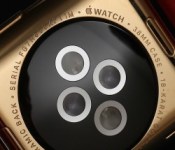
An engraving option certainly makes sense for Apple’s new fashion–focused wearable, especially considering that essentially all of the company’s mobile products include the personalization option, but the small footprint of the Watch does raise questions on where the actual engraving would be located.
The heart rate sensor located on the device’s backside takes up nearly all of the real estate of the 38mm or 42 mm device, although drastic character count limitations could perhaps fit truncated messages around the sensor. There’s also a possibility that more room could be found on the device’s side opposite the digital crown, but until Apple officially announces the engraving service, it remains to be seen where the personal messages would fit onto the wearable.
Despite being announced nearly six months ago, a number of details on the Apple Watch have yet to be revealed in the lead-up to its April launch. Last week, the company sent out invites for the “Spring Forward” media event to take place Monday, March 9 and for which most evidence points towards a heavy focus on pricing and launch day details for the new wearable device.
(Photo: aBlogtoWatch)

King of Thieves is the latest game from Cut the Rope creator, now on Google Play

Best known for its Cut the Rope series, Zeptolab recently unveiled its latest title, King of Thieves, for the Amazon AppStore. However, for those who were waiting for an official Google Play release, today is the day.
This time around the game has nothing to do with the cutting of ropes, and instead centers on a thief whose goal is to steal gems and gold from other players. Yes, that means there is a PVP component in this game, as well as 80 single-mode levels. In addition to stealing from others, you have to do your best to keep your own base safe, creating defenses to best protect your stash of gold and gems. In addition to looting and protecting your base, there’s also a crafting element, letting you make costumes for your thief.
The long term goal of the game? Keep thieving and growing your treasure until you find yourself at the top of the leaderboards, where you’ll be hailed as the King of Thieves. As you can tell in the video, this game isn’t meant to be taken too seriously, and while different from Cut the Rope, still maintains a similar vibe and artstyle.
You can get King of Theives free from Google Play, though there are in-app purchases as well. Anyone try this one out yet? If so, what do you think?

ShopCrackBerry.com now available in Spanish

Since 2007, ShopCrackBerry.com has been the most popular one-stop shop site for BlackBerry users by offering a wide selection of products, rapid fulfillment, and knowledgeable expert support. As part of our ongoing efforts to expand our e-commerce network and address our customers requests, I’m pleased to announce ShopCrackBerry is now also available in Spanish.

Rock Band 4 will thrash its way to the Xbox One in 2015
Harmonix will try to bring back the once massive music game genre with the release of Rock Band 4. The game will be out for the Xbox One, among other platforms, sometime in 2015.
 AIVAnet