


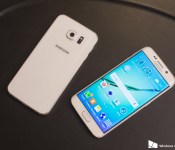
The Samsung Galaxy S6, complete with 115GB of OneDrive, OneNote and Skype

Remember those recent rumors about Microsoft services coming pre-loaded on the Samsung Galaxy S6? Turns out they were true. Now the phone (and its sibling, the Galaxy S6 edge) is officially official we know that it’s a thing, but a pretty limited thing. OneDrive and OneNote are preloaded, with 115GB (odd number, sure) of free storage for two years, and the hands-on our buddies at Android Central had showed Skype was also pre-loaded on the demo units.
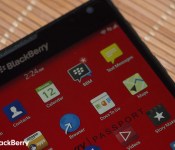
BBM Custom PINs, Android Wear support arriving March 2

BlackBerry has announced the arrival of new customization options for BBM. While in testing for awhile, tomorrow, March 2, will see the debut of custom BBM PINs. Also arriving tomorrow is BBM for Android Wear.

BerryFlow Upstream Podcast – Vanity

The past week for BlackBerry has been rather interesting. We’ve heard some news from QNX, saw some pics of the BlackBerry Leap / Rio, had Verizon release the BlackBerry Classic and now that Mobile World Congress is underway, had a few early announcements from BlackBerry go live. Have a look at the full discussion list and check out the audio and video below with special guest, Snap Developer Jim Muir.
Sony Xperia M4 Aqua announced: 64-bit Snapdragon 615, 13MP camera and LTE
Sony has launched its first handset with a 64-bit CPU, the Xperia M4 Aqua. Targeted at the mid-range segment, the device offers LTE connectivity, dust and water resistance, a 13MP camera and two-day battery life.
LG’s new Urbane LTE smartwatch runs webOS

LG’s taking their purchase of webOS back closer to where it was born: mobile, in the form of the LG Watch Urbane LTE. That’s right, the just-announced LG Watch Urbane LTE is a webOS smartwatch. We got our first hints of this new watch back at CES 2015, and today we’ve finally gone full hands-on with LG’s latest take on webOS. It’s worth noting though, that unlike the TVs, which LG emphasizes as running webOS, the Watch Urbane LTE is touted as running the LG Wearable Platform, but at it’s core, this is webOS.
We’ll get this out of the way right now: this is not like the webOS we’re used to. LG’s built an entirely new interface on top of the core of webOS, though it retains a lot of the gesture-driven feel of webOS. There’s a lot that’s had to change, by virtue of the new owner’s design style, the passing of time, and the constraints and requirements of a circular watch platform versus a larger phone or tablet screen. But the swiping left-to-right to go back gesture will be familiar to anybody that’s used a webOS device in the past.
Speaking of that interaction, the app menu is a spinning ring of your installed apps. There are three buttons on the right side — the top opens up the settings, the middle (and raised to for prominence) the apps launcher, and the bottom cycles through recently-opened apps. LG’s loaded a bunch of their own apps on the watch, including standards for messaging, phone calls, contacts, music, calendar, email, find my phone, voice memo, etc.
In addition, there are apps for LG Health (using the on-board sensors — we’ll get to those in a bit), remote camera shutter control, Cashbee (a Korean payments system), CGV (Korean movie theater chain), Golf, Tranggle Cycling (GPS fitness tracking), and a voice translator that works surprisingly well from the watch’s microphone and speaker.
At this point we should note that the LG Watch Urbane LTE is designed as a standalone device — as the LTE in the name would indicate. All of these apps are self-contained on the device (except for the obvious remote shutter needing a remote shutter to control) and aren’t mere companion apps to an app installed on your smartphone, as with Android Wear (which the standard LG Watch Urbane runs).
The Watch Urbane LTE is a standalone device. It might share part of its design and styling with the Android Wear-powered Urbane, but there’s little else about it. Inside it’s mostly a different and more powerful device. Under the 1.3-inch circular P-OLED display (the same as you’ll find in the standard Watch Urbane, as well as it’s less-fancy and slightly older Android Wear compatriot the LG G Watch R) is a Qualcomm Snapdragon 400 dual-core processor clocked at 1.2GHz, 1GB of RAM, and 4GB of storage.
This is all fueled by a 700mAh battery, and connects to the outside world with Wi-Fi 802.11b/g/n, Bluetooth 4.0 LE, NFC, and (of course) a cellular LTE. It even has fine motion tracking thanks to an accelerometer and gyroscope, a compass, barometer, heart rate monitor, and GPS + GLONASS. Combine that with the speaker and microphone and you’ve got what amounts to an entry-level smartphone, but strapped to your wrist. In fact, the power of this phone is roughly equivalent to that of the HP Pre 3 (from 2011).
All of this is crammed into a polished metal body that’s on the chunky side, noticeably, but not terribly so, in comparison to the average smartwatch today and many high-end watches today. Considering everything that’s in that body it’s not shockingly thick, nor thin. It’s right about what you’d expect.
Like webOS on an LG TV, this isn’t webOS like we grew used to under Palm and HP. This is LG’s webOS, where it’s not just the interface, but the core OS that’s useful and extensible. There are points here and there where you’ll find hints of the webOS of old (surely, if you look at the code, there’s a lot of webOS in there), but many of those are simply modern user interface conventions that aren’t anymore unique to webOS anymore. You won’t not find cards or classic webOS notifications here.
Then there’s the matter of availability. LG’s not commented on a launch time or price, but we can be sure it won’t be cheap with everything packed inside and the quality of the design. And right now it’s looking like the Watch Urbane LTE might only see a release in Korea. That could change, but LG put a strong emphasis on saying that Android Wear is still their primary platform.

Samsung condenses all of its MWC announcements into 60 seconds

The Galaxy S6 and Galaxy S6 edge are now official, and if you missed the reveal yesterday, Samsung is now offering a one-minute video that is essentially a highlight of its Unpacked 2015 event at Mobile World Congress.
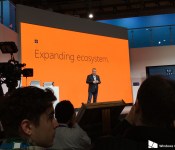
More than 2.8 million have signed up to Microsoft’s Windows Insider program

Microsoft today shared some statistics from its Windows Insider Program. Stephen Elop revealed that more than 2.8 million consumers have signed up to the program, offering more than 900,000 pieces of feedback to help shape the future of Windows 10 across the board.
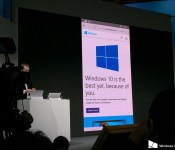
Microsoft’s Project Spartan web browser demoed on Windows 10 for phones

We got a look at Microsoft’s new web browser for Windows 10 — Project Spartan — in January, and at Mobile World Congress the Redmond giant is demoing the functionality of the browser on Windows 10 for phones.
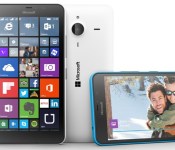
Microsoft reveals the Lumia 640 XL affordable-phablet Windows Phone with a 5.7-inch HD display

Barcelona, Spain – This morning, Microsoft has announced a second new Windows Phone for their budget range of devices. Following on the heels of the 5-inch Lumia 640 is its bigger brother the 5.7-inch Lumia 640 XL, which also includes a 13 MP rear and 5 MP front-facing cameras.
Launching this month in various markets worldwide, the $245 (219 euros) dual-SIM LTE Lumia 640 XL from Microsoft looks to bring robust hardware at an affordable price to those who want a smartphone with a large display. Coming in a variety of colors, Glance screen, and 1 GB of RAM, the Lumia 640 XL appears to be a substantial replacement for the aging Lumia 1320.
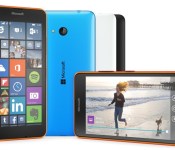
Microsoft announces the $180 Lumia 640 with a 5-inch HD display, Glance and Dual-SIM LTE

Barcelona, Spain – This morning, Microsoft has unveiled the Lumia 640, the latest budget-friendly Windows Phone in the Lumia lineup.
The Lumia 640 builds off of the strengths of the Lumia 635 but brings none of the drawbacks. With improved hardware and a larger, 720P display, the Lumia 640’s dual-SIM LTE design should open Windows Phone to a whole new market.
Additionally, Microsoft is tossing in a one-year subscription to Office 365 Personal, which includes Word, Excel, PowerPoint, Outlook and OneNote on the Lumia as well as on one PC or Mac and one tablet. The subscription comes with 1TB of OneDrive storage and 60 free minutes of Skype Unlimited Worldwide calling per month.
Pricing of the dual-SIM LTE version of the Lumia 640 is expected to be around $180 (159 euros) while the dual-SIM 3G should retail for $155 (139 euros) both starting in April.
 AIVAnet