



Sprint tweaks prepaid rate plans to match Boost, Virgin brands

Sprint on Monday announced a slight reconfiguration of its prepaid smartphone rate plans. Mirroring those of its Boost Mobile and Virgin Mobile brands, the new plans give customers more value for their money. Effective immediately, the Sprint Prepaid Plans range from $35-$55 per month and include unlimited talk and text. The only thing one has to figure out is how much data is needed per month.
- $35 – Unlimited Talk, Text and 1GB data
- $45 – Unlimited Talk, Text and 3GB data
- $55 – Unlimited Talk, Text and 6GB data
We're Hiring! Click here to learn more!
The post Sprint tweaks prepaid rate plans to match Boost, Virgin brands appeared first on AndroidGuys.
.CPlase_panel display:none;

Apple Confirms Record-Breaking Four Million First Day Pre-Orders for the iPhone 6 and 6 Plus
Apple today announced that it has processed more than four million iPhone 6 and iPhone 6 Plus pre-orders in the first day of pre-launch sales in the select countries that started accepting orders on September 12. This figure doubles Apple’s previously announced record of two million pre-order sales for the iPhone 5 in 2012.

“iPhone 6 and iPhone 6 Plus are better in every way, and we are thrilled customers love them as much as we do,” said Tim Cook, Apple’s CEO. “Pre-orders for iPhone 6 and iPhone 6 Plus set a new record for Apple, and we can’t wait to get our best iPhones yet into the hands of customers starting this Friday.”
First-day demand was strong for the two iPhone 6 handsets with pre-orders pushing out availability of the phones to October. Ship times for the larger iPhone 6 Plus began to slide several hours after pre-ordering started on September 12, while supply of the iPhone 6 remained strong until mid-day.
After announcing the iPhone 6 and iPhone 6 Plus at its September press event, Apple will begin selling the two phones in its retail stores and through third-party retailers and carriers beginning Friday, September 19th in the US, Australia, Canada, France, Germany, Hong Kong, Japan, Puerto Rico, Singapore and the UK. The company will roll out the handset to more than 20 additional countries on September 26.
.CPlase_panel display:none;

Phones4U Cancels All iPhone 6 and 6 Plus Pre-orders as UK Retailer Faces Closure [iOS Blog]
UK retailer Phones4U confirmed today in a public statement that it is canceling all iPhone 6 and iPhone 6 Plus pre-orders as the company enters administration, reports Huffington Post UK via Engadget. Administration allows a company to address its creditors as it attempts to rescue its business operations. Phones4U was forced to make this decision after UK mobile phone operators Vodafone and EE failed to renew their contracts with the retailer.

Phones4U has shut down its online store and closed its retail store operations as part of this administration process. The retailer is no longer accepting any new orders and canceling any existing orders that have not been shipped, including those for the new iPhone 6 or iPhone 6 Plus. All payments for these canceled orders will be refunded to customers.
“Any orders that have not already been dispatched will be cancelled and any payments refunded to customers. Phones 4u apologise for any inconvenience.”
Customers can still preorder an iPhone 6 or 6 Plus from Apple UK, but will face longer wait times as the delivery window for the two phones has slipped into October due to record-breaking demand. Customers also can wait in line and purchase a new iPhone 6 or 6 Plus when the handsets go on sale in retail stores starting Friday, September 19.
.CPlase_panel display:none;

Panasonic’s LX100 makes huge compact leap with 4K video, MFT sensor

If you’re thinking about buying Sony’s sublime RX100 III compact camera, Panasonic has just made that decision a lot more difficult. The new Lumix DMC-LX100 is leaps and bounds ahead of its LX7 predecessor and the most sophisticated compact the Japanese company has ever built. For starters, Panasonic has trumped the RX100’s 1-inch sensor by equipping the new model with a Micro Four Thirds, 12.8-megapixel MOS chip, the same size used on its big-boy interchangeable-lens models. It’s also got a fast Leica 24-75mm (35mm equivalent) f/1.7-2.8 lens, a wide-screen, 2,764K dot LVF (live viewfinder) and 4K video capture. Some of those specs put it on par with the company’s flagship GH4, and well ahead of all its other interchangeable MFT models.
It also borrowed the GH4’s autofocus, boosting it over the LX7 to 0.14 seconds with an 11fps burst speed. Other features include WiFi, NFC capability for easier smartphone pairing, in-camera RAW to JPEG conversion and an (included) external flash. Despite all that, the metal-bodied compact is only a hair bigger than the last model. Panasonic claims that the new 4K video mode can also be used to capture 8-megapixel stills at up to 30fps. It added that the much larger sensor combined with the relatively low 12.8-megapizel count will give the LX100 not only better depth of field, but superior low-light capability too. It now has a 25,600 max ISO instead of 12,800.
The Lumix DMC-LX100 is slated to arrive at the end of October, but Panasonic has yet to reveal the all-important price. For comparison’s sake, though, the RX100 Mark III runs $800 and Panasonic’s own LZ1000 superzoom (with a 1-inch sensor) is $900. The higher-res LVF, 4K and other specs also trump Panasonic’s latest ILC, the GM5, showing that the compact market is from from dead — instead, it’s just heading upmarket.
Filed under: Cameras
.CPlase_panel display:none;

Canon’s bringing back the square selfie cam with PowerShot N2

Early last year, a Canon rep pulled out a point-and-shoot with a very peculiar design. Instead of the rectangular form factor we’d grown used to, this camera was square. The PowerShot N was designed to be held any which way, making it a good fit for both righties and lefties, but without any pronounced grip, it didn’t feel quite as natural to hold. We were a bit relieved, then, when Canon debuted the N100 with a more familiar look and feel, but at Photokina, the company’s returning to the original shape and size with the PowerShot N2. The N2 replaces the original N — the N100 will remain on the market — bringing a slew of new features for social sharers and video bloggers alike.
There’s a new 16.1-megapixel sensor, a faster DIGIC 6 processor, a 28-224mm f/3.0-5.9 8x optical zoom lens (with improved IS) and a 461k-dot, 2.8-inch touchscreen that now flips 180 degrees for self-portraits (and videos). You still get WiFi (after all, this camera’s all about creating sharable content), but the N2 now includes NFC, making it easier to get up and running with a new device. The camera can capture 1080/30p video and thanks to a few added touchscreen controls, you can tweak exposure compensation, turn on the flash and adjust the smoothness of your skin (to decrease sharpness with certain facial features), all from the selfie mode. Canon’s expecting to ship the PowerShot N2 to customers this December; the camera is priced at $300.
.CPlase_panel display:none;
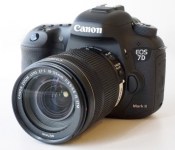
The 7D Mark II is Canon’s best DSLR without a full-frame sensor

The wait is over. Canon’s long-anticipated EOS 7D Mark II is here, shipping in November for $1,799, without a lens. With a price tag that high, you’d think it’d be safe to assume that the company’s consumer flagship sports a full-frame sensor. It does not. It does, however, represent an enormous step up from the original model — the Mark II includes just about every feature a pro photographer (and video shooter) could hope for, excluding a 35mm sensor, of course, and integrated WiFi. Instead, there’s a 20.2-megapixel APS-C CMOS sensor, which, despite a similar spec, is an improvement over what you’ll get with the 70D. You can also take advantage of a new 51,200 top ISO and a 10 fps continuous shooting mode (at full resolution, of course), powered by the dual DIGIC 6 processors.
You can capture up to 4 frames per second in silent mode, which, although not completely silent, is certainly the best option for shooting performances and other events where a clanging shutter wouldn’t be appropriate. The 7D Mark II now includes 65 autofocus points, compared to just 19 on the original model. There’s a dedicated AF lever for jumping between modes, and when you’re shooting video, Canon reps liken the focusing performance to what you’d experience with a camcorder. You can also adjust the speed at which the camera will focus and track subjects while you’re capturing video, with five levels to choose from. You can capture MP4 or MOV clips at up to 1080/60p to a CF or SD card, or output uncompressed footage (with audio) through the HDMI port. Speaking of ports, there are plenty to choose from, including USB 3.0, a mic input and headphone output, a PC socket for strobes and a wired remote connector.
The camera has a magnesium alloy construction, so even though you’ll want to avoid it, the body should survive a tumble or two (though there may be a different outcome for the lens). The new 7D is even four times more dust and weather resistant than the original model — reps say you shouldn’t have any problem shooting in moderate rain, assuming you’re using a weather-resistant L lens. There’s a new, slightly higher capacity battery on board (the LP-E6N), though the camera will work with older packs too. You will need to buy a new BG-E16 grip, however. Finally, the shutter, previously rated for 150,000 shots, can now handle more than 200,000 without repair. The 7D Mark II is expected in stores this November for $1,799 body only, or $2,149 when bundled with an 18-135mm f/3.5-5.6 IS STM lens.
.CPlase_panel display:none;

Canon targets Sony’s popular RX100 with PowerShot G7 X point-and-shoot

When you’re looking to buy a camera, the physical size of the sensor — not the megapixel rating — is what you want to keep an eye out for. The larger the better, of course, and while we may never see pocketable full-frame cameras with powerful zoom lenses, some manufacturers are getting close. Sony was the first such camera maker to debut a camera with a 1-inch sensor, the RX100, and now Canon’s trying to reclaim some of that high-end point-and-shoot market share with a model of its own. The PowerShot G7 X is Canon’s first 1-inch sensor camera, and while it costs a pretty penny ($700), you do get what you pay for.
In this case, that means a 20.2-megapixel CMOS sensor paired with a very respectable 24-100mm f/1.8-2.8, 4.2x optical zoom lens, besting Sony’s own 2.9x optic. And while there’s no pop-up electronic viewfinder (that’s still unique to Sony’s latest RX), you do get a very sharp 3-inch touchscreen that flips up 180 degrees for self-portraits. Canon’s latest processor, the DIGIC 6, is on board, as is WiFi with NFC support. You also get 1080/60p video shooting, a 6.5 fps continuous shooting mode and a top sensitivity of ISO 12,800. The camera has more control options than your run-of-the-mill compact — there’s a dedicated mode dial and an exposure-compensation dial behind, and even though there’s a touchscreen on board, Canon opted to include a variety of dedicated buttons on the back. You can pick up your own G7 X next month for $700.
.CPlase_panel display:none;

Panasonic’s GM5 mirrorless is still tiny and now has a live viewfinder
 Panasonic has just launched the Lumix DMC-GM5 targeted at shooters who want high performance with a form factor that’s about as small as you can make an interchangeable lens, Micro Four Thirds camera. To remind you (Panasonic has a dizzying array of MFT cameras that even confuses us), the GM5 is the successor to the GM1, the company’s smallest form-factor ILC model. It’s roughly the size of a pack of cards, and weights about 0.62 pounds including a battery and lens. Specs remain similar to the GM1, with a 16-megapixel sensor, 1080p/60fps video, a max ISO of 25,600, a 1/16,000 shutter speed and a new “snap movie mode,” that allows photos and video to be taken at the same time. The other new toy is a 1,166K-dot live viewfinder (LVF) with a 100 percent FOV and full color reproduction. Ironically, most of those specs (other than the pixel count) are lower than Panasonic’s LX100, a new compact, fixed lens MFT model also introduced today. We’re guessing the GM5 will actually be much less expensive, even with a kit lens included — we’ll find out by mid-November.
Filed under: Cameras
.CPlase_panel display:none;
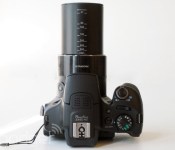
Canon’s most powerful superzoom sports advanced video features, 65x lens

If you need a 21-1365mm focal range in a single permanently affixed lens, man does Canon have the camera for you. The PowerShot SX60 HS, which replaces the SX50, sports a 65x optical zoom with an f/3.4-6.5 maximum aperture range and features to help you track distant subjects when you’re zoomed all the way in. The camera’s Advanced Zoom Framing Assist lets you select how much of a person you want to keep in the frame, and the camera will automatically zoom in and out to maintain that composition. The SX60 has an upgraded 16.1-megapixel 1/2.3-inch CMOS sensor, a DIGIC 6 processor, a 922k-dot viewfinder that flips out, up and forward, along with built-in WiFi and NFC.
The SX60 also packs some sophisticated video capture features, letting you shoot 1080/60p clips with full control over the exposure. There’s an external mic port with manual audio level controls and “silent” focus and zoom adjustments, so you can continue to make tweaks without interrupting recording. For stills, you can shoot up to 6.4 frames per second at full resolution (with fixed focus), and the camera’s zoom memory will bring you back to your previous zoom position after you swap a battery or SD card. Canon’s new flagship superzoom ships next month for $550.
.CPlase_panel display:none;

Panasonic’s ‘connected camera’ pairs an Android smartphone with a one-inch sensor and f/2.8 lens

Compact, point-and-shoot cameras are dying, simply because people would rather use smartphones and tablets to snap their dinner and instantly share them to Instagram. Unfortunately, that’s a segment of the market that Panasonic abandoned (at least in Europe) back in 2013. That left the company without a convincing rival to the Lumia 1020 and Samsung’s various phone / camera hybrids. That’s why the company has now launched the DMC-CM1, a “connected camera” (i.e. a smartphone with a proper lens) that’s capable of taking 20-megapixel stills and record 4K video thanks to a one-inch MOS sensor.
For its part, Panasonic knows that the device won’t beat equivalent smartphones on a spec-for-spec basis. Instead, it wants people to concentrate upon the photographic equipment that’s been crammed into this slender device. Perched atop the aforementioned one-inch sensor is an f/2.8 Leica DC Elmarit lens. The lens is fixed, but works equivalent to a 28mm zoom lens, packing an aperture that’ll run all the way up to f/11. A manual control dial runs around the lens, which you can assign to a function of your choice, lending this an old-school feel. In fact, the CM1 looks like the Lumia 1020 by way of Dieter Rams, all austere chrome with cracked-leather style back, and has a weird retro-futuristic look that’s tremendously attractive.
On the surface of it, it’s no slouch in the phone department either, packing a 4.7-inch full HD touchscreen that’ll offer full manual control of your images. Sandwiched between the frame is a 2.3GHz quad-core Snapdragon 801 with 2GB RAM and Android 4.4. The 16GB of internal storage can also, thankfully, be improved with microSD cards up to 128GB in capacity. Battery-wise, there’s 2,600mAh unit lurking inside the hardware, although we’d be concerned that it won’t hold enough juice to get you through a full day of snappin’ and callin’. If there is one downside, it’s that the CM1 is only earmarked for release in France and Germany of Christmas of this year. Still, we imagine that plenty of camera enthusiasts will be racing to get back in contact with some long-lost Gallic grandmother in the hope of scoring one of these as a present.
Steve Dent contributed to this report.
Filed under: Cameras
.CPlase_panel display:none;
 AIVAnet