


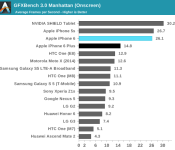
iPhone 6 and 6 Plus Top Most Benchmarks and Battery Tests, While 6 Plus Lags in Graphics
AnandTech spent the weekend benchmarking the iPhone 6 and 6 Plus, comparing the duo to the iPhone 5s and competing Android handsets. The test results show that iPhone 6 and iPhone 6 Plus models are at the top of the charts in CPU benchmarks and battery life, while the iPhone 6 Plus lags in graphics performance due to the larger screen.

In in GPU benchmarks, we generally see a pretty solid lead over the competition for the iPhone 6/A8. It’s seems quite clear that there is a significant impact to GPU performance in the iPhone 6 Plus due to the 2208×1242 resolution that all content is rendered at. It seems that this is necessary though, as the rendering system for iOS cannot easily adapt to arbitrary resolutions and display sizes.
AnandTech also examined battery life, noting that “Apple has managed to do something quite incredible with battery life. ” Even with a smaller 1810 mAh battery, the iPhone 6 manages to beat out the iPhone 5s and most other Android phones on the market. Not surprisingly with its 2910 mAH battery, the iPhone 6 Plus grabs second place behind the Huawei Ascend Mate 2.

Apple introduced the iPhone 6 and 6 Plus during its recent September press event and launched the phones on September 19. The two handsets include Apple’s new A8 processor, M8 motion co-processor, 8-megapixel iSight camera, faster 802.11a/b/g/n/ac Wi‑Fi and NFC. Demand for the two phones was high with Apple selling 10 million iPhone 6 and 6 Plus units in the first weekend of sales.
.CPlase_panel display:none;

Apple’s Ultra-Slim 12-Inch Notebook Rumored to Gain USB Type C and Fanless Internals
 Following a previous report claiming Apple’s much-rumored 12″ ultra-slim notebook is planned to arrive in silver, gold, and space gray color options, Jack March has issued a follow-up report sharing additional details on the machine.
According to March’s report, which MacRumors believes to be based on legitimate information, the new notebook has a much thinner design the appears to sacrifice many of the usual ports seen on Apple’s current notebooks and may adopt the new reversible USB Type C connector that has seen its specifications recently finalized.
A source familiar with Apple’s plans describes the 12 inch Macbook Air as having a noticeably thinner design, the source wouldn’t give dimensions however noted that the thinner design may sacrifice the standard USB port and Apple will move to the reversible USB Type C with this product, It is assumed Apple will include an adapter in the box for backwards compatibility.
Interestingly, the report raises some questions about charging on the notebook, indicating that the usual MagSafe port has been removed in favor of a new, unspecified charging method.
In line with previous rumors, the machine is reportedly fanless, suggesting it will adopt an ultra low-power processor such as the Broadwell-Y Core M processors recently announced by Intel. The body of the new notebook is also said to be narrower than the current MacBook Air, with narrower display bezels and a keyboard stretching right to the edges of the machine. Finally, the speakers are said to be located above the keyboard with visible grilles, unlike the MacBook Air and 13-inch MacBook Pro that have their speakers located underneath the keyboard.
Apple’s 12-inch notebook has been rumored for some time, with the launch perhaps being pushed back due to multiple delays for Intel’s Broadwell chips. March’s previous report indicated Apple appears to be currently looking toward a mid-2015 launch.
(Image: Chassis of current MacBook Air)
.CPlase_panel display:none;

Xprize’s next big challenge: software that lets kids teach themselves

The Xprize organization has inspired people to take on some pretty lofty goals, ranging from sequencing genomes to literal moonshots. Today, though, it’s focusing on a very practical objective: improving education for hundreds of millions of kids. Its new Global Learning Xprize will offer a total of $15 million to teams that build open source, easily scaled software that lets young ones in developing countries teach themselves math, reading and writing. Anyone hoping to join in will have 18 months to craft their tools, which will be tested in at least 100 villages. The top five entrants will get $1 million each, while the winning entry will get a hefty $10 million. It may not be the flashiest competition, but it could go a long, long way toward tackling the chronic shortages of schools and teachers that ultimately hurt kids’ futures.
[Image credit: Saeed Khan/AFP/Getty Images]
Filed under: Software
Source: Xprize
.CPlase_panel display:none;
What you need to know about the robots that feed humanity

In Iowa, there’s a 3,000-acre farm that uses machines to accomplish most tasks, from seeding to fertilizing and chemical application. This land, owned by the Mitchell family, is known as one of the most mechanized farms in the United States, and it’s far from being unique. The Mitchells and their equally high-tech neighbors are some of the top corn producers in the US, thanks to their machines. But more and more farmers in the country are also turning to agricultural robots, as laborers start dwindling in number and demands for crops and produce continue to grow. After all, they need all the help they can get to feed millions of people, since it’s just not feasible to farm by hand anymore as it was a hundred years ago. Seeing as the US population has grown by 22.5 percent between 1990 (253,339,000) and 2010 (310,384,000), and the Census Bureau expects it to balloon to 420,080,587 in 2050, you can expect to see more robots doing the dirty work on more American farms.
The Department of Agricultural and Biological Engineering at the University of Illinois at Urbana-Champaign, divides agricultural robots into three generations. The first gen is comprised of basic ones that can collect data, while the second-gen bots are capable of harvesting, seeding, spraying and cultivating. Finally, the third and most advanced generation is comprised of autonomous robots capable of caring for plants without (or with minimal) human intervention. As you can see below, American farms already use machines from across three generations, though most of the ones that fall under the third are still in development.
CURRENT AND UPCOMING ROBOTS ON AMERICAN FARMS
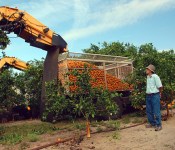
Some of the most well-known farming robots out there are shake-and-catch machines for oranges and other citruses, which literally shake trees side to side and up and down to harvest fruits. Obviously, they can collect fruits more quickly and efficiently than humans can, allowing farmers to plant more trees and increase their output. According to the University of Florida, a particular type of shake-and-catch machine being used to harvest oranges in the state can fill 100 boxes with fruits per hour per crew member. There are apple harvesters currently in development as well, but they’re much harder to design, since apples get bruised and damaged easily.
Earlier this year, a tree nursery in Florida hired a fleet of robots called HV100 (or “Harvey”), designed by Boston firm Harvest Automation. These Wall-E-like robots autonomously space out saplings as they grow bigger and pack them tightly when it’s time to sell them.
Just like Harvey, Blue River Technology’s Lettuce Bot is an automaton, which, as you could guess, can make sure rows upon rows of lettuce are growing perfectly. In 2012, a Lettuce Bot prototype was tested at “the Salad Bowl of the World,” Salinas Valley, where it crawled along rows of green veggies like a strict teacher doing rounds during an exam. The robot analyzes each plant, comparing it against more than a million images of lettuce in its database, to determine whether it’s a weed (or an errant lettuce growing too close to another) that needs to be eliminated. Its creators plan to tweak Lettuce Bot in the future, so it can be used on other crops.
A Minnesota company, on the other hand, spent 14 years developing a tractor that drives itself. It doesn’t use GPS so it can’t navigate streets like Google’s autonomous car can — instead, it responds to ground-based transponders planted around the perimeter of your land. The self-driving vehicle finds its way around the field based on the map it created after you take it around for the first time. To be sure that it doesn’t accidentally go on a rampage, its creators designed it to shut down if a transponder determines that it’s straying from its path. It’s also equipped with radar in order to avoid trees and other objects. The company believes that the tractor has potential to be used for mining and groundskeeping vehicles. There are also many monitoring robots like one San Diego company’s Crop Load estimator, used to estimate the amount of fruits of vegetables that a farmer can expect.
It’s not just fruit and veggie farmers that are going high-tech, though: many American dairy farmers have started using robotic milkers. They actually just set up these milkers on their farm, allowing cows to line up for milking whenever they want. Aside from being able to milk the animals, though, the machines can also monitor how much each cow has eaten, the number of steps she’s taken per day and, of course, the amount and quality of milk being produced.

AERIAL DRONES FOR FARMS OF THE FUTURE
While we always hear about drones being developed for the military and law enforcement, at least one person in the industry believes it has bigger potential in agriculture. Speaking to Wired, Chris Mailey of the drone promotion organization AUVSI, says farming has fewer hurdles to overcome and, at the same time, farmers are motivated by the potential rewards of early adoption.
While the Federal Aviation Administration hasn’t approved drones for farming yet, it’s already begun testing one, (which can not only monitor crops’ condition, but also test soil quality) in North Dakota. Some farmers are already using drones, though, such as this 17-year-old Redditor from Southwest Kansas, who flies a drone from Kansas company AgEagle over his family’s land to take infrared images of their crops and determine their health. His family then uses data gathered from those infrared images to adjust fertilizer distribution, as needed. Most aerial drones for farming have the same function, giving farmers an aerial view of their crops so they can save water, chemicals and fertilizer.
THE FUTURE OF ROBOTIC FARMING
Farm robots are not without fault. The Mitchells and their neighbors machines, for instance, have weakened the soil in the area and made it prone to erosion. Still, there’s no going back now, and you’ll likely see a variety of machines performing different functions on big farms across the globe. The US, in particular, seeks to develop better robots for the country’s farmers: the Department of Agriculture and the National Institute of Food and Agriculture are currently spending the $4.5 million funding they set aside in 2013 to fund various agrobot projects. Long story short, it’s just the beginning for robot-powered agriculture.
[Image credit: University of Florida (orange harvester), Draganfly (drone)]
.CPlase_panel display:none;

StackSocial Universal Lens Kit: 3 smartphone lenses for capturing impressive photos $24.99 [Deal of the Day]

With the wide popularity of photosharing apps like Instagram, folks everywhere are looking for ways to take more artistic photos with their smartphones. While the megapixel counts keep improving, fixed lenses can limit one’s ability to capture a truly stunning image.
Enter the StackSocial Universal Lens Kit which unlocks new possibilities for composing shots thanks to three different focal options. Compatible with most Android devices, this set improves shot versatility in a lightweight and portable solution. Featuring a wide-angle, macro, and fisheye lens, you’ll be able to pull off almost any look you have in mind. Attaching easily via magnet, installation and removal are extremely simple.
For just $24.99, this is a great opportunity for aspiring shutterbugs to really dial in their vision.
Check this deal out, and many others at deals.androidguys.com!
Deals, Discounts, Freebies, and More! Click here to save today!
The post StackSocial Universal Lens Kit: 3 smartphone lenses for capturing impressive photos $24.99 [Deal of the Day] appeared first on AndroidGuys.
.CPlase_panel display:none;

Apple sees 10 million iPhone 6 and 6 Plus sales in three days

The new iPhones have been on sale for three days, which means it’s time for Apple to announce how many devices it sold. Considering that the iPhone 5 hit five million sales in the same period, and the 5S and 5C earned nine million sales, it’s no surprise to see that both new devices raked in a record 10 million, even without the help of China. For now, the devices are only available in 10 countries, including the US, Canada and the UK, but the company promises that 20 more countries will have units available to sell by September 26th. Unfortunately, Apple neglected to mention how many people plumped for the 6 or its bigger sibling, but that’s hardly going to matter when Tim Cook wakes up and looks at the company’s bank balance.
Filed under: Cellphones, Mobile, Apple
Source: Apple (Businesswire)
.CPlase_panel display:none;

LG’s Wine Smart is an Android flip phone for the messaging elderly

Friends (“The One Where the Monkey Gets Away”) is on TV, Alanis Morissette is angrily screaming “You oughta know” on the radio, your bff messages you on WhatsApp. What’s this misfit in this picture? Nothing if you’re rocking LG’s Wine Smart — a rare smartphone flip phone. Nostalgia from the 90s (or, really, 2007) aside, the Wine Smart isn’t all that unusual. Flip phones are still popular in certain markets, and why wouldn’t you want one with the latest version of Android, a 1.2GHz processor, 8-megapixel camera and expandable memory? Well, that’s exactly what the Wine smart has, although if you were hoping LG’s 2K display might filter down from the G3, you’d be fresh outta luck (3.5-inch, 480 x 320 is what you’ll have to settle for). The inclusion of a “safe keeper” function that alerts friends or family if you fall suggest this is pitched at an older crowd. But, then there’s a dedicated button for a instant messaging app, too. We’re sure LG knows its market though, so who are we to question? Oh, there’s an FM radio too. Perfect for that Morissette revival, whenever and wherever LG decides to release it.
Filed under: Cellphones, Mobile, LG
Via: Android Community
Source: LG
.CPlase_panel display:none;

iPhone 6 and iPhone 6 Plus Sales Top Ten Million in Launch Weekend
Apple today announced that opening weekend sales of the 4.7-inch iPhone 6 and the 5.5-inch iPhone 6 Plus topped ten million units, breaking the previous record of nine million units set by the iPhone 5s and iPhone 5c last year.

“Sales for iPhone 6 and iPhone 6 Plus exceeded our expectations for the launch weekend, and we couldn’t be happier,” said Tim Cook, Apple’s CEO. “We would like to thank all of our customers for making this our best launch ever, shattering all previous sell-through records by a large margin.
As with previous years, the company also claims that demand for the iPhone 6 and iPhone 6 Plus has been very high, as more orders will be fulfilled over the coming weeks. Apple announced last Monday that it processed four million first-day pre-orders on September 12.
Currently, shipping estimates for new iPhone 6 orders remains at 7-10 business days, while the iPhone 6 Plus is still showing a shipping delay of 3-4 weeks. The iPhone 6 and iPhone 6 Plus will also be available in 20 more countries including Austria, Belgium, Finland, Ireland, Italy, Netherlands, New Zealand, Norway, Portugal, Russia, Spain, Sweden, Switzerland, Taiwan, Turkey, United Arab Emirates, and more on September 26.
.CPlase_panel display:none;
IKEA’s taking its low cost solar panels to eight more countries

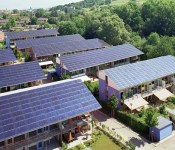
Remember when IKEA started selling solar panels in the UK despite its famous lack of sunshine? It must have been successful, because company CEO Peter Agnefjäll has just pledged that eight more nations will get the service in the next 18 months. First up is the Netherlands, which will begin offering the gear on October 28th, while Swiss stores will launch just before Christmas. The company’s remaining tight-lipped on the other six locations, but we’d imagine the bulk of them will be in neighboring European countries. At the same time, Agnefjäll also pledged that, by 2020, all of IKEA’s plastic products will be sourced from recycled plastic or renewable materials as part of a pledge to save 700,000 tons of CO2 each year. Clearly someone’s been listening to those clever folks down at the UN.
Filed under: Misc
.CPlase_panel display:none;

NASA’s MAVEN probe arrives in orbit around Mars

Whenever NASA achieves something, row after row of neatly-dressed mission controllers all begin whooping and clapping. The reason for today’s jubilation is the news that, after nearly a year, the Mars Atmosphere and Volatile Evolution probe has successfully entered orbit around the red planet. MAVEN began its tour of duty at 10:24pm EDT Sunday night, and after a six-week test phase, will analyze the upper atmosphere of Mars in an attempt to understand how its climate has influenced the surface below. In addition, the information will help other white shirt-and-pocket-protector-wearing analysts to determine if, when, and how best to send a manned mission to Mars in the 2030s. You never know, maybe MAVEN will be able to find some Methane in the atmosphere and make David Bowie very happy.
[Image Credit: NASA / Goddard Space Flight Center]
Filed under: Transportation, Science, Alt
Via: Ars Technica
Source: NASA
.CPlase_panel display:none;
 AIVAnet
