


Apple Rolls Out Refreshed iTunes Connect Web Portal for Developers [iOS Blog]
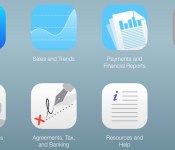
Apple late yesterday rolled out its overhauled iTunes Connect web portal with a new visual design and improved features to help developers manage the sales and marketing of their apps, books and other media. Apple first introduced the new iTunes Connect at WWDC 2014 and is rolling out the interface ahead of the expected fall launch of iOS 8.

The web-based tool has an iOS 7-inspired flat design that is similar to iCloud.com and brings the site in line with the iTunes Connect iOS app [Direct Link], which was updated earlier this year.
Besides visual changes, the latest version of the web portal also includes an improved My Apps management section and a “Resources and Help” tab for troubleshooting media distribution and payment issues. The “Users and Roles” section also was updated to make it easier to manage both iTunes Connect and Sandbox users. Developers and other media producers can check out the changes at the iTunes Connect website.
.CPlase_panel display:none;
Apple’s TestFlight Beta Testing Service Gearing Up Alongside iTunes Connect Revamp [iOS Blog]
Earlier this year, Apple acquired Burstly, the company behind the popular TestFlight service for managing beta testing of iOS apps, and at WWDC in June Apple announced it would be relaunching TestFlight with iOS 8 as an integrated service for developers and testers.
With the redesigned iTunes Connect web portal launching yesterday, the service is now including references to TestFlight and the company has made public a link to a universal iOS app [App Store] to allow users to install beta apps.
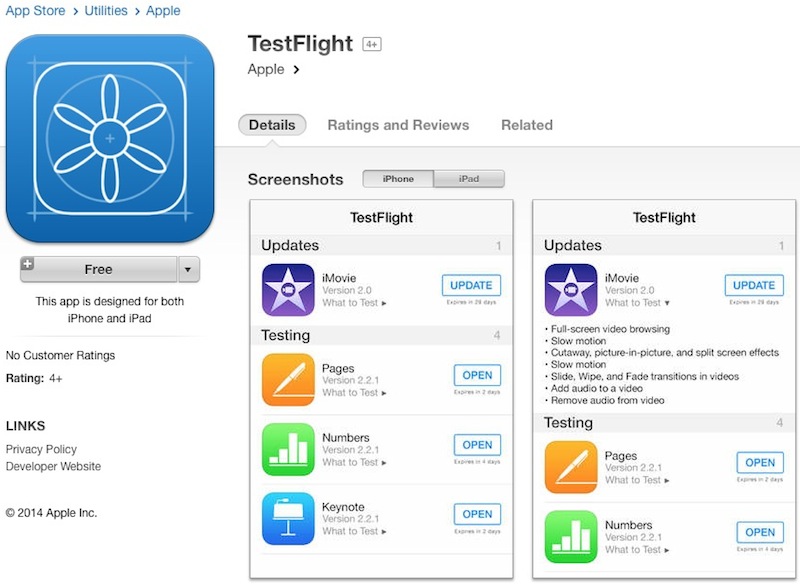
TestFlight allows app developers to invite you to beta test their apps on your iPhone, iPad, or iPod touch. Once you join a developer’s beta test through their email invitation, TestFlight makes it easy to install or update to new bet versions as they become available.
Beta testing apps has never been easier
– To receive your beta test invitation, all an app developer needs is your email address
– You will receive beta invitations in your inbox
– Accept the invitation to open TestFlight and install the app
– TestFlight will then notify you when new versions are available
– Tap to upgrade to the latest version and keep testing
The app requires iOS 8, and Apple will likely make a more thorough unveiling at next week’s media event where it will announce the public launch date for iOS 8.
.CPlase_panel display:none;
Speakasy? Personal? T-Mobile plays it coy for Un-carrier 7.0 event

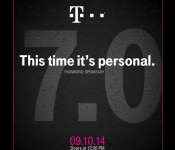
T-Mobile has scheduled its next Un-carrier event for Wednesday, September 7 where it plans to announce, well, something. It’s not clear what we might get out of T-Mobile and its promise of “This time it’s personal.” Factor in a password of “Speakeasy” and we might assume some sort of custom-picked plan, options, or rate choices. Of course, that’s pretty vague for us to even type, let alone imagine.
John Legere and the T-Mobile team invite you to join us in San Francisco on Wednesday, September 10 at the T-Mobile store at…
We’re anxious to see what merits a standalone event just so quickly after rolling out some new initiatives over the last few weeks. Just recently we saw them add new streaming music service providers to the list of Music Freedom and more data for its Simple Starter option. What could be so big that it would call for more than another press release? Thoughts? Sound off below if you’ve got an idea.
The post Speakasy? Personal? T-Mobile plays it coy for Un-carrier 7.0 event appeared first on AndroidGuys.
.CPlase_panel display:none;

Barclays wants you to give it the finger instead of a PIN

PINs, passwords and authentication codes: they’re a troublesome security solution that we’d love to see the back of. The bankers at Barclays know this, so they’ve looked to biometrics in a bid to banish them forever. Today, the company announced that it’s teaming up with Hitachi to launch a new fingerprint reader capable of scanning and recognising the unique vein patterns a customer’s hand. It’ll let you scan your finger to quickly access your online bank accounts and authorise payments, reducing fraud in the process. Hitachi’s Finger Vein Authentication Technology does the hard work and is said to be significantly harder to spoof because it’ll only work if the scanned finger is “attached to a live human body” (no finger-lopping movie plotlines happening here). Barclays’ Biometric Reader will roll out first to business account holders from next year, but staff at UK branches may ask you to put your best finger forward in the very near future.
Filed under: Internet, Software
Source: Barclays
.CPlase_panel display:none;
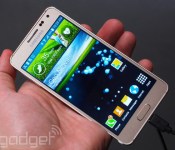
The Samsung Galaxy Alpha is smaller, lighter and more elegant than the GS5

With a 4.7-inch 720p display, 6.7mm profile, 115g (4.06 ounce) weight and aforementioned design language, the Alpha is tight, light, slim and classy. Since it’s a little smaller than most modern-day flagships and comes with straight sides and chamfered edges, it’s very easy to hold onto without losing my grip or feeling uncomfortable. The sides are also mostly flat until they approach the corners, where they curve slightly outward.
Despite the new design, the removable back still looks more like the Galaxy S5 than the Note 4; the latter has more of a leather-like appearance, whereas the Alpha’s polycarbonate back uses a series of very tiny divots. The back itself is flat except where it slopes inward toward the edges. The phone will come in five different colors, and some definitely look better than others; this is one of those times in which the gold version actually looks a little better than the black one, since some of the front and back colors blend better with the sides than others do. The 12MP camera (not quite as high quality as the GS5 or Note 4) sits in the top middle, with an LED flash and heart rate monitor module to its left.
With a smaller screen, the lower-resolution display is completely fine; everything looked crisp and sharp. It also comes with the same fingerprint scanner as the flagship phones. The only thing that truly concerns me with the Alpha right now is the 1,860mAh battery, which is quite limited for today’s standards (its battery is significantly smaller than the GS5’s). It also doesn’t come with external memory, so the 32GB internal storage will have to do.

The Alpha will come in two versions, much like many of Samsung’s other phones: An octacore Exynos 5-powered option, which comes with four 1.8GHz Cortex-A15 cores for higher performance and four 1.3GHz Cortex-A7 cores for smaller tasks, and a 2.5GHz quad-core Snapdragon 801 version. Both options will come with 2GB RAM. Samsung uses this two-model setup often, in which the Exynos model is typically sold in Korea and other select countries, while the Snapdragon model goes to the remaining regions like the US and Europe.
With a few exceptions, the Alpha seems to look like another Galaxy S5 mini of sorts, but with better specs and more elegant design. While Samsung is still keeping quiet on pricing — it’ll likely be dictated by region and carrier — it’ll likely be higher-priced than many of its competitors. If it manages to be competitively priced, however, the Alpha could easily become a hit among shoppers who want something more on the classy side without getting a monster-sized phone.
Photos and video by Zach Honig.
Filed under: Cellphones, Wireless, Mobile, Samsung, Google
.CPlase_panel display:none;

Rebecca Minkoff’s smart bracelets place emphasis on style and luxury

Some fashionistas wouldn’t be caught dead wearing certain smartwatches, okay? That’s why you see all these fancy wearables pop up these days, including a handful of new offerings from American designer Rebecca Minkoff. Her collection’s comprised of two high-tech, high-fashion bracelets like Intel’s MICA, as well as a golden phone charger, made in collaboration with luxury phone casing maker Case-Mate. Each bracelet has its own function, so it wouldn’t be redundant to wear them both: the $120 gold chain-linked one connects to your phone via Bluetooth and alerts you of calls and texts from chosen contacts. The $60 studded leather bracelet, on the other hand, transforms into a lightning cable that connects to a USB cable for times when you badly need to charge.
Minkoff’s the latest designer to cross over to tech from the fashion industry, following in the footsteps of Diane Von Furstenberg who designed stylish frames for Google Glass, Tory Burch who teamed up with Fitbit to create a special Flex tracker, and Ralph Lauren who recently launched a smart shirt for athletes. We’ll likely hear more about these bracelets when Minkoff launches them today at New York Fashion Week, though they seem pretty straightforward, so it may be best not to expect more features.
Filed under: Wearables, Mobile
Via: Stylelist
Source: Rebecca Minkoff
.CPlase_panel display:none;

AT&T’s connected car tech can now give you weather, radio and parking help

If you’re frustrated that many cars still don’t have internet-savvy software built-in, take heart: AT&T just gave its Drive connected car platform a big boost with the addition of six big-name apps. Automakers who put Drive in their infotainment systems can now easily give you forecasts on the road through AccuWeather, as well as customized listening through iHeartRadio, Stitcher or Tribune’s Newsbeat. You can also share your whereabouts through Glympse, and find that all-important parking spot using Streetline’s Parker. You’ll have to wait for manufacturers to roll these apps into their vehicles before you see the benefit, but don’t be surprised if your next ride is that much smarter.
Filed under: Transportation, Wireless, AT&T
Source: AT&T
.CPlase_panel display:none;
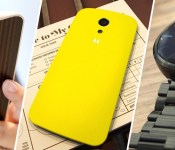
Hello Moto: when are Motorola’s new products coming to the UK?

Like many other phone makers at IFA this week, Motorola has shown its hand, introducing a new flagship and a revamped version of its highly-rated budget smartphone. It’s even told us when its circular smartwatch will go on sale. It’s unleashed the Moto X, Moto G and Moto 360 on the world, but when are they coming to the UK and how much will they cost? Let us explain.
Moto X

Yup, the Moto X is back. It has the same name, but don’t worry, things have upscaled quite a bit. With a 1080p 5.2-inch AMOLED display, it’s ever-so-slightly bigger than its predecessor, and it’s a little weightier too. Inside you’ll find Qualcomm’s Snapdragon 801 processor with a 2.5GHz quad-core CPU, an Adreno 330 578MHz GPU and 2GB of RAM. There’s also a 13-megapixel camera (up from the 10-megapixel sensor in the older model) and it’s powered by a 2,300 mAh battery. While it runs Android 4.4 KitKat now, expect an Android L upgrade in the very near future.
Although Motorola is now owned by Lenovo, the popular Moto Maker customization service is important to its new owner as it was to Google. It’s back and there’s an added bonus: it’s also coming to the UK. That’s right, you’ll now be able personalise your Moto X with a bespoke design and even deck it out in leather (if that’s what excites you).
Whether you buy a ready-made 16GB Moto X from Amazon or design your own using Moto Maker, the phone will cost £419.99 when it goes on sale at the end of September. If you’re looking to ramp up the quality, however, both the wood and leather options will set you back a little extra, meaning you’ll pay £439.99 for your unlocked handset. The same can be said of the 32GB model, which starts at £459.99 and rises to £479.99 if you want that premium feel.
Moto G

Like the X, Motorola has also decided to stick to what it knows with the new Moto G. Given that it’s Motorola’s best-selling smartphone of all time, there’s no reason to mess with success. Again, the company has decided to improve things a little, first by equipping the G with a bigger 5-inch 720 HD IPS display. That helps make it a touch bigger and heavier than its older sibling.
While it features the same 1.2GHz Snapdragon 400 processor, Motorola has upgraded the G’s sound output by including two front stereo speakers (up from the one rear-mounted speaker on the original) and enhanced it’s photo-taking abilities with an 8-megapixel rear camera and a 2-megapixel front-facer. As before, it’ll come with 8GB or 16GB of internal storage and let you add more with its expandable memory slot.
With more new than old, it’s reassuring to see that the new Moto G isn’t going to cost much more than the original. Amazon will sell it to you for a tenner extra from today (although we’re not seeing it yet), pricing it at £144.99. While you won’t enjoy the delights of Moto Maker with the G, Motorola’s coloured shells will be available and go on sale from October.
Moto 360

While we’ve got our hands on the Moto 360 before, Motorola kept specifics like release dates and pricing under wraps. We now know that the circular smartwatch will go on sale at O2, Tesco, Amazon and John Lewis from “early October,” starting at £199. It’ll ship with grey leather and black leather straps initially, but Motorola has said it will offer sleeker silver and black metallic options later this autumn.
Moto Hint

Motorola’s new stylish Bluetooth headset is designed to be discrete as possible. It’s so discrete that it’s not even got a UK release date or price yet. While we hunt for more details, here’s a photo of the Moto Hint to keep you entertained.
Steve Dent contributed to this article.
Filed under: Cellphones, Wearables, Software, Mobile
.CPlase_panel display:none;

Chrome on Android is the latest Google app to get a cleaner, flatter look

Google’s “Material Design” was a major part of this year’s I/O conference and now it’s rolling out to an Android app you probably use a lot more than the Play Store: Chrome. The browser’s stable version is the latest recipient of the not-quite-flat façade and fancy animations. Lest you think the mobile web-surfing tool’s new tricks are only skin deep, however, Mountain View has added a bit more functionality, surely. Signing into the application with your Google account now logs you into the search giant’s websites, like Groups, as well. It’s pretty easy to see where Page and co. see the hierarchy of importance for their apps, given the sequence of what’s getting the Material Design threads and when. Should Gmail be next in line, it likely wouldn’t surprise too many people. The odds of Google Voice getting these new duds anytime soon? Slim — but that’s just a guess.
Filed under: Cellphones, Tablets, Internet, Mobile, Google
Source: Google Play
.CPlase_panel display:none;

Philips’ new curved TV and 4K media player run on Android

Philips has just revealed a new lineup of 4K TVs, along with a way to actually play something on them. The standout model is the 55-inch curved Philips 8900 model that brings Smart TV features via Android. That gives access to the Google Play Store for apps, games and content and an interface that smartphone users may find less miserable more comfortable. The set itself uses Philips’ three-sided Ambilight and micro dimming to adapt the viewing experience to your room, along with a 1,000 Hz refresh rate, high-quality upscaling and a curved “ribbon” stand. Unlike Samsung and others, Philips didn’t explain exactly why it thought a curved screen was a good thing, other than hyping its “striking appearance” (hey, at least they’re honest).

Philips (or rather TP Vision, the awkwardly-named company that markets Philips TVs) also showed off the Philips 9100, a flat, high-end model UltraHD TV in 55- and 65-inch sizes. It also gets Smart TV functions powered by Android, and the 1,000 Hz refresh rate, upscaling, and four-sided Ambilight glow. But the model’s piece de resistance is Spotify integration, letting you control music with your smartphone, without actually tying it up for streaming. Unlike the curved model, it also ships with a 50 watt subwoofer.
For the budget set, TP Vision launched the Philips 7900 UltraHD TVs in 49- and 55-inch sizes. Those models are also powered by Android, but have knocked-down specs like two-sided Ambilight only (instead of four-sided), and 600Hz refresh rates — two features that purists won’t care about anyway. Like the rest of the models, the 7900 also sports minimal bezels.

Finally, if you’re tired of upscaling HD content, TP Vision also announced the Philips Media Player UHD 880, joining Samsung, Sony and a few others with such a box. It’ll work with all the new Philips models as well as those from 2013 and use a new HEVC streaming format (aka H.265), the standard used by video services like Netflix. The UHD 880 will be powered by Google’s upcoming Android L OS, giving users the store, apps and games that also come on the TVs. Other features include WiFi, ethernet, USB and HDMI 2.0. It’ll run 249 euros when it arrives in Europe early next year, but if you bought an 8000- or 9000-series model like the first two above, Philips will throw it in for free. Meanwhile, all three new 4K model lines will arrive to Europe in Russia sometime this quarter, but there’s no word yet on pricing.
Filed under: Home Entertainment, HD
.CPlase_panel display:none;
 AIVAnet