



How would you change Sony’s VAIO Fit 15?

Welcome to How Would You Change, where we ask you to join our forum and talk about what you’d change about a product that has been out on the market for a while. This week, it’s Sony’s VAIO Fit 15. When we reviewed it, the general consensus was that the unit kicked off back-to-school season on a strong note. Sony’s commitment to not scrimping on specs by including high-res screens and backlit keyboards earned high praise, and in fact the overall experience was generally better. In the demerits column was simply the fact that the battery life could have been longer and some wonky build quality issues. The question, therefore, is did your experience mirror ours? Use your indoor voice, please.
http://www.engadget.com/2013/05/07/sony-vaio-fit-15-review-2013/
(BU http://www.engadget.com/2013/05/14/sony-xperia-sp-review/)
Filed under: Laptops
Source: Engadget Product Forums
.CPlase_panel display:none;

Sprint boosts rural LTE coverage by teaming up with regional carriers

Your Sprint phone might start performing better than usual in certain rural areas, thanks to the new LTE roaming deals the company just closed with 15 regional carriers. These partnerships fall under the Now Network’s rural roaming program, which allow you to tap into the regional carriers’ mobile internet connections when you happen to wander into their territories. The program’s meant to aid the carrier in competing against Verizon and AT&T, as its current coverage areas are usually confined to urban locations. Even getting unlimited everything for $60 wouldn’t be enough to convert people who travel a lot, you know — or to entice old customers who suffered from extensive service disruption to come back. There are 27 regional carriers in the list from 27 states at the moment (Sprint partnered up with the first 12 in June), including the new ones listed after the break.
- Bluegrass Cellular, serving Kentucky
- Blue Wireless, serving New York and Pennsylvania
- Pine Belt Wireless, serving Alabama
- Pioneer Cellular, serving Oklahoma and Kansas
- Public Service Wireless, serving Alabama and Georgia
- Syringa Wireless, serving Idaho
- Rural Independent Network Alliance (RINA) members and their partners:
– STRATA Networks, serving Utah, Wyoming and Colorado
– Silver Star Wireless, serving Wyoming and Idaho
– All West Wireless Inc., serving Wyoming and Utah
– NNTC, serving Colorado
– Snake River Personal Communications Service, serving Oregon
– CTC Telecom Inc., serving Idaho
– South Central Communications Inc., serving Utah
– Custer Telephone Wireless, serving Idaho
– Breakaway Wireless, serving Utah
.CPlase_panel display:none;
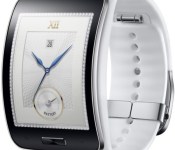
Samsung posts infographic of the Samsung Gear family
 Samsung looks like they are in a very ‘infographic’ mood. After posting an infographic of the Galaxy Note series over the years, Samsung has come out with another infographic of the Samsung Gear family, showing its full range of wearable devices, from the aging – but still supported – Galaxy Gear, the Gear 2, Gear 2 Neo, Gear Fit, Gear Live, right through to the brand-new Gear S announced just before IFA 2014. Check out the infographic below; be sure to click the thumbnail to view the full sized image:

It’s clear that Samsung is fully committed to the wearable craze, particularly with their efforts to update their seemingly abandoned Galaxy Gear with Tizen, their operating system baby. In fact, apart from the Gear Live smartwatch which runs Android Wear, all of Samsung’s Gear devices run on Tizen; it’s no wonder that Google has been annoyed at Samsung for investing far more effort into creating Tizen wearables rather than Android Wear wearables. Only time will tell whether Samsung has the better strategy or not, but with the influx of Android Wear smartwatches released at IFA 2014, it’s hard to imagine even Samsung triumphing in this space.
What do you think about this infographic of the Samsung Gear family? What are your thoughts on Samsung’s wearables? Let us know your opinion in the comments below.
Source: Samsung Tomorrow
//<![CDATA[
ord = window.ord || Math.floor(Math.random()*1E16);
document.write('‘);
//]]>
The post Samsung posts infographic of the Samsung Gear family appeared first on AndroidSPIN.
.CPlase_panel display:none;

T-Mobile sues Huawei for stealing parts from its phone testing robots

Cellular providers and phone makers don’t always have the best relationships, but things are getting particularly sour between T-Mobile USA and Huawei. The UnCarrier is suing Huawei for trying not just to copy its phone testing robot technology, but to steal it. The phone maker’s staffers reportedly took illegal photos of the testing gear, and then swiped components; they even tried to break in when banned from the premises. T-Mobile insists that it spent “tens of millions” of dollars to switch to other phones as part of the breaches, and that Huawei may have earned “hundreds of millions” in ill-gotten profit.
You would expect many companies to fight such allegations tooth and nail, but Huawei isn’t. It agrees that there’s at least some merit to claims that its workers were “acting inappropriately,” and notes that the employees involved were fired. While it’s planning to protect itself in court, it “respects” T-Mobile’s right to sue over the thefts and plans to cooperate. Those kind words probably aren’t going to placate Magenta’s lawyers, but they suggest that the two telecom giants won’t be fighting to the bitter end.
Filed under: Cellphones, Robots, Wireless, Mobile, T-Mobile
Via: TmoNews
Source: Seattle Times
.CPlase_panel display:none;
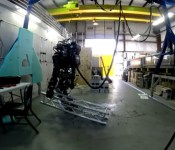
Watch MIT’s Atlas humanoid robot drag a metal pillar like it’s nothing

We’re interrupting your regularly scheduled programming full of cute, service robots to bring you the latest update on Boston Dynamics’ terrifying humanoid machine: Atlas. A group of MIT researchers have been working to refine their Atlas unit’s capabilities since 2013 for DARPA’s Robotics Challenge. The result? They’ve managed to program the machine to carry objects of different weights in each hand, making it more effective for real-life applications, like construction or clearing debris during times of disaster. You’ll see what we’re talking about when you watch the video below, showing Atlas lugging an aluminum pillar with one hand.
Via: IEEE, TechCrunch
Source: MIT DRC
.CPlase_panel display:none;

Robin Williams gets the World of Warcraft tribute gamers asked for

Blizzard promised gamers a tribute to the late, great Robin Williams in one of his favorite titles, World of Warcraft, and it looks like the studio has been quick to act on its word. Just days after Wowhead found hidden character code paying homage to the actor, that persona is live in the game. If you’re in the Warlords of Draenor expansion’s beta, you can visit an island with a familiar-looking lamp; rub it and a genie pops out flaunting his “infinite cosmic power,” directly referencing Williams’ beloved role in Aladdin.
That’ s not the only nod to Williams’ legacy, either. You’ll also find a broken egg with machinery inside (an allusion to Mork and Mindy), and there may be subtler odes to both Mrs. Doubtfire and Toys. The in-game memorial won’t be available to everyone until Draenor officially launches on November 13th, but you can get a peek at it right now through the video below.
[Image credit: Haldhur, Wowhead]
Filed under: Gaming
Via: Washington Post
Source: Wowhead, WoW Insider
.CPlase_panel display:none;

GM looks back to the future for new Cadillacs that (almost) drive themselves

We’ve talked a lot about autonomous driving developments like Google’s self-driving car, but today in Detroit GM CEO Mary Barra is announcing her company’s push to put similar technology in cars we can actually buy. Two years from now, Cadillac will launch an all-new car with its “Super Cruise” technology that not only holds your speed, but uses sensors to keep it in the middle of the lane, and can brake if necessary. We’ve ridden in a demo vehicle that could even steer to avoid obstacles, but what’s coming is more limited (likely because of legal and insurance questions that have yet to be answered), and says it will provide comfort to “an attentive driver” — hopefully with enough leeway for us to snap an in-traffic selfie or two.
GM’s other big news is that the 2017 Cadillac CTS is the first one announced with “vehicle to vehicle” (V2V) technology to go along with its 4G LTE data connection. That means it can send and receive info from other cars or sensors mounted along the road to notify the driver of events that they might not be able to see (a car that suddenly brakes three cars ahead, or if one detects hazards like a pothole or black ice). Meanwhile, across the Metro Detroit area several highways will be equipped with cameras and sensors to collect data that’s sent directly to V2V and vehicle to infrastructure (V2I) cars. The Michigan Department of Transportation is working with the University of Michigan, GM and Ford to roll out the tech along 120 miles of roads (I-96 from Brighton to St. Clair Shores, I-94 from Port Huron to Ann Arbor and US-23 from Ann Arbor to I-96), with a goal of “zero deaths on the road system,” according to State Transportation Director Kirk Steudle.

So how does it all work? GM says its vehicle to vehicle tech sends out information like “here I am, here’s how fast I am going” 10 times per second on the 5.9GHz wireless band. The car that receives the information can then use its safety tech like active collision warning or just alert the driver to what’s going on. Before it debuts though, the National Highway Traffic Safety Administration (NHTSA) will need to finalize the protocol so that the different automakers are all on the same page, and a standard for security protections will need to be laid out.
For Super Cruise, there are still more questions than answers. The demo we experienced last year (similar to Autoblog’s video, embedded above) was impressive, but actually rolling it out faces a number of hurdles. For now, GM is compromising by limiting it to certain locations (closed access roads, i.e. highways, where you won’t regularly encounter pedestrians, cyclists or other elements), and on what it can do. It can keep the car in the lane, driving at a preset speed while responding to changes in traffic, and it will let the driver take their hands off of the wheel and feet off of the pedals, but it’s not clear for how long. Right now, that makes it work well for handling your road trip through the boonies, or when you’re busy yelling at the other drivers in a bumper-to-bumper traffic jam. In her speech, Barra will namecheck the “Boss” autonomous Chevy Tahoe that GM and Carnegie Mellon developed to win the DARPA Urban Challenge in ’07, but says that developing a fully automated vehicle may take until the next decade. Super Cruise

[Image credit: Associated Press]
It will still require an attentive driver, although right now it’s not clear exactly what that means. The car could use eye- or head-tracking tech to make sure the driver is paying attention, and a recent rumor from Financial Times tied the company to an Australian group, Seeing Machines, that does just that. So which car will be the one to debut Super Cruise? GM isn’t giving any hints, but rumors have pointed to a new flagship full-size rear wheel drive model on the way called the LTS. It could be based on the Elmiraj coupe concept GM showed off in 2013 (above), and would be perfect to introduce the new technology. Other possibilities include crossover vehicles bigger or smaller than the current SRX, or an entry-level sedan that competes with the Audi A3 or Mercedes-Benz CLA that appeals to younger drivers.

GM CEO Mary Barra has a tough road ahead to recover from the embarrassing and dangerous ignition switch problems which recently came to light, and focusing on new tech could help do that. GM’s referencing its long history of working on intelligent and connected cars, reaching back to the 1956 Firebird II concept that dreamed of a car that connected to the road with a metal strip, drove itself, and had a communication system to talk to other cars or just watch TV. This week at the ITS World Conference in Detroit we’ll see demonstrations of connected and autonomous cars from a number of automakers, with GM bringing a self-driving version of its EN-V 2.0 electric car and an Opel Insignia concept that can drive itself at low speeds, through the city, or on highways.
Filed under: Transportation
.CPlase_panel display:none;

Apple Rolling Out New iBeacon Transmitters, NFC Readers to Apple Stores and Disney Stores
 Apple is rolling out near field communication (NFC) readers and updated versions of its iBeacon transmitters to its own stores and Disney Stores ahead of the launch of its mobile payments service and the iPhone 6, reports 9to5Mac.
The company will begin integrating new proximity beacons made by Gimbal that will provide more accurate iBeacon location tracking in its own stores, and roll out new payment systems to support the NFC capabilities on the iPhone 6 and its highly-anticipated wearable device.
The report also notes that Apple may be planning to roll out its own first-party iBeacon sensors in its retail locations, and could also provide or sell the transmitters to other retailers as an incentive to sign up for its new mobile payments service. An FCC filing earlier this year revealed that Apple was developing its own first-party iBeacon hardware, which may end up being the new hardware discussed in this latest report.
Disney’s retail stores are also said to be receiving new credit card machines that support NFC, which will also likely integrate with Apple’s new mobile payment service. Reports from this past week have also indicated that Apple will be partnering with a number of other retailers for the service, including Walgreens, CVS, Nordstrom and more.
Apple has also established deals with major credit companies such as Visa, MasterCard, American Express, and credit card issuers to support its mobile payments service.
Apple will likely unveil its mobile payments service on Tuesday, along with the new iPhone 6 and its highly-rumored wearable device. Apple’s media event kicks off at 10:00 AM Pacific Time, and MacRumors will have full coverage as the event unfolds.
.CPlase_panel display:none;
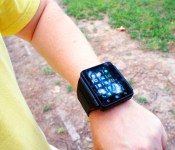
Here’s what it’s like to use a watch as a phone

No one wants the smartwatch category to succeed more than I do. As a kid, I dreamed of enjoying TV on my watch, or video calling “HQ” (or more likely, my mum), just like Penny in Inspector Gadget. Most smartwatches offer a taste of this experience, but not the whole enchilada. Enter Neptune Pine. It’s a smartwatch by the loosest definition: it’s a small Android phone in a wrist-strap. Whatever you want to call it, it’ll do both of the above things, and more. It’s also a genuine Kickstarter success story — like, one, where the product came out and everything! It might not be the first smartwatch/phone mash-up, and it’s (definitely) not the last. But, it’s one of the more ambitious takes on the idea I’ve seen. I spent seven days with it (and no other phone) to see how my dream stands up to the reality — and whether a watch could ever replace your trusty mobile. The galleries tell much of the story, so be sure to jump in when you see them.

I’m not joking when I say it’s a small phone. It has a 2.4-inch (320 x 240) display, has a micro-SIM slot, runs Android (JellyBean), comes with 512MB of RAM (plus 16- or 32GB of storage) has front and rear cameras and, well, pretty much everything you’d expect from a phone (GPS, apps, headphone jack etcetera). It’s a chunky device — pretty much what you’d expect a wrist-phone to look like. It’s also undoubtedly bigger than any watch I have ever used. By some margin. Dive in to the gallery to see for yourself.

If the form factor isn’t an issue for you (the strap comes with two choices: like it, or lump it), there’s the software to consider. Most smartwatches come with a custom user interface (until Android Wear showed up). Neptune’s plumped for stock Android, just as you already know it. While the screen size is uncommon these days, the resolution isn’t wacky (HTC’s Wildfire, for example, was/is 320 x 240), so theoretically most apps should work. How well is something of a case by case journey of discovery. But, if you’re wondering what Facebooking, tweeting or dialling a number from your wrist would be like, you’ll see in the gallery below. In short, with a bit of work, the Pine can feel just like your a regular Android. But, not without some important caveats. This raises the question: If a proprietary interface can’t win people over, and stock Android has challenges, where to do watch-phones go from here?
Let’s tackle the (other) elephant in the room. The biggest barrier for wearables is how they look and feel — a nut that’s yet to be cracked, despite best efforts. This shouldn’t be a surprise though, given that, well, you’re wearing these things. The Neptune Pine is big, chunky, and a bit uncomfortable if worn for long periods. It also has no style customization options (at time of writing), and, well, it’s fairly ugly. Like babies, though, some parents (owners) will love it regardless — but it’s definitely high on the dorky scale. I’m okay with it, but others, many others, won’t be. Of course, that might not be a problem if the user experience is delightful. Sadly, that’s not quite how I’d describe it. The lack of Google services/Play store out of the box means it requires some noodling to get it just how you want it. For those mainstream consumers who could see past the exterior, the Play hurdle is likely enough to turn them off. Then there are the small idiosyncrasies, like having to take it out of the strap (which can be a clumsy task) if you want to take a picture — so no impulse snaps we’re afraid.
The minor gripes continue. The headphone experience is only worth thinking about if you’re using a Bluetooth set. I think it’s nice to have the option of a 3.5mm line out for a number of reasons, but practical headphone use isn’t one of them. Put on some headphones now, and tuck the cable under a watch — you’ll soon see what I mean. More pressing (no pun intended), are the issues with the display. The touch detection is frustrating. Typing is possible, but quite often it can feel like you’re drunk, as you mash the tiny keys and the wrong letters or options respond. It’s serviceable, but it’s not perfect — SwiftKey works, and improves the experience somewhat. But input is a fundamental that companies will need to figure out. It can also be a little uncomfortable holding your wrist in the right position for typing/watching video. This is exacerbated by the fact the Pine’s screen has fairly poor viewing angles. Worse, is that if worn on the left wrist (for most right-handers), it’s that angle you’ll be viewing from that suffers most. The last of the bad news is that the battery life is just okay enough to see you through a day. But it’s usually a close call. Displays, input and battery-life: none of them new challenges for smartwatches.

There are positives though. Using apps like Skype, maps, and fitness loggers is, dare I say it, an improvement on the experience you often get on a phone. Voice calls do work, and still feel kinda “fun” or futuristic. You’ll definitely want to have a hands-free ready, but it’s not a bad experience. It’s also a good general purpose media player. While you wouldn’t want to watch a film on a smartwatch, it can make a great mp3/music player, and there’s definitely a novelty factor to watching YouTube videos on one (that, plus Skype, satisfies my childhood dreams!).
The bottom line, though, is that Pine only proves what plenty already suspected — a watch can’t usurp your phone, at least not yet, not permanently. The Pine has enough going for it though that it deserves, and already looks to have, a dedicated fan-base. Android tweakers, tech-savvy folk who can tolerate low-level gripes for a device that does more things, hobby-hackers and lovers of geek-chic (I kinda warmed to the looks of it myself in the end) will get on well with Pine. There are other entrants into this market. Samsung’s new Gear S is definitely a more refined take on the idea (in design at least, but the UI is yet to be proven). Perhaps the hybrid watch/phone will mature into something more practical and public-ready. But that time isn’t now.
Filed under: Cellphones, Wearables, Mobile
Source: Neptune
.CPlase_panel display:none;

Motorola Migrate just got more powerful

The worst part about getting new phones is having to recollect all of your contacts. Well Motorola decided to make that easier. Motorola Migrate is a powerful tool by Motorola that enables users to transfer data from their old phones to their new Motorola handset. Initially, it would only work with your old Android phones, but a update later added compatibility for iPhones. Now in this latest update, you can also transfer your contacts from any Bluetooth enabled device!
This is especially useful because it is doubtful that your none smartphone device could sync your contacts with Google or has a SIM card that would fit into your new Moto phone. Now just about anyone can make sure that they retain all of their contact information when moving to a Motorola device.
With this update, Motorola also introduced a new icon for Migrate along with a new UI that is cleaner and easier to follow.
The post Motorola Migrate just got more powerful appeared first on AndroidGuys.
.CPlase_panel display:none;
 AIVAnet