


Trading ‘presence’ for untethered virtual reality: Gear VR versus Oculus Rift

Standing up and moving around with a virtual reality headset is risky. What if you walk into a table? Or step on your dog? Or bash your face into the wall? Standing up and moving around while wearing Samsung and Oculus VR’s Gear VR headset isn’t suggested. But when you put it on, seated, and turn your whole body around to look behind your virtual self, and no cords get in the way, that’s a magical experience. “There are going to be different categories of VR,” Oculus VR CEO Brendan Iribe told Engadget in an interview last week at IFA 2014 in Berlin, Germany.
On one side, there’s a tethered experience like Oculus Rift, where, “There’s going to be this bigger, more expensive experience … that has a much bigger sense of ‘presence’ right now all attached to a computer where you have power plugged into the back,” he said. That’s the concept of being transported to another world and actually being there: a sense of “presence.” On the other side, there’s mobile VR: untethered, intended for mainstream accessibility and able to use your existing devices (such, as, say, your cellphone). “It’s untethered, but there’s now limitations and restrictions around the GPU/CPU,” Iribe said.
Virtual reality, right now, is all about trade-offs. This discrepancy between mobile and tethered VR is the biggest trade-off there is: Do you want convenience, or do you want “presence”?
If you answered, “I want both,” we’re right there with you. Sadly, that’s not a reality just yet. Iribe explained:
“There are certainly trade-offs. We don’t know how long it’ll take to get to the magic VR sunglasses that are untethered. It’s a dream. We all believe in that future of a mobile, VR pair of sunglasses, but that’s pretty far away.”
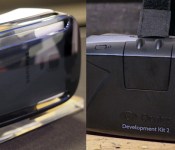
Gear VR is a staging ground for mainstream virtual reality. It uses the Note 4. It’s focused on media consumption. It’s light and pretty. Heck, when it launches this October alongside the Note 4, everything you can do on it will be free experiences. That’s part of the plan of pushing virtual reality into the mainstream. Hook ‘em with casual VR, then show off the big guns with tethered, interactive virtual reality.
Having spent a lot of time with Oculus VR’s second development kit, I was skeptical of the experience being offered with Gear VR. The graphical fidelity is, of course, nowhere near that of a dedicated PC. There’s no depth-tracking, so if you move your head forward, the scene remains static. These are major barriers to delivering on “presence,” the concept of feeling as though you’re physically there while wearing a VR headset. “Presence” is at the core of VR: It’s what distinguishes virtual reality headsets from head-mounted displays.
Oculus VR CTO John Carmack agreed, and said that his team is hard at work on taking those next, necessary steps to make mobile VR more capable:
“We are absolutely tackling position tracking, multi-user experiences, better gaming — all these things — in the coming year. It’s an exciting train we’re hitched onto with Samsung here, because there technology ticks twice a year. And that’s a treadmill that we’ve chosen to get on, and we’re going to do our very best to stay on that and continue innovating at that pace.”
After Gear VR, Carmack expects the competition from other electronics giants will step up tremendously. “This is good enough that it’s going to attract competition from the other significant players,” he said. And that competition is good for us, the VR users, as it means rapid innovation. Video passthrough on Gear VR is a perfect example: If Oculus’ Rift doesn’t ship with some form of video passthrough — what Carmack calls his “Diet Coke button” — that would be tremendously surprising.
Characteristically, Oculus co-founder Palmer Luckey doesn’t see video passthrough as just the ability to interact with reality while wearing a VR headset. He wants more, like augmented reality. “It’s one thing to have a convenience window,” he told us. “It’s another to try and make something where that’s a core feature of the device like AR. That’s a much harder problem to solve.”
Despite the trade-offs, Gear VR offers Oculus a chance to get its name out there on a virtual reality product and to set a foundation for software on the first consumer version of the Rift. The basics — the dashboard and store UI, for instance — will be familiar on the Rift. “Our dashboard, the basic interface, platform and store: Expect it to be similar between the two,” Carmack said.
It also enables VR developers to start making some money. Beyond just helping push VR into the mainstream, Gear VR enables virtual reality developers to start building a financial foundation for future projects. “The critical thing, from the developer standpoint, is we’re actually going to have a market where they can sell and get checks from Oculus with this sooner than on the PC front,” Carmack noted.
In the long-term, mobile virtual reality and tethered virtual reality won’t be separate entities. Carmack foresees a not-so-distant future where the Rift has a dedicated processor that enables both tethered and untethered VR. That’s always been the end goal, really. How soon it’s coming is up for debate.
“I have my vision for where this goes for Oculus,” Carmack said, “Where Oculus starts building systems that might as well include systems-on-a-chip (SOCs), graphics renderers and things inside ours. Not state-of-the-art necessarily, something that will boost the cost all that far up. But then Oculus version three or five or whatever it ends up being is something that can be use unplugged — we’d have our own Android stuff and all that — but you could plug it into the PC and use that.” An interesting vision of the future indeed. Here’s hoping it’s even sooner than we expect.
Filed under: Cellphones, Gaming, Peripherals, Wearables, Software, HD, Mobile, Samsung, Facebook
.CPlase_panel display:none;

Fujifilm’s got a pair of retro cameras in the works for next week

Less than a week after the tech industry swallows up Berlin, the photography industry does the same thing to Cologne. Photokina kicks off in just under six days, and already Fujifilm’s big surprise for the show has been ruined by those tricksy leakers over at Digital Camera Info. According to the report, Fuji’s about to launch the X100T, a retro-styled shooter with a 16-megapixel APS-C censor, 3-inch LCD screen and built-in WiFi for smartphone shutter control. Boasting a 23mm f/2.0 lens and shooting up to 51,200 ISO, the X100T will arrive in a wide variety of colors: black, and black with a silver trim.

Of course, in the headline we mentioned that there were two new cameras coming, but the second isn’t as exciting. In fact, it’s just a refresh of the existing X-T1, this time with a graphite silver trim and a tweaked high-speed shutter. Still, Fuji loyalists may be cheered to see that the company is also working on two new lenses, including an XF 56mm f/1.2 R APD with an apodizing filter for smoother bokeh, and a 50-140mm f/2.8 R LM OIS WR lens with dust- and water-resistance. Price-wise, the new X-T1 will reportedly set you back $1,370, with the 56mm lens priced at $1,470 and the 50-140mm going for $1,560.
Filed under: Cameras
Via: Photo Rumors, SlashGear
Source: Digital Camera Info, (2), (3)
.CPlase_panel display:none;

HP’s Chromebook-like ‘Stream’ laptop is real, but not as cheap as we thought

Don’t believe everything you read, kids. When we first saw leaks for the HP Stream, a $199 laptop primarily meant to be used online, like a Chromebook, we were pretty excited — here was something as affordable as a Chrome OS device, but running full Windows. It turns out, however, that although the Stream is indeed a real product, it’s not as cheap as we all thought. HP just formally unveiled it, and it’s actually going to start at $300, not $199, as previously reported.
That disappointment aside — a $199 Windows laptop would have been sweet — the specs match up perfectly with the rumors. This is a 14-inch machine, with a 1,366 x 768 display, 2GB of RAM, 32GB of local storage and a low-powered AMD A4 Micro processor that allows for a fanless design. On the outside, it looks similar to HP’s Android-powered SlateBook, with bright-colored accents, two USB ports (3.0 and 2.0), an HDMI socket and a microSD slot. Even the weight is basically the same, at 3.8 pounds. Similar to how Chromebooks come with 100GB of Google Drive storage, the Stream will include 100GB of OneDrive space, free for two years.
The Stream ships later this month, on September 24th. The higher-than-expected price aside, we still hope to check one out — ultimately, having more alternatives to Chromebooks is a good thing. Until then, what say you guys? Anyone out there buying? Sound off in the comments.
.CPlase_panel display:none;
Amazon’s Fire phone coming to the UK as an O2 exclusive

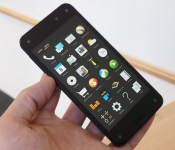
Amazon’s usually quick to stock its national sites with any new homegrown hardware, but we were reminded just how long Fire TV has been out in the States last week when the company announced its European launch. Today, we’ve learnt Amazon’s other new(ish) device, the Fire phone, will be making a much more timely appearance in the UK. From right now, you can pre-order it exclusively through O2, with September 30th set as the delivery date. The smartphone, which first landed in the US in late July, has a bunch of unique features like 3D head-tracking, one-handed gesture controls and live, on-device customer support through Mayday. There’s also Firefly, an image- and audio-based search engine that can help you find products on Amazon, translate text, extract information from business cards and similar, as well as integrate with other apps like StubHub.
When we reviewed the handset, we weren’t sold on the usefulness of all these features, especially when they can be a burden on battery life. That being said, the UK model will launch with Amazon’s latest software update, which includes various systems tweaks and other improvements, like the addition of quick app switching. Curiously, Amazon has decided to replicate the carrier exclusive model it has with AT&T in the US, just with O2 in the UK (the Fire phone is also launching in Germany soon with Deutsche Telekom). It seems the company is intent on sticking to partnerships, even if it limits the potential customer base.
Being an exclusive, O2’s current in the process of porting its Android apps to the Fire, including O2 Priority, My O2, Tu Go and O2’s WiFi hotspot finder. All these have been adapted to take advantage of the Fire phone’s Carousel UI, which pulls info from the app to serve it underneath the icon, and will be available come the end of September.

The handset will be free from £33 per month on O2’s Refresh tariff, making the total handset price £360 (for the 32GB model), and as we’ve said, it’s up for pre-order online, in-store and over the phone today. Anyone that picks up a Fire phone before the year’s out will get a little bonus, too: one free year of Prime membership, or a year extension when renewal looms.
Filed under: Cellphones, Mobile, Amazon
.CPlase_panel display:none;
What you need to know about dashboard-mounted car cameras

We’ve all had it happen while out walking, cycling or driving. Somebody does something foolish and it results in an accident or a near miss, a giant meteor comes streaking through the sky or we catch a rare glimpse of a hoverbike-riding robot. Something memorable always happens when your phone is cached safely in your pocket. This typically leaves you shaking your fist at the missed opportunity.
Victim of road rage? An accident? Ever had your car dinged while parked in a public lot? These are all great reasons to invest in a dash cam. And with prices for decent units at well under a hundred bucks, the cost of admission is easy for just about any budget. While the technology may not appeal to everyone, the payoff in the unfortunate event of an accident might just make it a must have. So if you’re in the market for a dash cam or a just plain curious what they’re for, here’s what you need to know.
WHAT IS IT?
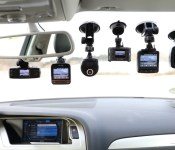
A ‘dash cam’ is exactly what its name promises it to be: a camera that’s mounted in or around your car’s dashboard. The cams are easily attached using a suction cup mount, direct dash friction mounts (those sticky rubber pads), and even built right into a not-too-conspicuous replacement rear mirror for your ride. Powered by batteries, hard-wired into your vehicle’s 12-volt system or via cigarette lighter, the dash cam faithfully records all it sees as you go about your daily business.

The cameras come in every conceivable configuration, from single lens to multiple lenses allowing for simultaneous front- and rear-recording. While 1080p-capable cams are now becoming standard fare, VGA versions exist and can be had for pocket change. Of course, while dash cams are seen most often in cars, these cameras aren’t just reserved for the auto industry. It’s become commonplace to see a cam perched on the heads of two-wheeled vehicle riders, too. Purpose-built cameras are slowly beginning to occupy the space that was once reserved for pricey sport action gear. Both cyclists and motorcyclists have long complained about how dangerous car drivers are and are now taking advantage of the chance to prove it.
WHY SHOULD I CARE?
The camera’s footage can be used for all kinds of fun and positive stuff: from sharing videos of hilarious vanity plates, to shots of beautiful cars and scenery. Pedestrian shenanigans you happen to roll past can transform a mundane commute into a Facebook highlight reel. We’ve seen great time-lapse coverage of long drives, animals doing cute stuff, weather footage during storms — the possibilities for entertainment are endless.
But of course the more pragmatic use is for video evidence in cases of personal accident insurance or proof of innocence (or guilt) in an accident. Consider your options without any proof other than your word: Your insurance may have to pay, your rates climb and the jerk gets off scot-free. The Internet is stuffed to bursting with videos of people willingly diving in front of cars in traffic, accepting minor injury for an insurance payout.
HOW DOES IT WORK?
Most dash cams simply plug in to power, automatically start when your car does, and record video onto removable storage. When you hit your storage limit, the system will begin to overwrite the oldest files in a never-ending loop. Of course, more sophisticated versions exist that geotag your files so you can pinpoint the location of what’s been recorded and also monitor speed, time and date for the recordings. Shock sensors can even tag recordings upon impact to ensure they’re not overwritten in the event of a collision. Some cams are able to sit in a standby mode and only begin recording on impact — pretty neat! Consider if somebody bumps you and then drives away in a parking lot: The footage from your camera, combined with any footage from the lot itself, might help the police track down whoever bumped into your whip.
WHAT DOES THE LAW SAY AND HOW CAN IT PROTECT ME?
The law generally says that dash cams are legal. As long as you’re not infringing on people’s privacy, you’re fine. There’s no reasonable expectation of privacy while in public, which is exactly where the roads you’re driving and recording on are. In fact, we’d argue that has potential to simplify the police officer’s job at an accident scene.
Video aside, if your unit records audio in the car, you’d be wise to alert your passengers that the system is recording at the beginning of your trip.
As for a real-word use case, I was recently the victim of some pretty crazy road rage behavior. After the police were contacted, license plate info and car description were handed over. We were quickly told that the most that could be done was to issue the other driver a warning, as it was our word versus the other driver’s. In this case, a dash cam recording would have provided irrefutable evidence and empowered the police to take legal action.
WANT TO KNOW MORE?
If you want to see some samples of footage, just Google “Russia dash cam winter driving” and prepare for chaos. Not comfortable shopping online? No worries: dash cam videos have become so popular that even BestBuy has a section and display dedicated to this new frontier of video recording.
[Image Credits: Pocketnavigation.de]
Filed under: Cameras, Transportation, Wearables, Software
.CPlase_panel display:none;

Accessory of the Day: 4-port wall to USB travel charger $8.45

Who doesn’t bring multiple devices with them practically everywhere that they go? If you’re anything like me then you’ve undoubtedly run into a lack of power outlets more often than not. This 4-port USB charger allows you to power 4 USB powered devices at once, through a single outlet. With great reviews and priced at just $8.45 (Prime eligible), there’s absolutely no reason to not have this in your luggage on your next trip.
The post Accessory of the Day: 4-port wall to USB travel charger $8.45 appeared first on AndroidGuys.
.CPlase_panel display:none;

Purported Schematics and Details on iWatch Show Rectangular Body, Round Sensor Plate
With just one day to go until Apple’s media event where it is expected to show off not only the iPhone 6 but also its much-rumored “iWatch” wearable device, last-minute leaks and rumors are continuing to roll in. The latest involves schematics and details on the iWatch, and while it is difficult to assess the validity of the claims and images (which have been reposted to Imgur) given that they come from an anonymous Reddit post, the slide images are detailed enough that they are worth highlighting as a possibility.

The poster claims the iWatch will include a microphone, speaker, and support for Siri, and be waterproof to 20 meters with battery life of over a day. The device will reportedly come in eight different varieties as four “colors” in two sizes each.

Purported schematics are labeled as coming from Quanta, which has been reported to be Apple’s manufacturing partner for the device. The majority of the slides appear to show comparisons of how various parts have evolved between an earlier prototype stage (P2B) and the engineering validation test stage (EVT).

As shown in one poor-quality and obviously manipulated picture of what is said to be the device’s housing, the body would be somewhat rectangular in shape, with a large circular region centered in the bottom where the device’s health and fitness sensors are to be located to contact the skin.
While an assortment of iWatch rumors have pointed to displays of around 1.5 inches or as high as 2.5 inches, there have yet to be any leaks of claimed physical parts for the device, making it difficult to assess schematics such as these. At any rate, their validity will apparently become clear tomorrow as Apple officially takes the wraps off of the iWatch.
.CPlase_panel display:none;

Apple Now Sending Alert Emails When iCloud Accounts Accessed via Web [Mac Blog]
In an interview last week, Apple CEO Tim Cook noted that Apple would be beefing up iCloud security measures in response to the recent disclosure of compromised celebrity accounts. Among the additional security features said to be rolling out over the following two weeks were new email alerts whenever there is an attempted password change, a device restore from the account, or a login from a new device. Password change and login alerts had previously only been sent when the event took place on an unknown Apple device.
As noted by Letem světem Applem and confirmed by MacRumors, Apple has already begun sending out alert emails when iCloud accounts are accessed via web browsers. The alerts are being sent out even if the specific browser has been used previously to access iCloud, but this is presumably a one-time measure that will not be repeated for future logins with that combination of browser and machine.

With Apple rumored to be announcing a mobile payments service at tomorrow’s event, it is clear the company needs to reassure users that the company is taking security seriously. While the compromised celebrity accounts were targeted attacks rather than a wholesale breach of Apple’s iCloud systems, the company’s move to enhance security and keep users informed is an important one.
.CPlase_panel display:none;
Older iPhone 5 and iPad 2 Models Still Lead Apple’s iOS Device Lineups in Usage [iOS Blog]
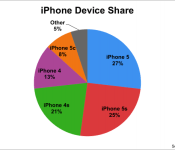
As Apple prepares to launch its new iPhone 6, the iPhone 5 remains the company’s most popular model in use, claims Localytics in a report that examines both mobile and web app analytics data from over 100 million iOS devices for the month of August 2014. According to the report, the iPhone 5 has 27 percent market share, edging out the year-old iPhone 5s, which has 25 percent. The now free on contract iPhone 4S rounds out the top three with 21 percent of the iPhone market.

With a new iPhone 6 on the horizon, these iPhone numbers will undoubtedly shift as owners upgrade their phones. The biggest change will likely be in the iPhone 5, which will lose market share as customers take advantage of upgrade offers.
The iPhone 5, launched in 2012, is Apple’s most popular phone with a 27% share, but only leads its successor, the 5s, by a small (2%) margin. This is likely because most iPhones come with a cheaper price if the consumer locks into a two-year contract, putting the average consumer on a two-year upgrade cycle. With the new iPhones expected to be available for purchase later this month, the iPhone 6 will likely eat into the iPhone 5’s market share.

While consumers tend to upgrade their iPhone on a regular basis, the latest Localytics data suggests the iPad has a longer lifespan. Though it is more than three years old, the iPad 2 remains the most popular iPad model in the company’s lineup with 29 percent market share. Though it is heavily advertised and has received rave reviews, the current iPad Air occupies fifth place with 13 percent market share, beating only the original iPad.
In the past couple of years, Apple has launched the iPhone in September and the iPad in October, but one recent rumor claimed the company may unveil both devices during its press event tomorrow. But while numerous have pointed toward introduction for both the 4.7-inch and 5.5-inch iPhone 6, along with the iWatch, new iPads are less certain.
.CPlase_panel display:none;

My First Hour Playing: This War of Mine Preview
 Often, I know exactly how I’m going to feel about a game after just watching a trailer – some set my pulse racing, others make me feel like they just revealed their whole hand in a high stakes Poker match, and others make me feel such intrigue that I get extremely excited about it. The last emotion is exactly how I felt after watching the trailer for 11 bit studios‘ newest game, This War of Mine. If 11 bit studios sounds familiar, that’s because they are the studio behind the award winning Anomaly strategy game series, and This War of Mine is a foray away from that frenetic gameplay with something a little deeper, and boy, have they nailed it. I was fortunate enough to get to try a preview build of This War of Mine, and I’ll be sharing my thoughts about it below. Keep in mind though that this is just a preview and the final game may differ from what I express here.
 The premise of This War of Mine is war. Except, unlike most other war time games, you aren’t actively fighting in the war. Often what is overlooked in war time are the people affected, the people in the crossfire, or – for lack of a more humane term – the collateral. These are the people that you will be playing and the outlook is bleak. This much is clear even from just the title menu – while I’m sure the final game will have more game options, the only selectable option here is “Survive”.
If you want to find out more about This War of Mine, head over to TheSavvyTechs to read the full review. Note that the This War of Mine preview was for the PC version, but it is expected for release sometime in the remainder of 2014 for PC and mobile devices.

//<![CDATA[
ord = window.ord || Math.floor(Math.random()*1E16);
document.write('‘);
//]]>
The post My First Hour Playing: This War of Mine Preview appeared first on AndroidSPIN.
.CPlase_panel display:none;
 AIVAnet