


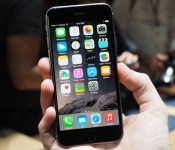
The iPhone 6 hands-on

One iPhone model. Two sizes. Aside from a suite of feature and software improvements, the iPhone 6 is also getting upgraded in screen size — the smaller version at 4.7-inches, with the Plus option at 5.5-inches. The more petite iteration is what I’ll focus on here, though you’ll be able to take a look at the larger size here. Aside from the difference in diagonal screen size, there’s very little to tell these two versions apart until you start looking deeper; the Plus comes with a bigger battery, better display, one-handed mode and an extra stabilization feature on the camera, but everything else is essentially identical. Take a look at the photos and video below, and I’ll be adding my thoughts as I go.
Naturally, there’s going to be some hesitation by those who’ve been used to the 3.5-inch or 4.0-inch size of all previous generations of the iPhone, but the 4.7-inch model is still reasonable enough that most users should easily get used to the new size. At 6.9mm, it’s thinner than the 5s (7.6mm), and its curved sides bring a sleek look that should still be plenty comfortable for most traditional iPhone fans.
Developing…
Filed under: Cellphones, Wireless, Mobile, Apple
.CPlase_panel display:none;
Apple Seeds iOS 8 Golden Master to Developers Ahead of September 17 Public Launch
Following today’s media event, Apple has seeded the golden master (GM) version of iOS 8 to developers. The golden master represents the final version of iOS 8 that will be released to the public on September 17, two days ahead of the launch of the iPhone 6.
The update is available through Apple’s over-the-air updating mechanism on iOS devices and it can also be downloaded via the iOS Developer Center. Apple has also seeded a golden master version of the new Apple TV software and Xcode 6.

Prior to the launch of the golden master, Apple seeded five iOS 8 betas to developers, with the fifth beta released on August 4.
iOS 8 introduces a range of new features, including improved integration with OS X through Continuity, a Health app, Family Sharing features, interactive notifications, a new QuickType Keyboard and improvements to several apps like Safari, Mail, and Messages, with all of the features being refined over the course of the beta testing period.
.CPlase_panel display:none;
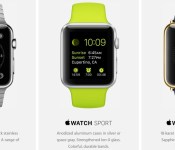
Apple Announces Apple Watch, Its New Wearable Device With a Range of Colors and Designs
Apple today announced its long-rumored wearable device, the Apple Watch, which actually uses the Apple Symbol () followed by “Watch” in its name. Apple’s Watch is designed to be both fashionable and functional, available in an array of different color and materials with six different types of watch straps that are easily interchangeable. Prices for the device, which will be available in early 2015, start at $349.
There are six different Watch face colors and materials: Stainless Steel, Silver Aluminum, 18-Karat Yellow Gold, Space Black Stainless Steel, Space Gray Aluminum, and 18-Karat Rose Gold.
There’s the Apple Watch collection, which has stainless steel or space black stainless steel cases combined with a range of metal and leather bands, the Watch Sport collection, which includes anodized aluminum cases in silver or space gray with colorful, durable bands, and the Apple Watch Edition, which includes 18-karat gold cases in yellow or rose with “exquisitely crafted” bands and closures.
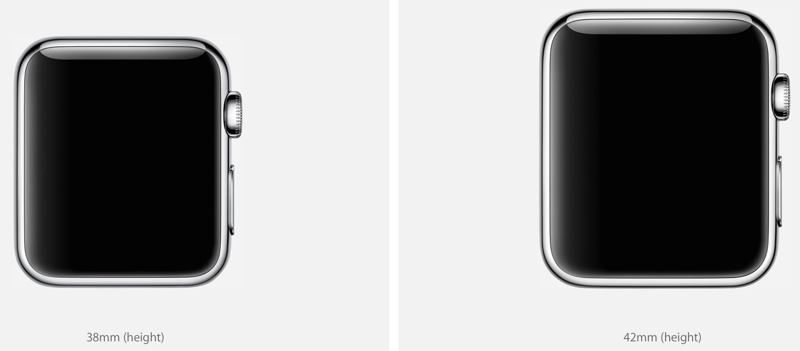
 All of Apple’s Watches can be customized with an array of different digital watch faces to suit different tastes. Each of the watches is available in two separate screen sizes for different sized wrists: 38mm and 42mm, and the watches have a flexible, durable sapphire display.
Apple’s Watch uses unique input methods, taking advantage of the traditional watch dial or crown, which Apple refers to as a “digital crown” on the device. This scroll-type wheel allows users to zoom and scroll through various user interface elements.
The device also takes advantage of new pressure-sensing technology and is able to determine the difference between a tap and a press, allowing for a new range of contextually specific controls. A second physical button next to the digital crown lets users tap to bring up a list of contacts and then communicate with friends by sending quick drawings, messages, and animated emoji. It’s also possible to send a heart beat, drawn from the watch’s sensors.
Inside the device, there’s a new Taptic Engine that allows users to hear and feel the design of the user interface. A new custom designed chip, the S1 processor, integrates many subsystems into one singular module. The back of the watch is constructed from zirconia with four sapphire lenses that can detect pulse rate. There is also a gyroscope and accelerometer, which helps the Apple Watch provide a comprehensive picture of daily activity.
The back of the device is also the home of Apple’s charging solution, which uses a MagSafe with inductive charging. The user will not have to worry about exposed contacts or aligning the charger properly. Apple has declined to comment on battery life at this point.
Apple’s Watch will support third-party apps, with support for both extended notifications from the iPhone and apps that run directly on the device. The Watch does rely heavily on the iPhone and does not function as a standalone device as it is designed to work with Apple’s new Continuity features, letting users shift tasks from one device to another with ease.
The Watch does include support for NFC, and it will function with Apple’s new payment initiative, Apple Pay, which lets users make secure payments from the iPhone 6, iPhone 6 plus, and Apple Watch.
Apple’s iWatch will be available starting at $349, with users able to purchase the device in early 2015.
.CPlase_panel display:none;
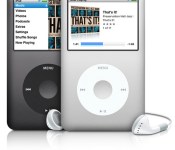
Apple Removes iPod Classic from Online Store [iOS Blog]
Following today’s announcements of the iPhone 6, iPhone 6 Plus and Apple Watch, Apple has removed the iPod classic from its online store. The last iPod classic was introduced in September 2009, and while a number of rumors have pointed to a discontinuation of the product, Apple still chose to sell it in silver and black color options at $249 for a number of years.

Earlier this year, CEO Tim Cook was quoted as saying that the iPod was a “declining business.” In May, Apple removed the sidebar link to the iPod classic in several of its online refurbished stores, leaving only the iPod nano and iPod touch.
The iPod was Apple’s “halo” product for years, introducing many consumers to Apple’s line of products. Since their peak in 2008 however, iPod sales have declined sharply as the iPhone and iPad have captured more of the market.
.CPlase_panel display:none;
Intel and Fossil partner for Android Wear
Intel, a leader in chip-making and powering technology, and Fossil, a leader in fashion accessories, are partnering up for future smartwatches and wearable technology. While they plan to build all kinds of wearable technology, Android Wear devices are a certainty since they both are listed as partners on Android Wear’s official website. This partnership is… Read more »
The post Intel and Fossil partner for Android Wear appeared first on SmarterWatching.
Read the rest at SmarterWatching.com!
The post Intel and Fossil partner for Android Wear appeared first on AndroidGuys.
.CPlase_panel display:none;
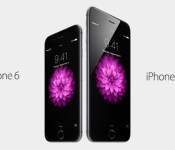
Apple’s two new iPhones are 25% faster than last year’s models thanks to the A8 chip

Ah yes: another year, another new iPhone with another new chip at its heart. This year, there are two iPhones — a 4.7-incher and a 5.5-inch model — and they’re both powered by what Apple’s calling a “next-generation” A8 chip. But what can it do for you? Apple’s saying it brings a 25 percent speed boost over the iPhone 5S’ A7 chip, with a 13 percent size decrease (assuredly helping to keep the duo of iPhone 6 phones so svelte). As much as we like performance, we also like our phones to last longer than five hours — what does the A8 offer in energy conservation? A 50 percent increase over last year, apparently.
What that actually means in terms of real-life performance is another question — we’ll have to find out when we get our hands on review units in the coming weeks. For now, Apple’s offered the following stats: 14 hours of 3G talk time for the 6, and 24 for the Plus; 10 days standby for the 6, 16 for the Plus. 11 hours of video for the 6, 14 for the Plus. That’s straight from our liveblog as Apple announces new products today in Cupertino, California.

Apple’s also boasting of the A8’s graphics prowess, enabling better looking gaming in particular. Epic Games, EA, and a variety of others are apparently (still) on board to create games for Apple’s devices.
In addition to the A8 inside the new iPhones, an M8 coprocessor handles the usual gamut of sensory readings, and adds a new one: a barometer for elevation. We expect to hear much more about the M8 as Apple speaks to HealthKit and — maybe — it’s new smartwatch/health wearable.
Filed under: Cellphones, Mobile, Apple
.CPlase_panel display:none;
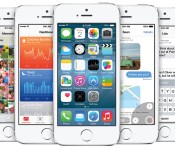
iOS 8 will be available to download on September 17th

New iPhones mean new software to go with it. So, with the iPhone 6 and 6 Plus going on sale soon, that means iOS 8 is on the way as well. Apple just confirmed the next-gen operating system will arrive next week, on September 17th, as a free download. In particular, you’ll be able to download it for every iPhone from the 4s on, every iPad starting with the iPad 2, and the fifth-generation iPod touch.

Included in the update is Apple Pay, a new feature that allows iPhone 6 and 6 Plus users to make payments via NFC. Otherwise, not much has changed since we last saw iOS 8, back at WWDC in June. Key features still include interactive notifications, an improved mail app, Spotlight search, support for third-party keyboards, Apple’s new HealthKit application, audio messages and improved integration with other Apple devices, like Macs. We’ll have a review up at some point but of course, you can also just download it for yourself.
Filed under: Software, Mobile, Apple
.CPlase_panel display:none;
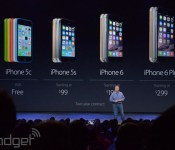
Apple drops iPhone 5s price to $99 and the 5c to ‘free’ on contract

We’re at Apple’s big iPhone 6 shindig, and as you might expect, Apple’s new 4.7-inch and 5.5-inch handsets have rendered its previous handsets a little more… moot. But hey, that means it’s discount time! Apple has lowered the starting price of the 8GB iPhone 5s flagship to $99 on contract, while the 5c runs a cool “zero.” Both devices will also ship with iOS 8 starting September 17th.
Filed under: Cellphones, Mobile, Apple
.CPlase_panel display:none;
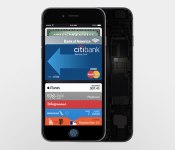
Apple Pay comes to the iPhone for handling mobile purchases, NFC in tow

For years, Apple has resisted including NFC connectivity inside its iPhone handsets… until now. With the arrival of the new iPhones, the folks in Cupertino are finally including the option that will sort mobile payments. What’s more, it’s doing so with a process it built for use on its handsets: Apple Pay. The new feature is included on both the iPhone 6 and iPhone 6 Plus and uses NFC, Touch ID and a Secure Element chip to keep that precious info under lock and key. So how does it work? Well, you add a card to your iTunes account which then adds it to Passport. From there, you can suspend payments on the phone if your card gets lost or stolen without the need to make a phone call. In terms of security, Apple doesn’t know what you’re buying, and cashiers won’t even see your name. Instead, a one-time payment number and a dynamic security code complete the transactions.
At launch, American Express, Mastercard and Visa are all on board with a load of banks opting in to Pay as well. As far as retail is concerned, Apple Stores, Bloomingdale’s, Macy’s, Walgreens, Subway, McDonald’s, Whole Foods and many more will allow you to pay for goods with that newfangled iPhone or the outfit’s wearable. For shopping on the web, there’s a one-touch feature that replaces the need to manually enter a card number, shipping address and other into. Once again, no credit card info is shared with merchants. Apple Pay is set to arrive in October via a free update to iOS 8
Filed under: Cellphones, Mobile, Apple
.CPlase_panel display:none;
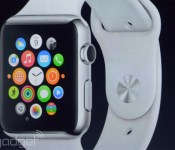
Apple Watch is the wearable Cupertino hopes you’ve been waiting for

If you’re tired of rumors and speculation about Cupertino’s so called “iWatch,” then good news — that all ends today. Apple has just confirmed the arrival of its first fully-fledged wearable device — Apple Watch. How much of what we heard in the run up to the event was true? How does it compare to the recent slew of Android smartwatches? In typical Apple fashion, the device has a few surprises.
First up some top-level details: Apple Watch has a sapphire display, four sensors on the back, NFC, Apple Pay, and a choice of straps at launch — these are proprietary, not standard. Apple also claims it’s accurate to 50ms and is the “most personal device we’ve ever created.” Probably to the surprise of many, the new watch isn’t swiss-style at all, in fact sharing much of the iPhone’s design language — curved edges and a power button on the side. There’s also a hardware dial, just like on a regular watch, that Apple is calling a “digital crown,” which can be used to navigate menus, zoom into images and more. A big heads up: you’ll need an iPhone 5 or above and $350 if you want one of these when they become available “early next year.”
How will it work? Tim Cook is keen to assure that his team didn’t want to create a boiled down iPhone — joking that there’s no pinch-to-zoom etc. In a similar way to how Samsung’s Gear watches work, the Apple Watch knows when you lift your wrist to look at it, and activates the display (and showing you some apps). If you were wondering about how you’ll charge it, it uses inductive charging, but actually uses something that looks quite a lot like a small MagSafe. Other rumored details that turned out to be true include the flexible display, and a heart-rate monitor.
Worried that you won’t get along with a watch that everyone else also has? Apple has thought of that, and has created three watch “collections.” These main difference being the finishes: aluminium, stainless steel and 18-carat gold! There’s a choice of two-sizes also. The bad news is, you’ll need an iPhone to go along side it, whichever one you choose. Also, as you’d expect, Apple Watch does notifications, so you can see meetings and message alerts — many of these are actionable too, so you can decline an invite without reaching for the phone. As we’d heard earlier in the week, there will be dedicated apps for the Apple Watch, both from third-parties (American Airlines, City Mapper) and Apple (such as maps, with navigation etc.).
What about fitness credentials? Yup, that’s a big part of Apple Watch too, with Cook stating: “It’s a very important area for me, and important for Apple.” What that really means is that it will act as a fitness tracker, and a dedicated sports watch, complete with workout app (but you’ll need your iPhone’s GPS for tracking a run — BOO!).
Developing…
Filed under: Wearables, Mobile, Apple
.CPlase_panel display:none;
 AIVAnet