



Property Mogul Recalls Apple Store Fifth Avenue Planning, Says Steve Jobs Wanted 40-Foot Cube [Mac Blog]
Since it opened in 2006, Apple’s iconic glass cube retail store Fifth Avenue retail store in New York has been praised for its design and its ability to attract a large amount of customers daily. Now, author Vicky Ward (via ifoAppleStore) has shared new details about the store’s beginnings on the plaza of the General Motors Building in her book The Liar’s Ball: The Extraordinary Saga of How One Building Broke the World’s Toughest Tycoons.

Ideas for a store on Fifth Avenue originally began in November 2003 when former Apple CEO Steve Jobs met with property mogul Harry Macklowe after being connected through Apple’s former Vice President of Real Estate George Blankenship. Jobs initially wanted a store that “would be open 24/7″, and worked with architects from architectural firm Bohlin Cywinski Jackson who designed Apple’s store in SoHo, Manhattan.
It was at that point where Jobs, Macklowe, and the designers thought of placing a square glass cube in an unused basement within the GM Building’s Plaza:
What happened next has long been the subject of speculation and some dispute: Who came up the idea of placing a 30‐foot square glass cube — the world’s “smallest skyscraper” — in the middle of the GM Building plaza? In that lightbulb moment, an unused basement that had caused headaches for its owners for more than 40 years morphed into what is arguably the most famous retail space in the world.
Said Macklowe: “[Jobs] presented to me and I presented to him. He had this cube, which was quite different from what you see there today, and I had a cube that was quite different from what we see today as well. It took us half an hour to make a deal.”
Jobs initially wanted a 40-foot cube, leading the designers to set up a scaffolding mockup of the building. However, once Jobs and other Apple executives went to go see the mockup, all agreed that it was too big and obscured the vision for the store. However, Macklowe also showed off a 30-foot cube built secretly underneath, which caused Jobs and the Apple executives to agree to the size.
From there, Macklowe convinced retailers and a CBS studio residing in the area to move, as construction began while Jobs waited. The store eventually opened on May 19, 2006 to much public attention, and went on to become one of Apple’s most iconic and busiest stores.
Macklowe’s real estate attorney also later regretted not negotiating a higher “percentage rent” with Apple, which saw his client receiving a portion of the store’s profits. Macklowe called the negotiations “horrendously low,” and claims that Apple had no idea just how well the store was going to do in business per year.
.CPlase_panel display:none;

Nixie is a wearable drone that captures your activities on the fly

Remember the dronie? If not, it’s a self-taken photograph (sigh, selfie) from a UAV like the Parrot AR Drone 2.0 that provides a bit more creativity than your arm reach allows. Imagine that you can attach that drone to your wrist and launch it instantly, and you have some idea about how the Nixie works. Once aloft, it’s designed to detect your presence and fly around you, pointing its camera to film your exploits — ranging from tourism to mountain climbing, as the video below shows. The project is part of Intel’s Make it Wearable contest, and uses an Edison chip to track you and avoid obstacles. For now, it’s just a delicate prototype that can fly off your wrist and not do much else. But it’s scored a $50,000 finalist prize from Intel, meaning our dream of having aerial footage of all our hum-drum activities could finally come true — yes, we are that vain.
Via: Hot Hardware
Source: Nixie
.CPlase_panel display:none;
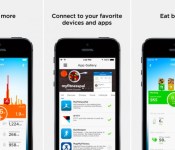
Jawbone Launches HealthKit-Enabled ‘Up’ App Featuring Personalized Fitness Advice [iOS Blog]
Jawbone has launched its new Up app for the iPhone, which utilizes Apple’s Health app and HealthKit to track and deliver advice based on a user’s diet and physical activity. Not to be confused with Jawbone’s other Up app, this newest app does not require the company’s fitness tracker and works with over a hundred apps and devices, including MyFitnessPal, Strava Running and Cycling, IFTTT, and more.

Information from meals logged throughout the day can be used to help generate nutritional advice, while data from workouts can be used to help set goals for the future. The Up app also allows users to log their sleep, which can be analyzed and used to provide advice on future sleep adjustments. All of the advice generated is powered by Jawbone’s Insight Engine, which works with both recorded data and data from the Internet to deliver information on a variety of fitness-related subjects.
The app also includes a number of social functions, including the ability to add friends to a “team” to compare and track fitness scores and goals. Users can also set their own goals within a team and receive notifications when progress is being made. Insights generated by the Up app can also be shared through email, message, Facebook, and Twitter.
Up by Jawbone is a free app for the iPhone and can be downloaded in the App Store. [Direct Link]
.CPlase_panel display:none;

Scientists make an invisibility cloak using off-the-shelf optical lenses

Most invisibility cloaks require fairly exotic technology to work, such as fiber optics or light-altering metamaterials. That’s not very practical, especially since the illusion still tends to break when you move. The University of Rochester may have a far more realistic solution, however — it has developed a cloak that only needs run of the mill optical lenses to hide objects from view. The system really boils down to clever math. By positioning two pairs of lenses in the right order, researchers can bend light in a way that hides almost everything you put in the middle of this arrangement. The approach scales up with the size of the glass, and it works at angles of 15 degrees or more; you don’t need to look head-on to see the effect.
There is a big catch to this visual trickery. You can’t hide whatever is directly on-axis, so this is more of an invisibility “doughnut” than a perfect disguise. It doesn’t have to be used as camouflage, though. The lens-based system could eliminate blind spots in vehicles, or let surgeons see through their hands during delicate operations. Those uses are a long ways off at this early stage, but the relative simplicity of the technique makes them very plausible.
Filed under: Science
Via: Phys.org
Source: University of Rochester, arXiv
.CPlase_panel display:none;

iOS 8 Safari Supports Animated PNG Images [iOS Blog]
 With the release of iOS 8, Safari has gained the ability to display Animated PNGs (APNGs). Originally proposed in 2004 as a replacement to animated GIF images, APNGs offers more color and transparency support over GIFs.
The Animated Portable Network Graphics (APNG) file format is a non-standard extension to the Portable Network Graphics (PNG) specification. It allows for animated PNG files that work similarly to animated GIF files, while supporting 24-bit images and 8-bit transparency not available for GIFs. It also retains backward compatibility with non-animated PNG files.
The APNG specification, however, was rejected by the PNG group in 2007, so support for the format has been rather limited. In fact, the format has been declared dead due to the lack of official adoption. Firefox was the only major browser that provided standard support for APNG, until iOS 8.
The beach ball image in this article is animated when viewed in iOS 8 or Firefox.
Thanks Parasprite
.CPlase_panel display:none;

How would you change Huawei’s Ascend Mate?

Can a 6.1-inch smartphone ever be accepted in the mainstream? That was what Jonathan Fingas asked while reviewing Huawei’s Ascend Mate, and found the answer to be a resounding “no.” The handset offered a lot of things that did impress him, including a staggering battery life, big display and the company’s Emotion UI. On the downside, the old(er) internals, 3G-only modem and modest storage meant that the device had “niche proposition” stamped all over it. But, what about you, out there? Did you buy one? If so, what did you like, what did you hate and what, if anything, would you change? Head to the forum and spill your brains.
Filed under: Cellphones, Mobile
Source: Engadget Product Forums
.CPlase_panel display:none;

Documentary shows how One Laptop Per Child has helped kids in Peru

The staff changes, massive layoffs and the shutdown of its entire Boston office over the years make the One Laptop Per Child program sound like a huge failure. But this documentary by filmmaker Michael Kleiman shows that OLPC really did change some of its recipients’ lives, particularly those who’ve never heard of computers and the internet before the organization gave them laptops of their own. The documentary, called WEB, looks at the OLPC rollout in the poor areas of Peru, showing kids typing on their small laptops in dingy classrooms and teaching their parents how to use Google underneath trees. It’s been shown in several film festivals before, but it’s now available for download from iTunes, Google Play, Amazon Instant Video, Xbox Video, Sony Entertainment Network and Vudu.
Since it’s not all sunshine and roses for OLPC as we mentioned earlier, the documentary also details the challenges the organization had to overcome, along with interviews of several tech bigwigs, including Father of the internet Vince Cerf and OLPC founder Nicholas Negroponte. If you’ve forgotten OLPC’s original purpose (before it went into the tablet business, that is), it’s a project that aims to provide children in developing countries with laptops of their own. To make that happen, though, it relies on the generosity of people with money to spare, asking them to pay $399 to get one of its laptops and donate another to a kid in the developing world at the same time.
Filed under: Laptops
Via: TheNextWeb
Source: WEB the Film
.CPlase_panel display:none;
AT&T Doubling Data on Mobile Share Value Plans in Limited Time Promotion [iOS Blog]
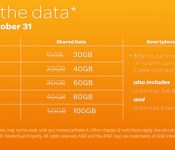
AT&T today announced that it is launching a new limited-time promotion for its Mobile Share Value Plans, offering double the amount of data for new and existing customers with monthly data plans of 15GB or more.

Under the promotion, customers with monthly shared data plans of 15GB will now be receiving 30GB of data, while those on 20GB, 30GB, 40GB, and 50GB plans will see an increase to 40GB, 60GB, 80GB, and 100GB of data, respectively. In order to receive the promotion, new and existing customers must sign up by October 31.
The promotional pricing applies to new and existing customers who buy a phone under the AT&T Next early upgrade program, and also includes those who bring their own smartphone or purchase one at full price. In addition to data, the plans include unlimited talk, text, and international messaging.
The move follows an announcement from Sprint last month that offers 20GB of shared data plus an additional 2GB of data per line for $100 a month to new customers switching from other carriers. Additionally, Sprint is offering up to $350 (via Visa Prepaid Card) to cover early termination fees for users switching from other carriers.
.CPlase_panel display:none;

Feedback Loop: Building PCs, running headphones and more!

The leaves are starting to change color and the air is getting cooler, signaling that fall has finally arrived. You know what else has arrived? Feedback Loop! This week’s edition features the Engadget community discussing the benefits of homebuilt PCs, recommending affordable running headphones, sharing fun Raspberry Pi hacks and dishing on smartwatches. Head past the break for all this and more.
Are there still any reasons to build your own gaming PC?
PC gaming is as popular as ever. But if you’re looking for a new rig, is it better to buy something prefabbed or build it yourself? Cbibbs is a big fan of building his own machines, but doesn’t think there’s a cost advantage in doing so these days. Despite this, do you still desire and enjoy building your own mean machine? Head over to the forums and share your thoughts.
Suggestions for affordable running headphones
Summer is over in the Pacific Northwest, and Philip Palermo is thinking of switching his fitness routine from tennis to running. Before he swaps his racket for some running shoes, he needs to find some good headphones to help him jog in style. Let’s give him some recommendations!
Fun hacks with the Raspberry Pi
When the Raspberry Pi launched in 2012, it provided hobbyists with a cheap, easily hackable device with which to learn programming. And enthusiasts immediately started doing some really neat things with it. Engadget reader Kodai has two of the devices at home and wants to know what sorts of things can be done with them. If you’ve done something fun with your Raspberry Pi, post it here.
What do you want in a smartwatch?
There’s no doubt that smartwatches are one of the more interesting categories of wearables. Now that Apple’s thrown its hat into the ring, what are some truly killer things that smartwatches should do? Tell the Engadget community your hopes and dreams for the perfect smartwatch. (We all want something that does more than display Facebook notifications, right?)
Other discussions you may also like:
- What are your preferred brands when building PCs?
- Ethernet, still worth it?
- iOS 8.0.2 is available to download now!
That’s all this week! Want to talk about your favorite gadget or have a burning question about technology? Register for an Engadget account today, visit the Engadget forums and start a new discussion!
.CPlase_panel display:none;

Supposed Internal Memo Suggests October 10 Launch for iPhone 6 in China [iOS Blog]
Apple may be looking to launch the iPhone 6 and iPhone 6 Plus in China on October 10, according to an internal Apple retail employee memo shared by Techweb (Google Translate). The memo also states that “prototype” iPhone 6 units will be put on store shelves starting October 7, allowing customers to experience both models before their launch three days later.

It was reported earlier this month that Apple received one out of the two regulatory licenses needed to sell the iPhone 6 in China. China’s Ministry of Industry and Information Technology (MIIT) is said to be performing the review, and would need to give Apple a critical regulatory license before the device goes on sale

Meanwhile, a report from Bloomberg states that the country’s largest carrier, China Mobile, would be taking steps to eliminate $2 billion in smartphone subsidies for customers. The move would double the total cost of handsets like the iPhone over two years, with the up-front cost of the device decreasing while service contracts increase
China has become a growing market for Apple throughout the past few years, as the company has opened a variety of new stores and pushed iPhone sales through China Mobile, China Unicom and China Telecom, which are country’s three biggest carriers. An October launch for the iPhone 6 in China would also be positive for Apple’s important holiday quarter, which usually sees the company pushing to increase its sales in all of its markets before the end of the year.
.CPlase_panel display:none;
 AIVAnet