



Apple’s (probably not broken this time) new iOS 8 update is ready to download

It’s take two for Apple’s first update to iOS 8. After the company released a version yesterday that cut off cellular connections and TouchID for the iPhone 6 family, there’s a new one available now. According to an Apple spokesperson, less than 40,000 device were affected by yesterday’s glitch — a large number, but maybe not that big when sales of the new devices are already at 10 million and climbing. Version 8.0.2 also carries the fixes we were expecting yesterday which should get HealthKit apps going and fix some third-party keyboard issues, among other tweaks. We understand if you’re not in a hurry to try this one out, but the update is available via iTunes or the software update option on your Apple device. If you’re bravely rushing once more unto the breach, please let us know how it goes in the comments.
Photos by Will Lipman.

Filed under: Cellphones, Tablets, Mobile, Apple
Source: Apple
.CPlase_panel display:none;

Apple’s Second Wave iPhone 6 and 6 Plus Launch Kicks Off With Online Availability in Several Additional Countries
Apple Online Stores around the world have begun accepting orders for the iPhone 6 and 6 Plus as part of a second wave launch that will see the devices become available in more than 20 additional countries.
The two devices are now available for order online in multiple different countries, and will become available in local retail stores in the morning. The iPhone 6 and 6 Plus are already on sale in stores in New Zealand, where it is just after 11:30 AM.

Second wave launch countries for the iPhone 6 and 6 Plus include Austria, Belgium, Denmark, Finland, Ireland, Isle of Man, Italy, Liechtenstein, Luxembourg, Netherlands, New Zealand, Norway, Portugal, Qatar, Russia, Saudi Arabia, Spain, Sweden, Switzerland, Taiwan, Turkey and United Arab Emirates.
Many countries where the iPhone 6 and 6 Plus are available for purchase online are displaying shipping estimates of five to seven days for both devices, for all colors, carriers, and capacities. In many cases, these shipping estimates are better than the shipping estimates for new orders placed in first wave launch countries, but estimates may change as available supply per country dwindles.
Initial iPhone 6 and 6 Plus sales in the United States, UK, Australia, Canada, France, Germany, Hong Kong, Puerto Rico, and Singapore topped 10 million during the first weekend that the devices were available for purchase, which Apple CEO Tim Cook said “exceeded expectations.”
Apple has plans to bring the new iPhones to 115 countries by the end of 2014.
.CPlase_panel display:none;

Apple Releases iOS 8.0.2 With Fix for Cellular Issues, Broken Touch ID
 Apple has just released iOS 8.0.2, its second update to iOS 8 designed to fix major issues introduced with iOS 8.0.1, which went out to iPhone owners on Wednesday. After installing iOS 8.0.1, many iPhone 6 and 6 Plus users found that their cellular service was disabled and that Touch ID was non-functional.
Apple pulled the iOS 8.0.1 update approximately an hour and fifteen minutes after it was first released, but not before numerous iPhone users were able to download the software. The company announced an investigation in the afternoon, and in the evening, released a support document saying iOS 8.0.2 was in the works and directing users to fix the problem via an iTunes restore to iOS 8.
iOS 8.0.2 is available immediately as an over-the-air download and presumably fixes all of the issues that were introduced with iOS 8.0.1. iOS 8.0.1 contained a fix for a major HealthKit issue that was discovered just before the public release of iOS 8, prompting Apple to remove all HealthKit enabled apps from the App Store. Following iOS 8.0.1 and iOS 8.0.2, these apps will be able to return to the App Store. The updates also bring fixes for third-party keyboards, Reachability, Photo Library, SMS/MMS messages, and more.
.CPlase_panel display:none;

Mystery Moto devices makes the LG G3 look tiny in comparison, but is it the Nexus 6?
Yesterday image renderings of what the Motorola Nexus device would look like surfaced. They showed us an early look at the front and back of what is supposedly code-named “Shamu”. Hardware information came along with the renders that indicated a 5.92-inch QHD resolution screen with a resolution of 2560×1440. Other details listed out a Snapdragon 805 processor, 3GB of RAM, 13MP camera and 32GB of internal storage. There is now a new image floating around the internet that places a mystery Motorola device, face down, along side a LG G3. It is quite a bit larger. Check it out.

This would seemingly confirm the screen size of a new Motorola device as we know the screen on the LG G3 is 5.5-inches. Zooming into the label you don’t get any information at all as all the fields are marked with xxxxx. The only thing we do know for sure is that it is designed by Motorola. It says so on the label. Looking closely at the camera in the center though you can see the dual LED flashes on either side of the ring. This was also present on the renders that 9to5Google showcased yesterday. There is no doubt that this is an early prototype of the device, but just which device is it.
The original poster wants you to believe that it is the next Nexus device. Hence the wonderful labeling that was done with some paper and a piece of tape. That doesn’t detract from the fact that we know there is something on the way though. It is very likely that this is the Nexus 6, but that is me just going off of the last renders depicting a similar device that was previously claimed as the next Nexus. That could be terribly wrong as well. There have been talks of Google working with Verizon on a device, there have been talks of a Moto S phablet style device and even talks that Google will be doing a double Nexus device this year. Yes, two sizes to choose from. Kind of like Apple just did with the iPhone.
Everything is up in the air and we are all just dropping speculations left and right. One could always use a little more wood on the fire, right? What are your thoughts? Is this the Nexus 6? Nexus X? Moto S? Or perhaps it is the Moto Droid MAXX. My guess doesn’t involve the last two choices.
Image via comment on Droid-Life
//<![CDATA[
ord = window.ord || Math.floor(Math.random()*1E16);
document.write('‘);
//]]>
The post Mystery Moto devices makes the LG G3 look tiny in comparison, but is it the Nexus 6? appeared first on AndroidSPIN.
.CPlase_panel display:none;

For clucks sake: KFC Japan takes extra crispy to a new level

There’s really only one way to properly celebrate Colonel’s Day: a collection of fried chicken-themed accessories to show your pride. That’s just what KFC Japan is doing as part of a Twitter promotional campaign. Lucky winners will be treated to the likes of an over-sized chicken leg iPhone case, a keyboard that’s adorned with various pieces of chicken and both a USB drive and mouse that each showcase rather drumstick-like appearances. For the less tech savvy, there’s chicken leg Ostrich Pillow-like headwear for comfy napping and a set of earrings to let everyone know what your favorite food is. The whole lot is quite ridiculous really, but don’t take my word for it, take a gander at the entire collection in the gallery that follows.
Filed under: Misc
Source: KFC Japan
.CPlase_panel display:none;

Ingress’ user-created missions give added meaning to your walking tours

Ingress certainly has a following among augmented reality gamers, but its relative lack of direction can be intimidating — especially if you’re a newcomer. Where do you go first? As of today, you’ll (usually) have an easy answer. Google’s Niantic Labs has added user-created missions to the game that give you an incentive to get moving. Effectively, they’re walking tours with objectives. You’re usually asked to hack portals or solve puzzles at each stop, with the promise of special medals at the end. Each mission includes both average completion times and ratings, so you’ll likely know in advance whether or not a given adventure is worth the effort.
Not everyone can take advantage of missions just yet. You can only access them on Android right now (iOS is due soon), and only a small batch of “experienced” players can create them; Niantic eventually plans to open up creation to everyone with a level five rank or higher. It could be a while before you see many missions near you, then. Even so, what’s here could keep you playing Ingress when you might otherwise have given up — and you’ll probably get some exercise in the process.
Filed under: Cellphones, Gaming, Mobile, Google
Via: The Next Web
Source: Ingress (Google+), Google Play
.CPlase_panel display:none;

Apple Invites Reporters Into Testing Lab, Details iPhone 6 Plus Durability Tests
Earlier today, Apple released a statement to several different media outlets in response to reports about the iPhone 6 Plus bending within user pockets, stating that bending from normal use was “extremely rare” and suggesting only nine customers had complained about bending issues.
In addition to outlining its rigorous testing policies, Apple has now invited reporters from both CNBC and The Verge to its testing facility to see the machines that it uses to test its products in person. The lab contains an array of different testing equipment, with Apple’s head of engineering Dan Riccio telling CNBC the iPhone 6 was “the most tested product we have ever done” and that Apple had not tested another phone as exhaustively.
http://player.theplatform.com/p/gZWlPC/vcps_inline?byGuid=3000313669&size=530_298
“As we add more and more features, we have to find out a way to break them before customers do,” Riccio told The Verge. According to Apple, 15,000 separate tests were conducted on both the iPhone 6 and the iPhone 6 Plus. “The bottom line is that if you use enough force to bend an iPhone, or any phone, it’s going to deform,” said Riccio.
When asked about the reports of bending, Apple’s head of marketing, Phil Schiller, called them “extremely rare occurrences” reiterating to CNBC that out of millions of iPhones sold, Apple had only received nine complaints. He also told The Verge that Apple “designed the product to be incredibly reliable throughout all your real world use.”
Apple also outlined some of the different durability tests conducted on the iPhone 6 Plus to The Wall Street Journal, explaining that it’s subjected to three-point bend tests, which place pressure on the iPhone to ensure it can handle reasonable force, and pressure-point cycling, which places “substantial” force on the enclosure hundreds of times. The iPhone is also subjected to torsion testing, which twists and torques the device, and there were sit tests simulating real-life scenarios.
 Torsion test image, courtesy of The Verge
Apple pointed to five different tests that new iPhones go through in the development process, including what is known as “pressure point cycling test” when it applies substantial force on the display and enclosure hundreds of times while the phone is held by the sides. Apple said this process bends the enclosure repeatedly to ensure that the iPhone can be bent and pressed at reasonable force throughout its life.
Another test, according to Apple, is called the “sit test.” This test simulates sitting on a hard surface with the phone in the back pocket of a pair of tight jeans. Apple said it runs the phones through thousands of cycles testing the phone in different positions.
In addition to all of the above testing, Apple also tested the phone in real-life, handing iPhone 6 and 6 Plus devices out to “hundreds of company employees” to use in various situations to test for durability and performance.
Reports of the iPhone 6 Plus’s weakness to bending first surfaced on Monday, after multiple MacRumors forum members shared images of devices that had bent subtly while in a pocket. The bending issue then went viral after a YouTuber posted a video of the iPhone 6 Plus warping out of shape when bent in his hands.
Given the significant amount of media attention the bending has received over the course of the last few days, it has been difficult to determine how many users were truly affected by iPhone 6 Plus bending during real world usage. According to Apple, the number of affected users is comparatively low based on how many devices are now out in the wild.
Despite keeping quiet on the issue for several days, Apple has directed support staff to replace affected phones under warranty following a visual inspection. “In this case, as in many things, we tell customers that if you think something’s occurred that shouldn’t have with your device, go to AppleCare, go to The Genius Bar, and let them take a look at it,” Schiller told The Verge. “And we’ll see if your product is having an experience it shouldn’t have and is covered under warranty.”
Additional photos of Apple’s testing equipment and details on the testing process can be found in The Verge‘s original report on Apple’s testing facility.
.CPlase_panel display:none;

These domains are making me thirsty: .beer options arrive for suds sites

New top-level domains have been popping up on the regular for quite a while, and now there’s an option for breweries and other suds-focused operations. Starting today, .beer is an option for those looking lock down a new web address thanks to registry outfit Minds + Machines. In fact, US-based Elysian Brewing Company and Bear Republic Brewing Company have already opted in. If you’ll recall, .london, .nyc, .scot and many more options are already available as a part of ICANN’s internet naming overhaul. Sadly, ilove.beer has been snatched up.
[Photo credit: Alexander Hassenstein/Getty Images]
Filed under: Internet
Via: Triangle Business Journal
Source: PR Newswire
.CPlase_panel display:none;

Google and Microsoft want to put Brazil’s favelas on the map

To the Brazilian government, favelas, often referred to as “the slums,” don’t portray an image they’re willing to share with the world. So much so, in fact, that during the past World Cup some favela residents were reportedly being forced to leave their homes behind, as Brazil officials were looking to polish areas surrounding the stadiums playing host to the most watched sporting event on the planet. In Rio de Janeiro, favelas make up roughly a quarter of the population, yet somehow they aren’t often found city maps, either physical or online. To help with the latter, The Wall Street Journal is reporting that Google and Microsoft have begun mapping Rio’s favelas, albeit both companies are doing so in separate initiatives.
Interestingly enough, the two giant technology companies are crowdsourcing the information; given the lack of cooperation from Brazil’s government, they are relying on the favela communities to gather data for Google Maps and Bing Maps. “Online presence is really important to opening them up and getting them integrated into the city,” Google Director of Marketing for Latin America, Esteban Walther, said to The Wall Street Journal.
[Image credit: Getty Images]
Filed under: Misc, Internet, Microsoft, Google
Source: The Wall Street Journal
.CPlase_panel display:none;
What is the Shellshock Bash bug and why does it matter?

By now you may have heard about a new bug found in the Bash shell. And unless you’re a programmer or security expert, you’re probably wondering if you should really worry. The short answer is: Don’t panic, but you should definitely learn more about it, because you may be in contact with vulnerable devices.
This bug, baptized “Shellshock” by Security Researchers, affects the Unix command shell “Bash,” which happens to be one of the most common applications in those systems. That includes any machine running Mac OS X or Linux. The “shell” or “command prompt” is a piece of software that allows a computer to interact with the outside (you) by interpreting text. This vulnerability affects the shell known as Bash (Bourne Again SHell), which is installed not only on computers, but also on many devices (smart locks, cameras, storage and multimedia appliances, etc.) that use a subset of Linux.
But, what is it?
The bug is a little hard to explain without getting technical and mentioning some programming terminology, but bear with us, because it’s not difficult to understand. Basically, an attacker can run code by simply asking for basic information from your computer, a server or an “internet of things” (IoT) device. Now, your computer is most likely unaffected because you are (and should be) running a firewall and blocking external requests not initiated locally by the software already authorized to run, but servers and IoT devices are a different issue.
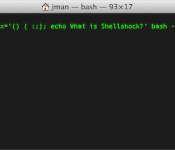
Let’s start with your computer. If you have a Mac OS X or Linux system, open the Terminal and run this line of code:
env x='() :;; echo vulnerable’ bash -c ‘echo this is a test’
If you see the word “vulnerable” as an answer, your system is, well… vulnerable.
Your Bash shell is simply running more code after a function (the “() :;;” part), and that shouldn’t be happening. The function is the “allowed” code, while everything after it is where the potentially “malicious” code could be installed.
What can an attacker do?
The remote execution (over the internet or a network) of extra code could let an attacker load malware on a system and steal private information, delete files, activate your camera, open a lock and, well, do pretty much anything with a little know-how. However, as we mentioned, this is not something that should matter much on a user’s computer with a working firewall, because it hasn’t been proven possible to take advantage of the bug under that scenario.
A server, well, that’s a completely different story, because a server has to listen to requests in order to “serve” (pun intended) its purpose. This means that by requesting almost any data and running malicious code, an attacker can infect any affected server, which is about 60 percent of web servers out on the internet, most routers (even your home router) and many consumer devices (including security cameras and “smart” appliances — which don’t seem so smart right about now). This is because smart appliances are a form of servers.
How can this problem be solved?
It’s super simple to solve this problem. Many software developers have already issued patches and more are being released by the hour. Two of the most popular Linux distributions, Red Hat and Ubuntu, already have patches available, and we suspect Apple will soon release its fix. Updating a system takes almost no time. It’s a simple process and it’s a common task for most users. The problem is with systems that are not often updated. For example: It’s not very common to update the software on your router, and even less common to update something like a door lock, a light switch or a security camera.
The internet of things complicates the situation because there are many more devices that should be updated, and for some, the manufacturers may not even issue patches. However, most of the devices are configured to function in a secure manner, behind a firewall. Regardless, if you suspect your “things” use a version of Linux (and there’s a really good chance they do), we recommend you check for updates and even inquire about them from the manufacturer.
The bottom line is: this is a serious bug, but patches are available and should be installed promptly. But, there’s no doubt we’ll be hearing plenty more about Shellshock and the problems it can cause in the coming days and weeks — especially since it’s gone unnoticed for around 25 years. There’s a lot of holes out there to patch.
Filed under: Internet, Software
.CPlase_panel display:none;
 AIVAnet