



California issues permits for self-driving car trials on public roads

The first trio of companies looking to test self-driving cars on California’s public roads got newly required permits from the state’s Department of Motor Vehicles last week. Google nabbed paperwork for taking a fleet of 25 Lexus SUVs to the streets, while Audi and Mercedes-Benz also secured written approval that’s now a must for trials amongst regular automobiles. The Guardian reports that other automakers are working on getting the proper approval for testing as well, so long as vehicles have a way for the driver to take control if needed. Of course, California has welcomed autonomous vehicles since 2012, but the state announced new rules for testing on public roads earlier this year that went into effect this month.
[Photo credit: Justin Sullivan/Getty Images]
Filed under: Transportation, Google
Source: The Guardian
.CPlase_panel display:none;

Heroes of Camelot

Heroes of Camelot is a card summoners game by Kabam. For those who do not know, a card summoners game is one where the player is given a hand of cards that act as their game characters. You build a deck or hand of these characters to fight against other decks or hands. The player generally has no control over the battles themselves. The game play consists of “exploring” game fields and leveling your cards by combining them together.
Heroes of Camelot is no different. You start off with a hand of cards and are sent off to “Reclaim Camelot from the Black Knight”. The game play is over simplified. You tap explore to advance your position in the dungeons. Occasionally, you are met by another group of characters who battle you. The player has no control over these battles as with most other card summoner games. All one can do is tap “Battle” and hope for the best.
While the player is given no control over the battles itself, they can manage their hand to ensure a higher chance of victory. To do this, one has to collect various cards with different stats and abilities. The player is left to build their deck with their various cards. The abilities are activated randomly during battle, so all you can do is make sure that you have useful abilities to ensure that whatever is activated will be useful.

Once a player has their hand built, they can also upgrade their cards. This is achieved by adding cards together to level up the base card, or merge two cards together to evolve the base card. This boosts the stats of the cards making your hand that much stronger.

Although I find most card summoner games to be boring and never end up playing on for more than 3 hours, Kabam did something different with theirs. I can’t quite identify why I am more attached to this game over others, but I actually have logged in to the game for 8 days straight now. I have never had a streak of more than 3 days in a row before.
My best guess is that I like Heroes of Camelot more than others because of their resources system. While they do have stamina and mana limiting how long you can play, I have never found it to be as much of an annoyance as I have with other games.
Mana is used to let you field your chosen cards in battle. The better the card, the higher the mana costs. Every battle, the total mana required by all of your cards is subtracted from your mana pool. My current mana pool is only able to support my cards through a single battle.
Stamina is used when you explore the dungeons. Each time the player elects to progress in the dungeon, a predetermined amount of stamina is taken from your stamina pool.
Both, your mana pool and stamina pool, are replenished each time you level up. To enable myself to continue playing, I return to past dungeons in order to gain experience and level up. That way, I can refill my mana pool in order to fight a battle in my current dungeon. Most of your game play time is spent spamming the explore button in an attempt to level up.
While there are IAPs, they are actually not required to progress in the game or to avoid waiting between gaming sessions. I have not spent a single penny on this game, and I have a very respectable hand going along with plenty of gold to pay for my card upgrades. Basically, this is in no way a “pay to win” or “freemium” style game.
After you build up your hand to a reasonable level, you can participate in PvP. You could have done this just about the entire time, but you wouldn’t win a single battle. The PvP mechanics are the exact same. Click battle, watch the cards fight it out, repeat.

Heroes of Camelot can be fun for a while, but after about two weeks to a month, I expect it to get really old really fast. There is nothing new or challenging. All I do now is tap the explore button. There is no challenges at all. It is repetitive and no real journey.
Keep in mind though, I am not a fan of card summoner games in the first place, and I have played this one for more than a week now. That is an amazing accomplishment by Kabam. For anyone who is into card summoner games, Heroes of Camelot should keep them entertained for a good while.
Deals, Discounts, Freebies, and More! Click here to save today!
The post Heroes of Camelot appeared first on AndroidGuys.
.CPlase_panel display:none;

Accessory of the Day: RAVPower dual USB power bank $34.99

Need a little portable power? The RAVPower Dual USB Charging Bank refills your battery at a speed of up to 3 amps and can fill a Galaxy S5 over three times on just one charge. There are plenty of power supply options floating around online but not many are #1 best-sellers with 5 star reviews. With a built-in flashlight and LED’s rounding out the feature set, this is a great buy at just $34.99 (Prime eligible).
Deals, Discounts, Freebies, and More! Click here to save today!
The post Accessory of the Day: RAVPower dual USB power bank $34.99 appeared first on AndroidGuys.
.CPlase_panel display:none;

AT&T rings up Samsung Galaxy Alpha for September 26

AT&T on Monday kicked off the week with a new smartphone announcement. Arriving later this week, the Galaxy Alpha brings Samsung’s new design language to the United States.
Pricing for the smartphone is listed at $612.99 outright or $199.99 with a two-year service agreement. Those who opt for an AT&T NEXT plan can scoop it up for $30.65 per month over 20 months or $25.55 per month over 24 months.
Available in Charcoal Black, Dazzling White or Frosted Gold colors, the Galaxy Alpha runs Android 4.4 KitKat. Key features include a 4.7-inch, display, 2.5 GHz quad-core processor, 2 GB RAM, 32GB of internal storage, a 12-megapixel rear/ 2-megapixel front facing camera duo. As is the case with other recent Samsung smartphones, the handset features a hear-rate sensor, S-Health, and Ultra Power Saving mode.
AT&T is still running its limited time promotion which offers $100 bill credit for signing a new line of service; the deal is good for new and existing customers.
Deals, Discounts, Freebies, and More! Click here to save today!
The post AT&T rings up Samsung Galaxy Alpha for September 26 appeared first on AndroidGuys.
.CPlase_panel display:none;
Spotlight Watch Face [‘Watch’ This App]
If you want a simple analog watch face, but sometimes have trouble reading one with small numbers, then the Spotlight Watch Face may just be the app to solve that problem for you. All it is is a watch face that is a huge close up of the hour hand with a red line going… Read more »
The post Spotlight Watch Face [‘Watch’ This App] appeared first on SmarterWatching.
Deals, Discounts, Freebies, and More! Click here to save today!
Read the rest at SmarterWatching.com!
The post Spotlight Watch Face ['Watch' This App] appeared first on AndroidGuys.
.CPlase_panel display:none;

Google employees are running Android L on the Nexus 4

When Google released a developer preview for Android L at its I/O event this summer, owners of Nexus devices were excited. However, this excitement was short lived for owners of the Nexus 4. Google only released the preview for the Nexus 5 and Nexus 7 (2013). Many believed that this meant the Nexus 4 was not going to receive the next big Android update.
Recently, it appears that a few Google employees are testing a version of Android L on their Nexus 4′s. Some Google+ users have spotted two different users claiming to be running “L” on their Nexus 4′s on code.google.com. One even specifies he or she is running build number LRW52G. This has gotten Nexus 4 owners excited because it could mean that Google will update the N4 to the latest Android version. Unfortunately, just because there are employees running “L” on a Nexus 4 does not at all mean that it will receive the update; although, the Nexus 4 has hardware that could easily run Android L considering that it will be running on the lesser-powered Android One devices that recently launched. Only time will tell if Google will update it’s two year old Nexus, but these recent findings do give N4 owners more hope.
Do you think Google will update the Nexus 4 to Android L? Tell us in the comments!
Source: Chromium post 1 and 2 ; Via: Android Police
Deals, Discounts, Freebies, and More! Click here to save today!
The post Google employees are running Android L on the Nexus 4 appeared first on AndroidGuys.
.CPlase_panel display:none;
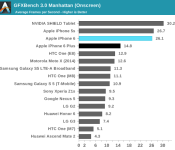
iPhone 6 and 6 Plus Top Most Benchmarks and Battery Tests, While 6 Plus Lags in Graphics
AnandTech spent the weekend benchmarking the iPhone 6 and 6 Plus, comparing the duo to the iPhone 5s and competing Android handsets. The test results show that iPhone 6 and iPhone 6 Plus models are at the top of the charts in CPU benchmarks and battery life, while the iPhone 6 Plus lags in graphics performance due to the larger screen.

In in GPU benchmarks, we generally see a pretty solid lead over the competition for the iPhone 6/A8. It’s seems quite clear that there is a significant impact to GPU performance in the iPhone 6 Plus due to the 2208×1242 resolution that all content is rendered at. It seems that this is necessary though, as the rendering system for iOS cannot easily adapt to arbitrary resolutions and display sizes.
AnandTech also examined battery life, noting that “Apple has managed to do something quite incredible with battery life. ” Even with a smaller 1810 mAh battery, the iPhone 6 manages to beat out the iPhone 5s and most other Android phones on the market. Not surprisingly with its 2910 mAH battery, the iPhone 6 Plus grabs second place behind the Huawei Ascend Mate 2.

Apple introduced the iPhone 6 and 6 Plus during its recent September press event and launched the phones on September 19. The two handsets include Apple’s new A8 processor, M8 motion co-processor, 8-megapixel iSight camera, faster 802.11a/b/g/n/ac Wi‑Fi and NFC. Demand for the two phones was high with Apple selling 10 million iPhone 6 and 6 Plus units in the first weekend of sales.
.CPlase_panel display:none;

Apple’s Ultra-Slim 12-Inch Notebook Rumored to Gain USB Type C and Fanless Internals
 Following a previous report claiming Apple’s much-rumored 12″ ultra-slim notebook is planned to arrive in silver, gold, and space gray color options, Jack March has issued a follow-up report sharing additional details on the machine.
According to March’s report, which MacRumors believes to be based on legitimate information, the new notebook has a much thinner design the appears to sacrifice many of the usual ports seen on Apple’s current notebooks and may adopt the new reversible USB Type C connector that has seen its specifications recently finalized.
A source familiar with Apple’s plans describes the 12 inch Macbook Air as having a noticeably thinner design, the source wouldn’t give dimensions however noted that the thinner design may sacrifice the standard USB port and Apple will move to the reversible USB Type C with this product, It is assumed Apple will include an adapter in the box for backwards compatibility.
Interestingly, the report raises some questions about charging on the notebook, indicating that the usual MagSafe port has been removed in favor of a new, unspecified charging method.
In line with previous rumors, the machine is reportedly fanless, suggesting it will adopt an ultra low-power processor such as the Broadwell-Y Core M processors recently announced by Intel. The body of the new notebook is also said to be narrower than the current MacBook Air, with narrower display bezels and a keyboard stretching right to the edges of the machine. Finally, the speakers are said to be located above the keyboard with visible grilles, unlike the MacBook Air and 13-inch MacBook Pro that have their speakers located underneath the keyboard.
Apple’s 12-inch notebook has been rumored for some time, with the launch perhaps being pushed back due to multiple delays for Intel’s Broadwell chips. March’s previous report indicated Apple appears to be currently looking toward a mid-2015 launch.
(Image: Chassis of current MacBook Air)
.CPlase_panel display:none;

Xprize’s next big challenge: software that lets kids teach themselves

The Xprize organization has inspired people to take on some pretty lofty goals, ranging from sequencing genomes to literal moonshots. Today, though, it’s focusing on a very practical objective: improving education for hundreds of millions of kids. Its new Global Learning Xprize will offer a total of $15 million to teams that build open source, easily scaled software that lets young ones in developing countries teach themselves math, reading and writing. Anyone hoping to join in will have 18 months to craft their tools, which will be tested in at least 100 villages. The top five entrants will get $1 million each, while the winning entry will get a hefty $10 million. It may not be the flashiest competition, but it could go a long, long way toward tackling the chronic shortages of schools and teachers that ultimately hurt kids’ futures.
[Image credit: Saeed Khan/AFP/Getty Images]
Filed under: Software
Source: Xprize
.CPlase_panel display:none;

What you need to know about the robots that feed humanity

In Iowa, there’s a 3,000-acre farm that uses machines to accomplish most tasks, from seeding to fertilizing and chemical application. This land, owned by the Mitchell family, is known as one of the most mechanized farms in the United States, and it’s far from being unique. The Mitchells and their equally high-tech neighbors are some of the top corn producers in the US, thanks to their machines. But more and more farmers in the country are also turning to agricultural robots, as laborers start dwindling in number and demands for crops and produce continue to grow. After all, they need all the help they can get to feed millions of people, since it’s just not feasible to farm by hand anymore as it was a hundred years ago. Seeing as the US population has grown by 22.5 percent between 1990 (253,339,000) and 2010 (310,384,000), and the Census Bureau expects it to balloon to 420,080,587 in 2050, you can expect to see more robots doing the dirty work on more American farms.
The Department of Agricultural and Biological Engineering at the University of Illinois at Urbana-Champaign, divides agricultural robots into three generations. The first gen is comprised of basic ones that can collect data, while the second-gen bots are capable of harvesting, seeding, spraying and cultivating. Finally, the third and most advanced generation is comprised of autonomous robots capable of caring for plants without (or with minimal) human intervention. As you can see below, American farms already use machines from across three generations, though most of the ones that fall under the third are still in development.
CURRENT AND UPCOMING ROBOTS ON AMERICAN FARMS
Some of the most well-known farming robots out there are shake-and-catch machines for oranges and other citruses, which literally shake trees side to side and up and down to harvest fruits. Obviously, they can collect fruits more quickly and efficiently than humans can, allowing farmers to plant more trees and increase their output. According to the University of Florida, a particular type of shake-and-catch machine being used to harvest oranges in the state can fill 100 boxes with fruits per hour per crew member. There are apple harvesters currently in development as well, but they’re much harder to design, since apples get bruised and damaged easily.
Earlier this year, a tree nursery in Florida hired a fleet of robots called HV100 (or “Harvey”), designed by Boston firm Harvest Automation. These Wall-E-like robots autonomously space out saplings as they grow bigger and pack them tightly when it’s time to sell them.
Just like Harvey, Blue River Technology’s Lettuce Bot is an automaton, which, as you could guess, can make sure rows upon rows of lettuce are growing perfectly. In 2012, a Lettuce Bot prototype was tested at “the Salad Bowl of the World,” Salinas Valley, where it crawled along rows of green veggies like a strict teacher doing rounds during an exam. The robot analyzes each plant, comparing it against more than a million images of lettuce in its database, to determine whether it’s a weed (or an errant lettuce growing too close to another) that needs to be eliminated. Its creators plan to tweak Lettuce Bot in the future, so it can be used on other crops.
A Minnesota company, on the other hand, spent 14 years developing a tractor that drives itself. It doesn’t use GPS so it can’t navigate streets like Google’s autonomous car can — instead, it responds to ground-based transponders planted around the perimeter of your land. The self-driving vehicle finds its way around the field based on the map it created after you take it around for the first time. To be sure that it doesn’t accidentally go on a rampage, its creators designed it to shut down if a transponder determines that it’s straying from its path. It’s also equipped with radar in order to avoid trees and other objects. The company believes that the tractor has potential to be used for mining and groundskeeping vehicles. There are also many monitoring robots like one San Diego company’s Crop Load estimator, used to estimate the amount of fruits of vegetables that a farmer can expect.
It’s not just fruit and veggie farmers that are going high-tech, though: many American dairy farmers have started using robotic milkers. They actually just set up these milkers on their farm, allowing cows to line up for milking whenever they want. Aside from being able to milk the animals, though, the machines can also monitor how much each cow has eaten, the number of steps she’s taken per day and, of course, the amount and quality of milk being produced.

AERIAL DRONES FOR FARMS OF THE FUTURE
While we always hear about drones being developed for the military and law enforcement, at least one person in the industry believes it has bigger potential in agriculture. Speaking to Wired, Chris Mailey of the drone promotion organization AUVSI, says farming has fewer hurdles to overcome and, at the same time, farmers are motivated by the potential rewards of early adoption.
While the Federal Aviation Administration hasn’t approved drones for farming yet, it’s already begun testing one, (which can not only monitor crops’ condition, but also test soil quality) in North Dakota. Some farmers are already using drones, though, such as this 17-year-old Redditor from Southwest Kansas, who flies a drone from Kansas company AgEagle over his family’s land to take infrared images of their crops and determine their health. His family then uses data gathered from those infrared images to adjust fertilizer distribution, as needed. Most aerial drones for farming have the same function, giving farmers an aerial view of their crops so they can save water, chemicals and fertilizer.
THE FUTURE OF ROBOTIC FARMING
Farm robots are not without fault. The Mitchells and their neighbors machines, for instance, have weakened the soil in the area and made it prone to erosion. Still, there’s no going back now, and you’ll likely see a variety of machines performing different functions on big farms across the globe. The US, in particular, seeks to develop better robots for the country’s farmers: the Department of Agriculture and the National Institute of Food and Agriculture are currently spending the $4.5 million funding they set aside in 2013 to fund various agrobot projects. Long story short, it’s just the beginning for robot-powered agriculture.
[Image credit: University of Florida (orange harvester), Draganfly (drone)]
.CPlase_panel display:none;
 AIVAnet