



Politician wants Iceland to become ‘the Switzerland of bits’

Birgitta Jónsdóttir was sitting in the audience at the Icelandic Digital Freedom Conference when John Perry Barlow, a co-founder of the Electronic Frontier Foundation called for Iceland to “become like the Switzerland of bits.” Six years later, Jónsdóttir is trying to make that dream a reality. She was elected to parliament in 2009 and has proven to be one of the most tech savvy and outspoken members of Iceland’s government. Last year she was one of three members of the Pirate Party elected at a national level, and she is spearheading efforts like the Icelandic Modern Media Initiative, which focuses on protecting whistle blowers, journalists’ sources and ensuring the freedom of information. Some of this work has been done in conjunction with the controversial organization headed by Julian Assange, WikiLeaks. While the implementation of many of these ideas has been far from perfect, the country has made great progress towards becoming a safe haven for data, in the same way that Switzerland has become the defacto repository for wealth — whether it was gained honestly or through less that noble means. And Jónsdóttir has pledged that she will continue to fight. Especially after discovering that she, herself, was the target of surveillance by the US Department of Justice.
For more on Birgitta Jónsdóttir check out Motherboard’s excellent profile here.
Photo courtesy of re:publica 2014/Flickr
Filed under: Internet
Source: Motherboard
.CPlase_panel display:none;
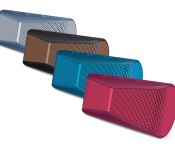
Which portable speakers are worth buying?
 While some people like to listen to their favorite music on a quality sound system with a set of high-end speakers or headphones, most people are just fine listening from a cheap headset or the built-in speakers on their phones. But what if you’re somewhere in the middle, and want your music to be portable, but still sound great? Plenty of companies have stepped up to give you just that, releasing speakers that deliver solid highs and clear lows, all in a package that you can fit in a bag. There are too many out there for us to review ourselves here at Engadget, so we’ve pulled together reviews from sources we trust to help highlight some of the better recent options.
Filed under: Sony
.CPlase_panel display:none;

US Navy’s Triton UAV completes first cross-country flight

While Triton — the US Navy’s largest unmanned craft — might have no one in the cockpit, it still requires a hefty ground team to keep it (safely) in the air. Never more so than on a recently completed cross-country flight. Back in March, the Northrop Grumman craft completed initial flight testing, but this 11-hour 3,290 nautical mile flight is the most intensive testing yet — bringing it ever closer to the estimated 2017 delivery into operational Naval fleets. Triton’s route took it from from Northrop Grumman’s Palmdale, California base along the southern US border, before a successful landing at Naval Air Station Patuxent River. Triton spends most of its time at around 50,000 feet — well above domestic flights — but has sensors that allow it to safely descend through cloud layers for closer observation of enemy ships as needed. Watch Triton pull off its silky smooth landing after the break — human pilots take note!
Filed under: Transportation
Source: US Navy
.CPlase_panel display:none;
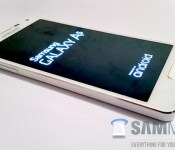
Samsung’s Galaxy A5 has some Alpha style, but not the substance

Samsung likes to get some mileage out of its lofty design themes and plenty of people have gone gaga over the Galaxy Alpha’s subtle style, so it’s no surprise that the phone’s design DNA is being injected into other devices. SamMobile has been reporting for a while now that the Korea electronics giant has been working on a range of phones — the so-called A series — that feature some of the Alpha aesthetic, and now they’ve obtained images of the first one. It’s called the Galaxy A5, and if these reports hold true it falls very firmly onto the middle of the road. There’s a 5-inch Super AMOLED screen running at 720p up front, paired with a 13-megapixel rear camera and a Qualcomm Snapdragon 400 chipset ticking away within the minimalist frame that may or may not actually be made of metal. Yeah, we know, it’s a bummer, but the more modest price tag that’ll almost assuredly stick to it might make the change in materials worth it.
Source: SamMobile
.CPlase_panel display:none;

Tesla Model S update brings calendar integration and traffic-based navigation

If you look at the changelog for Tesla’s Model S, you’ll see most of the updates have been minor bug fixes; it’s fairly rare that the luxury electric vehicle gets upgraded with new features. Every once in a while, though, Elon Musk and co. unleash a meaty update and as it happens, today is one of those days. The company just released the (previously leaked) version 6.0 of its software, which adds a built-in calendar that syncs with your smartphone, along with a remote-start feature and traffic-based navigation to help you avoid the busiest roadways.
Calendar app w tap to nav & traffic predictor in Tesla V6.0 release will radically improve how the car adapts to the owner over time
– Elon Musk (@elonmusk) September 20, 2014
Starting with the calendar, you can see a daily view of your appointments on the in-car display. If you’ve already added a location, you can tap it to immediately bring up driving directions. Meanwhile, the traffic-based navigation basically sounds like what Google Maps does to warn you of clogged roads. In this case, the Model S monitor real-time traffic conditions based on data collected from other Tesla drivers, and it also gives you a pop-up notification if it thinks you should take a faster route. Rounding out the list, Tesla now lets you start the Model S using your phone — a handy feature if you forgot your key fob.
That’s it for major features, though the update includes a few smaller tweaks as well. A location-based air-suspension feature knows where you previously chose high ride heights and then remembers to adjust the air suspension should you ever return. Finally, you can give your car a nickname in the app, while a new power management setting allows you to automatically put the Model S into energy saving mode at night. The update is available now — just make sure first that you’re using the latest version of the Android/iOS app.
Filed under: Transportation
Via: The Verge
Source: Tesla
.CPlase_panel display:none;
Fingertip sensor lets robots ‘see’ what they’re touching

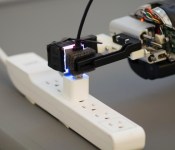
We’ve seen robotics improve by (literal) leaps and bounds recently, but what about more nuanced things, like a fine sense of touch? Researchers at MIT and Northeastern University are showing off a new fingertip version of the GelSight sensor, a cube-shaped attachment that uses a camera and a sensitive rubber film to 3D map the objects they’re grabbing. That new level of precision, the team says, could lead to more independent robots that are better able to manipulate their environment.
In the team’s demo (shown in the video above), a Baxter robot from Rethink Robotics uses its standard sensors to grab a dangling USB cord. At that point, the GelSight sensor attached to the robot’s two-pronged hand susses out the finer details, specifically the raised USB logo embossed on one side of the plug. The sensor’s cube-shaped housing features a thin rubber film covering one side. That layer conforms to whatever is being pressed against it, while multicolor LEDs bounce light off the resulting bumps and ridges. A camera then uses that data to build a 3D depth map of the object. Using what it knows about USB connector design, the system can then position the plug accurately enough to place it in an adapter plugged into a power strip below.
While the sensor isn’t quite as accurate as earlier, larger iterations of the GelSight tech, the team says the fingertip-mounted version still demonstrates about 100 times more sensitivity than a human finger.
[Image credit: Melanie Gonick/MIT]
Source: MIT News
.CPlase_panel display:none;
MIT can turn your smartphone into a different kind of second screen

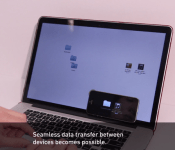
Sure, we’ve seen apps that let you easily share files between your phone and PC. No biggie there. But the demo we’re about to show you is a tad more sophisticated than that. Over at MIT, two teams of researchers have developed a smartphone system called THAW, which allows you to share files and use the phone as a game controller — all by pressing the handset against your computer’s display. As you can see in the below demo video, for instance, it’s possible to transfer files onto the phone simply by dragging them where the phone is, as if it were just another folder on your desktop. Similar to what you can already do with NFC, you can press the phone against the screen, and walk away with whatever web page you had been looking at. (To be fair, iOS 8’s Continuity feature does that automatically.)
Most interesting of all, perhaps, are the implications for gaming. Indeed, the researchers’ nearly four-minute video spends more time on desktop games than any other use case. For starters, the phone can act as a boundary for something in the game — the equivalent of a wall, or a rock, that a character has to jump over. Additionally, the handset can become a “container” (for lack of a better word), which you can use to carry a character or object out of the game, and then redeposit them somewhere else on the screen. Alternatively, by holding the phone over the display while a game is in progress, you can alter the behavior of a game — maybe that Guillotine of Doom moves a bit slower when the phone is there.
Throughout, the phone never obscures what’s on the screen; it actually reflects it, as if the entire phone were a see-through piece of glass. The trick: Your phone’s rear camera captures imagery on the computer, while additional software processing on the handset allows you to manipulate objects from your handheld device. As always with prototypes, there’s no guarantee if or when this will come to market. As MIT describes it, though, it seems this could work on any handset with a rear camera and possibly an accelerometer. In other words, any modern smartphone.
Filed under: Cellphones, Science, Mobile
Via: PhysOrg
Source: MIT
.CPlase_panel display:none;
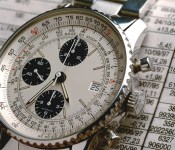
Researchers have created an oscillator that could silence the mechanical watch

You’re running late to a meeting, glaring at your wrist in disbelief that it’s fifteen minutes past the hour. Are you really that late? Lifting the watch to your ear you hear the all-too familiar tick of its internal mechanisms. Yes, it works — and you are indeed late. This scenario could soon be a thing of the past, mostly because the mechanical watches of tomorrow may not tick at all. Researchers at École Polytechnique Fédérale de Lausanne have created a new, silent oscillator that could potentially be used to make watches with fewer mechanical parts.
It’s not a digital conversion — watches built on EPFL’s new technology would still very much be mechanical timepieces, they would just operate on different principals. The new oscillator, which is called IsoSpring, turns continuously in one direction instead of using gears and a balance wheel to alternate between oscillations. Right now, the team is working on miniaturizing the technology to fit in clocks and watches. If successful, it’ll mean more than just silent time pieces, but perhaps longer lived ones, too: traditional watches lose 60% of their energy to mechanical parts. Hate ticking, but can’t wait for the new technology? Well, there’s always smart watches.
[Image Credit: Getty Images]
Filed under: Science
Via: Phys Org
Source: EPFL
.CPlase_panel display:none;

Engadget Daily: NVIDIA revisits the moon landing, why Microsoft is buying ‘Minecraft,’ and more!

Still don’t believe man journeyed to the moon? According to NVIDIA’s recreation of the landing site, it definitely happened. But that’s not all we have on deck for the weekend. Read on for Engadget’s news highlights from the last 24 hours, including a review of a WiFi-enabled crock pot and personality analysis based on your Twitter feed.
.CPlase_panel display:none;

The first zero-g 3D printer is about to launch into orbit

Gravity. More than the name of a killer movie, it’s likely something we take for granted every single day. After all, nearly everything we do is reliant on the idea that stuff stays in place when we stop holding it. Astronauts don’t have that luxury, however, and when even simple tasks take a ton of effort, something relatively complex like using a 3D printer is even harder. Why would astronauts need one of those? Well, because stuff breaks in space, and replacing a busted part isn’t as simple as hitting Home Depot — just ask the crew of Apollo 13. To help get around that, the folks at Made in Space have designed a 3D printer that circumvents the lack of Earth’s gravity when used in orbit. Instead of molten filament essentially “stacking” on itself to form an object like it does planetside, according to The Verge, the Zero-G Printer liquid’s surface-tension holds a widget together.

If everything goes according to plan (an August launch was scheduled previously), the proof-of-concept model pictured above will launch into orbit early tomorrow morning aboard a SpaceX Dragon rocket at 2:14 AM ET / 5:14 AM PT (you can watch the launch live on NASA TV, the stream is embedded below). Should the unit prove worthy in its test run, the outfit says a larger model capable of printing with harder plastics could eventually start manufacturing, among other things, commercial micro-satellites on-board the International Space Station. There are also plans to make a gizmo that’d allow astronauts to melt tools down and repurpose the plastic into another tool when the need came. Made in Space says that this focus on sustainability could bring down costs — and launch weight — by effectively letting Mission Control email plans for a part to the astronauts instead of launching a rocket every time a petri dish or something else is needed. The team is even toying with the idea of sending 3D-printing robots to Mars or the moon and using their respective soils as printing material for future structures. Crazy!
[Base image credit: FragileOasis/Flickr]
Via: The Verge
Source: Made in Space
.CPlase_panel display:none;
 AIVAnet