


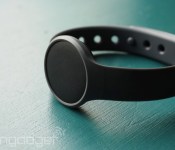
Misfit’s new activity tracker is a cheaper, plastic version of its first

This week, Misfit announced its second wearable activity tracker… or did it? It’s called the Flash, and essentially, it’s a clone of a product the company already makes: the Shine. Both are small tokens capable of recording steps and sleep, as well as figuring out when you’re doing more vigorous activities like cycling, swimming or playing tennis. So, where’s the incentive? Well, that lies in the price, as the Flash costs half as much as the Shine at $50 or £50 — or it will, anyway, when it launches in the US mid-October and in the UK a month later. Catching up with Misfit in London, we had a chance to check out the Flash, which is just that little bit bigger and fatter than the Shine. The front and back are also flat this time ’round, rather than convex, but the main difference is the materials used to make it.
To make the new price point work, anodized aircraft-grade aluminum has given way to a textured, rubbery plastic. In fact, it’s the same material used for the Shine’s sporty wrist mounts, since Misfit already knows it doesn’t cause skin irritation (shoutout to Fitbit). On that note, the included sports band and clip mounts have been redesigned for the Flash. You can only pop the token in from the underneath, and a lip on the front side keeps the thing from escaping in that direction — this was a problem with the Shine that later generations of accessories have begun to address. Misfit also tells us that a simpler design means the battery, which keeps the token running for around six months, should be easier to replace.

Other changes include the central button on the face of the Flash (hidden under the malleable plastic), which illuminates a ring of LEDs to show you how much progress you’ve made towards the next activity goal. On the Shine, you did this by double-tapping the touch-sensitive panel on the front of the token. Barring a few new colors options and lower waterproof rating (up to 30m compared with 50m for the Shine), then, it’s more or less the same product for half the price. Misfit isn’t too worried about cannibalization, however, banking on one group of consumers who’ll prefer the more premium design of the Shine, and another who’ll favor the value proposition the Flash offers. And with its low price point, the hope is the Flash will attract a whole new demographic of users that wouldn’t have bought a Shine anyway.

To coincide with the Flash’s launch, Misfit has also gone about updating its mobile apps. Formerly known as the Shine app, the new Misfit app works with both devices, and you can sync multiple tokens to the same smartphone or tablet. Also, based on user feedback, yoga and dance (Zumba time!) have been added to the list of activities the Shine and Flash are able to track. While the Android version has already been updated with these features, the iOS app isn’t expected to receive them until next week, as soon as the Apple overlords have given it the green light.
Filed under: Wearables
Source: Misfit
.CPlase_panel display:none;

Tech giants team up to build friendlier security tools

If there’s one overarching, fundamental truth about the internet, it’s that you’re never as safe as you think you are. Dropbox, Google and the Open Technology Fund get that all too well — that’s why they (along with a slew of security researchers) teamed up to launch a new organization called Simply Secure. The name says it all, really — everyone involved knows there are plenty of effective digital security tools floating around, but not very many of them are designed with friendliness and ease of use in mind. That’s where Simply Secure comes in.
The group (headed by former Google project manager Sara Sinclair Brody) wants to develop its own open-source tools that wrap powerful online security measures in a tasteful, thoughtfully designed veneer that means the less-than-tech-savvy get to be as safe as we nerds without poring through tomes or scrutinizing FAQs. It’s still early days for the project, so it could be a long while before we catch a glimpse of what the team actually cooks up. Still, Google managed to paint a (pretty vague) picture of what Simply Secure might tackle on its Online Security blog, noting that the group will work the developers of projects like Open Whisper Systems and Guardian to make them easier to average folks to grok.
Via: BusinessWire
Source: Simply Secure
.CPlase_panel display:none;
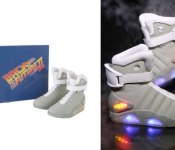
You can now buy Marty McFly’s light-up high-tops for under $100

For some people, the holographic movie posters and hoverboards from Back to the Future II’s Hill Valley are nothing compared to Marty Mc Fly Jr.’s self-lacing Nike Air MAGs. Of course, when the sportswear company released a limited-edition set for Michael J. Fox’s charity, they came without the self-lacing aspect and a prohibitive price tag. Nike may be promising the real deal next year, but in the meantime, Universal Studios has signed a deal with HalloweenCostumes.com to keep us all tied over. The fancy dress website has produced a set of knock-off lookalike Air MAGs with light-up soles that’ll go great with your pink Zboard and DeLorean DMC-12. Fitting with a wrap-around velco strap, the internal battery is charged with a USB cable that’s included within the BTTF II-branded box, and the whole package, priced at $99, is slated to arrive at the end of September.
Via: The Mirror
Source: Halloween Costumes
.CPlase_panel display:none;

Larry Ellison steps aside as Oracle CEO, former HP exec Mark Hurd promoted

Usually the only time we talk about Oracle is in relation to its battle with Google over Java and the use of related APIs in Android, but not today. At the age of 70, co-founder Larry Ellison is stepping down from the post of CEO and moving to a new post as Executive Chairman of the Board and CTO. Taking over the reins of the enterprise software company is the duo of Safra Catz and Mark Hurd. You’ll recall Hurd as the former CEO of HP, who resigned from that company over a sexual harassment investigation and false expense reports, and then became the target of an (eventually resolved) lawsuit when he joined Oracle four years ago. His awkward exit resulted in collateral damage to HP acquisition Palm, and by extension webOS. The trio of Ellison, former CFO Catz and Hurd will share responsibilities going forward, with Ellison stating in the press release that the only difference is “Safra and Mark will now report to the Oracle Board rather than to me.”
[Image credit: NBAE/Getty Images]
Pictured above at a Golden State Warriors game, it doesn’t appear that Larry is going to sink his billions into a team Ballmer-style as Oracle claims he will “keep working full time and focus his energy on product engineering, technology development and strategy.” Of course, with an array of boats, planes, islands and everything else a net worth in the neighborhood of $50 billion gets you, we’re figuring a vacation or two is due.
Source: Oracle
.CPlase_panel display:none;
 AIVAnet