


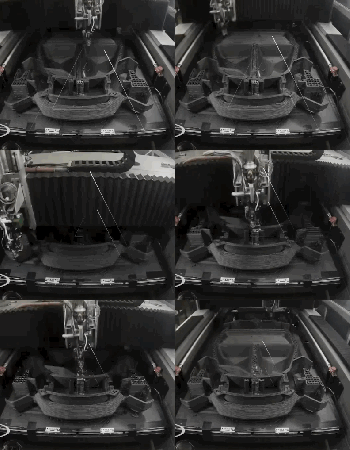
Someone’s trying to 3D print (most of) a car in six days

You can probably get quite a bit done by yourself in six days time, but could you build an entire car from scratch and take it for a test drive? Probably not. The folks at Local Motors are pretty confident that their 3D-printed car can roll out of Chicago’s McCormick Place and go for a spin this Sunday, though. Printing started a few days ago at the International Manufacturing Technology Show in The Windy City, using carbon-reinforced plastic and a Big Area Additive Manufacturing printer, according to 3DPrint. Not everything on the car can be 3D printed mind you, that’d just be crazy. The Strati still needs a battery, engine, wiring and suspension, which, as IGN notes, will be sourced from a handful of suppliers rather than being manufactured onsite. If all goes according to plan, Local Motors hopes to offer “production-level” 3D printed vehicles in the coming months. It isn’t an Aston Martin, to be sure, but aside from a DB4, what is?
Really starting to look like a #car… #3DPrintedCar #epic #IMTS2014 #strati pic.twitter.com/1aiA9vqMI9
– Local Motors (@localmotors) September 11, 2014
Filed under: Transportation
.CPlase_panel display:none;

Nikon’s full frame D750 packs a tilting LCD and WiFi for pros on the go

Rumors of the full frame Nikon D750 have been floating around for a little over a month now, and where there’s smoke there’s usually a fire. To wit: Nikon just officially pulled back the curtain on its latest SLR, and it packs quite a bit of oomph into a body that’s only $2299. The D750’s foundation is awfully solid with its 24-megapixel FX format CMOS sensor, an Expeed 4 image processor (the same one seen in bodies like the much pricier D810), a more light-sensitive 51-point autofocus system, and an ISO range that stretches from 100 to 12,800. Oh, and did I mention it packs better battery life and some carbon fiber trim to keep the weight down? What might really put the D750 over the top for some of you, though, are some of the firsts that it boasts.
It’s the company’s first FX format camera to have a tilting LCD screen (we’re looking at 3.2-inches diagonal) and the first to have built-in WiFi — all of that has been crammed into a body that’s thinner than usual thanks to some savvy internal component shuffling. Nikon’s given the thing enough horsepower to make it worthy of slipping into a pro’s bag, but it also pegs the D750 as a worthy upgrade for photogs with a more modest amount of experience under their belts and a selection of DX lenses they don’t want to give up. As a concession to some of those greener camera buffs, Nikon has also included a slew of scene modes and effects too, just in case they’re more concerned with grabbing fun shots than stunningly composed ones. Interest piqued? You’ll be able to pick up the body by itself or with a 24-120mm f/4 VR kit lens by the middle of October… though if you’re feeling the latter, you’ll still need to wait for Nikon to disclose its price tag.
.CPlase_panel display:none;

Viber’s latest shot at Skype: video calling on Android and iOS

Viber really, really wants you to abandon Skype and all those other messaging apps, so its latest update adds an important feature for something in its category: video calls. The Rakuten-owned app now gives you the power to video chat with friends on Android and iOS, almost a year after it introduced the capability to call any number you want. And, in case you want to switch devices in the middle of a conversation, you can transfer video calls from mobile to desktop (where the feature’s been available for a while) and vice versa. Other than that, Viber 5.0 now lets you add friends quickly by scanning QR codes, but that sounds like a lackluster afterthought compared to video calls, doesn’t it?
[Image credit: Sam Azgor/Flickr]
Filed under: Cellphones, Mobile
Via: The Next Web
Source: iOS, Google Play
.CPlase_panel display:none;

Apple Store Down Ahead of iPhone 6 and 6 Plus Pre-Orders
Apple has taken its online store down in order to prepare for the launch of iPhone 6 and iPhone 6 Plus pre-orders. Pre-orders for the two devices are expected to begin at 12:01 AM Pacific Time or 3:01 AM Eastern Time on September 19, on Apple’s site and on several carrier sites.
Ahead of pre-orders, prospective iPhone 6 buyers should make sure to check both their upgrade eligibility and their trade-in options for old devices.

Apple’s iPhone 6 is available in 16, 64, and 128 GB capacities in the United States for $199, $299, and $399, respectively, with a two-year contract. Contract-free pricing begins at $649. Apple’s higher-priced iPhone 6 Plus is available in 16, 64, and 128 GB capacities for $299, $399, and $499, respectively, with a two-year contract. Contract-free pricing on that device begins at $749.
Apple will be accepting pre-orders in the United States, Australia, Canada, France, Germany, Hong Kong, Japan, Puerto Rico, Singapore, and the UK, with the phones available in retail stores beginning on September 19.
.CPlase_panel display:none;

US government threatened to fine Yahoo $250,000 a day to force access to user data

Back in 2008, in the days of the BlackBerry Storm, netbooks and well, yes, Yahoo, the internet company was threatened with a hefty $250,000 per day fine from the US government. This was because it didn’t want to comply with requests to hand over user communications. Yahoo believed that the request was unconstitutional, and while the company fought a legal battle to avoid handing over the data, it was an unsuccessful one. The court loss was apparently a key moment in the creation of the NSA’s PRISM program, and meant that Yahoo was also one of the first to provide information, followed soon by the likes of Google, Apple and AOL. Yahoo faced a hostile public after the Snowden leaks revealed the NSA’s monitoring of online activity and the collusion of several tech companies. “The released documents underscore how we had to fight every step of the way to challenge the U.S. Government’s surveillance efforts,” added Ron Bell, the company’s general counsel — in a Tumblr post, naturally.
Source: Washington Post, Yahoo (Tumblr)
.CPlase_panel display:none;

Google buys an online polling startup to help improve Google+

You know what Google+ really needs, more than anything else? Polls.
Right, maybe not, but Google did just acquire a startup (yes, another one!) called Polar that specialized in crafting buzzy online polls like “Who did a better job hosting ‘The View’?” and “Is WhatsApp worth $16 billion?” (no, really) for media outlets and website operators. While it wouldn’t be impossible for those sorts of click-driving questions to find a new home in Google+, that’s not really why Google opened its checkbook. As the New York Times points out, this was actually an acquihire — a deal meant more to snag the people behind the product than the product itself. Those folks (including co-founder Luke Wroblewski, a big proponent of mobile-first design) are joining the Google+ team to do, well, no one really knows yet. Google VP of engineering Dave Besris cryptically noted on his own Google+ page that they’d be working on making the maligned social service “even more awesome,” which in this case apparently means helping fine-tune the Google+ experience, especially when it comes to those small screens we carry with us everywhere.
Via: New York Times
Source: Polar
.CPlase_panel display:none;

Engadget Daily: Moto X review, ‘Ninja Particles’ and more!

Ninja Particles? Yep, IBM’s new superbug-fighting nanobots are even cooler than their name. But that’s not all we’ve got on deck today. Read on for Engadget’s news highlights from the last 24 hours.
Filed under: Misc
.CPlase_panel display:none;

Facebook wants to know why you don’t like its ads

Advertising comes hand-in-hand with almost any free service on the internet, but those ads are only useful to companies if you actually look at that them. Facebook has been trying to filter out unwanted ads for awhile, but now it’s taking a direct approach: it’s simply asking users what they don’t like. From now on, whenever users select “I don’t want to see this” on an item in their newsfeed, Facebook will ask why: is it offensive? Is it spam? Have you seen this ad before? In all, the social network will give users five options to chose from and use the data to adjust ad distribution accordingly. In tests the feature showed a significant reduction in ads reported as inappropriate. Check out the company’s official announcement at the source link below.
Via: TechCrunch
Source: Facebook
.CPlase_panel display:none;

You can buy those excavated ‘E.T.’ cartridges at auction soon

It would seem that the saga of Atari’s video-game mass grave in New Mexico is coming to a close. The Alamogordo City council has voted unanimously to auction off half of the recovered cartridges (around 800 of ‘em, according to Reuters). Interested in owning a piece of history? Eurogamer says that we should see the items — a likely majority of which will be E.T. — pop up on eBay and the council’s website within the next few weeks. Of the remaining carts, the city plans to keep 500 of them and the rest will be donated to museums. If you still can’t get enough of the tale, there’s always the upcoming Microsoft-backed documentary and our own interview with E.T.‘s sole developer, Howard Scott Warshaw. The move to sell these to the highest bidder instead of at a fixed price is a pretty clear indication that city is being a bit opportunistic and taking advantage of nostalgia, if you ask us — something that probably rubbed off from Atari itself.
Filed under: Gaming, Home Entertainment, HD
Via: Eurogamer
Source: Reuters
.CPlase_panel display:none;

‘Virtual Reality Camera System’ uses 6 Red Dragons to make 360-degree video magic

Oculus/Facebook, Samsung, Sony, Google. We’re about to be flooded with virtual reality hardware, but what about content? While John Carmack works on the gaming side, the folks at NextVR (formerly Next3D) have been developing camera rigs to record live video in full surround that will let VR units put you anywhere in the world you want to go, and here’s the latest one. Red Camera’s Jarred Land spilled the beans, posting pics of this “Virtual Reality Camera System” which links six of his company’s 6K Dragon cameras together in a rather monstrous-looking array. There should be demo footage on display at the IBC conference, but based on what we’ve seen from NextVR already, the potential is high. There aren’t any cameras pointing up (or down) but previous systems from NextVR have used fisheye lenses to expand their range, and we expect something similar would be in store for this. NextVR is providing video to go along with Samsung’s Gear VR headset when it launches and it’s working with Oculus too. Judging by this setup more video experiences — whether live streamed or recorded — will be coming to the VR space soon.
Filed under: Cameras, Home Entertainment, HD
Source: Reduser.net, NextVR
.CPlase_panel display:none;
 AIVAnet