



Apple Store App Gets Redesigned Look, Improved Navigation
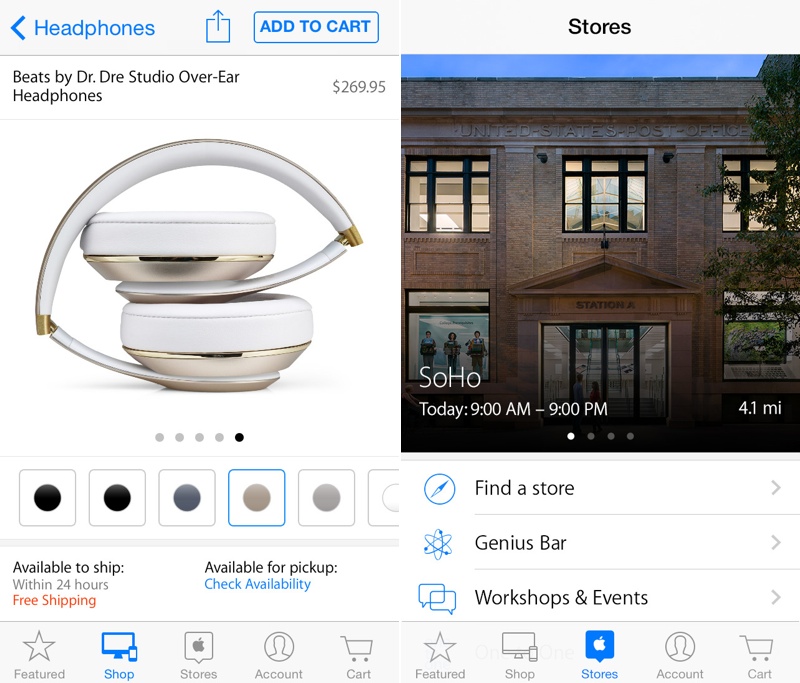
 Apple today updated its Apple Store app to version 3.0, adding several new improvements and design updates. The app now features new icons along the bottom bar, with the “Products” section renamed to “Shop” to make it easier for users to make purchases within the app. The overall app icon has shifted from a cart to a bag.
There’s also a new icon for “Stores,” and an “Account” tab that replaces the previous “More” tab. Several other UI elements have been redesigned as well, giving the iPhone app a cleaner feel that’s more in-line with the iPad version.
According to Apple’s release notes, it’s now possible to start shopping on one device and seamlessly switch to another device, including a Mac or PC. That means that a user who puts an item in the cart in the app will see the same item in the cart on Apple’s website if logged in, allowing for easy transitions between devices.
Along with purchasing improvements, the “Stores” tab has been updated to display information about upcoming events at a user’s local retail location, and the app, which is now universal, has been updated with the ability to create One to One reservations on the iPad.
What’s New in Version 3.0
– Now start shopping on one device and finish on another, or even on your Mac or PC.
– Find out about upcoming events and workshops at nearby Apple Retail Stores using the new Stores tab on your iPhone.
– On iPhone and iPod touch, there’s an all-new design with more refined navigation and imagery.
– On iPad, you can now make One to One reservations.
The update to the Apple Store app comes just days before Apple’s upcoming iPhone 6 event and a few weeks before the iPhone 6 is expected to go on sale. Prior to this update, the Apple Store app was last given a minor update in March to add notification improvements. The app’s last major update came in late 2013, when the company released a version of the app for the iPad.
Apple’s newly updated Apple Store app can be downloaded from the App Store for free. [Direct Link]
Update: As the iPhone version of the Apple Store app is now universal, replacing the original Apple Store app for the iPad, users in countries outside of the U.S. are now able to install the app on their iPads. Previously, the Apple Store app for the iPad was limited to U.S. customers.
.CPlase_panel display:none;

IBM wants to kill the hard drive it invented

Saving files to memory is something that’s supposed to be mostly invisible for the end user. We don’t need to think about it; it just has to work. But whether it’s a solid-state or hard disk drive, conventional storage solutions have their limitations — namely, speed, rewritability and durability. A team at IBM Research’s Almaden facility in California has a cure for all of that and it’s called “racetrack memory.”
Stuart Parkin, an IBM fellow heading up research into the field of magnetoelectronics and spintronics, is the man overseeing the creation of this new storage solution that’s poised to kill your hard drive. Which is ironic because IBM invented the HDD back in the mid-1950s. So what exactly is racetrack memory? Imagine a series of tiny magnets, all built one atomic layer at a time by Parkin’s team, that can be moved up and down along a (figurative) racetrack “in a highly coherent fashion” with the application of a simple current. That arrangement not only guarantees increased read/write speeds, but it’s also cheaper to produce, is incredibly resilient due to the lack of moving parts and boosts storage capacity significantly.
Already, Parkin’s team has been able to demonstrate the advantages of this new storage solution by applying it to existing flash memory chips. His team was able to generate about “250 of these magnetic domain walls in one racetrack” which, when applied to flash, could increase storage capacity by a factor of 100. And, what’s more, it won’t ever wear out, meaning it’d be infinitely rewritable. That’s something flash memory simply cannot do in its current state.
Watch as Parkin explains how racetrack memory could pave the way for more efficient, more compact computing devices.
Stay tuned for part two of our inside look at IBM’s Almaden research facility.
[Image credit: Jacob Haskew/Getty]
.CPlase_panel display:none;
Get an Inside Look at Apple’s Early Field Failure Analysis Program Ahead of the iPhone 6 Launch [iOS Blog]
Ahead of the iPhone 6′s launch, Adam Satariano of BloombergBusinessweek has shared some details on Apple’s early field failure analysis (EFFA) program, designed to solve potential iPhone issues quickly and efficiently. The EFFA Program, which is run by Apple’s AppleCare team, has been in place since the late 1990s.
As outlined by Satariano, shortly after any iPhone release, the EFFA program sees couriers shuttling defective units received from returns to a testing room in Cupertino, where they are inspected by iPhone engineers in an attempt to fix problems in a timely manner. As soon as a fix is in place, it’s deployed across the company’s global supply chain.

“They take them apart to diagnose what’s happening right then and there,” says Mark Wilhelm, who helped lead Apple’s returns program. […]
Often, they jury-rig a hardware fix, then coordinate a solution across Apple’s global supply chain. Sometimes the problems can’t be solved quickly–remember Apple Maps leading people astray. “Every day they don’t recognize a problem, they are potentially manufacturing more bad products,” says Michael Fawkes, the former head of supply chain for Hewlett-Packard (HPQ).
With the EFFA program, engineers in Cupertino learn of a potential problem as soon as a return is made in a retail store, and the serial numbers of each device allow the company to track defective devices down to “individual workers on an assembly line.”
An example of EFFA in action came in 2007, with the release of the original iPhone. Several devices returned with a faulty touchscreen caused by an earpiece flaw that let in a user’s sweat. Apple engineers fixed the problem with a new coating, which rolled out to assembly lines shortly after and prevented a more widespread issue.
According to former employees, EFFA testing is most crucial during the weeks after a device first launches, but the team remains active for many months, and publishes a weekly report highlighting common issues reported by customers. Apple’s EFFA team will be called to action in just a few short weeks, as Apple is expected to introduce the iPhone 6 at a media event on September 9, with a launch coming shortly after.
For additional details on EFFA, make sure to check out Satarino’s full piece over at BloombergBusinessweek.
.CPlase_panel display:none;

Twitter CFO hints at big changes to how your timeline works

Twitter has already started to look more like Facebook, and it might soon start acting more like it too. You see, company CFO Anthony Noto hinted yesterday that the reverse-chronological firehose of tweets that some users hold so dear may give way to a more curated collection of messages cast into the digital ether. To hear him tell it, the Twitter experience as we know it “isn’t the most relevant” to the people who actually use the service (a notion that some people would definitely disagree with). That tidbit was lodged inside a broader conversation (which the Wall Street Journal captured) about improving Twitter’s search functionality — Noto pointed out the need for “an algorithm that delivers the depth and breadth of the content we have on a specific topic and then eventually as it relates to people.” Those last few words seem crucial — it sounds like he wants the Twitter experience to become one where content is tailored and presented differently depending on how relevant it is to the user. In the end, it might wind up getting Twitter a bunch of new users (which is exactly what all those antsy shareholders want to see), but would it really be worth alienating the service’s hardcore fans?
What do you think about Twitter’s possible shift to a “filtered” feed?
Filed under: Internet
Via: Gigaom
Source: Wall Street Journal
.CPlase_panel display:none;
Apple’s Digital Stores, iTunes Radio Down for Some Users [Update: Fixed] [Mac Blog]
According to Apple’s System Status Page, some users are unable to access the App Store, iTunes Store, Mac App Store, and iBooks Store. iTunes Match, iTunes Radio, and iTunes in the Cloud also appear to be experiencing issues.
App Store users were also seeing problems accessing apps on Tuesday, making this the second outage the sore has seen this week. Problems appear to have began at approximately 1:30 PM Pacific Time, and are ongoing.
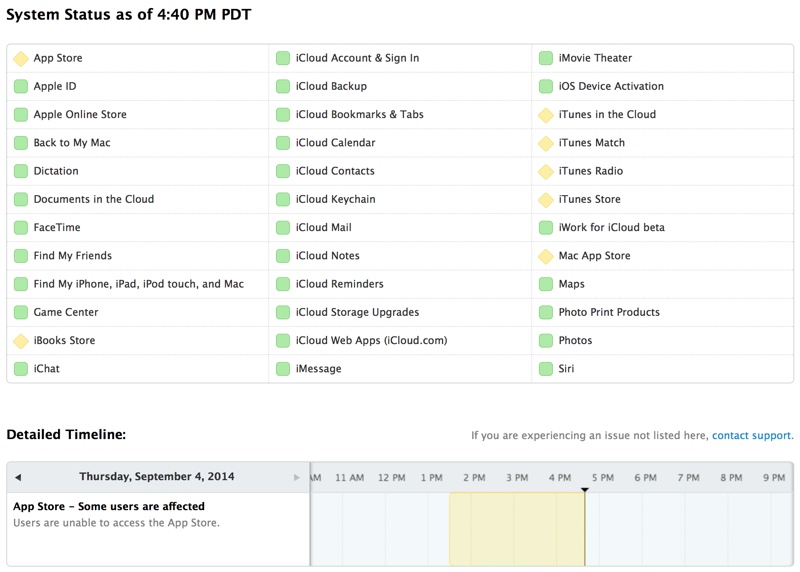
Apple does not say how many users are affected by the outage, but there are multiple reports of problems on Twitter and other social networking sites. Some users are not experiencing any issues, however, and appear to be able to access all services without a problem.
Update 5:40 PM PT: Apple’s System Status page suggests the outage is now over.
.CPlase_panel display:none;
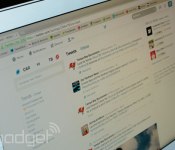
Twitter helps you keep track of NFL action with curated timelines

While you’re sitting on the sofa watching your NFL team of choice take the field, you’re likely peeking at a mobile device for updates, too. If that’s the case, Twitter is looking to lend a hand this season with curated timelines for action around the league and game-specific options. In the #NFL timeline, you can see what the folks you follow are saying with “relevant tweets” from teams, players, coaches, media and celebrities peppered in to keep you in the know. For the game-focused feed (#SeahawksvsPackers or #SEAvsGB for example), everything is distilled down to what you need to watch that particular matchup. If that sounds a bit familiar it’s because the social network did the same thing during the World Cup, and now it’s looking to keep American football fans well-informed. For now, the timelines are only available on iOS and the web, so Android users will have to sit tight for the time being.
Filed under: Internet, Software, Mobile
Source: Twitter
.CPlase_panel display:none;

Tim Cook: Apple to Add Security Alerts for iCloud Users, Broaden Two-Factor Authentication
 Apple will add security alerts for iCloud users, broaden two-factor authentication and make a more aggressive effort to alert users about protecting their accounts, Apple CEO Tim Cook told the Wall Street Journal in his first interview since the recent hacking incident involving celebrities’ iCloud accounts.
To make such leaks less likely, Mr. Cook said Apple will alert users via email and push notifications when someone tries to change an account password, restore iCloud data to a new device, or when a device logs into an account for the first time. Until now, users got an email when someone tried to change a password or log in for the first time from an unknown Apple device; there were no notifications for or restoring iCloud data.
Cook said the new notifications will begin in two weeks and will allow users to take action on potential hacking immediately, allowing them to either change the password to retake the account or alerting Apple’s security team. Cook echoed Apple’s previous press release on the hackings, stressing that the best prevention for future incidents are more human than technological.
“When I step back from this terrible scenario that happened and say what more could we have done, I think about the awareness piece,” he said. “I think we have a responsibility to ratchet that up. That’s not really an engineering thing.”
Apple will also broaden use of its two-factor authentication system, allowing it to also cover access to iCloud accounts from mobile devices like iPad and iPhone. Cook said the majority of Apple’s users don’t use two-factor authentication, so the company is planning on aggressively getting its users to turn on the feature. Cook also mentioned that had the celebrities been using two-factor verification, the hackers would not have been able to guess their security questions.
Apple has previously explored expanding two-factor authentication to some iCloud services, but an official expansion of the feature had not yet been introduced.
.CPlase_panel display:none;
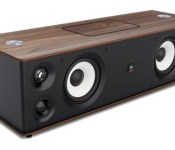
Spotify headed to Harman’s ritzy JBL wireless music docks

Want to listen to that back-to-school playlist with a bit of panache? Harman International’s chi-chi JBL Authentics L16 and L8 wireless streaming docks now support Spotify Connect streaming, letting you control songs from your phone while not actually streaming from it. On top of improving Bluetooth range, that means you can play games or surf without interrupting music playback. The Authentic devices also support Airplay and DLNA connectivity, and come with an optional Qi charging pad. If you were thinking the L16 dock shown above looks pretty posh, bear in mind that it also runs a cool $1,000 (the L8 is $500). If those figures don’t make you flinch, Spotify-equipped units are now shipping, and existing Authentics devices will receive an update soon.
Filed under: Home Entertainment
.CPlase_panel display:none;

Google and EA animate trash talk with the Madden ‘GIFERATOR’

The NFL regular season kicks off tonight, and to make sure you’re properly amped for the week’s action, EA has teamed up with Google for some GIF-based smack talk. The Madden GIFERATOR allows you to pick your favorite team, a star player, their environment, add some text and the software does the rest. From there, sharing is a breeze, and you can peruse creations for any franchise or by schedule from week to week. If you’re itchin’ to give it a go, you can do just that right here.

Filed under: Internet, Software, Google
.CPlase_panel display:none;

LG covered some televisions in Swarovski crystals, because why not?

We’ll be honest: We were expecting more. When we heard LG was coming out with a television covered in Swarovski crystals, we just assumed LG would go big. Crystals on the bezels. Crystals on the remote. Crystals coming out of the HDMI ports. Actually, though, it’s just a dusting of 460 crystals on the base of an otherwise normal 55-inch OLED TV. Additionally, there’s a version where the base is made of sculpted crystal. Like, the see-through kind. Not the sparkly Freddie Mercury kind. It’ll ship by the end of this month for €4,000 in Germany, and maybe some other European countries. Because if there’s anyone who knows class — well, we won’t go there.
Filed under: Home Entertainment, HD, LG
.CPlase_panel display:none;
 AIVAnet