


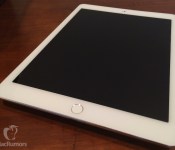
Apple Said to Upgrade iPad Air With Gold Option and Anti-Reflective Laminated Display
In a bit of a surprise prediction, Apple may use its upcoming September 9 event to introduce the iPad Air 2 along with the iPhone 6 and iWatch, claims KGI Securities analyst Ming-Chi Kuo in a research report released today. That plan would differ from Apple’s announcement schedules in recent years that have seen the company unveil the iPhone in September and the iPad in October at a second press event.
 Physical mockup of the second-generation iPad Air
According to Kuo, Apple is preparing modest upgrades primarily for the iPad Air and not the iPad mini, because the larger iPad is more popular among consumers. While the iPad Air 2 is said to carry several improvements, including an anti-reflective display as previously rumored, the second-generation Retina iPad mini may receive only Touch ID support.
In light of limited development resources and the fact that iPad Air contributes more to Apple’s sales and earnings than iPad mini, we think that only iPad Air 2 will see a major upgrade in specs this year, including anti-reflective coating for the cover lens, full lamination for the touch panel, a gold-colored metal casing, an A8 processor, Touch ID/ fingerprint recognition and an 8-megapixel rear camera. iPad mini may be upgraded with fingerprint recognition, if any.
While Kuo doesn’t address whether the updated iPad Air will be thinner than the current model, a recent report from Digitimes claimed the device will indeed be thinner, and a laminated display could help Apple shave a small amount from the device’s thickness.
Kuo claims that the anti-reflective display and full lamination will push back availability of the iPad Air 2 until October due to production issues with this new display. This delay may be fairly immaterial, however, as Kuo predicts iPad sales will continue to lag due to tablet market dynamics that see customers retaining their older iPad models instead of upgrading.
Kuo has been among the most accurate analysts regarding Apple’s product plans, having been first to correctly peg a number of features and launches over the past several years. He has, however, had some misses and so it will be interesting to see if his iPad predictions pan out.
.CPlase_panel display:none;
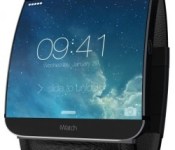
iWatch With Curved OLED Display to Include NFC for Mobile Payments
 Apple’s upcoming “iWatch”, reportedly set to be unveiled at next Tuesday’s media event, will include near field communications (NFC) technology, according to The Wall Street Journal. The technology, which has already been seen on a leaked iPhone 6 logic board, will likely be used to support a mobile payments initiative.
NFC wireless is central to Apple’s plans to incorporate so-called tap-to-pay into its mobile devices, allowing users to pay for goods and services using credit cards stored with iTunes, people close to Apple said.
The report goes on to claim the iWatch will be available in two sizes and carry a curved OLED display. And as extensively rumored, the device will include a variety of health and fitness sensors.
The report also reiterates recent claims that while the iWatch will be unveiled next week, it will not begin shipping until somewhat later, perhaps not until early 2015.
People familiar with Apple’s plans said it is unlikely that Apple will release the smartwatch this year, because the Cupertino, Calif., company is still working out engineering kinks in production. Earlier in the year, Apple had targeted a November release, these people said.
One person familiar with Apple’s suppliers said there is “no way” that it will be able to ship the iWatch this year. However, Apple hasn’t changed its timetable for component suppliers that are shipping parts as scheduled to Taiwan’s Quanta Computer Inc., the proposed device’s manufacturer.
Sources indicate Apple will accept pre-orders for the iWatch, but timing and pricing are unknown. A previous report from Re/code claimed Apple has been weighing pricing in the $400 range, although some models would be cheaper.
(Image: iWatch concept from ifyoucouldseethefuture.com)
.CPlase_panel display:none;

Drone Aerial Footage Reveals Mystery Flint Center Building for iPhone 6 Announcement
As part of its planned September 9th event, Apple is building a massive structure in front of the Flint Center for the Performing Arts on the De Anza College campus in Cupertino, California. The structure is covered by a white barricade that conceals the details of the building underneath.

Earlier photos gave us a hint of the building, but recent aerial footage captured using a drone piloted by Sachin Patel reveals the size and scope of the project (via 9to5Mac). The building sits in front of the Flint Center on top of the college’s Sunken Garden and wraps around the sides of a pre-existing sculpture.
Speculation about the building has run the gamut from performance stage to model home, with the most reasonable prediction suggesting Apple may use the venue for product demonstrations. Apple is expected to introduce the iPhone 6 along with the iWatch at the event, which means it could use the building’s ample space to showcase any home automation or fitness features of its new hardware.
The Flint Center is the venue where Steve Jobs introduced the original Mac. Apple has not held an event at the location for some time, opting instead to announce new products at the Yerba Buena Center for the Arts or its own Cupertino campus Town Hall theater. Due to this change in venue, it is not yet known whether Apple will be live streaming the announcement as it has done with its most recent press events. MacRumors, however, will be providing live coverage both on MacRumors.com and through the MacRumorsLive Twitter account.
Update: Shortly after this post was published, Apple confirmed it will be streaming its September 9th iPhone event to compatible Mac, iOS and Apple TV devices.

.CPlase_panel display:none;
Apple Supplier Catcher Accused of Endangering and Exploiting Factory Workers [iOS Blog]
One of Apple’s suppliers is once again being accused of labor violations, with both Green America and China Labor Watch claiming a Catcher factory in Suqian, China has endangered the health and safety of its workers. Catcher is responsible for producing casings for many of Apple’s products, including its MacBooks and iPads.
According to the report [PDF], Catcher has failed to provide adequate protective equipment for employees who handle toxic materials. The floor is said to be littered with aluminum-magnesium alloy shreddings and there are heavy amounts of dust in the air, which poses a health and fire safety risk. There are also locked safety exits preventing workers from leaving quickly during a disaster.
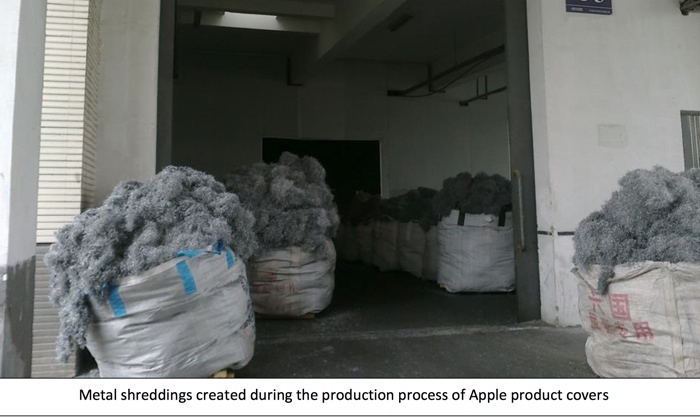
Fires and explosions are a major risk at supplier factories, and explosions at both Pegatron and Foxconn have caused major injuries in the past. At Catcher, workers have reportedly not participated in fire drills and have had poor safety training.
Other violations include student workers working long hours, excessive hours for all workers, forced overtime, and unpaid overtime for workers. Catcher is also said to be discriminating against potential employees based on age and the presence of tattoos.
“The health and safety violations found in this factory two years in a row are startling,” said Elizabeth O’Connell, campaigns director at Green America. “The lack of fire drill training and locked safety exits are inexcusable in a work environment that requires the handling of flammable materials. Additionally, the lack of safety training in this facility and improper handling of hazardous materials contributes to the risk of life-threatening emergencies.”
China Labor Watch initially reported its findings to Apple in 2013, and claims that though Apple promised to fix the issues, no progress has been made to improve worker conditions. Today’s report calls on Apple to “do what is necessary” to ensure that factory workers are treated according to the law, and it asks consumers to reach out to Apple by filling out an email form. Apple, for its part, has given a statement to The New York Times saying that it has worked to correct issues at Catcher.
Apple said its most recent annual audit of the Suqian plant, in May, had “found some concrete areas for improvement in Catcher’s operations, and we worked with Catcher to develop a corrective action plan.”
Apple often finds itself in the spotlight over the conditions at the factories where its product components are produced, and the company has demonstrated little tolerance for factories that violated its rules. It is an ongoing issue for Apple, however, given both the sheer number of suppliers and the fact that factories benefit from producing high quantities of products at low costs.
Apple has committed to ensuring that its suppliers live up to a strict code of conduct that prevents underage labor and provides safe, comfortable working and living conditions for workers. Apple maintains a Supplier Responsibility Team to audit supply chain facilities and it also participates in factory assessments by the Fair Labor Association.
Note: Due to the political nature of the discussion regarding this topic, the discussion thread is located in our Politics, Religion, Social Issues forum. All forum members and site visitors are welcome to read and follow the thread, but posting is limited to forum members with at least 100 posts.
.CPlase_panel display:none;

Apple to Live Stream September 9 iPhone Event
Apple today updated its website to announce that it will indeed be streaming the September 9 iPhone event. A new Live page includes a countdown to the event and a note that it will host the event stream next Tuesday.

Apple will also likely stream the event to the Apple TV with a dedicated channel, as it has done for past events. MacRumors will be providing live coverage of the event as well, both on MacRumors.com and on the MacRumorsLive Twitter account for those unable to watch Apple’s live stream.
The September 9 event, which kicks off at 10 a.m. Pacific Time, will be held at the Flint Center at De Anza College in Cupertino, where Apple first unveiled the original Mac 30 years ago. Apple is expected to introduce the iPhone 6 in two separate sizes, its upcoming wearable device, and its payments initiative at the event.
.CPlase_panel display:none;

Apple Negotiates Lower Transaction Fees With Credit Card Issuers for Mobile Payments Initiative
 As part of its upcoming payments initiative, Apple has reportedly negotiated deals for lower credit card transaction fees with several credit card issuers. According to Bank Innovation, Apple has entered into agreements with American Express, JP Morgan Chase, Citigroup, Capital One, and Bank of America.
The banks have agreed to allow all of Apple’s transactions to be conducted as “card present,” a set fee charged when a customer uses a card in a physical retail location. Typically, there’s also a higher “card not present” fee that’s charged when a card is used online, due to security issues. Apple’s also managed to secure a lower “card present” fee on top of that, cutting its costs further.
Beyond that, Apple has also managed to bump down the actual “card present” rate by 15 to 25 basis points, according to people with knowledge of the talks. Normal “card present” discount rates, which are shared by issuers and networks but determined by the network, are about 1.5%, which means that Apple appears as though it will get around a 10% discount on the processing rate it will pay. Last quarter, Apple generated $4.5 billion of iTunes revenue — this implies that Apple will save at least $27 million as a result of these deals with the banks. Of course, more revenue volume is expected upon launch of Apple’s payments venture.
Apple has reportedly been able to negotiate this lower rate by ensuring banks that transactions will be secure, both through the use of the NFC chip which reports location, and through Touch ID, which will be used to authenticate transactions.
In addition to signing deals with several financial institutions, Apple has also managed to secure deals with major credit card companies Visa, MasterCard, and American Express, and it’s also been speaking with various retailers about its upcoming payments service.
Rumors have suggested that Apple’s payment service will allow iPhone owners to use their devices to make payments both online and in retail stores, possibly linking credit cards to existing iTunes accounts. Apple is expected to announce its mobile payments initiative during its September 9 media event.
.CPlase_panel display:none;
iPhone 6 to Support ‘One-Handed Mode’ to Address Usability on Larger Screens
In a lengthy article covering Apple’s iWatch and iPhone 6 plans for next Tuesday’s media event, The New York Times reports the iPhone 6 will support an optional “one-handed mode” to make it easier for users on the larger-screened devices.
To deal with concerns that a bigger phone will make typing with one hand difficult (the current iPhone has a 4-inch screen), some changes to the design of the iPhones’ software interface will allow people to type or use apps with just one hand — there will be a one-handed mode that can be switched on and off, two employees said.
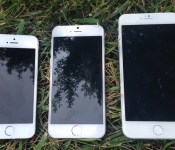
The report reiterates rumors that the iPhone 6 will come in 4.7-inch and 5.5-inch sizes, considerably larger than the 4-inch screen included on recent iPhone models. Apple has touted the ease of one-handed use on its current lineup as competitors have moved to even larger displays, and this new one-handed mode will clearly serve as an answer to Apple’s own previous criticism of large-screen phones. Exactly how this mode will work is unclear, however.
 iPhone 5s next to physical mockups of 4.7-inch and 5.5-inch iPhone 6
The New York Times also reiterates circulating rumors that the 5.5-inch iPhone 6 will be priced higher than the 4.7-inch model, with both devices also including near field communications (NFC) to support a new mobile payments initiative.
Apple’s media event kicks off at 10:00 AM Pacific Time next Tuesday, and Apple will be providing a live video stream of the event. MacRumors will also be providing coverage of the event with a liveblog and Twitter updates.
.CPlase_panel display:none;
Why Dyson’s robot vacuum took 16 years, and why it’s headed to Japan first

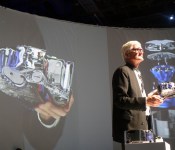
Dyson almost launched a robot vacuum. Back in 2001, after three years in development. Its first effort, shown to the British public in London looked nothing (and we mean nothing) like the eventual Eye 360 unveiled today. Sixteen years is a long time in tech. The DC06, as it was called, never made it past home-trial stages in 2012 — apparently too pricey and heavy. Between then and now, technology got better. A lot better. At the Tokyo launch of its new robot vacuum, Sir James Dyson himself, told us how it all came together, and why it’s not his native UK, but Japan, that’ll get to buy it first.
At the start of its 16-year development, Dyson’s early robot vacuum model was powered by old, heavy Ni-Cad batteries and “old motion-detection technology sensors.” Dyson explained: “We ended up with 85 different sensors and big, old motors. We got very close — spent a lot of money on it — but then we decided it just wasn’t good enough.”

“And we had better ideas,” he added. “Engineers are dreadful — they always have better ideas. I don’t mind that — I think it’s quite a good habit.” The point being, he continues, that his company spent a lot of money in 16 years “to make the right product.”
“We got very close — spent a lot of money on it — but then we decided it just wasn’t good enough.”
Dyson added that the team soon realized that vision sensors geared to measure a room, to triangulate location were the way forward. “This technology has a lot of mileage in it — and we’re just at the beginning,” he said. The team paired it with its existing, but still very recent, digital motor (the same one used in Dyson’s stick vacuums) — a motor that balanced suction power with a small footprint and weight.

If you’re basing your impressions of Dyson’s new vacuum on those press images, we have some very good news: It might look huge in the renders, but it’s pleasingly petite in real life. Notably taller, but not like the rice-cooker-on-wheels we feared from those shots. Dyson being Dyson, there’s a reasoning:
“If you think about chairs, [large-diameter vacuums] can’t get between those, between wardrobe and door gaps,” Dyson said. “Other robot vacuums may look bigger, but you need to consider [Dyson’s] full-width brush bar.” The smaller-sized bot’s brush covers the width of the machine, but it’s also handily contained by a plastic barrier. From Dyson: “If you make a really big brush bar, you lose the suction to pull it in. This size is optimal for the power we’ve got … and it can go into [smaller] spaces. You don’t sacrifice anything.”

The second (and it’s the almost literal jewel) of Dyson’s robot vacuum is that eye: a panoramic lens that aims itself at a 45-degree angle, getting a view of the room, of your house, and taking what it sees into the center and reflecting it downward. “It’s interpreting what it’s seeing and calculating triangulations at 30 times a second,” Dyson said. And it’s been designed to ensure it can find its way back home easier. “The first thing it does is turn around to view the dock, all while filming the room,” he explained. “In those seconds, it knows the room and where the dock is.”
Dyson adds that it isn’t specifically geared for hard flooring or carpet– it’s designed for everything, thus the tank-styled caterpillar treads. And that’s coupled with that Dyson suction: “We have 100 times the suction power of the Roomba model.” That’s almost exactly the numbers shown from the company’s tests comparing its model to one of iRobot’s latest. Granted, it’s Dyson doing the testing, but:

The ‘bot can climb up to 15mm with those treads, but the combination of high-level suction and nylon bristles also makes it well-suited to Japan’s tatami (rice straw) mats — lots of nooks, but also relatively delicate fibers. Which is convenient, as the Eye 360 will be coming to Japan first, in the spring of 2015. And barring Dyson’s love of launching things in (and having an excuse to visit) Japan, there’s some solid reasoning for it. “The country adopts to new technology faster than anyone else,” he said. “We’re also ‘Big in Japan’ — the largest vacuum brand in Japan, and this country is the largest market for robots.” No arguments there.
Filed under: Household, Robots
.CPlase_panel display:none;

Apple’s ‘iWatch’ to Feature Flexible Display, Wireless Charging
 Adding to this morning’s report from The Wall Street Journal pointing towards a curved OLED screen for Apple’s upcoming “iWatch”, The New York Times has released several details about the wearable device, suggesting it will have a flexible display and wireless charging capabilities.
Echoing past rumors, The New York Times says the iWatch will come in two separate sizes, focusing on health/fitness and mobile computing tasks, and that it will allow people to make purchases with included NFC support. Its flexible display is described as “unique,” and Apple is said to have settled on wireless charging after a failed experiment with solar charging.
It has a flexible display panel that is protected by a cover composed of sapphire, a type of tougher glass, they said. The device’s circuit board, which includes its sensors and chips, was described as tiny, about the size of a postage stamp.
For replenishing the battery, the smartwatch will rely on a wireless charging method. Apple had at one point tested solar charging for the watch, but that experiment failed.
According to unnamed employees who spoke to The New York Times, Apple’s iWatch is “one of Apple’s most ambitious projects to date,” with an “enormous” amount of time and money put into the health and fitness sensors in the device, which will be “much more” accurate than existing fitness devices. Rumors have suggested the iWatch will measure an array of different health-related metrics, from steps taken and sleep quality to blood pressure.
The iWatch is said to take advantage of HealthKit, a set of APIs Apple introduced alongside iOS 8 that will integrate into existing health devices and apps, reporting data to a central location. It’s also going to rely on Handoff, a Continuity feature that lets users seamlessly transition tasks from one iOS or Mac device to another.
The report also echoes a litany of rumors that have suggested Apple’s wearable device will not be available for purchase until 2015, despite Apple’s plans to unveil the iWatch at its September 9 media event. The gap between the introduction of the iWatch and its debut will give Apple time to finish work on the device as well as provide an opportunity for developers to create new apps suited to the smaller form factor.
(Image: 2.5-inch iWatch concept by SET Solutions)
.CPlase_panel display:none;

High-tech fabric can take a beating and lead to tough smart clothing

To be able to make smart clothing like Ralph Lauren’s shirt for athletes, you need fabric embedded with sensors and circuitry. Engineers from the Hong Kong Polytechnic University have designed one such type of fabric, and based on its test results, it has the potential to evolve into material superhero costumes are made of. According to the paper published in Proceedings of the Royal Society, the researchers tested the fabric’s durability not only by folding and wrinkling it, but also by washing it, repeatedly stretching it to its limits and even shooting bullets at it. They found that the cloth, knitted with wiring as you can see above, could withstand extreme abuse before it even begins to break down.
Its circuits apparently continued to work even after a million cycles of washing and stretching, and only 6 out of 30 samples were affected after being washed 30 times in a washing machine. The fabric even remained intact beneath Kevlar when sewn into a bulletproof vest. While it obviously has huge potential in the development of military equipment, other kinds of smart clothing could certainly benefit from a fabric this tough.
Filed under: Misc
Via: Wired
Source: The Hong Kong Polytechnic University
.CPlase_panel display:none;
 AIVAnet