



Twitter trademark turmoil forces Twitpic to shut down

It’s the end of an era, folks: Twitpic, one of the first sites that let users upload and share photos to Twitter, will go dark on September 25. Unlike other shuttered startups though, Twitpic hasn’t run out of cash or been pushed out of the spotlight by fierce competitors. No, its demise is all thanks to some trademark turmoil initiated by the folks at Twitter who reached out to the Twitpic team a few weeks back. The social giant wanted the company (which at one point was valued at over $10 million) to give up its nearly 5 year old trademark application or face the prospect of being shut out of the Twitter ecosystem entirely. Rather than devote gobs of time and resources to proving his point, founder Noah Everett (sadly) decided to call it quits on the operation. Don’t feel too bad for him, though: he’s got another startup in the works called Pingly that basically aims to build a “better Gmail”. We don’t want to harp on a guy who’s already down on his luck but… join the club, pal. In any case, you’ve still got time to download all of your stored photos from Twitpic — just give those poor folks a little time to release the tool that’ll let you do it.
Filed under: Internet
Source: Twitpic
.CPlase_panel display:none;
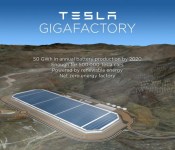
Tesla Motors preps for its $35k Model 3 with a new battery factory in Nevada

Tesla Motors is going to need to expand production to hit its goal of selling a $35,000 electric vehicle by 2017, and as rumored, today it’s announcing plans for a new plant in Nevada that will help it get there. Several states were in the running to host the “Gigafactory” (and its 6,500~ jobs) but Elon Musk and Co. have chosen to put down roots in the Reno area. According to local papers like the Reno Gazette-Journal, that’s why Nevada Gov. Brian Sandoval will ask the state legislature to approve a $1.25 billion tax incentive package to make the deal stick. According to Elon Musk, the factory will use solar, wind and geothermal energy to produce all of the energy it needs as a “net zero energy factory.” As seen above, it’s supposed to produce 50 GWh in annual battery production by 2020, enough to power 500,000 of Tesla’s cars. The deal is being announced right now at a press conference, check out the live video after the break to follow along (update: the live stream appears to have died, but Jason Hidalgo of the Reno Gazette-Journal is live tweeting Musk’s statements).
Nevada selected as official site for Tesla battery Gigafactory: http://t.co/T2TwWT3gi8
– Tesla Motors (@TeslaMotors) September 4, 2014
We have reached an agreement with Tesla Motor Company. #AllNevada pic.twitter.com/Z9zeDdVkuN
– Governor Sandoval (@GovSandoval) September 4, 2014
Gigafactory confirmed for Nevada. pic.twitter.com/1vGucDJ8fY
– Tesla Motors (@TeslaMotors) September 4, 2014
Musk: #Tesla gigafactory will be bigger than all lithium ion factories in world combined #tech #automotive
– Jason Hidalgo (@jasonhidalgo) September 4, 2014
Filed under: Transportation
Source: Tesla Motors, YouTube, Las Vegas Review-Journal, Reno Gazette-Journal
.CPlase_panel display:none;

NYT: the new, larger iPhones will feature a one-hand mode

Now that we’re nearing Apple’s September 9th reveal, more and more details about the event are starting to leak out. According to The New York Times, the new and bigger iPhones will have a one-handed mode that can be toggled on or off to make their large screens easier to use. The new phones (and yes, there might be more than one) will reportedly come in 4.7-inch and 5.5-inch variants, you see, and both are a lot larger than the current model’s 4-inch screens. While we’ve yet to find out what the mode can do, it could very well be similar to comparable features in large Android devices.
The 5.7-inch Samsung Galaxy Note 3 and the 5.9-inch LG G Pro 2, for instance, come with shrinkable interfaces so you can reach apps and everything else more easily with your fingers. Huawei’s Ascend Mate, on the other hand, lets you shrink its keyboard and dial pad. Aside from that, the NYT also reports that the company’s upcoming wearable, the iWatch, will be equipped with a circuit board the size of a postage stamp loaded with sensors and chips. Despite its size, it’s apparently so powerful that it can detect heart rates and other vital signs more readily and accurately than other wearables, which can do the same. Both these details haven’t been verified by Apple, of course, but you only need to wait a few more days to know if they’re true anyway.
Filed under: Cellphones, Wearables, Mobile, Apple
Source: The New York Times
.CPlase_panel display:none;

Philips’ Hue Beyond looks like a lamp, only smarter

Philips Hue Beyond is the company’s attempt at taking its connected lighting platform to the mainstream. That’s why the new range of light fixtures – lamps, pendant and ceiling lights – pair a color-changing module with a “tunable” white light for actually being able to see. We managed to sneak around to the back of Philips’ booth at IFA and into a demonstration area where we got to see the gear in use for the first time. It was here that we learned that the company will break out a standalone Hue Beyond app, specifically designed to cater to the more complex dual-bulbed platform. We also learned that there are a trio of hue modules powering both of the lights, while a single hockey puck-shaped component can be found lurking beneath the lamp’s cover. Still unsure if Hue Beyond is worth the investment? Check out the snaps.
.CPlase_panel display:none;

Would-be game makers can sell each other new levels, art in Unreal Engine 4

Let’s say you’ve been fiddling with Unreal Engine 4 for months and want the world to see the lovingly detailed recreation of your first college apartment — right down to the hemp wall tapestries and the weird stains on the living room rug. Well, with the newly launched Unreal Engine Marketplace you can do just that. In addition to anything that’s been released through other channels before, your custom wares will sit alongside sample scenes and games (like Tappy Chicken), as well as bits of C++ code, art and audio. And if you’re looking to turn a profit, or, at least recover the toolset’s monthly subscription fee, you can even put a price-tag on your digital wares.
What’s more, Eurogamer has spotted that the Unreal overlords at Epic Games have announced that in an effort to foster a lively game-development scene, they’re waiving the cost of Unreal Engine 4 for schools and universities. So long as you’re a student enrolled in a qualifying degree program, you’ll have access to one of the most prominent game engines in the business for free. Well, there’s still that pesky thing called tuition, but until you have to start paying back those student loans, that mostly feels nonexistent too. Who knows, though, maybe you could strike it big and make a game that’d cover the cost of college while you’re still enrolled. If that is the case, though, you’ll have to pony up the standard 5 percent royalties for on any quarterly profits exceeding $3,000.
Filed under: Gaming, Home Entertainment, HD
Via: Eurogamer
Source: Unreal Engine (1), (2), (3)
.CPlase_panel display:none;

Healthcare.gov was hacked, but none of your sensitive data was stolen

Healthcare.gov might have a dedicated team looking after its welfare thanks to its disastrous launch, but it’s still not completely bulletproof. Apparently, the insurance website was hacked in July, and the perpetrator managed to slip in malware that wasn’t spotted until August 25th. Before you have a panic attack, though (the website did ask for your Social Security number, among other sensitive info), the Department of Health and Human Services says no data was stolen from the breach. According to HHS spokesperon Kevin Griffis, the compromised server didn’t contain personal information, because it’s only used for testing and should never have been connected to the internet in the first place.
Moreover, the malware wasn’t designed to steal data — the hacker slipped it in to use the server as a puppet for denial of service attacks on other government properties. These attacks constitute taking over many, many computers so hackers can use them to redirect traffic to a single website in an effort to take it down, indicating that Healthcare.gov wasn’t being targeted in particular. HHS officials say Healthcare.gov undergoes regular security scans, and they’ve “taken measures to further strengthen security” since the breach took place.
Filed under: Internet
Source: CNN, The Wall Street Journal
.CPlase_panel display:none;

Tim Cook says new security alerts for Apple’s iCloud are coming soon

Although Apple’s initial response to a recent release of stolen celebrity photos stated that its iCloud and Find My iPhone systems had not been breached, now CEO Tim Cook is talking about how to beef up its security. In an interview with the Wall Street Journal, Cook said that several changes are coming very soon, with email and push notifications to alert users any time someone tries to change their iCloud password, restore data to a new device or add a new device to an account. When the notifications pop up, users can respond by changing their password or alerting Apple to a possible breach. Those changes are due in two weeks, however Cook reaffirmed that criminals gained access to victim’s accounts by using phishing scams to get their IDs and passwords, or answering their security questions. In response, Apple is also going to start pushing two-factor authentication harder (which currently does not cover access to iCloud from a mobile device, but will after the release of iOS 8), and Cook said its aim will be to increase “awareness” of hackers, and using security measures like strong passwords — we’ll see if there are any other security changes revealed during next week’s new iPhone event.
Filed under: Cellphones, Internet, Mobile, Apple
Source: Wall Street Journal
.CPlase_panel display:none;

Engadget Daily: Dyson’s robot vacuum cleaner, LG’s G Watch R and more!

Today, we interview Oculus VR’s John Carmack, gawk over Dyson’s new robot vacuum cleaner, take a closer look at the LG G Watch R, learn how IBM plans to kill the hard drive and more! Read on for Engadget’s news highlights from the last 24 hours.
.CPlase_panel display:none;

NVIDIA aims its first patent lawsuit at Samsung and Qualcomm

It’s true, Samsung is about to find itself back in the courtroom facing another round of patent litigation — but this time, the lawsuit isn’t coming from a direct competitor. NVIDIA just filed its first patent lawsuit in the company’s 21 year history, and charging both Samsung and Qualcomm with infringing seven of its GPU patents. NVIDIA says that it’s tried to negotiate licensing fees with the companies directly, but have made no progress. “Samsung repeatedly said that it was mostly their suppliers’ problem,” the company wrote on its official blog. Now NVIDIA is taking them both to court.
Specifically, NVIDIA is targeting Qualcomm processors with Adreno graphics, as well as Samsung devices using ARM Mali or Imagination PowerVR GPUs — this includes devices like the Samsung Galaxy S5, Note 4, Galaxy Tab S and several older smartphones and tablets. The patents at issue cover chip design, various processes, and lighting, rasterization and rendering technologies, all of which NVIDIA claims are violated by Samsung and Qualcomm’s unlicensed use of the technologies. The company is seeking a trial jury to validate its claim and assign damages, and seems optimistic that it the legal system will help it cement a licensing agreement for the alleged technology use. Check out the company’s official announcement (and its official complaints) for the full details.
[Image credit: Shutterstock]
Filed under: Misc, Samsung, NVIDIA
Source: NVIDIA (1), (2), (3)
.CPlase_panel display:none;
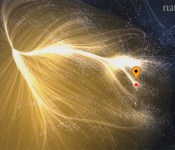
Our entire Milky Way galaxy is just a dot in this supercluster

Ready to feel small? Our sun is just one of 300 billion stars in the Milky Way galaxy, which itself is one of many, many other galaxies — but at least we now know where it is. Astronomers have mapped a “supercluster” of galaxies including the Milky Way and dubbed it Laniakea, or “immeasurable heaven” in Hawaiian. Using several radio telescopes, the team calculated the movement of nearby galaxies relative to each other, after taking into account cosmic expansion. They chose the supercluster boundary based on that motion, since galaxies tend to flow along the same paths toward common gravitational wells. Lanaikea was defined based on its flow toward the “Great Attractor,” along with another supercluster called Perseus-Pisces. As shown in the stunning video below, our own insignificant galaxy is on a prominent flow path in Laniakea, right at the edge of a massive void.
Via: Sploid
Source: Nature (paywall)
.CPlase_panel display:none;
 AIVAnet