


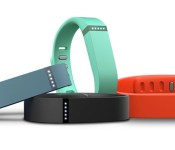
Sound off! Have fitness trackers and wearables improved your health?

Smartwatches are all the rage right now, but before we were obsessed with interesting new ways to get more notifications, it seemed like every company was developing a fitness tracker. Fitbit was one of the first with its pocketable tracker. Now there are bracelets, watches, belt clips and more that can track your every movement. Are you using these tools to help you become a more healthy person? Is it working? Hop over to the Engadget forums and share your stories!
Filed under: Wearables
.CPlase_panel display:none;

Iranian President says internet access is crucial for his country

Iran may be quick to clamp down on internet freedoms, but President Hassan Rouhani doesn’t believe that the country should cut itself off from the rest of the planet — just the opposite. In a speech this weekend, he argued that it was crucial for young Iranians to have internet access. It isn’t right to “close the gates of the world” to youth and deny them access to science, he says. He even went so far as to argue that supporting mobile internet service (which recently opened up in Iran) was inevitable; if the nation didn’t embrace the technology now, it would have to before long.
Whether or not Rouhani gets his way is unclear. Iran’s clerics still see the internet (particularly on mobile) as a vehicle for immorality, and they still have a lot of sway over local politics. It’s also doubtful that the country will make an about-face on censorship any time in the near future, even if the President gets what he wants. Still, the speech is significant in a nation that frequently blocks the internet first and asks questions later — Iranians who want better internet access clearly have a big ally in their corner.
[Image credit: Behrouz Mehri via Getty Images]
Filed under: Internet
Source: BBC
.CPlase_panel display:none;
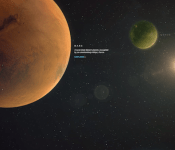
Explore the world of ‘Destiny’ through Google Street View

Whether it’s touring an insanely large cruise ship or the Polar Bear capital of the world, Google’s Street View has you covered. But the search giant doesn’t want to limit that virtual experience to tangible, real-life things, which is why it’s teamed up with Bungie to let you experience the magical nature of Destiny by way of Street View. Once inside, explorers can choose to wander around and learn more about places which are key elements to the storyline of Bungie’s new franchise. Destiny Planet View, as the map is officially known, offers detailed, 360-degree views of locations inside Mars, Venus and the moon, It gives the break down on various hotspots, more information on characters from a particular territory and allows users to Destiny tips along the way. Bungie points out that this is the first time Google’s mapped a video game world, and it’s a good one — sure, it’s pretty to look at, but the real goal is to get you even more hyped up ahead of Destiny’s launch, next week on September 9th.
Filed under: Gaming, Home Entertainment, Internet, Google
Source: Destiny Planet View
.CPlase_panel display:none;
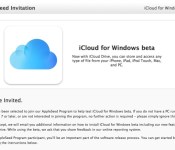
Apple Begins Inviting AppleSeed Members to Test iCloud for Windows Beta [Mac Blog]
Apple today began sending out invitations to AppleSeed members, inviting them to test the iCloud for Windows beta, which includes access to iCloud Drive. An iOS 8/Yosemite feature, iCloud Drive allows users to store any document in iCloud.
Content stored in iCloud Drive can be accessed from any iOS device, Mac, or PC, via the new iCloud for Windows beta. AppleSeed testers receiving invites to the iCloud for Windows beta must be running Windows 7 or later, and Apple does not recommend installing the pre-release software on “personal-critical and/or business-critical systems.”

Ahead of offering an iCloud for Windows beta to AppleSeed members, Apple released a beta version of the software to developers. The latest version of that beta, launched on July 21, noted that iCloud Drive functionality was only available on on OS X Yosemite and iOS 8, so it appears that Windows users may be getting their first functional look at iCloud Drive with the launch of the AppleSeed beta.
iCloud Drive is expected to be officially available with the launch of iOS 8 and OS X Yosemite. While iOS 8 will likely be released to the public in September following Apple’s iPhone event, OS X Yosemite may not be available until later in the year, possibly October.
Thanks, Larry!
.CPlase_panel display:none;
Pre-Launch Adoption of OS X Yosemite 33 Times Higher Than for Mavericks
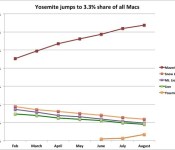
Adoption of OS X Yosemite is steadily increasing ahead of its fall launch, due to both a system-wide redesign and the introduction of a public beta for the first time. As of August, Yosemite was installed on approximately 2.6 million machines or 3.3 percent of all Macs, according to new numbers from Net Applications (via Computerworld).

For August, Yosemite powered 3.3% of all Macs, according to metrics vendor Net Applications. That was 33 times the user share of its predecessor, OS X Mavericks, in September 2013, one month before its official launch, and nearly one-third of Mavericks’ share the following month, when it was first made available to all customers.
In June, adoption rates were at 0.9 percent, jumping up to 1.2 percent in July. The 3.3 percent number comes after the introduction of the public Yosemite beta in late July, which saw as many as 1 million registered beta program members receiving access to the software. Following the launch of the beta, Yosemite’s share of global Mac traffic nearly doubled.
Though the public beta has bolstered Yosemite’s adoption numbers much higher than Mavericks adoption rates during a similar time frame last year, developer interest in Yosemite has also been high. July adoption numbers from before the public beta release suggested Yosemite beta usage was four times higher than Mavericks usage last year.
Operating system usage metrics can very widely, however, as Yosemite installation numbers from GoSquared are quite a bit different. According to GoSquared, machines running OS X Yosemite have accounted for just one percent of total Mac OS traffic over the past several hours, and 0.58 percent since launch. Though GoSquared points towards lower overall adoption numbers, it does show a fairly steady increase in Yosemite usage.

Last year, seven percent of all Mac users had installed OS X Mavericks just 24 hours after its public launch. Based on public beta numbers and high developer interest, it’s likely that Yosemite Adoption will be even more rapid following its public launch. In addition to offering a revamped look, OS X Yosemite includes several features like iCloud Drive and Continuity, allowing Macs to interact with iOS devices in new ways.
OS X Yosemite is currently available only to registered developers and those who signed up for the public beta test. The operating system, which will be provided to consumers at no cost, is expected to see its public release in the fall, possibly in October.
.CPlase_panel display:none;

‘Big players’ from US and China reportedly interested in OUYA

OUYA’s remained relatively quiet over the past few months, aside from making content-focused announcements here and there — such as OUYA Everywhere and the expansion of it. That said, the gaming startup, once a Kickstarter sensation, could be making a very big splash in the near future. Re/code is now reporting OUYA is in the middle of acquisition talks with “multiple big players” in the US and China, citing sources familiar with the matter. Chinese companies said to have had discussions with OUYA are Xiaomi and Tencent, among others; meanwhile, here Stateside, Amazon and Google reportedly took part in “some engagement” over a possible sale. Interestingly enough, though, Re/code notes that these outfits are primarily interested in the sale to acquire members of OUYA’s staff, rather than the business stemming from its tiny game consoles. Only time will tell if anything ends up actually happening — but as they say, where there’s will, there’s a way.
Filed under: Gaming, Home Entertainment, HD
Source: Re/code
.CPlase_panel display:none;

Kyocera’s sapphire screen is tougher than we expected

Few things in life are more satisfying than taking out pent-up aggression on a poor, helpless phone, and the Kyocera Brigadier gave me that opportunity this week. Armed with a 4.5-inch Sapphire Shield screen, the rugged Verizon-exclusive device claims to be scratchproof and drop-proof because the material is harder than glass. Since an increasing number of manufacturers (including Apple and Huawei) are reportedly planning on using sapphire on future products, I wanted to torture-test the Brigadier with a lot of sharp and abrasive objects to see if it really holds up to its claims.
In an earlier piece, I discussed that sapphire is four times as tough as glass and incredibly scratch-resistant, but most smartphone makers are hesitant to swap Gorilla Glass out for it. Sapphire’s more difficult to produce, limited in quantity and costs more; more importantly, it’s typically easier to break and harder to bend because the material is more brittle. Of course, this was all based on the claims of manufacturers, so I didn’t want to just take their word for it — I had to test out a real end-user device.
Kyocera not only encouraged me to give the Brigadier an extensive thrashing, but it also even sent me a tool kit designed to help me do just that. It came with a pocket knife, steel wool and a bucket filled with small rocks. This was a good start, but it felt too… controlled. After all, a company isn’t going to send a torture kit to reporters without making sure it passes with flying colors. So I brought along plenty of other sharp objects from my house to try out: scissors, a screwdriver, Brillo Pad, cutting knives, screws and keys.
As you can see in the video, I used every single object with reckless abandon, pressing down as hard as I could and scraping them across the entire surface of the screen. I added screws and keys to the bucket of rocks, placed the phone inside and shook it all together for 30 seconds. Colleagues came in with knives of their own to work out anger issues. Finally, as a last resort, I vigorously rubbed the phone against a protruding section of the brick wall in Engadget’s studio. Still, nothing.

Ultimately, it likely isn’t impossible to scratch — even Kyocera calls it “virtually scratchproof,” which technically leaves some leeway — but you’d need a harder material, like diamond. This means that the sapphire screen is going to withstand scratches from almost every object that rubs or digs into it.
Satisfied, I next turned to impact testing. I threw the phone at a brick wall. I dropped it onto concrete, facedown, from waist- and chest-level a few times. I threw it high up in the air at least four times. The case was in far worse shape than the screen itself; since the bezel is raised, the screen is safely protected from most drops. So I banged it against objects that could impact the sapphire without the phone’s frame getting in the way: the top of a metal street pole sign, the corner of several tables and a couple of protruding walls.
The verdict? The screen didn’t shatter, ding or even show any signs of having just withstood several severe blows. The case, however, was chipped and came apart from the screen in some places, revealing a gap underneath. The power button is also harder to press. The touchscreen is still surprisingly responsive, though oddly I now have to press the power button twice before the lock screen registers my touch.

At this point, I still haven’t been able to physically damage the screen, and that’s not good enough — after all, I came into this test ready to break a sapphire display, and there are technically a few ways to break the Sapphire Shield. uBreakiFix, a smartphone repair company, managed to crack the screen by dismantling the entire phone and dropping the sapphire panel from three feet without its protective casing; the team also proved that it can’t bend as far as Gorilla Glass before shattering. Granted, you’re likely never going to run into a situation in which you’ll use a Kyocera Brigadier display outside its casing — nor will you ever need to bend it that far — so can you break the screen in a real-life situation?
I discovered that I could indeed inflict damage on the Sapphire Shield by dropping the phone facedown from waist level or higher onto jagged, pointy rocks (or similar objects), because they’re small enough and sharp enough to penetrate the screen. Even then, however, the phone only succumbed to a few visible marks.
The sapphire screen on the Kyocera Brigadier (which is currently $100 with a two-year contract and $400 at full retail) isn’t invincible, but it does much better at withstanding force and scratches than I expected. I’ve never seen a Gorilla Glass phone stand up to the kinds of relentless beatings I unleashed upon the Sapphire Shield. Congratulations, Kyocera — you’ve made this sapphire skeptic a believer.
Filed under: Mobile
.CPlase_panel display:none;

Hackers are using Google’s antivirus tool to test their attacks

Google’s VirusTotal site can be very handy if you’re worried about malware; upload a file and dozens of antivirus tools will check to see if it’s malicious. However, it’s now clear that this site can hinder as much as it helps. Security research Brandon Dixon has spotted several big hacking teams using VirusTotal to test attacks before launch, including two linked to state-sponsored operations. They effectively treat it like a debugging tool — if one or more scanners detect a pre-release virus, the developers tweak their code until it slips under the radar. In some cases, they’ve even putting old malware through the site to make it dangerous again.
Some malware groups are smarter than others about hiding their tracks, and Dixon’s discovery may get the less clever outfits to mask their activities. However, the revelations could still help Google and security software producers catch abuse of testing services by making it easier to spot suspicious behavior; they could even prevent attacks by tracking the code and building appropriate safeguards. We’ve reached out to Google to see what it can do. Whatever it’s doing, your best defense may simply be to take a cautious attitude. Be wary of files and websites you didn’t ask to see, even if your antivirus apps give them the all-clear.
[Image credit: Shutterstock]
Source: Wired
.CPlase_panel display:none;
 AIVAnet