


Sony’s latest headphones tackle high-res and bass-heavy listening

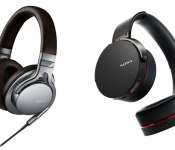
While several other audio outfits have already unveiled hi-fi minded and bass heavy options, Sony’s looking to add some more of the same. First, the MDR-1a are a high-res set of on-ear cans aimed at listeners who fancy high-end aesthetics, with a bit more sophisticated look than the MDR-1. There’s silver accents with leather-like material wrapping both the earcups and headband for “long-term” comfort and silent joints keep movement from muddying the tunes. Inside, sound reproduction ticks the meter at up to 100 kHz to keep things clear with 40mm drivers powering beats. Of course, there are two cables included — for those who prefer in-line controls — designed to curb signal loss and a folding design that tucks nicely into that rucksack. Sound too good to pass up? The MDR-1a will arrive later this month with a $300 price tag that matches several other high-end options.
For folks who fancy a wireless set with a heavy dose of bass, Sony is adding to its existing line focuses on those tones with the MDR-XB950BT. This time around, the over-ear unit with built-in electronic bass boost and 40mm drivers cut the tether and go full-on wireless — as the alphanumeric moniker suggests. The Bluetooth connectivity handles streaming with AAC and apt-X support alongside a mic for making calls. What’s more, NFC allows for quick and easy pairing with your smartphone or streaming device of choice. And of course, if you gobble up that 20 hours of advertised battery life, there’s a passive option with a cord so you can still listen while you find an outlet. They have a bit of the leather-esque material of their own too, in case that’s a deal breaker. These are set to arrive mid-September for $200 where Sony’s gadgets are usually sold. For now though, take a look at both sets in the hands-on gallery below.
Filed under: Portable Audio/Video, Sony
.CPlase_panel display:none;
Sony announces the SmartWatch 3 with Android Wear

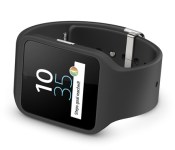
Sony’s been making smartwatches since before they were cool, and with the advent of Android Wear it was only a matter of time before they made another. Enter the Smartwatch 3, announced at IFA today, running Google’s new platform specifically for wearables. The third member of the family comes with a 1.2GHz quad-core processor, 1.6-inch screen and Sony’s now trademark IP68 waterproofing. Other key features include 4GB of storage, 512MB of memory NFC support, GPS and a 420mAh battery (charged over micro-USB).
Sony has also made it clear that the Smartwatch 3 will make use of the incoming Android Wear features we recently heard about (that make the watch more useful on its own). It’s also promising “better” battery life from that 420mAh cell — suggesting it’ll be good for up to two days of use, or four days on standby. If you’re a believer in “third time lucky,” then you can pick one up for 300 Euros starting this fall.
Filed under: Wearables, Mobile, Sony
.CPlase_panel display:none;
Sony outfits the SmartBand Talk with an e-paper screen and voice calling

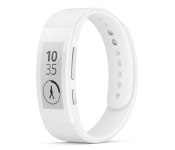
When does a fitness band become a smartwatch? We’d argue that an e-paper display is one feature you can use to make that distinction, which is exactly what Sony’s added to its “lifelogging” SmartBand. A display isn’t the only thing new about the SmartBand Talk, because as the name suggests, you can also make/take calls on the wearable thanks to an embedded microphone and loudspeaker. There’s an ARM Cortex-M4 32-bit processor to power the whole thing with 2MB of flash memory and that 1.4-inch black and white display to keep you updated on progress. As you might expect, Sony’s Core is at work here as well with edge-mounted volume and menu buttons to round out the on-board controls. The IP68 waterproof and dustproof wearable connects to an Android 4.4 (and above) device via NFC and Bluetooth to wrangle tasks for up to three days before needing a charge. If you’re looking to get a bit more active, €160 (around $210) will be the cost of admission when the SmartBand Talk arrives this fall in four different color options.
.CPlase_panel display:none;
Wearable and high-res music players added to the Sony Walkman fold

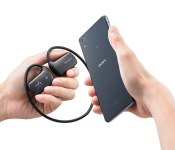
Still opt for a dedicated music player for listening on the go? Sony has two new options in its Walkman line that’ll do just that, and the NWZ-WS613 takes the wearable player and has it double as a Bluetooth headset. Connecting to your smartphone can beam tracks or you can listen to tunes loaded directly on the device with a ring-like controller for controls and calls that won’t break your stride. A smartphone app is also capable of tweaks and skipping around — should you want to limit the number of items in that gym bag. As you might expect, the unit is indeed waterproof to keep the sweat at bay and connects to fitness apps to further enhance those workouts. Does the wrap-around look sound like a solid addition to your exercise attire? Parting with $160 in October will secure one of your very own, but for those who’d rather keep the music player and headphones separate, there’s an option for that, too.

High-resolution audio has been talked about a great deal lately in regards to new gadgets, and Sony’s new Walkman music player continues to take aim there as well. The NWZ-A17 claims its the “world’s smallest and lightest” device to sort such files, with support for WAV, AIFF, ALAC, FLAC and more baked in. For regular ol’ MP3 and WMA files, DSEE HX upscales the tunes for higher quality listening. There’s 64GB of storage on board that’s expandable via a microSD slot, and the gadget allows for up to 50 hours of regular and 30 hours of high-res listening. Bluetooth and NFC connectivity is included too, and the whole lot is accessed via a 2.25-inch QVGA LCD display. So what about loading the thing with music? It appears to be quite easy as drag and drop functions play nice with iTunes on both Mac and Windows. Interested parties can grab one later this month for $300, and to tide you over, there’s a closer look in the gallery that follows.
Filed under: Portable Audio/Video, Sony
.CPlase_panel display:none;
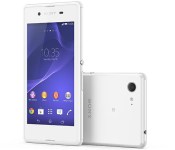
Sony’s Xperia E3 is its next colorful, budget device

Not everyone needs a smartphone that’s as fast (and as expensive) as their laptop, and competition in the affordable handset market is fierce. Never one to miss an opportunity, Sony has announced that it’s complimenting the top-end Z3 handset with the more modestly endowed Xperia E3. Of course, that means compromising — Sony says the E3 features “flagship design” and 4G capability, but that’s where the high-end comparisons end. It carries a 4.5-inch, 854 x 480 screen, quad-core 1.2GHz Snapdragon 400 CPU, a 2,330 mAh battery, 1GB RAM, 4GB expandable memory and a 5-megapixel camera. Though those specs aren’t exactly inspiring, Sony is emphasizing social and camera features like HDR and Timeshift burst. There’s no word on pricing or availability yet, but we imagine its young target market will be able to afford it.
Filed under: Cellphones, Mobile, Sony
.CPlase_panel display:none;
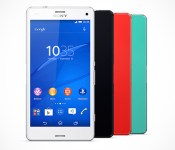
The Xperia Z3 Compact is a cut-down version of Sony’s latest flagship

Sony may’ve decided against making a pint-sized variant of its previous leading device, but not this generation. The company’s announced at its IFA press conference the Xperia Z3 Compact, a smaller version of the new flagship also revealed today. Here’s the thing to remember about the pint-sized variant — it packs the same quad-core 2.5GHz Snapdragon 801 chipset under the hood, 20.7-megapixel rear camera (complete with Sony’s Exmor RS sensor) and the same sort of waterproof as its big brother. It’s the screen that differs most dramatically — we’re looking at a 4.6-inch Triluminos display running at 720p, a pretty significant step down from the 5.2-inch 1080p panel that graces the full-size Z3. Yeah, we know, a 720p screen seems downright passé these days, but it might be a small price to pay for someone tired of all these pocket-busting phablets floating around out there. Of course, you can also expect that slightly less impressive screen to drive the Z3 Compact’s price tag down, though at this point we’re not entirely sure how much cheaper it’ll be than the Z3.
Filed under: Cellphones, Mobile, Sony
Source: Sony Mobile
.CPlase_panel display:none;
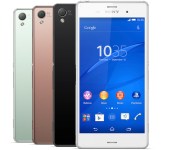
Sony announces its latest flagship smartphone, the Xperia Z3

We hope you weren’t getting too comfy with the months-old Xperia Z2 — Sony has just unveiled another range-topping Android smartphone, the Xperia Z3. It’s really a subtle evolution of its predecessor. You’ll still find a 5.2-inch, 1080p display, a 20.7-megapixel camera and waterproofing, but there’s now a more rounded aluminum frame. Sony has also added a new, wide-angle 25mm lens (to fit more into a shot) and extra-high ISO 12,800 light sensitivity. It’s a little bit faster as well, with a speed-bumped 2.5GHz Snapdragon 801 processor instead of the 2.3GHz chip you saw in the Z2.
There are some new media experiences, too. The Z3 has brought its DSEE HX audio upscaling technology to improve the quality of compressed music, and there’s digital noise cancelling that cuts out nearly all ambient sound. For photographers, Face In lets you capture your reaction to a shot as the same time as you take it; you can add drawings to pictures, build movies with a new editor, shoot scenes from multiple angles using multiple phones, and add sound to photos.
You’ll get the Z3 sometime this fall. Sony hasn’t immediately announced carriers, but there will be at least one version with North America-friendly LTE data.
Filed under: Cellphones, Mobile, Sony
.CPlase_panel display:none;
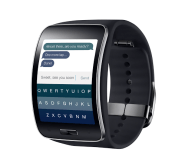
The Samsung Gear S makes Fleksy its day-one integrated keyboard
 Fleksy is one of the more recognizable names when it comes to third-party keyboard apps and it’s about to get a little more recognizable. Fleksy has announced a new partnership with Samsung which will see the new Samsung Gear S smartwatch make Fleksy its only fully-integrated keyboard at launch and is going to be free for all Gear S owners. This makes a lot of sense for the Gear S seeing as it will be a standalone device able to make calls and access mobile data, and having Fleksy there will make it all the more simple to type commands on the Gear S’s curved display.
Of their partnership with Samsung, Fleksy founder Ioannis Verdelis had this to say: “We are delighted to announce our first OEM partnership today, and we are excited to be part of the Samsung ecosystem… This is a big milestone for Fleksy, and we plan to solidify our position as the leading typing technology for smart devices over the coming months.”
Fleksy is already available as an option on the Gear 2 and Gear 2 Neo with their messaging app, so this new move seems like the next logical step in their relationship with the Korean tech giant.
Press Release
Fleksy partners with Samsung to bring its keyboard to Samsung Gear S
First OEM partnership for Fleksy keyboard
SAN FRANCISCO — September 03, 2014 — Fleksy, the fastest keyboard in the world, announced a partnership with Samsung today to bring its keyboard to the newly launched Samsung Gear S smartwatch.
The partnership makes Fleksy the only fully integrated third-party keyboard on Gear S on launch day, allowing users to type in every app right from their wrist. Through the partnership, Fleksy will be available for free for all Gear S users.
“We are delighted to announce our first OEM partnership today, and we are excited to be part of the Samsung ecosystem” said Ioannis Verdelis, Founder and CEO of Fleksy. “This is a big milestone for Fleksy, and we plan to solidify our position as the leading typing technology for smart devices over the coming months”.
Fleksy confirmed it will also continue support for its Fleksy Messenger app, available for Samsung Gear 2 and Gear 2 Neo smartwatches, with a major update coming soon.
“With thousands of daily downloads of Fleksy Messenger, we are already publishing one of the Top 3 selling apps of the Gear ecosystem” said Kosta Eleftheriou, Founder and CEO of Fleksy. “We are very excited by the growth of the wearable tech market, and proud Fleksy has already established itself as the leader for typing on watches”.
Fleksy confirmed that it will be providing demonstrations of its keyboard on Samsung Gear S during the IFA trade show taking place in Berlin this week.
About Fleksy
Fleksy is a next-generation keyboard powered by patent-pending technology that makes typing on any device fast, accurate and so easy you can even type without looking. Fleksy recently broke the Guinness World Record for fastest typing on a touchscreen keyboard (May 2014).
Its unique language algorithm founded on Geometric Intelligence moves beyond text prediction and autocorrect, to give a much more accurate and easier typing experience than last-generation keyboards.
Winner of the prestigious “Golden Apple” award, Fleksy is the first keyboard to enable full-speed typing by blind iPhone users. Winner of the 2013 CES “Innovations Design and Engineering Award”, Fleksy is also the first keyboard app to be shipped on a SmartWatch, the first to arrive on iOS, the first to work on 3D gesture systems (Leap Motion) and the first app developer to integrate with the Samsung Gear 2.
Fleksy’s award-winning design and technology is backed by venture capital including Highland Capital Partners and Kleiner Perkins Caufield & Byers. To learn more about Fleksy, visit http://www.fleksy.com.
About Samsung Electronics Co., Ltd.
Samsung Electronics Co., Ltd. is a global leader in technology, opening new possibilities for people everywhere. Through relentless innovation and discovery, we are transforming the worlds of TVs, smartphones, tablets, PCs, cameras, home appliances, printers, LTE systems, medical devices, semiconductors and LED solutions. We employ 286,000 people across 80 countries with annual sales of US$216.7 billion. To discover more, please visit http://www.samsung.com.
//<![CDATA[
ord = window.ord || Math.floor(Math.random()*1E16);
document.write('‘);
//]]>
The post The Samsung Gear S makes Fleksy its day-one integrated keyboard appeared first on AndroidSPIN.
.CPlase_panel display:none;

Samsung’s announcing a bunch of new products today, get your liveblog here!

The headline says it all, really: Samsung is one of the biggest, if not the biggest, companies here at IFA, and it’s about to unveil some shiny new stuff. Join us at 9AM ET today as the tech giant holds its annual “Unpacked” event. Will we see a new Galaxy Note? Maybe that leaked virtual reality headset? Another smartwatch? We’ll be on the ground in Berlin, reporting live — and you can bet your Galaxy S5 that we’ll be getting hands-on afterward. Bookmark our liveblog, and meet us there in exactly one hour. Be there or be square.
Filed under: Misc, Mobile, Samsung
.CPlase_panel display:none;

Google leaps into another quantum computing research project

Though the effectiveness of quantum computing is highly disputed right now, that hasn’t deterred Google from throwing more money at it. Mountain View just announced that it’s backing another effort to build a new breed of quantum processors with scientists from the University of California at Santa Barbara (UCSB). Google is already a partner at NASA’s Quantum Artificial Intelligence Lab (QUAIL), and invested some $15 million in a D-Wave quantum computer for the project. However, a study done on a D-Wave’s computer has cast doubt on the efficacy of the machine, a claim that was refuted by D-Wave as “bullshit.” Intriguingly, several researchers involved in that study were also from UCSB — like John Martinis, who has worked on quantum computing for nearly 30 years.
Google has recruited Martinis, along with several other members of his team (who will continue to work at UCSB as well). That team recently developed a method for improving the reliability of quantum processors to make them more commercially viable. However, despite the apparent friction between the researchers and D-Wave (which is developing a new, more powerful “Vesuvius” computer) Google’s Hartmut Neven sees the research as complimentary. “We will continue to collaborate with D-Wave scientists and to experiment with the “Vesuvius” machine at NASA Ames.”
Filed under: Science, Alt, Google
Via: Bloomberg
Source: Google
.CPlase_panel display:none;
 AIVAnet