


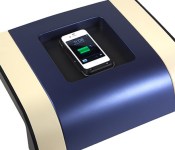
Future Cadillacs to come with dual-standard wireless chargers

If you’re thinking of buying a new Cadillac soon (congrats!) and you’re also big on gadgets, you may want to keep an eye out for some specific models. Visteon, a car electronics supplier that conjured up a smart infotainment system in 2013, is set to debut its wireless charger in the 2015 ATS luxury sedan. It will also be installed on the CTS Sports Sedan this fall, though, as well as the Escalade SUV and other General Motors cars by the end of 2014. Unlike most wireless chargers, Visteon’s works with two standards — Qi and Power Matters Alliance (PMA) — similar to the ChargeSpot Pocket out of Canada. The dual-standard capability future-proofs your in-car charger… unless manufacturers decide to stick to another standard instead.
These Cadillacs will serve as the launching pad for Visteon’s technology, which can be installed anywhere from the cockpit to the glove compartment. To get a glimpse of how it works, check out the video below that shows a Cadillac ATS with the wireless charger behind the instrument panel, which connects to the charging phone via Bluetooth.
Filed under: Peripherals, Transportation, Mobile
Source: VIsteon
.CPlase_panel display:none;

Google is bringing the Chrome OS desktop to Windows 7

The Chrome browser on Windows 8 has had a Chrome OS-like view for a while, but it now looks like that OS-within-an-OS option is spreading to other platforms. François Beaufort notes that Chrome Canary now has an experimental “Chrome OS mode” for Windows 7 that drops you into Google’s web-based desktop, complete with an app launcher; you’ll even get Google Now notifications through the app. There’s no telling when (or if) this full-screen mode will reach polished versions of Chrome, but you can try it in Canary today if you’re willing to live on the bleeding edge.
Filed under: Internet, Software, Google
Source: Francois Beaufort (Google+), Chromium.org, Chrome Canary
.CPlase_panel display:none;
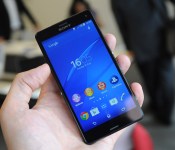
Sony’s Xperia Z3 Compact represents what all ‘mini’ phones should be

Miniature. Every phone maker is trying out the Mini Me approach these days, but most of them don’t do it very well. Sony’s one of the exceptions: Last year the manufacturer came out with the Xperia Z1 Compact, which was a smaller version of the flagship phone with almost the same specs. This is a big deal, because more often than not, “mini” models don’t get the same stellar treatment as their bigger siblings. Fortunately, the first Compact must have done well enough for Sony to give it a second heave-ho; enter the Xperia Z3 Compact, which debuted today at IFA 2014 in Berlin.
To be clear, the Z3 Compact isn’t an exact shrunken-down replica of the Xperia Z3 — also announced at today’s show — but it’s still much closer than any other manufacturer has been. It uses a 4.6-inch 720p screen instead of a 5.2-inch 1080p option; Sony claims that phones this small doesn’t really need such high resolution, so this is clearly an optimal way for them to cut costs. (My first impressions of the screen are quite lovely; the lower resolution didn’t negatively effect my initial experience, albeit it was in a brightly lit press booth.) Additionally, it has a smaller battery as a result of the smaller size, but 2,600mAh is still nothing to balk at — especially given the lower resolution won’t be much of a battery burden.
It also comes lined with a “liquid reflection” frame (which sounds like something you’d get at a bar after a long day at work), which uses translucent plastic on the sides instead of aluminum; and although I’m always a fan of phones that feature metal frames, the plastic feels extremely solid and the translucence simply looks pretty cool.
But those differences aside, the Compact has nearly everything else. It comes with the same IP68 waterproof rating, Snapdragon 801 chipset, 20.7MP ExmorRS camera sensor with 2.2MP front-facing camera, 16GB internal storage and microSD card slot (though the Z3 gets up to 128GB, whereas the Compact is 64GB).
As you might expect, the smaller body and svelte 7.3mm profile makes it quite easy to hold, and the slight curves on the side bubble out to offer a solid grip without the feeling of the corners or edges being too sharp for comfort. It comes with a hardware camera shutter button on the lower right, just below the volume button and power key; the volume is in a rather awkward spot, however, as it’s the exact place I like to keep my grip, so it may likely result in more accidental presses for anyone with similar preferences. Over on the left, you’ll find the nano-SIM slot, microSD reader and micro-USB charger, and the 3.5mm headphone jack is on top.
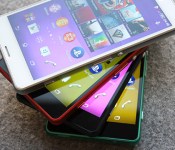
The Compact will come in several colors when it gets released this fall: White, black, green and orange, with the latter two being much more sporty than the Z3′s options. All told, I’m actually a bit more excited to use this phone than the Z3 itself, though both are rather tempting offerings; but there are still plenty of people who prefer a smaller size but don’t want to sacrifice flagship components to get it. Fortunately, although Sony’s option isn’t a perfect replica of its big brother, it’s at least the best compromise for a “mini” smartphone that we’ve seen so far.
Filed under: Cellphones, Wireless, Mobile
.CPlase_panel display:none;
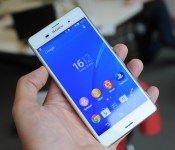
A closer look at Sony’s Xperia Z3 flagship

The Xperia Z2 is just over six months old, but Sony’s intent on staying ahead of the curve with the new Xperia Z3, announced today. With a 2.5GHz quad-core Snapdragon 801 processor, a whopping 3 gigs of RAM and various other high-end components like a 20.7-megapixel camera, we’re talking about serious future-proofing, even if it’s still a relatively incremental upgrade over its predecessor. Sporting more or less the same omnibalance design with aluminum detailing round the perimeter, you’re going to need to be a fan Sony’s previous work to appreciate the Z3. Anyone who may’ve found the Z2 unwieldy, however, might see the more refined, newer flagship as a viable option.
It’s immediately apparent the Xperia Z3 doesn’t carry quite the bulk of the Z2, being both thinner, lighter, and just as simply designed. There’s nothing much to the glass front and back of the device (which comes in white, black, silver-green and copper colors), with camera lenses, bezels and understated logos more of less where you’d expect them. The aluminum power key, volume rockers and dedicated camera shutter button adorn the right edge of the device, alongside the waterproofing flaps that hide the microSD and SIM card slots. One more noticeable difference from the Z2 is the aluminum edges are now broken up at the corners, and replaced with corner caps made out of a type of nylon. These are more resilient than the aluminum, we’re told, and thus won’t ding or deform if you happen to drop the thing.

Otherwise, not much has changed on the design front at all. The Z3 does have a higher water and dustproof rating than the Z2, even if you can’t tell, at IP65/68. Sony has stuck with a 5.2-inch, 1080p display on the Z3 (just like the Z2), although this panel has contrast-enhancing technology for improved sunlight readability. Sony didn’t want to upgrade to a 4K or even 2K display for better a spec sheet if it was going to impact battery life, thus no improvement in resolution. The display also has dedicated memory, so it won’t refresh when it doesn’t have to, saving on battery life further. The more efficient Snapdragon 801 should help on that front, too, and every little helps when you have a 3,100mAh battery (100 mAh less than the Z2) driving such a powerhouse. We’re told that it’ll last for two days without needing to be plugged in, but we’ll have to see what kind of usage conditions that entails.
The camera hasn’t changed in terms of megapixel count from the Z2. The 20.7-megapixel sensor, however, is said to have better low-light performance, a new 25mm wide-angle G-lens, and a new upper limit to the ISO setting of 12,800 (a smartphone first, apparently). A new “Intelligent Active Mode” when shooting video offers improved digital stabilization, which operates on top of the Steadyshot tech Sony already incorporates into its top-end devices. New camera features include live to YouTube streaming and “Face in,” a mode that captures feeds from both the rear and 2-megapixel front-facing camera simultaneously. There’s also “AR fun,” which lets you add 3D AR effects to the frame, and a multi-camera mode that pairs the Z3 with other Sony cameras and smartphones via WiFi Direct, allowing you to see both viewfinders on the screen and dynamically direct video from just the one phone.

The Z3 is also equipped with high-resolution audio playback, and an upscaling engine called DSEE HX that upscaled low-res audio (whether that be from streaming services or files) to near hi-res audio, although you’ll need a high-end set of headphones to feel the benefit. Finally, Sony has equipped the Z3 and others devices in the Z3 family with PlayStation 4 remote play, previously only a feature of the handheld Playstation Vita console. It works best over your home WiFi network (say, if the TV is required for some other purpose), but it can theoretically work anywhere, albeit with terrible lag. A new controller mount that adds a suction cup to the DualShock 4 controller gives you the optimum setup for smartphone gaming. The remote play feature isn’t due to be enabled until November, however, possibly a little later than the Z3′s “fall” release date for an as-yet unknown price.
Filed under: Cellphones, Mobile, Sony
.CPlase_panel display:none;
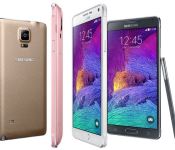
Samsung Galaxy Note 4 and Note 4 Edge officially announced, launching this Fall
Samsung has taken the wraps of their new line up for the Note line. Offering not just one, but two Note 4 devices. You have the more traditional Note 4 and a spin off Note 4 Edge device. For the most part both devices are the same, with the exception of a few minor details. First though, let’s tell you what the new Samsung Galaxy Note 4 is packing.
Samsung Galaxy Note 4 Specs:
- 5.7-inch 2560×1440 Quad HD Super AMOLED display
- 2.7 GHz Quad-Core processor or a 1.9GHz Octa-Core processor depending on your region
- 3GB of RAM
- 32GB internal storage
- Micro SD card slot
- 16MP rear camera
- 3.7MP front camera
- 3,220 mAh battery
- Dimensions: 153.5 x 78.6 x 8.5mm
- Weight: 176g

The new Galaxy Note 4 will be offered in Charcoal Black, Frost White, Bronze Gold and Blossom Pink in global markets starting in October. You will notice the Note 4 has a bit more of the Galaxy Alpha design paired up with faux leather backing. They even were kind enough to toss in the Heart Rate monitor from the Galaxy S5 in for good measure. It also includes a revamped S-Pen and accompanying software that gives it a more fluid and natural feel. The S-Pen also introduces a more user friendly Air Command functionality with features like Action Memo, Screen Write, Image Clip and Smart Select. It also includes a new fast charge capability that is said to be able to charge the device from 0% to 50% in just 30 minutes.
Moving along to the other variant that Samsung announced today we see the Galaxy Note 4 Edge. Like the name might lead you to believe, there is a screen on the edge of the device. This was previously rumored to be coming and we are intrigued to see it, and also glad to see that it is a variant and not the only model option.

You can see the design is pretty much the same as the Note 4, with the exception of that small 160 pixel curved screen aspect on the side. The internal battery on this guy had to be shrunk slightly and comes in at 3,000 mAh. The side screen acts as a notification ticker, quick access to most used apps and various bits of device functionality. Samsung is quick to point out that a user can do a quick swipe to read notifications while not interrupting a movie on the screen or flipping the front cover of the folio open.
The Note 4 Edge specs:
- 5.7-inch 2560×1440 Quad HD Super AMOLED display + 160 pixel side ticker
- 2.7 GHz Quad-Core processor or a 1.9GHz Octa-Core processor depending on your region
- 3GB of RAM
- 32GB/64GB internal storage
- Micro SD card slot
- 16MP rear camera
- 3.7MP front camera
- 3,000 mAh battery
- Dimensions: 151.3 x 82.4 x 8.3mm
- Weight: 174g
It does look pretty weird and I am not sure how useful it will be. Not being in Berlin to handle it myself makes it a little tricky to form any opinion beyond it looking odd. The Samsung Galaxy Note Edge will be launched in Charcoal Black and Frost White in select markets, Samsung’s retail channels, e-commerce and carriers later this year.
As for the more traditional Note 4, we do know that AT&T, T-Mobile, Sprint and US Cellular will be offering the device. We also know that Sprint will also carry the Galaxy Note Edge as well. No pricing or specific dates were mentioned yet.
What are your thoughts about the new Note line from Samsung? Is the Note 4 everything you hoped it would be with the metal frame, rocking screen and killer hardware, or are you finding yourself oddly drawn to the Note 4 Edge with the curved notification display?
More info from Samsung – Note 4 | Note 4 Edge
//<![CDATA[
ord = window.ord || Math.floor(Math.random()*1E16);
document.write('‘);
//]]>
The post Samsung Galaxy Note 4 and Note 4 Edge officially announced, launching this Fall appeared first on AndroidSPIN.
.CPlase_panel display:none;
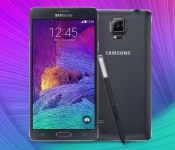
Samsung Details New Galaxy Note 4, Note Edge, Gear S Watch and Gear VR Headset
Ahead of Apple’s upcoming press event where it will introduce larger iPhone models, Samsung today kicked off IFA 2014 with a presentation that unveiled several new mobile and wearable devices including the Note 4, Note Edge, Gear S smartwatch and Gear VR headset.

The Note 4 and Note Edge are two new models in Samsung’s popular Note series of large smartphones. The Note 4 is the premium model offering a 5.7-inch Quad-ultra HD (2560×1440) Super AMOLED display at 518 pixels per inch and either the 2.7 GHz quad-core Snapdragon 805 processor with support for Category 6 LTE or the 1.9 GHz octo-core Exynos 5433 with Category 4 LTE, depending on geographic location. There’s also a 16-megapixel rear camera with image stabilization, a 3.7-megapixel front camera designed for selfies, a heart rate sensor, and a new S-Pen with improved sensitivity that detects pressure, nib tilt, and speed. Design-wise, the Note 4 sports a plastic textured rear housing with metallic edges.
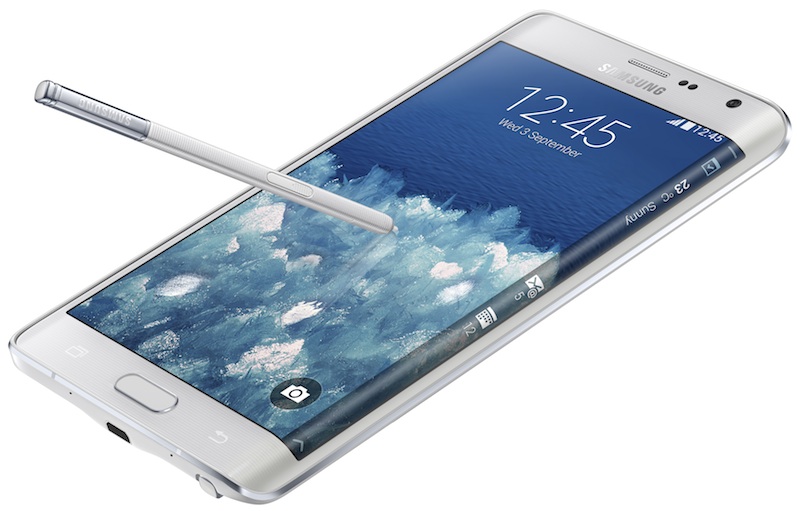 Galaxy Note Edge
As an alternative to the Note 4, Samsung also unveiled the Note Edge, a smartphone that is identical to the Note 4 under the hood, but features a curved display. The curved edge of the display operate separately from the main display providing an app launcher or contextual controls depending on the app that is being used.
Samsung also detailed its Gear VR virtual reality headset that was developed in conjunction with Oculus and is compatible with the Note 4. Finally, the company also re-introduced the recently announced Gear S smart watch. The Gear S is Samsung’s latest wearable, featuring a 2-inch, curved AMOLED display, and 3G connectivity. The Tizen-powered device also includes dual-core 1.0 GHz processor, 4 GB of storage, 512 MB of RAM, and sensors such as GPS, accelerometer, gyroscope, UV detector, barometer, and heart rate monitor.
 Galaxy Gear S
Samsung did not provide pricing or exact launch dates for this new hardware, but the Korean company is expected roll out these products in the coming months. Samsung’s latest mobile and wearable devices will compete with Apple’s upcoming gear, which will be announced beginning next week. Apple is expected to announce its new iPhone 6 in both 4.7-inch and 5.5-inch sizes and its iWatch wearable at a press event scheduled for September 9. This event likely will be followed by a second event in October that Apple may use to unveil its next generation iPad models.
.CPlase_panel display:none;
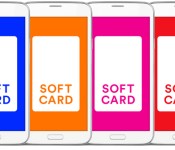
Isis mobile wallet becomes Softcard to distance itself from terrorists

The Isis crew promised it would rebrand its mobile wallet to eliminate any confusion with ISIS, the Middle Eastern terrorist group, and today that change is at hand: meet Softcard. It’s not a particularly bold name, but the payment company believes that the “inherent simplicity” of its new badging could make it ubiquitous. Whether or not that’s true, the transition should happen relatively quickly. You should see the Isis Wallet app transform into Softcard within a few weeks. Traces of the old naming scheme will stick around for a short while, but it should be a distant memory before too long.
Filed under: Cellphones, Mobile, Verizon, AT&T, T-Mobile
Source: Isis
.CPlase_panel display:none;
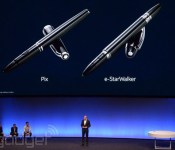
Samsung partners with Mont Blanc on a chic Galaxy Note 4 stylus

At IFA 2014 Unpacked, Samsung has announced that it’s partnering with venerable pen-maker Mont Blanc on two custom styluses for its new Galaxy Note 4. The “Pix” and the “e-Starwalker” are done in the pen maker’s classic style for any Note smartphone or tablet user. The company calls it a “digital writing” device, a clear sign they’re targeting those for whom a flimsy plastic pen just won’t do. The company also revealed two flip covers for the Note 4, the “Extreme” in a threaded fabric that mirrors Samsung’s Galaxy S5 “band-aid” design, and the “Soft Grain” with a classic leather look. There’s no word yet on availability or cost, but we don’t imagine that a digital writing device comes cheap.

Filed under: Cellphones, Peripherals, Mobile, Samsung
.CPlase_panel display:none;
Live from Sony’s IFA 2014 Xperia event!

If you don’t see this message, that’s probably a good sign — it means that the liveblog is going strong and we’re telling you about the latest Sony products as they’re introduced on stage at IFA 2014. If you do see this message, however, it just means that we haven’t been able to get settled into our seats quite yet, but are busily working toward achieving that goal. Keep refreshing this page (or at least hang onto it as a bookmark if you need to come back to it later) and soon you’ll see exactly what we’re seeing: New phones, tablets, smartwatches and who knows what else.
[Image credit: Ausdroid]


Filed under: Announcements, Cellphones, Tablets, Wearables, HD, Mobile, Sony
.CPlase_panel display:none;

Sony’s soundbar combo offers another high-definition audio option

Headphones and music players aren’t all Sony had on tap in the audio department for IFA, as the company has also announced a new soundbar/wireless subwoofer combo. Having already outed two of the devices earlier this year, the HT-ST5 offers the option of 380 watts of 7.1 surround sound across seven digital amps and nine total speakers with support for both Dolby TrueHD and dts-HS formats. There’s a Bluetooth option that touts one-touch NFC connectivity and handles aptX and AAC audio codecs. For hooking up all of those living room gadgets, a trio of HDMI jacks with 4K pass through connects to your TV with a single cable. And a mobile app for both Android and iOS streams music from places like Pandora and Spotify while providing remote control for the system as well. Ready to upgrade your flat’s theater setup? Well, the pair will hit your wallet for $1,000 when it arrives later this month.

Filed under: Home Entertainment, Sony
.CPlase_panel display:none;
 AIVAnet