


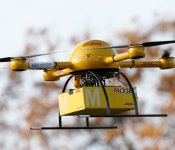
What you need to know about commercial drones

Wondering why you don’t see drones everywhere, despite the intention of Amazon and others to deliver all the things with flying robots? Here’s why: it’s illegal. The United States Federal Aviation Administration (FAA) doesn’t permit filming, crop-spraying, spying, tour-guiding, pizza delivery or any other commercial drone applications (you can, however, fly one privately). “But that’s unjust!” you may rail. “Why should the government stop businesses from plying their trades?” The FAA is charged with keeping the skies safe, and drone operators could pose a danger to commercial aircraft or spy on you illegally. On the other hand, US businesses want the FAA to approve drone use, stat, so they can stop operating quasi-illegally and start making money. So, who’s right? Who’s wrong? Here are the ABC’s of commercial drone flight in the US.
WHAT ARE THEY?
First, a little terminology. The industry would prefer Unmanned Aerial Vehicle (UAV), or any moniker except “drone,” but we’ll use the terms interchangeably. UAVs/drones are defined as any aircraft without a pilot aboard, but they can be broken down broadly into two categories: rotary drones — like the swarming KMEL quadrotors or Amazon’s octacopter — and fixed-wing drones like the Puma. (We’re focusing on commercial models, not Predator-style military drones.) Like their civilian helicopter and airplane counterparts, each has its own strengths and weaknesses.

Rotary drones get the glory. For one, they make perfect camera platforms for stunning aerial shots, since they can hover and maneuver in any direction. While you may be familiar with the smartphone-guided Parrot AR Drone II, other models — like the DJI Phantom series — are more common for commercial purposes. Starting at $679, the latter can pack a GoPro Hero 3 or its own camera, but if you want to carry a mirrorless, DSLR or cinema camera, you’ll need one of DJI’s expert cameras or models like the BeetleCopter or Infinite Jib — and a lot more money. Rotary copters also do real estate fly-overs, journalism, herding, agriculture, deliveries and spying, to name just a few. The main drawbacks to copter drones are slower speeds and shorter range than fixed-wing models; even with battery extenders, most can’t run more than a half-hour.

As for fixed-wing UAVs, the FAA just approved the first commercial use of the AeroVironment Puma, a four-and-a-half foot, hand-launched fixed-wing drone and the Insitu ScanEagle (pictured above). The main advantage of such craft is that they can fly for 4-5 hours at decent speeds, making them useful for surveys, maintenance operations, long-range sensing and even aerial photography. As for downsides? Fixed-wing drones often require a runway or catapult, aren’t very maneuverable and they can’t hover — so forget about a dronie.
WHAT’S AT STAKE AND WHY SHOULD I CARE?

The UAV industry is already pretty large despite the handicap of being arguably illegal. Once drones became powerful enough to hoist cameras, a cottage industry sprang up with services at a fraction the price of manned aerial photography. As a result, the Motion Picture Association of America has requested exemptions to the current drone ban, citing “tangible economic benefits.” Media organizations have also demanded clarity after a journalist nearly lost his job filming a fatal car accident by drone. Another industry looking for a break is search and rescue, which has seen the FAA clamp down on drone operations. Simply put: the drone industry is already booming and could be worth multi-billions of dollars in the coming decade.
There are other tangible benefits to Joe Public besides prettier movies. A search-and-rescue drone could help find a missing loved one in a difficult-to-search area. They could also make it cheaper and faster to map your property, protect you from bad guys or spray your crops. The industry would also create jobs for drone pilots doing something less stressful than targeting bad guys.

On the other hand, if the FAA isn’t careful with the rules, drones could negatively impact your safety. For starters, it’s easy to imagine a package-laden Amazon copter dropping out of the sky and injuring or killing a bystander. The tightly controlled airspace system around airports is also vulnerable right down to ground level (drones are banned at any elevation in those areas). As illustrated by the “Miracle on the Hudson” aircraft, something as innocent as a bird can bring down a large aircraft. Officials fear that drones could easily be sucked into a jet engine and cause catastrophic failures. Despite the potential economic benefits of drones, a single accident would create a storm of negative publicity, particularly if it involved fatalities.
WHAT’S THE ARGUMENT?

Once the FAA does create new laws, the drone industry could really take off. It estimated that 7,500 UAVs could enter the system if they become legal. But the FAA’s sole mandate is keeping air travel safe for pilots and passengers, a duty it performs admirably. Given the complexity of the current airspace system, throwing tens of thousands of drones into the mix could create chaos. There have already been high-profile near-misses between drones and commercial aircraft, including one incident that had the pilot actually bracing for a collision. In Vancouver, a drone fell while filming a movie scene (injuring nobody, luckily), which caused the city to temporarily ban the practice. That’s why FAA drone head Jim Williams has told industry that he’s aware of the pressing need for clear rules, but the process “must take place incrementally and with the interest of safety first.”
Still, companies have chided the FAA for failing to meet its own regulation deadlines. Right now, many operate in limbo, aware they could be shut down at any time. One operator was fined $10,000 by FAA for illegal filming, though the decision was later overturned. Another who received a warning told the FAA it could “piss off.” Adding to the anger, the FAA said that it would announce new rules this November, several years later than promised — and those rules could take several more years to implement.

The good news is that the US regulator has at last approved some UAV flights over land and water. Once oil company BP proved that flights of its Puma AE were safe, the FAA okay’d it for road and infrastructure inspection. In addition, the FAA now has a test site at a private Nevada airport to scrutinize all aspects of drone flights, with five more sites coming online soon. It could also start granting exemptions to filming companies, thanks to a request by the Motion Picture Association of America. Near-term approval of drone use in low-risk industries like agricultural, powerline, pipeline and oil and gas inspection is also likely. By assessing UAV use on a case-by-case basis, the FAA could hold off industry clamoring until final rules are implemented.
WANT TO KNOW MORE?

If you’ve decided to go into the drone business despite the shaky legal ground, a good place to start is the Association for Unmanned Vehicle Systems International (AUVSI). Once you’re ready to pick out a drone, there’s a fairly extensive list on prosumer hobbyist site Drone Flyers. You can also get in touch with the two most popular companies selling drones in kits or ready-to-fly models (DJI and Parrot). The WSJ has an informative article about drone safety, CNN detailed how they could be used in industry and Motherboard recounted the rescue industry’s fight against the FAA. For its part, the FAA itself has published a myth-busting article about drones, discussed industry petitions for drone ban exemptions and detailed progress on its UAV test sites. Finally, we’ve published quite a few drone articles ourselves.
[Image credits: AP/Jim Cole, FCC, Insitu, AeroVironment, DJI]
Filed under: Robots, Transportation

Google Fit in the works , possible launch at I/O

Health and fitness tracking is shaping up to become big business and we are seeing a multitude of wearable fitness devices hitting the market that can monitor and track every move you make to achieve your fitness goals. Big names are also releasing health related services with the likes of Sami, a biometric data platform… Read more »
The post Google Fit in the works , possible launch at I/O appeared first on SmarterWatching.
Read the rest at the source, SmarterWatching.com
The post Google Fit in the works , possible launch at I/O appeared first on AndroidGuys.

Google to Take on Apple in Health and Fitness Tracking with ‘Google Fit’
 Just weeks after Apple announced its Health app for iOS 8 and corresponding HealthKit platform for allowing developers and accessory manufacturers to tie into the system, Google will apparently be making a similar announcement at its Google I/O conference. According to Forbes, Google’s new “Google Fit” service will perform a similar function to HealthKit, aggregating data from fitness trackers and apps in one place on the user’s device.
Google Fit will aggregate data through open APIs, instruction sets that allow apps to share information, and will also announce partnerships with wearable device makers at its I/O conference, Forbes understands. One source with knowledge of Google’s plans said Google Fit would allow a wearable device that measures data like steps or heart rate to interface with Google’s cloud-based services, and become part of the Google Fit ecosystem.
Forbes says it is unclear whether Google Fit will be integrated into Android by default or if it will be handled through a standalone app.
Earlier this year, Google announced its Android Wear project to bring Android to wearable devices such as smart watches, with a focus on health monitoring. As a result, Forbes speculates Google Fit could serve as a hub for integrating data from a variety of Android Wear devices, as well as other products tying into the platform.
Apple’s Health feature received only a few minutes of stage time at the company’s Worldwide Developers Conference last week, although the company does have a feature page up on its site previewing the system. While Health will be able to tie into a variety of devices and apps as developers build in support, Apple’s iWatch is expected to be a major focus for the platform. Rumored for launch later this year around the time iOS 8 is released to the public, the iWatch will reportedly feature a number of biometric sensors to help monitor health and fitness. As a result, we can expect to hear much more about Apple’s Health initiative when the iWatch is ready to go.

Top 10 smartwatch companies [Infographic]

The smartwatch industry is about to explode; it’s the calm before the storm, and everyone is anxiously awaiting the launch of Android Wear to see how Motorola and LG can implement the smartwatch operating system. Smartwatches are nothing new, however, and have been around in consumer electronics right back to calculator watches. Functionality has enhanced… Read more »
The post Top 10 smartwatch companies [Infographic] appeared first on SmarterWatching.
Read the rest at the source, SmarterWatching.com
The post Top 10 smartwatch companies [Infographic] appeared first on AndroidGuys.

EE opens its broadband packages to all

After initially limiting connections to mobile customers, EE is throwing its broadband packages open to everyone. With BT and Virgin Media firmly in its sights, the company has slashed the cost of its internet bundles, allowing customers to sign up for a 17Mbps connection for just £2.50 a month. Don’t expect them to stay that low, though, as EE will hike prices after the 12-month promotion expires. Once it does, the £2.50 and £7.50 tiers rise to £9.95 and £12.95 respectively. Getting fibre broadband is also cheaper for a time, starting at £5 for a 38Mbps connection, but increases sharply to £19.95 after just three months.
EE doesn’t run its own lines, so you’ll be required to pay the £15.75 monthly line rental on top. However, it’s attempting to sweeten the deal by throwing in free weekend calls and removing download caps. For those signing up to its top-tier fibre package (£20 per month for the first three months, rising to £34.95 thereafter), EE stretches speeds to 76Mbps, throws in unlimited landline calls, 1,000 mobile minutes and international calls to 30 countries. If you’re already midway through a contract, EE wants to lure you away by offering a £100 buyout of your existing deal, but only if you upload a copy of your final bill to the EE website.
Filed under: Internet
Via: The Telegraph
Source: EE Broadband

Oculus game teaches journalists how to survive in war zones

You’re sat in the back of an armored personnel carrier when, suddenly, something hits you and the lights go out. Stumbling out of the darkness, you emerge onto the battlefield armed with just a video camera and a first-aid kit. Laying in front of you is a wounded soldier screaming for help, but would you know what to do? This is Stringer, an Oculus Rift title designed not as an alternative to Battlefield or Call of Duty, but to teach journalists sent into war zones how to survive.
The figure behind the project is former soldier turned journalist Ben Sainsbury, who was inspired by the story of a war correspondent who died because they lacked even basic first-aid training. Afterwards, he learned that writers that are sent into combat zones rarely receive any sort of survival awareness, let alone know how to properly tie a bandage. That’s why, alongside Ali Kokulu, he began developing a game that would give civilians a safe taste of life on the front line, and hopefully teach them some very basic first aid. Unfortunately, work on the game has currently stopped, but we can imagine that plenty of people would fancy giving this a try — after all, this is just the sort of immersive experience that VR was built for.
Filed under: Gaming
Via: Motherboard

A surfboard attached to a firehose is a… hoverboard?

A few years ago, JetLev developed a jetpack that let users float in mid air, so long as they were on the water. Using that same principle, French jet ski champion Franky Zapata developed the Flyboard, which let you follow behind a speedboat with a set of water-powered rocket boots. A few years later, and Zapata is back with the Hoverboard, which does the same job, but attached to a board with a single nozzle hanging out back. Now, aquatic daredevils and perform tricks and stunts to shame nearby surfer dudes. If there’s one downside, it’s that you’ll spend the better part of $6,000 on one of the units — not to mention owning or having access to your own speedboat.
Filed under: Transportation
Source: Zapata Racing

The Motorola Moto 360 may retail for £199.99 in the U.K.
 The Motorola Moto 360 smartwatch has garnered some attention in the past week after being inadvertantly (or advertantly) shown off on Jimmy Fallon’s The Tonight Show. It wasn’t supposed to be the star of the show, but it was nonetheless spotted on the wrist of The Verge’s Chief Editor, James Topolsky, suggesting again that the device is going to be announced in the very near future. For some time, we’ve been wondering how much the Moto 360 is going to cost at launch, and popular U.K. retailer, Mobile Fun, has recently suggested that the Moto 360 may retail for £199.99 in the U.K.
After rumours that the Moto 360 was going to cost €249 in Europe, the pricing for the device is starting to become a bit clearer. Both the U.K. and Europe pricing seem to suggest that an equivalent price in the U.S. would be $340 USD, however we know pricing can vary region to region, particularly as the Moto 360 is likely being manufactured in America itself. And seeing as Motorola itself has suggested the Moto 360 is worth about $249 USD (albeit for tax purposes), you can bet that the price is going to be that ballpark region.
Is the Moto 360 looking like a sure purchase for you? Are these prices what you’re expecting for the Android Wear smartwatch? Let us know what you think in the comments.
Source: Mobile Fun via TalkAndroid
//<![CDATA[
ord = window.ord || Math.floor(Math.random()*1E16);
document.write('’);
//]]>

Apple recalls older European iPhone chargers due to overheating risk

Apple recently launched a takeback program for faulty, third-party iPhone chargers, but should’ve looked inside its own glass house first. It has just issued an advisory that Apple-branded iPhone USB adapters sold between October 2009 and September 2012 could pose a safety risk by overheating. The affected model number “A1300″ came with European versions of the iPhone 3Gs, 4 and 4s. The good news is that you can get it replaced free of charge with a redesigned adapter (A1400) at an Apple Store, authorized service provider or through Apple technical support. Apple has a full list of the affected countries (including most of Europe but not the UK), along with information about how to swap it at a dedicated support page. In case you’ve already purchased a third-party replacement adapter, Apple will also give you a full refund.
Filed under: Cellphones, Apple
Via: 9to5 Mac
Source: Apple

CloudFlare donates tech to stop politically-sensitive sites from being knocked offline

If protecting yourself from hackers wasn’t tough enough, there’s another crippling internet attack that knocks websites completely offline while you’re a target: a denial of service attack. That’s why a company called CloudFare has launched Project Galileo, a free service that helps “protect politically and artistically important organizations and journalists against attacks that would otherwise censor their work.” CloudFlare has been in the business of protecting sites for quite some time, operating as a content delivery network that offers DDoS protection, but only to paid customers.
Websites that have come under attack before or feel that they could be targeted can apply, but they must be vetted first. In order to separate itself from the decision-making process, CloudFlare has formed an advisory board comprising of 15 organizations including American Civil Liberties Union, the EFF, Freedom of the Press Foundation and Mozilla. They’ll decide if a website acts in the public interest and allow it to receive enterprise-grade protection against hacker and DDoS attacks. CloudFlare intends to keep the recipients a secret though, stopping attackers from giving its servers a thorough workout.
[Original image credit: Russell McNeil, Flickr]
Filed under: Internet
Source: CloudFlare
 AIVAnet