


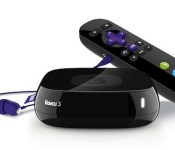
How would you change the Roku 3?

When we’re recommending media streamers, our first thought is always toward the Roku 3. After all, it’s got the best features of the Roku 1 and 2, a motion gaming remote and, slightly belatedly, now even supports YouTube. Our question, if you choose to accept it, is what you’d want Roku to add for a (theoretical) Roku 4? For our part, we’d love to see native live TV support, so we wouldn’t have to switch between that and the Chromecast during the World Cup. Got a better idea? Come to the forum and share it.
Filed under: Home Entertainment, HD
Source: Engadget Product Forums

Autonomous camera drone lets you shoot your own action scenes

If you want to record a bike ride or some other adventure by yourself, you typically have to wear an action camera. Going that route is fine for a first-person view, but what if you want some more dramatic shots? That’s where Hexoplus’ crowdfunded Hexo+ camera drone comes into play. The robotic hexacopter captures aerial footage of your expeditions simply by detecting where you are (or rather, where your phone is) and following along — you only have to set a preferred distance. It’s fast (43MPH) and stabilized, too, so it should keep up even if you’re racing across hilly terrain.
Should you like the idea of starring in your own sports movie, you’ll need to pledge at least $499 if you want a Hexo+ and already have a GoPro camera on hand; $699 will get you both the craft and a camera. That’s a lot of money just to get yourself in the frame, but it might be worthwhile if it gives you the production quality you usually only see from a big studio. You’d better hope that the FAA gets its drone rules in order before Hexoplus’ planned May 2015 ship date, though. After all, you don’t want to get into a legal battle over your airborne magnum opus.
Source: Hexoplus, Kickstarter

Want to hijack people’s PCs? Pay them a few cents

Apparently, hackers wanting to control PCs are wasting their time with elaborate botnets and vulnerability exploits — all they may really need is some pocket change. A study found that between 22 to 43 percent of people were willing to install unknown software on their PCs in return for payments ranging from a penny to a dollar, even when their OS flagged the app as a potential threat that required permission to run. While you might think that respondents would naturally be a bit suspicious, that wasn’t usually the case. As researcher Nicolas Christin notes, just 17 people out of 965 were running virtual machines that limited the possible damage; only one person went in fully expecting trouble, according to exit surveys.
It’s no surprise that you can get someone to compromise security if you say the right things. Just ask Kevin Mitnick, who breached networks by getting logins from overly trusting workers. However, the study also suggests that it would make more financial sense for hackers to pay targets directly rather than to pay for a botnet. Since people don’t seem to attach much monetary value to their security, criminals could pay roughly what they do now to steal data while avoiding the use of unreliable bots and equally sketchy bot sellers.
The study isn’t a big one, so it’s difficult to know if the results would be consistent on a larger scale. Also, people looking at tasks in Mechanical Turk are already eager for money; it may be tougher to pay for control of a PC when the offer comes out of the blue. Even if the voluntary infections would be lower in practice, though, the finding is a friendly reminder to always treat unfamiliar code with caution, no matter how much profit you’ll make by installing it.
[Image credit: Zack Jones, Flickr]
Filed under: Internet
Via: Nicolas Christin (Twitter 1), (2)
Source: Carnegie Mellon University (PDF)
Easily root your AT&T or Verizon Galaxy S5 with Geohot’s towelroot

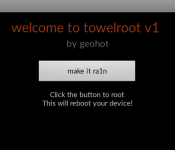
If you’ve been waiting for a way to root your AT&T or Verizon Samsung Galaxy S5, the wait is over. Today developer George Hotz, aka Geohot, released a solution that’s as easy as sideloading an APK and clicking “make it ra1n.”
The towelroot APK is said to work with the not only the AT&T and Verizon GS5, but also the Samsung Galaxy S4 Active, LG Nexus 5 and every phone with a kernel build date before June 3, 2014. It was noted in the XDA thread that the AT&T and Verizon Samsung Galaxy Note 3 may have some issues though.
Geohot said that some known bugs are that if the /proc/version on the Note 3 includes 3.4.0-722276, it doesn’t seem to work, the su binaries don’t seem to update, but this may not be the root’s fault. Also, Motorola and HTC devices don’t currently work because /system is write protected.
To install towelroot, head over to towelroot.com and click the lambda to download the APK and before you install, although everyone should know this, make sure you click to allow apps from Unknown Sources. After that, all you need to do is click the root button.
If you’re wondering if this will trip the Knox security system, this will more than likely void your warranty, but you already knew that, right? Geohot said that when he ran the root method, his device said “KNOX WARRANTY VOID: 0×0.”
One last thing, if you come across any bugs, be sure to report them. Geohot plans to release a new version later today that will hopefully squash them.
Enjoy the freedom of your newly rooted device!
VIA: XDA
Source: towelroot
UPDATE: The Note 3 with kernel 3.4.0-722276 is fixed, so if you had downloaded it before, please redownload.Current known bugs include the Note 3 with kernel 3.4.0-257432 not working, but updating to 722276 should fix it. The newest Motorola and HTC devices still don’t currently work because /system is write protected.
The post Easily root your AT&T or Verizon Galaxy S5 with Geohot’s towelroot appeared first on AndroidGuys.

IRL: A few rounds with Babolat’s Play Pure Drive smart tennis racquet

The market for connected, stat-tracking tennis gadgets has blossomed seemingly overnight. Some companies offer motion-sensing, snap-on attachments; others sell fancy racquets with built-in sensors. The French company Babolat is taking the latter route with its pricey but capable Play Pure Drive racquet. I took advantage of Tennis Warehouse’s demo program to see if the $400 sensor-laden racquet could help me up my game.
Babolat says the Play Pure Drive feels and plays like its standard Pure Drive racquet, which usually retails for around $190 to $200. While I didn’t have one of those handy to compare, I did have my trusty Wilson Six.One 95S on hand. Yes, the Play’s 100-square-inch head size is slightly larger than the Six.One’s 95 square inches, but the important part is that it does behave like a serious racquet — not a chintzy, bargain-basement affair with a sensor taped to the bottom.
In fact, as far as balance is concerned, I wouldn’t have been able to tell there was a suite of sensors and a Bluetooth module nestled in the handle. About the only thing out of the ordinary was having to charge a tennis racquet. Babolat recommends charging for three hours and rates the racquet for about six to eight hours of runtime.
During my demo period, I recorded about 1,200 shots during solo practices, two-person sessions and informal shotgun matches. Babolat says the Play can identify forehands, backhands, serves and smashes — all while comparing your strength level to other users and pro-level players. I conducted a quick, 30-shot test to gauge its accuracy with 10 serves, forehands and backhands and the Play was accurate to within one shot. A subsequent 60-shot session showed similar accuracy, though it did count a few serves as overhead smashes, something that may be due more to the informal nature of my practice session versus a more structured match. Impressively, the racquet ignored those small, rapid-fire warm up bounces many do before an actual point begins. It also measures where on the racquet you’re hitting and can determine if shots are hit flatly or with spin.
Users can sync play sessions to an iOS or Android app (Windows and Mac users also have access to a web-based client). iPad users like myself can also run the app in 2x Mode, though if you’re perusing stats while on the court, it’s best to have an internet connection handy — most of the app’s comparison/community features will be unavailable unless you’re connected.
Speaking of community, part of the app’s appeal lies in the ability to compare and compete with other Play users, including profiles set by Babolat-sponsored pros like Rafael Nadal and Li Na (spoiler alert: Nadal’s stats are slightly better than mine). That community competition and the game-like ability to “level-up” as you work on different shots can indeed encourage players to improve. I found myself sneaking in just one more practice session before returning my demo racquet — I didn’t want to end mere percentage points away from leveling up.
Overall, the Babolat Play Pure Drive is a surprisingly robust and capable bit of connected sports equipment. At $400, though, the Play makes sense for those truly serious about improving their games or, perhaps, tennis coaches and academies looking to better monitor students. Hopefully, this is just Babolat’s first volley, a preview of things to come. I could imagine an entire line of Play variants of the company’s other offerings for those looking for a racquet with a different play style or, fingers crossed, a lower price tag.
Filed under: Misc
Yosemite ‘Hand Off’ Feature Limited to Macs with Bluetooth LE
One of the more exciting features in Apple’s upcoming OS X Yosemite is the Handoff feature that allows a seamless app transition between your Mac and iOS devices.
The feature, however, is based on Bluetooth 4.0/LE which was first introduced in Macs in Mid 2011. The feature has since made its way into later Mac releases, finally coming to every Mac as of the 2013 Mac Pro.
Apfeleimer has published this chart which shows all Macs that support Yosemite, and the subset of those which have support for this version of Bluetooth:
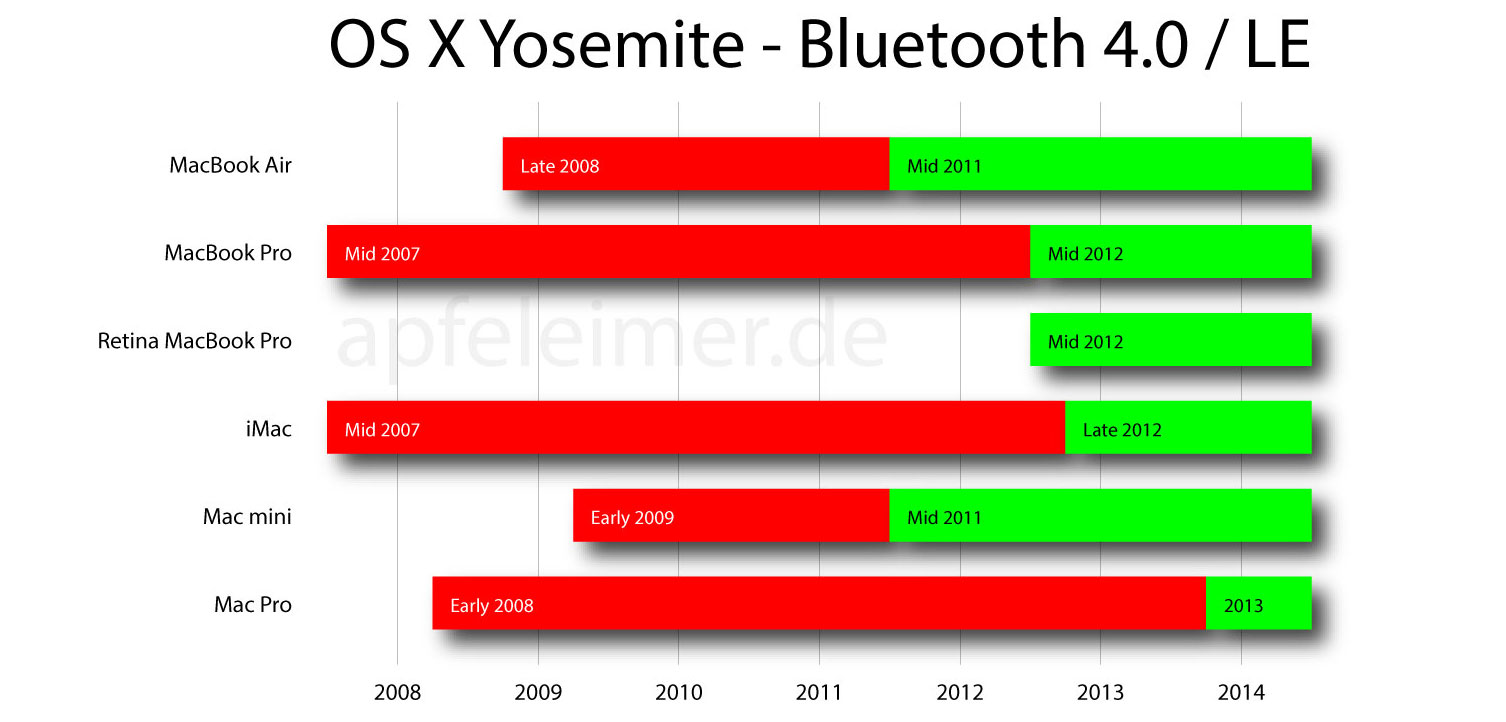
The full bars represent Macs that can run OS X Yosemite, while only Mac models in the green bar timeframes support the required Bluetooth protocol for Handoff. For iOS users, the iPad 2 is the only device that is capable of running iOS 8 but doesn’t come with hardware support for Bluetooth LE.
OS X Yosemite is in developer beta right now and will be released to customers later this year.

Gadget Rewind 2006: Nintendo Wii

Nintendo planned a “Revolution” for your TV. When it arrived in 2006, it was a lot more fun than the confrontational term might imply. Revolution turned out to be the code name for the company’s new console, and just before E3 that year Nintendo ditched the subterfuge and unveiled its official title: Nintendo Wii. It was revolutionary, using motion-tracking remotes to get players off the couch and involved in the action. The Wii rapidly became the centerpiece at parties, stepping into the arena with classics like Pictionary and charades. The console’s popularity was also a welcome turnabout for Nintendo, which had been languishing over its latest console’s missteps.
When the Nintendo Wii launched in late 2006, it made the holiday deadline, but also ended up in head-to-head competition with Sony’s PlayStation 3. While the PS3 and Xbox 360 offered higher-resolution games and more complex titles, they didn’t really have the motion-tracking magic that Nintendo brought to the table. At least not until 2010, when Sony’s PS Move and Microsoft’s Kinect appeared on the scene.
The Wii’s success was about accessibility. Nintendo games like Wii Sports — wisely bundled with the console — and WarioWare showcased the system’s uniquely intuitive controller. Players got to act out their favorite sports: swinging the remote around like a baseball bat, golf club or bowling ball. Even mundane activities like cooking could be transformed into hours of enjoyment through the Wii. Sadly, third-party game studios never quite figured out how to mirror the success of Nintendo’s first-party. As a result, few third-party games were sold on the Wii, which led most studios to give up on supporting the system.
Even though the console was an enormous hit, Nintendo decided that it would have to evolve in order to compete with emerging trends. In late 2012, Nintendo launched the Wii’s successor with a slightly tweaked moniker: Wii U. Its GamePad controller was aimed at challenging tablet gaming and providing a “second screen” experience. Unfortunately, the launch left many confused. With such a subtle name change, it was often misinterpreted as an add-on for the existing Wii system — which it wasn’t.
Just like life, Nintendo’s consoles seem to have lots of ups and downs, at least in terms of market success. The Wii was definitely a high point in its history of gaming systems. It sold over 24 million units by its second year and surpassed 100 million units in its lifetime. The impact of that system even served to inform future consoles of competing brands. The mainstream affinity for Wii Sports led to developments like Wii Fit and its Balance Board accessory, which took things a step further by adding fitness tracking and exercise programs into the mix. The living room could now serve double duty as a gym, and children (as well as adults) no longer needed to suffer the oppressive nature of “going outside” just to get some exercise.
Did you own a Nintendo Wii? Add it to your Engadget profile as a device you had (or still have) and join the discussion to reminisce or share photos of your device with other like-minded gadget fans.

These are the biggest Nintendo games at E3 2014

Nintendo’s in a weird place. The company’s got a game console that no one’s buying, the Wii U, and it’s the only place to play some of gaming’s biggest franchises: Super Mario, The Legend of Zelda, Metroid, Donkey Kong. The list goes on. Nintendo’s also got a tremendously popular handheld game console, the 3DS, but Wii U software was the focus of E3 2014. Rather than a press conference like in the past, Nintendo chose to unveil its E3 news in a digital venue: a Nintendo Direct video stream. Much of Tuesday morning’s announcements were available to play at E3, impressions of which we’ve shared below.
And yes, we played a lot of Smash Bros.
YOSHI’S WOOLLY WORLD
For those who don’t remember Kirby’s Epic Yarn, the cutesy platforming game that came out on Wii in 2010, allow us to jog your memory. It’s a standard Kirby platforming game — relatively easy, the same chameleon mechanics Kirby is known for — but the world (and all of its characters, including Kirby) is made of yarn. As if a fluffy pink ball of a character wasn’t cutesy enough, eh?
In 2015, the Yoshi’s Island-themed iteration of Epic Yarn is coming to Wii U in Yoshi’s Woolly World. Like Yoshi games before it, you jump on enemies, consume them to create shootable eggs, and exaggeratedly jump across gullies as Mario’s goofy green dinosaur. Like Epic Yarn, well, everything’s made of yarn. Rather, it’s made of “woolly” things this time around. The levels are gorgeous and look like real, living worlds, only everything’s made of craft store items. Secrets abound, and the textured cloth effect is hidden everywhere. In the demo we played, there weren’t any GamePad-specific features beyond off-screen play.
We’re not exactly upset, but the GamePad not being featured was a theme among the demos we played.
CAPTAIN TOAD: TREASURE TRACKER
Super Mario 3D World was a highlight of 2013, if not the best game released on game consoles last year. And a highlight of Super Mario 3D World was Toad’s puzzle levels, wherein you navigate a twistable 3D maze using a light helmet-wearing Toad. They were a welcome aside, and a notable deviation from the usual Mario formula. Nintendo apparently recognized their excellence as well, awarding Toad his own game — Captain Toad: Treasure Tracker — and making the puzzles better than ever.
In 3D World, Toad’s worlds were limited. In Captain Toad, they range in size dramatically, from the standard-ish 3D cube to a vertical world inside a volcano. On one puzzle, we had to carefully time our movements based on the attacks of a fire-breathing lava monster. On another, we struggled with deciphering the twists and nooks of a floating world. We’re told it’s not a digital game, but a full release; Captain Toad: Treasure Tracker arrives this holiday.
Oh, and most importantly, there’s a button reserved for making Toad say silly things. Perfect. If we could somehow get a level that involves Toad wearing an astronaut suit on the Moon, that’d be great. Thanks Nintendo.
SUPER SMASH BROS. FOR 3DS / WII U
You’ll have to excuse me as I break format here for a moment: I come to Super Smash Bros. for Wii U/3DS as a longtime player of the series and a total Smash nerd. I’m going to restrict this piece to a broader approach, but I welcome your questions on Twitter. That said!
Super Smash Bros. for Wii U and Super Smash Bros. for 3DS are completely different beasts. The issue isn’t so much that they’re different games — they are, but not that different — but that the control methods for each are so wildly different. Even on a 3DS XL, which we used to play Super Smash Bros. for 3DS, it’s really tough and kind of painful. Blocking is a central component to any fighting game, and in Smash Bros. it’s handled by the shoulder buttons. In practice, this means discomfort at least and, more likely, frustrating hand cramps.
3DS control issues aside, both games play a lot like you’d expect. Nintendo favorites return and new favorites are added; it’s the same raucously fun affair it’s always been. We loved Little Mac — he’s fast and brutal — and Samus — she’s better than ever. Mega Man was seemingly less powerful than we expected, but with only 10 rounds to play, we’ll need much more time before leveling any real judgment. Though the 3DS version is noticeably pared down, both games are very pretty and run just as smoothly as we hoped. Both versions of Super Smash Bros. are set to arrive this holiday, with the 3DS version launching a bit sooner in October.
HYRULE WARRIORS
The folks behind Dynasty/Samurai Warriors were given access to the world of The Legend of Zelda. The result is Hyrule Warriors, a third-person action game that revolves around quickly disposing of large quantities of enemies to achieve an ever-changing set of goals. It’s fun, quick, and light. There are plenty of Zelda references embedded, from the loading screen 8-bit animation to the trademark jingle that plays when treasure chests are opened, but this is pretty far from a main series Zelda game.
Hyrule Warriors is fine, but nowhere near the grandeur or delivery of a standard Zelda entry. Sadly, all we have for now is a 2015 window and a brief tease of the actual next series entry from longtime producer Eiji Aonuma.
MARIO MAKER
We’re not even gonna bother with this one — check out Brad Molen’s lengthy writeup right here. We can confirm that Mario Maker is a treat!

Inhabitat’s Week in Green: Ocean Cleanup Array, ForceShoes and a warp-capable spacecraft

Innovative design has the power to save the world. Case in point: Last year, teenage inventor Boyan Slat announced plans to create an Ocean Cleanup Array that could remove up to 7 million tons of plastic trash from the world’s oceans. The plan was met with a fair bit of skepticism, but a new yearlong study confirms Slat’s claims. The hefty report goes as far as to suggest that a single array could remove half of the plastic in the Great Pacific Garbage Patch in a decade. Slat isn’t the only youngster turning heads: A 14-year-old Indian girl recently invented a pedal-powered washing machine that doubles as an exercise bike, which she uses to wash her family’s clothes. Google just announced that an 11-year-old girl won the 2014 Doodle 4 Google competition by dreaming up a fantastical water purifier that turns dirty polluted water into fresh, clean H2O. And a team of Dutch architects is building the world’s first 3D-printed house using a massive printer contained within a shipping container!
It isn’t just the oceans that are filled with trash; a surprising amount of manmade “space junk” is also orbiting the planet. It’s estimated there are about 20,000 pieces of large debris floating in low orbit around the Earth. In other space news, NASA just unveiled a new ultra-light expandable habitat designed to expand the capacity of the International Space Station. The module is scheduled to arrive at the space station in 2015 for a two-year test period. In a separate (admittedly less fashionable) development, NASA has developed a pair of sandals known as “ForceShoes” that will help astronauts maintain bone and muscle health while in outer space. And if you’ve ever wondered what a real-life version of the starship Enterprise would look like, here’s your chance: NASA recently unveiled concept images of a warp-capable spacecraft, and it looks like something worthy of Starfleet.
On the green architecture front, a pair of Russian physicists just launched an Indiegogo campaign to rebuild Nikola Tesla’s Wardenclyffe Tower. The tower will be used to transmit clean energy wirelessly. For this year’s London Festival of Architecture, Chilean-German firm GUN Architects built a pavilion made of pyramidal “stalactites” that drip water to create a refreshing rainforest-like oasis in the heart of the city. The world’s longest artificial reef is under construction off the coast of Quintana Roo, Mexico. Once completed, it will be longer than the Brooklyn Bridge and it will support an estimated 13,000 species. And in Scotland, architecture students have built a tiny, mirror-clad lookout that blends seamlessly into the surrounding landscape.
Tesla has never done anything the traditional way, and by shaking up the auto industry, the company hopes to make cars cleaner and greener. This week, Tesla CEO Elon Musk announced that Tesla would release its patents, effectively giving away its ideas to competitors. In doing so, he hopes to spark more electric car innovation — even if it cuts into Tesla’s bottom line. Geodesic dome houses are all the rage in the design community, but what about geodesic vehicles? Designers Mauro Fragiotta and Mark Beccaloni recently teamed up to produce plans for the world’s first all-electric geodesic car. In other automotive news, Ford announced that it is teaming up with the food giant Heinz to turn ketchup byproducts, like tomato skins, leaves, stems and seeds, into a composite bioplastic for use in Ford’s vehicles. And the UK is embracing the future by jumping on the driverless car bandwagon: Ministers in the Department for Transport are writing up new laws to address special needs associated with these vehicles.

Amazon lines up a drama from writers behind Braveheart and Lost

Amazon clearly doesn’t think that one politically charged show is enough to counter Netflix efforts like House of Cards. The online retailer turned media producer has ordered a pilot for Point of Honor, a drama set on the cusp of the American Civil War and originally planned for ABC in 2011. The setting is intriguing, although the real highlight of the would-be series may be its pedigree — Braveheart‘s Randall Wallace and Lost‘s Carlton Cuse are writing the story for the initial episode, while Wallace will also direct. Amazon will still have to gauge viewer reactions to the pilot before it greenlights a full run, but the talent involved so far is promising.
[Image credit: Don Sniegowski, Flickr]
Filed under: Home Entertainment, Internet, HD, Amazon
Source: Variety
 AIVAnet